Culinary Advisor
A cooking platform built around craft, culture, and the stories behind what we eat.
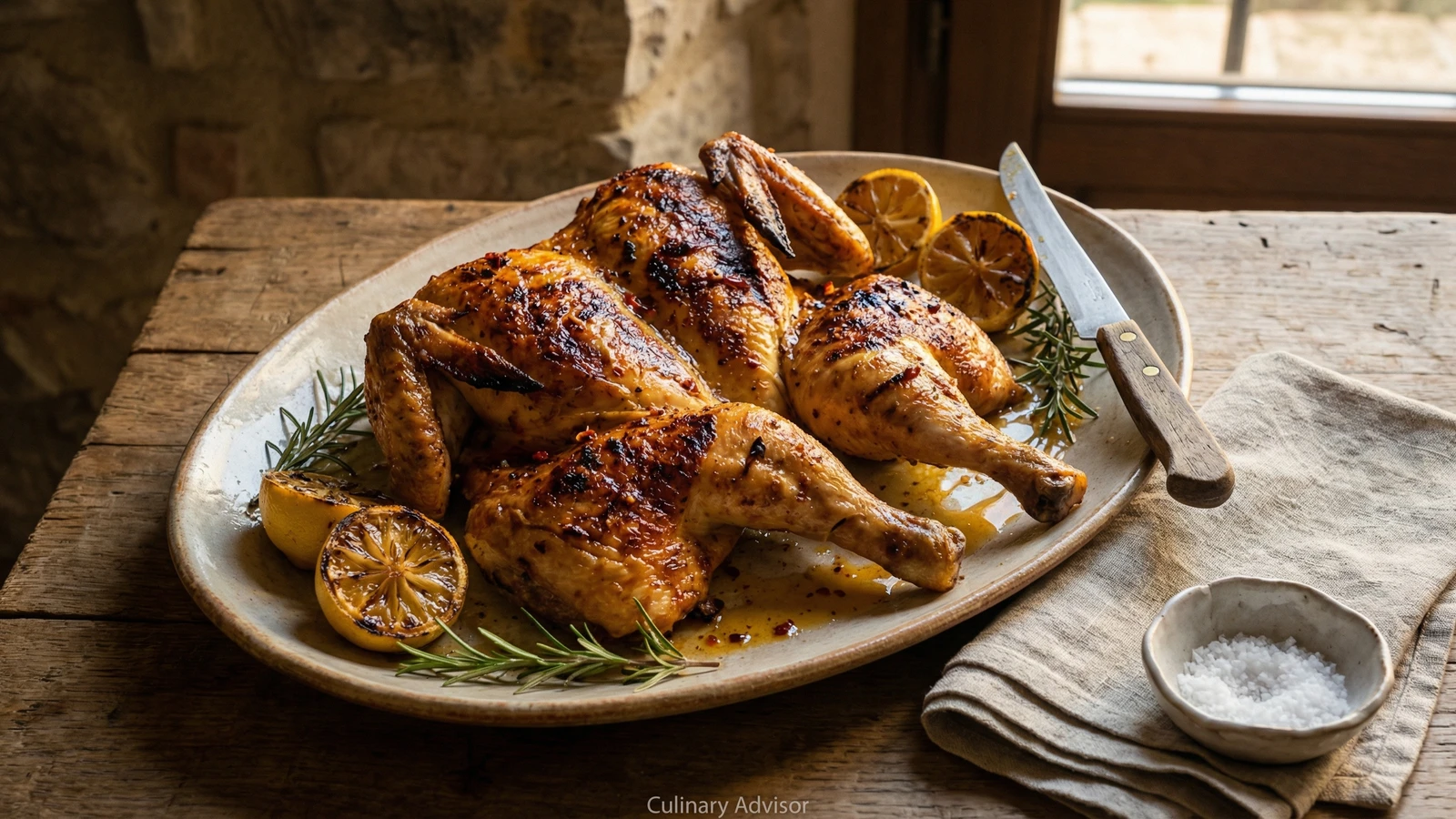
Pollo alla Diavola
Created by Chef Graziella
Tuscan grilled chicken, flattened and rubbed with olive oil and peperoncino, cooked over live fire until the skin crackles and the meat stays impossibly juicy. The devil is in the restraint.
The devil in this dish is not an inferno. Italians understand heat differently than Americans, who seem to believe that more chili means more flavor. One teaspoon of peperoncino is enough. You want warmth that builds at the back of your throat, not pain that obliterates everything else. The fire comes from the grill itself, from the char on the skin, from the smoke that perfumes the meat.
Spatchcocking is essential. A whole round chicken over a grill is an exercise in frustration: burnt skin, raw joints, dry breast meat. When you flatten the bird, everything cooks at the same rate. The thighs and breasts finish together. The skin crisps evenly. This is not a shortcut. This is correct technique.
Tuscan cooks have grilled chicken this way for generations, varying only in the amount of heat they add. Some use more peperoncino, some less. What they agree upon is this: the chicken must be good quality, the olive oil must be worthy of the name, and the fire must be tended with attention. Simple does not mean careless.
Pollo alla diavola appears in Italian cookbooks from at least the 19th century, though Tuscan farmers grilled spatchcocked birds long before anyone thought to write it down. The name refers both to the chili heat and to the splayed shape of the flattened bird, which some say resembles a devil's outline. In Florence, the dish was traditionally cooked al mattone, under a brick, to press the chicken flat against the hot grate.
The technique, the tradition, and the story behind every dish.
Discover Culinary AdvisorIngredients
whole chicken
Quantity
1 (3 1/2 to 4 pounds)
extra virgin olive oil
Quantity
1/3 cup
peperoncino flakes
Quantity
1 teaspoon
garlic cloves
Quantity
4
lightly crushed
lemon
Quantity
1
juiced and zested
kosher salt
Quantity
1 tablespoon
black pepper
Quantity
to taste
freshly ground
fresh rosemary
Quantity
2 sprigs
lemon wedges
Quantity
for serving
| Ingredient | Quantity |
|---|---|
| whole chicken | 1 (3 1/2 to 4 pounds) |
| extra virgin olive oil | 1/3 cup |
| peperoncino flakes | 1 teaspoon |
| garlic cloveslightly crushed | 4 |
| lemonjuiced and zested | 1 |
| kosher salt | 1 tablespoon |
| black pepperfreshly ground | to taste |
| fresh rosemary | 2 sprigs |
| lemon wedges | for serving |
Equipment Needed
- •Sturdy kitchen shears for spatchcocking
- •Charcoal or gas grill
- •Instant-read thermometer
- •Cast iron skillet with brick or heavy pot (if cooking indoors)
Instructions
- 1
Spatchcock the chicken
Place the chicken breast-side down on a cutting board. Using sturdy kitchen shears, cut along both sides of the backbone and remove it entirely. Save it for stock or discard it. Turn the chicken over and press down firmly on the breastbone with the heel of your hand until you hear it crack and the bird lies flat. This is not delicate work. The bird should lie flat as a book.
A flattened bird cooks evenly. The legs and breasts finish at the same time instead of the breast drying out while you wait for the thighs. This technique is not optional. - 2
Prepare the marinade
In a small bowl, combine the olive oil, peperoncino flakes, crushed garlic, lemon juice, and lemon zest. The garlic is crushed, not minced or pressed. You want its perfume, not its aggression. Let this mixture sit while you prepare the chicken. The flavors will begin to meld.
- 3
Season and marinate
Pat the chicken completely dry with paper towels. Season generously on both sides with the salt and black pepper. Place the rosemary sprigs on the flesh side of the chicken. Pour the olive oil mixture over the bird, rubbing it into every surface, under the skin where possible. Let it marinate at room temperature for 30 minutes, or refrigerate for up to 4 hours. If refrigerated, remove it one hour before cooking.
Cold chicken on a hot grill results in burnt skin over raw flesh. The bird must be at room temperature. This is not a suggestion. - 4
Prepare the grill
Build a two-zone fire. On a charcoal grill, bank the coals to one side. On a gas grill, heat one side to medium-high and leave the other side on low. You need direct heat for crisping and indirect heat for cooking through. The grate should be clean and lightly oiled.
- 5
Grill flesh-side first
Remove the garlic cloves and rosemary from the chicken. Place the bird flesh-side down over direct heat. Grill for 8 to 10 minutes until well marked and golden. Do not move it constantly. Let the fire do its work. The flesh side should develop color but not burn.
Resist the urge to press the chicken with a spatula. You are not trying to squeeze out the juices. You are trying to keep them inside. - 6
Finish skin-side down
Flip the chicken skin-side down over direct heat. Cook for 5 minutes to begin crisping the skin. Then move the bird to the cooler side of the grill, skin-side down, and cover. Continue cooking for 20 to 25 minutes until the thigh registers 165°F when probed at the thickest point. The skin should be deeply bronzed and crackling, the fat rendered.
- 7
Rest and serve
Transfer the chicken to a cutting board and let it rest for 10 minutes. This is when the juices redistribute throughout the meat. Cut into pieces: separate the legs, then halve each breast. Arrange on a warm platter. Squeeze fresh lemon over all. The heat is in the meat now. The lemon brightness finishes it.
Chef Tips
- •The chicken must be completely dry before it goes on the grill. Wet skin steams instead of crisping. Use paper towels, then let the bird sit uncovered for 10 minutes.
- •If you do not have an outdoor grill, use a cast iron skillet on the stovetop, then finish in a 450°F oven. Press the chicken with a heavy pot or foil-wrapped brick for the first 10 minutes to maximize contact with the pan.
- •The peperoncino sold in Italian markets is milder than American crushed red pepper. Adjust accordingly, or your guests will remember only the burn, not the bird.
- •Do not serve this with elaborate accompaniments. Grilled lemon halves, perhaps some arugula dressed with olive oil. The chicken is the point.
Advance Preparation
- •The chicken can be marinated for up to 4 hours in the refrigerator. Any longer and the lemon begins to affect the texture of the meat.
- •Prepare your grill and bring the chicken to room temperature during the same hour. Both tasks require attention.
Frequently Asked Questions
Nutrition Information
1 serving (about 240g)
Where cooking meets culture.
Culinary mentorship, cultural storytelling, and the editorial depth that makes cooking meaningful.
Explore Culinary Advisor