Culinary Advisor
A cooking platform built around craft, culture, and the stories behind what we eat.
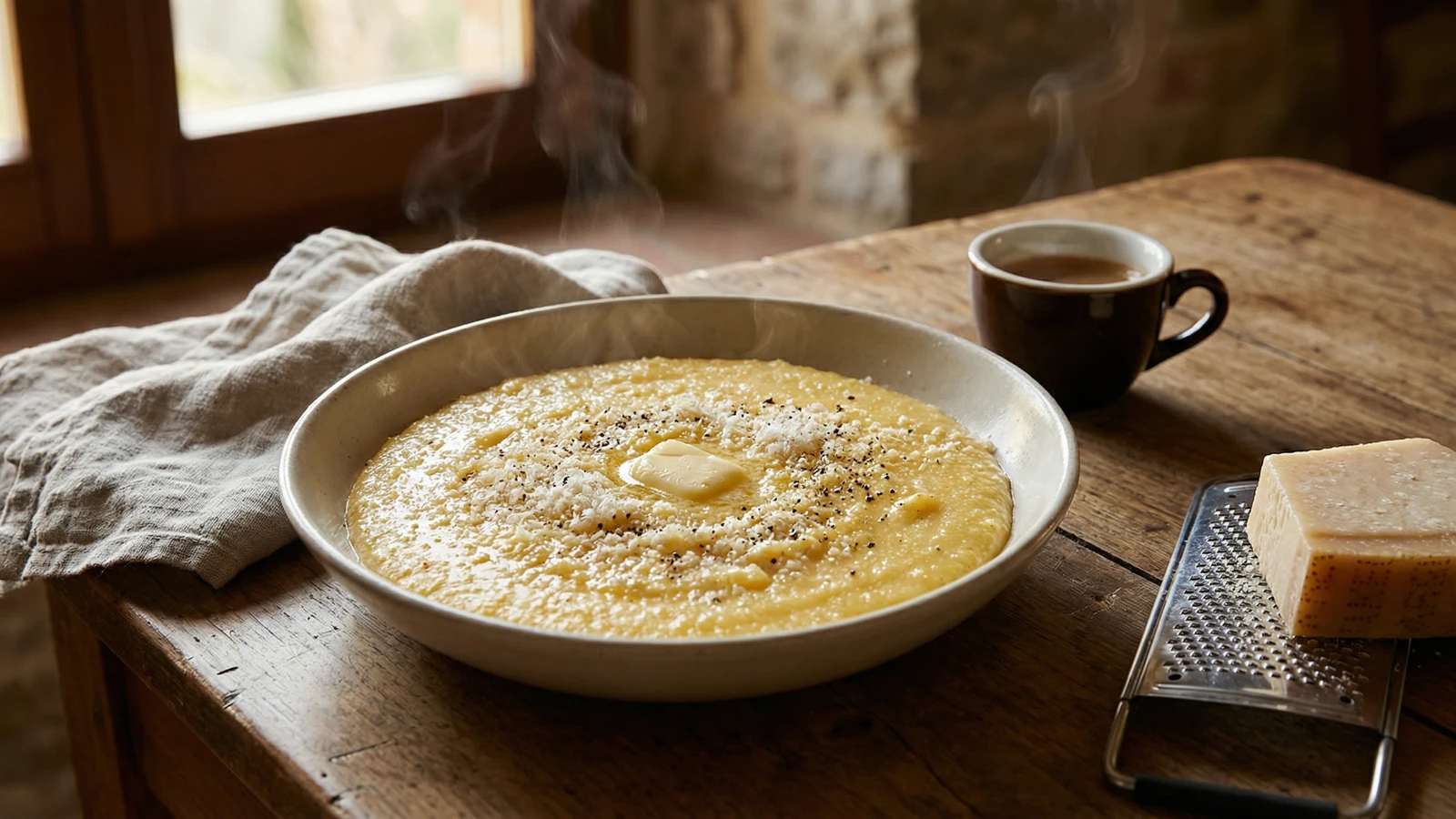
Polenta con Burro e Parmigiano
Created by Chef Graziella
The ancient porridge of Northern Italy, transformed through forty-five minutes of patient stirring into something silky, rich, and deeply satisfying. Four ingredients. No shortcuts.
Polenta is peasant food, and like all peasant food, it demands respect. For centuries, this cornmeal porridge sustained the farmers and laborers of Lombardy, Veneto, and Friuli. They ate it morning, noon, and evening because they had little else. What they lacked in variety, they made up for in technique.
The secret is time. You cannot rush polenta any more than you can rush a conversation with someone you love. Forty-five minutes of stirring, of watching the golden meal transform from gritty suspension to flowing silk. Your arm will tire. This is how you know you are cooking.
Instant polenta exists on supermarket shelves. I do not acknowledge it. The texture is wrong, the flavor flat, the experience hollow. If you are not prepared to stand at the stove and stir, make something else. Polenta rewards patience. It punishes haste.
The finish is simple because it must be: cold butter that emulsifies into cream, aged Parmigiano-Reggiano that melts and disappears, black pepper for warmth. What you keep out is as significant as what you put in.
Polenta predates corn itself. For centuries, Northern Italians prepared similar porridges from millet, spelt, and chestnuts. When maize arrived from the Americas in the 16th century, it gradually replaced these ancient grains. By the 18th century, polenta had become so central to the diet of Venetian peasants that widespread pellagra resulted from its nutritional limitations. The dish survived this grim chapter to become a symbol of Northern Italian identity.
The technique, the tradition, and the story behind every dish.
Discover Culinary AdvisorIngredients
coarse stone-ground polenta
Quantity
1 cup
water
Quantity
4 cups
fine sea salt
Quantity
1 teaspoon
unsalted butter
Quantity
4 tablespoons
cold, cut into pieces
Parmigiano-Reggiano
Quantity
3/4 cup
freshly grated
black pepper
Quantity
to taste
freshly ground
| Ingredient | Quantity |
|---|---|
| coarse stone-ground polenta | 1 cup |
| water | 4 cups |
| fine sea salt | 1 teaspoon |
| unsalted buttercold, cut into pieces | 4 tablespoons |
| Parmigiano-Reggianofreshly grated | 3/4 cup |
| black pepperfreshly ground | to taste |
Equipment Needed
- •Heavy-bottomed 4-quart saucepan
- •Long wooden spoon or silicone spatula
- •Warmed serving bowls
Instructions
- 1
Bring salted water to boil
In a heavy-bottomed saucepan, bring the water and salt to a vigorous boil over high heat. The pot should be larger than you think necessary. Polenta bubbles and spits like something alive. A wide, deep pot gives you room to stir and protects your arms.
- 2
Add the polenta
Reduce heat to medium-low so the water simmers gently. Take the polenta in one hand and let it fall into the water in a thin, steady stream while stirring constantly with a wooden spoon in your other hand. This prevents lumps from forming. Once all the polenta is added, continue stirring for one full minute without stopping.
If lumps form despite your efforts, press them against the side of the pot with your spoon. They will surrender eventually. - 3
Stir and simmer
Reduce heat to the lowest setting. The polenta should bubble lazily, like mud in a hot spring. Stir frequently for the next 40 to 45 minutes. Not occasionally. Frequently. Every few minutes at minimum, scraping the bottom and sides of the pot. The polenta will thicken gradually and begin to pull away from the sides of the pan. This is how you know it approaches readiness.
Instant polenta exists. I do not acknowledge it. Proper polenta requires 45 minutes of attention. This is the price of silky texture. - 4
Test for doneness
The polenta is ready when it falls from the spoon in thick, slow ribbons and no longer tastes grainy on your tongue. Taste it. This is the only reliable test. The texture should be creamy and smooth, with no hint of raw cornmeal. If you feel grittiness, continue cooking.
- 5
Finish with butter and cheese
Remove the pot from heat. Add the cold butter pieces and half the Parmigiano-Reggiano. Stir vigorously until the butter melts completely and the cheese disappears into the polenta. The mixture should become glossy and flow like thick cream. Taste and adjust salt if needed. The butter must be cold. Cold butter emulsifies into the polenta and creates silk. Warm butter melts too fast and separates.
- 6
Serve immediately
Spoon the polenta into warmed shallow bowls. Top with the remaining Parmigiano-Reggiano and a generous grinding of black pepper. Serve at once. Polenta waits for no one. It begins to set the moment it leaves the pot, and reheated polenta, while acceptable, is not the same thing as polenta served in its first glory.
Chef Tips
- •Seek out stone-ground polenta from a reputable source. The coarse grind labeled 'bramata' is traditional. Fine-ground polenta cooks faster but lacks the texture that makes this dish satisfying.
- •The ratio of four parts water to one part polenta produces a flowing, creamy consistency. For firmer polenta that can be sliced and grilled, reduce the water to three parts.
- •If you must step away from the pot, cover it and reduce heat to the absolute minimum. The polenta will not burn in two minutes, but it will form a skin. Stir vigorously when you return.
- •Leftover polenta can be poured into a loaf pan, chilled until firm, then sliced and grilled or fried in butter. This is not a lesser preparation. It is simply a different one.
Advance Preparation
- •Polenta is best served immediately. It sets as it cools and loses its flowing texture.
- •To hold polenta briefly, keep it covered in the pot off heat with a film of butter on the surface. Stir vigorously before serving.
- •Leftover polenta can be refrigerated overnight, then sliced and pan-fried in butter until golden for tomorrow's breakfast.
Frequently Asked Questions
Nutrition Information
1 serving (about 210g)
Where cooking meets culture.
Culinary mentorship, cultural storytelling, and the editorial depth that makes cooking meaningful.
Explore Culinary Advisor