Culinary Advisor
A cooking platform built around craft, culture, and the stories behind what we eat.
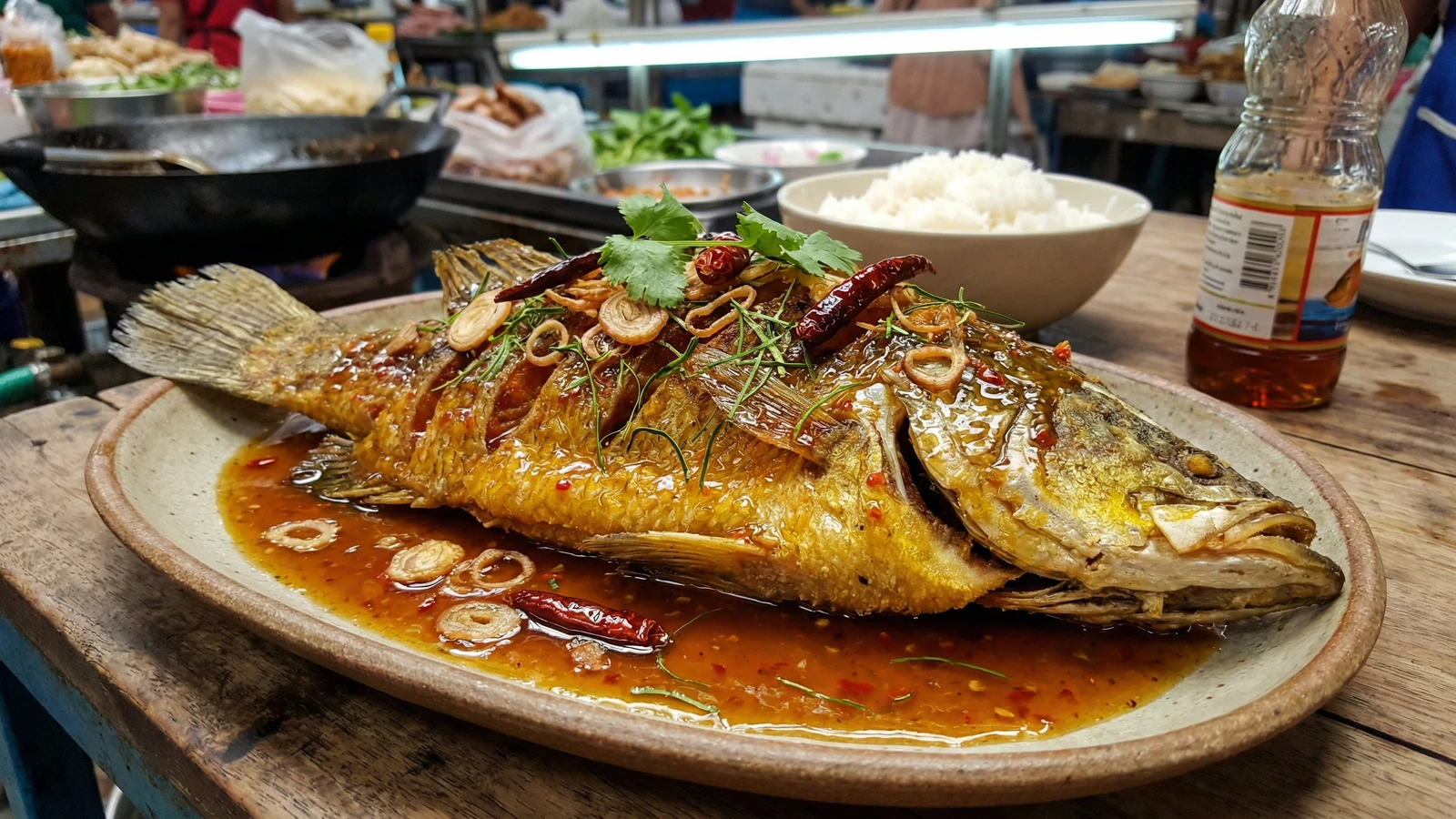
Three-Flavor Fried Fish (Pla Sam Rot)
Created by
Sweet, sour, spicy: three of the four pillars in one glossy sauce, poured over a whole fish fried so crispy it shatters. The system names itself in this dish.
Three flavors. Sam rot. The dish literally names three of the four governing pillars: sweet from nam tan pip, sour from makham, spicy from prik. The fourth, salt from nam pla, is in the sauce too, holding the whole thing together. You don't need me to explain the system here. The system explains itself.
But here's what you need to understand: even this dish, which looks like a fried fish with a sauce on top, has a kreung tam moment. The garlic, the chilies, the cilantro root, they go into the krok first. Pounded rough, not minced, not pressed through a garlic crusher. Pounded. The cell walls break, the allicin releases, the chili oils merge with the garlic. That paste goes into hot oil and becomes the foundation of the sauce. Ajarn always said: the kreung tam is everywhere, even where you don't expect it.
Down south, on the Andaman coast and along the Gulf, this dish hits different. Southern cooks tip the balance. The tamarind gets aggressive. The chilies come in quantity, prik khi nu by the fistful, not the polite Central Thai three-or-four. The palm sugar? Present, but it knows its place. Southern Thai food leans sour and spicy. The sweetness exists to round the edges, not to dominate. If your pla sam rot tastes like candy, you've made a Central Thai version. Not wrong, just not Southern.
The fish matters. On the coast, you're working with whatever came off the boat that morning. Pla kapong (sea bass), pla thap thim (red tilapia), pla kraphong daeng (red snapper). The fish gets rubbed with kamin (turmeric), the Southern marker that stains your hands and your cutting board and tells you exactly which region this kitchen belongs to. Score it deep, coat it in starch, and drop it into oil hot enough to seal the skin on contact. The fish must shatter when you tap it. If it bends, it's not done. Pour the sauce over at the last possible second, so the top is glossy and saucy while the belly stays crispy against the plate. That contrast is the whole point.
Pla sam rot is a celebratory dish found across Thailand, commonly served at weddings, temple fairs, and family gatherings where a whole fish signals abundance. The name 'sam rot' (สามรส, three flavors) maps directly to three of the four governing pillars of Thai cuisine: sweet, sour, and spicy. While Central Thai versions balance the sauce toward sweetness, Southern coastal preparations from provinces like Nakhon Si Thammarat, Surat Thani, and Krabi tilt aggressively toward tamarind sourness and chili heat, reflecting the broader Southern palate and the region's abundant supply of fresh-caught fish from the Andaman Sea and Gulf of Thailand.
The technique, the tradition, and the story behind every dish.
Discover Culinary AdvisorIngredients
whole sea bass or red snapper (pla kapong or pla kraphong daeng)
Quantity
1 fish, about 600-800g
cleaned, gutted, and scored
ground turmeric (kamin)
Quantity
1 teaspoon
or 1 tablespoon fresh turmeric, finely grated
salt
Quantity
1/2 teaspoon
tapioca starch or rice flour
Quantity
1/4 cup
vegetable oil
Quantity
enough to submerge the fish
for deep-frying
garlic
Quantity
6 cloves
bird's eye chilies (prik khi nu)
Quantity
6
cilantro roots (rak phak chi)
Quantity
2
scraped clean
shallots (hom daeng)
Quantity
4
thinly sliced
dried red chilies (prik haeng)
Quantity
5
cut into 1-inch pieces
tamarind paste (nam makham piak)
Quantity
3 tablespoons
palm sugar (nam tan pip)
Quantity
2 tablespoons
fish sauce (nam pla)
Quantity
2 tablespoons
water
Quantity
1/4 cup
kaffir lime leaves (bai makrut)
Quantity
3
very finely julienned
fresh cilantro leaves (phak chi) (optional)
Quantity
for garnish
| Ingredient | Quantity |
|---|---|
| whole sea bass or red snapper (pla kapong or pla kraphong daeng)cleaned, gutted, and scored | 1 fish, about 600-800g |
| ground turmeric (kamin)or 1 tablespoon fresh turmeric, finely grated | 1 teaspoon |
| salt | 1/2 teaspoon |
| tapioca starch or rice flour | 1/4 cup |
| vegetable oilfor deep-frying | enough to submerge the fish |
| garlic | 6 cloves |
| bird's eye chilies (prik khi nu) | 6 |
| cilantro roots (rak phak chi)scraped clean | 2 |
| shallots (hom daeng)thinly sliced | 4 |
| dried red chilies (prik haeng)cut into 1-inch pieces | 5 |
| tamarind paste (nam makham piak) | 3 tablespoons |
| palm sugar (nam tan pip) | 2 tablespoons |
| fish sauce (nam pla) | 2 tablespoons |
| water | 1/4 cup |
| kaffir lime leaves (bai makrut)very finely julienned | 3 |
| fresh cilantro leaves (phak chi) (optional) | for garnish |
Equipment Needed
- •Heavy granite mortar and pestle (krok hin)
- •Large wok or deep pot for frying (wide enough to hold a whole fish)
- •Spider skimmer or large slotted spatula
- •Wire cooling rack
- •Cooking thermometer (recommended)
Instructions
- 1
Score and season the fish
Make three or four deep diagonal cuts on each side of the fish, all the way down to the bone. Not shallow decorative lines. Deep. The knife should touch bone. This does two things: it lets the turmeric and salt penetrate the flesh, and it creates more surface area for the oil to crisp. Rub the turmeric and salt into the cuts and across the skin. The fish should be yellow. Your hands should be yellow. That's how you know you've used enough kamin. Let it sit for ten minutes while you prep the sauce.
Southern cooks use turmeric where Central Thai cooks use nothing. The kamin serves double duty: it seasons the flesh and helps the starch coating adhere and brown evenly. It's not optional down south. - 2
Pound the sauce paste
In a granite mortar (krok hin), pound the garlic, bird's eye chilies, and cilantro roots to a rough paste. Not smooth. You want texture, chunks of garlic that will turn golden in the oil, flecks of chili that will bloom. Five or six firm strikes, rotate with a spoon, five more. When the aroma hits you, sharp garlic, raw chili burn, earthy cilantro root, you're there. Set it aside.
Cilantro root is the ingredient most people outside Thailand don't know exists. It's the root of the coriander plant, and it tastes nothing like the leaves. Earthy, pungent, slightly peppery. If you can't find it, use the lower stems of a cilantro bunch, but know what you're missing. - 3
Dry and coat the fish
Pat the fish completely dry with paper towels. Every surface. Inside the cavity. Inside the score marks. Water is the enemy of crispy. If there's moisture on the skin, the oil will spit and the coating will steam instead of fry. Dust the entire fish with tapioca starch: skin, cavity, inside the cuts. Shake off the excess. The coating should be thin, a veil, not armor.
- 4
Deep-fry the fish
Heat oil in a wok until it reaches 180°C (350°F). If you don't have a thermometer, drop a pinch of starch into the oil. If it sizzles immediately and floats, you're ready. Carefully lower the fish into the oil using a spider or two spatulas. Don't drop it. Lower it away from you so the oil doesn't splash back. Fry for 12 to 15 minutes, depending on the size of the fish. Ladle hot oil over the top if the fish isn't fully submerged. Flip once, gently, halfway through. The fish is done when the skin is deep golden, the edges of the score marks are curling and crisp, and the whole thing is rigid. Tap it with your spatula. It should sound hollow, almost like tapping a shell. Lift it out, drain on a wire rack set over a tray. Not paper towels. Paper towels trap moisture against the bottom and kill the crispiness you just worked for.
The fish must be crispy enough to hold up under the sauce. That means fully cooked, deeply golden, structurally rigid. If it bends when you lift it, it's not done. Give it more time. A soggy fish under this sauce is a tragedy. - 5
Fry the shallots and dried chilies
While the fish drains, pour off most of the frying oil, leaving about three tablespoons in the wok. Over medium heat, fry the sliced shallots until they're golden and starting to crisp, about 3 minutes. Remove them with a slotted spoon. They'll continue darkening off the heat. In the same oil, fry the dried chili pieces for 30 seconds until they darken and the oil smells smoky. Remove and set aside with the shallots. These go on top at the end.
- 6
Cook the three-flavor sauce
In the same wok with the remaining flavored oil, fry the pounded paste over medium heat. Stir it constantly. When the garlic turns golden and the raw chili smell shifts to something roasted and fragrant, about one minute, add the tamarind paste, palm sugar, fish sauce, and water. Stir to dissolve the sugar. Let it bubble and reduce for 3 to 4 minutes. The sauce should thicken to a glossy, syrupy consistency that coats the back of a spoon. Taste it. Sour should lead. Then heat. Then sweet rounding the back. Salt holding the structure. If the tamarind isn't forward enough, add more. If the chili doesn't build, you didn't pound enough. Adjust now. This is the moment.
Ajarn always said: taste the sauce before it goes on the fish, because once it's on, you can't pull it back. The Southern balance is sour first, spicy second, sweet third. If you're tasting sweetness before sourness, you've added too much palm sugar. Fix it with more tamarind. - 7
Plate and serve immediately
Place the crispy fish on a serving platter. Pour the hot sauce directly over the top, letting it pool around the base and seep into the score marks. Scatter the fried shallots and dried chilies over the top. Add the julienned kaffir lime leaves and a few cilantro leaves. Serve immediately with jasmine rice. The clock is ticking from the moment the sauce hits the fish. The top is glossy and saucy. The belly against the plate is still crispy. That contrast lasts about five minutes. Eat fast. Fight over the cheeks. That's the best part of a whole fish and everyone at the table knows it.
Chef Tips
- •The fish must be dry. I can't say this enough. Pat it dry, let it air-dry for ten minutes, pat it again. Moisture under the starch coating turns to steam in the oil, and steam is what makes batter lift off and go soggy. Dry fish, thin starch coating, hot oil. That's the formula for a shatteringly crispy skin.
- •Tamarind paste quality varies wildly. The best is the wet, dark-brown block tamarind you soak and strain yourself (makham piak). The jars of tamarind concentrate work but taste thinner, less complex. If you're using concentrate, reduce the water in the sauce and add a bit more paste to compensate. Don't use tamarind powder. It tastes like dust.
- •This is a Southern coastal dish in spirit. Down in Krabi or Nakhon Si Thammarat, the fish came off the boat hours ago. The turmeric rub is standard. The sauce leans hard into sour and spicy. If you're making this at home and your fish counter has whole sea bass or red snapper, that's your target. Fillets won't work. The whole fish presentation is part of the dish's identity, and the bones keep the flesh moist during deep-frying.
- •The fried shallots and dried chilies on top aren't garnish. They're texture. The crispy shallots shatter against the glossy sauce. The fried dried chilies add a smoky, roasted heat that's different from the fresh bird's eye heat in the sauce itself. Two kinds of heat, two kinds of crunch. Skip them and you lose a dimension.
Advance Preparation
- •The sauce paste (garlic, chilies, cilantro root) can be pounded up to a day ahead and refrigerated. Bring it to room temperature before frying.
- •The shallots can be sliced in advance, but fry them right before assembly. Pre-fried shallots go stale quickly in humid air.
- •The fish cannot be fried ahead. It must go from oil to plate to sauce to table. Reheated fried fish is not crispy fried fish. Time the frying so the fish comes out of the oil just minutes before you're ready to serve. Make the sauce while the fish drains.
Frequently Asked Questions
Nutrition Information
1 serving (about 190g)
Where cooking meets culture.
Culinary mentorship, cultural storytelling, and the editorial depth that makes cooking meaningful.
Explore Culinary Advisor