Culinary Advisor
A cooking platform built around craft, culture, and the stories behind what we eat.
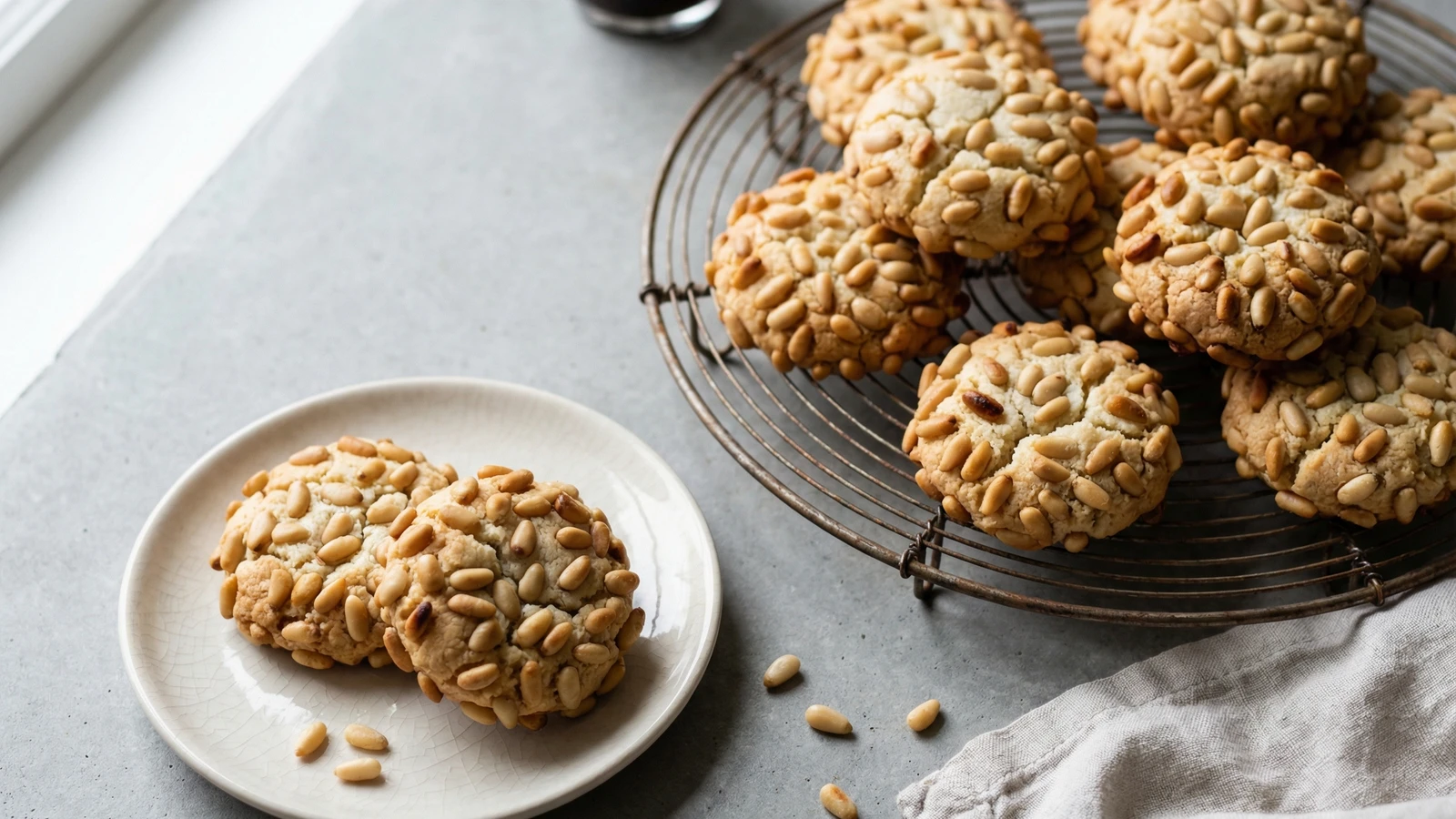
Pignoli Cookies
Created by
Chewy almond paste cookies rolled in pine nuts, crackled and golden from the oven. These Italian-American bakery classics deliver intense marzipan flavor with a satisfying chew that improves over two days.
Walk into any Italian bakery in Brooklyn, the Bronx, or South Philadelphia and you'll find these cookies arranged in neat rows behind the glass. Pignoli cookies arrived with Sicilian immigrants at the turn of the twentieth century, and they've been a fixture of Italian-American holiday tables ever since. The recipe couldn't be simpler: almond paste, sugar, egg whites, pine nuts. Four ingredients. No flour at all. The result is a cookie that tastes like concentrated almond essence, chewy in the center with a delicate crackled crust.
The quality of your almond paste determines everything here. This is not marzipan, which contains more sugar and less almond. True almond paste runs about fifty percent almonds by weight, and you can taste the difference immediately. Odense and Solo are reliable supermarket brands. If you have access to an Italian specialty grocer, their house-made paste will be superior still.
These cookies demand pine nuts on the exterior, pressed into the dough before baking so they toast golden in the oven's heat. Yes, pine nuts are expensive. There is no substitute that delivers the same buttery richness. Consider this: the recipe makes two dozen cookies from a single seven-ounce tube of almond paste. The investment per cookie is modest when you do the arithmetic.
I've watched home bakers overcomplicate these for years, adding flour or ground almonds or extra egg. Resist the urge. The original formula works because of what it leaves out. Trust the simplicity.
The technique, the tradition, and the story behind every dish.
Discover Culinary AdvisorIngredients
almond paste (not marzipan)
Quantity
7 ounces (200g)
granulated sugar
Quantity
3/4 cup (150g)
fine sea salt
Quantity
1/4 teaspoon
large egg whites
Quantity
2
at room temperature
pine nuts
Quantity
1 cup (140g)
| Ingredient | Quantity |
|---|---|
| almond paste (not marzipan) | 7 ounces (200g) |
| granulated sugar | 3/4 cup (150g) |
| fine sea salt | 1/4 teaspoon |
| large egg whitesat room temperature | 2 |
| pine nuts | 1 cup (140g) |
Equipment Needed
- •Stand mixer with paddle attachment
- •Two rimmed baking sheets
- •Parchment paper
- •Tablespoon measure or small cookie scoop
Instructions
- 1
Prepare your equipment
Position racks in the upper and lower thirds of your oven and preheat to 325°F (165°C). Line two baking sheets with parchment paper. Pour the pine nuts into a shallow bowl or onto a small rimmed plate. They'll scatter less this way when you roll the cookies.
Parchment is essential here. These cookies stick tenaciously to unlined pans and silicone mats can leave them too flat. - 2
Break down the almond paste
Cut the almond paste into rough one-inch chunks and drop them into the bowl of a stand mixer fitted with the paddle attachment. Add the sugar and salt. Beat on medium-low speed until the mixture resembles coarse, sandy crumbs, about 2 minutes. The almond paste will break down unevenly at first. This is normal. Scrape the bowl once halfway through.
If your almond paste feels hard or dry, microwave it for 10 seconds to soften before crumbling. Old paste will never fully incorporate. - 3
Add the egg whites
With the mixer running on medium-low, add the egg whites in a slow stream. Increase speed to medium and beat until you have a smooth, thick paste, about 3 minutes. The dough should be glossy and hold its shape when you stop the paddle. It will be sticky. Very sticky. This is correct.
Room temperature egg whites incorporate more smoothly. Cold whites can cause the almond paste to seize into stubborn lumps. - 4
Shape and coat the cookies
Wet your hands lightly with water to prevent sticking. Scoop a rounded tablespoon of dough and roll it between your palms into a ball roughly one inch in diameter. Drop the ball into the pine nuts and roll gently, pressing the nuts into the surface until the dough is completely coated. Transfer to the prepared baking sheet. Repeat with remaining dough, spacing cookies two inches apart. Re-wet your hands as needed.
Work quickly once you start shaping. The dough develops a skin as it sits, which prevents the pine nuts from adhering properly. - 5
Flatten slightly
Using the bottom of a drinking glass or your palm, gently press each cookie to flatten it to about half an inch thick. Some pine nuts will shift. That's fine. The cookies should look like rough discs, not perfect circles. Rustic is the goal.
- 6
Bake until golden
Bake for 14 to 17 minutes, rotating the pans from top to bottom and front to back at the halfway point. The cookies are done when the pine nuts turn golden brown and the tops show fine cracks. The centers will look slightly underdone. They'll firm as they cool. Pull them a minute early rather than a minute late.
The pine nuts can go from golden to burnt in under two minutes. Watch them closely after the 12-minute mark. - 7
Cool completely
Let the cookies cool on the baking sheets for 10 minutes. They're fragile when warm and will break if you try to move them too soon. Transfer to a wire rack and cool completely before storing. The texture improves dramatically after 24 hours as the moisture redistributes.
Chef Tips
- •Almond paste and marzipan are not interchangeable. Marzipan contains more sugar and will produce flat, overly sweet cookies that spread too thin. Check the label: almond paste lists almonds first, marzipan lists sugar first.
- •Store pine nuts in the freezer. Their high oil content turns them rancid quickly at room temperature. No need to thaw before using.
- •If you can only find blanched slivered almonds and want to approximate the coating, toast them lightly and chop coarsely. The flavor won't match pine nuts, but the texture will be pleasant.
- •These cookies actually improve with age. By day two, the exterior softens slightly while the center becomes more fudgy. They're perfect for shipping or gifting.
- •For a professional bakery touch, dust cooled cookies very lightly with powdered sugar. Apply it just before serving; it will absorb into the surface overnight.
Advance Preparation
- •The dough can be made up to 3 days ahead, covered tightly, and refrigerated. Let it come to room temperature for 30 minutes before shaping, or the cold dough will be too stiff to roll.
- •Shaped unbaked cookies can be frozen on a parchment-lined sheet, then transferred to a freezer bag for up to 2 months. Bake directly from frozen, adding 2 to 3 minutes to the bake time.
- •Baked cookies keep at room temperature in an airtight container for up to 1 week, or frozen for up to 3 months. Layer them between parchment to prevent the pine nuts from embedding into each other.
Frequently Asked Questions
Nutrition Information
1 cookie (about 23g)
Where cooking meets culture.
Culinary mentorship, cultural storytelling, and the editorial depth that makes cooking meaningful.
Explore Culinary Advisor