Culinary Advisor
A cooking platform built around craft, culture, and the stories behind what we eat.
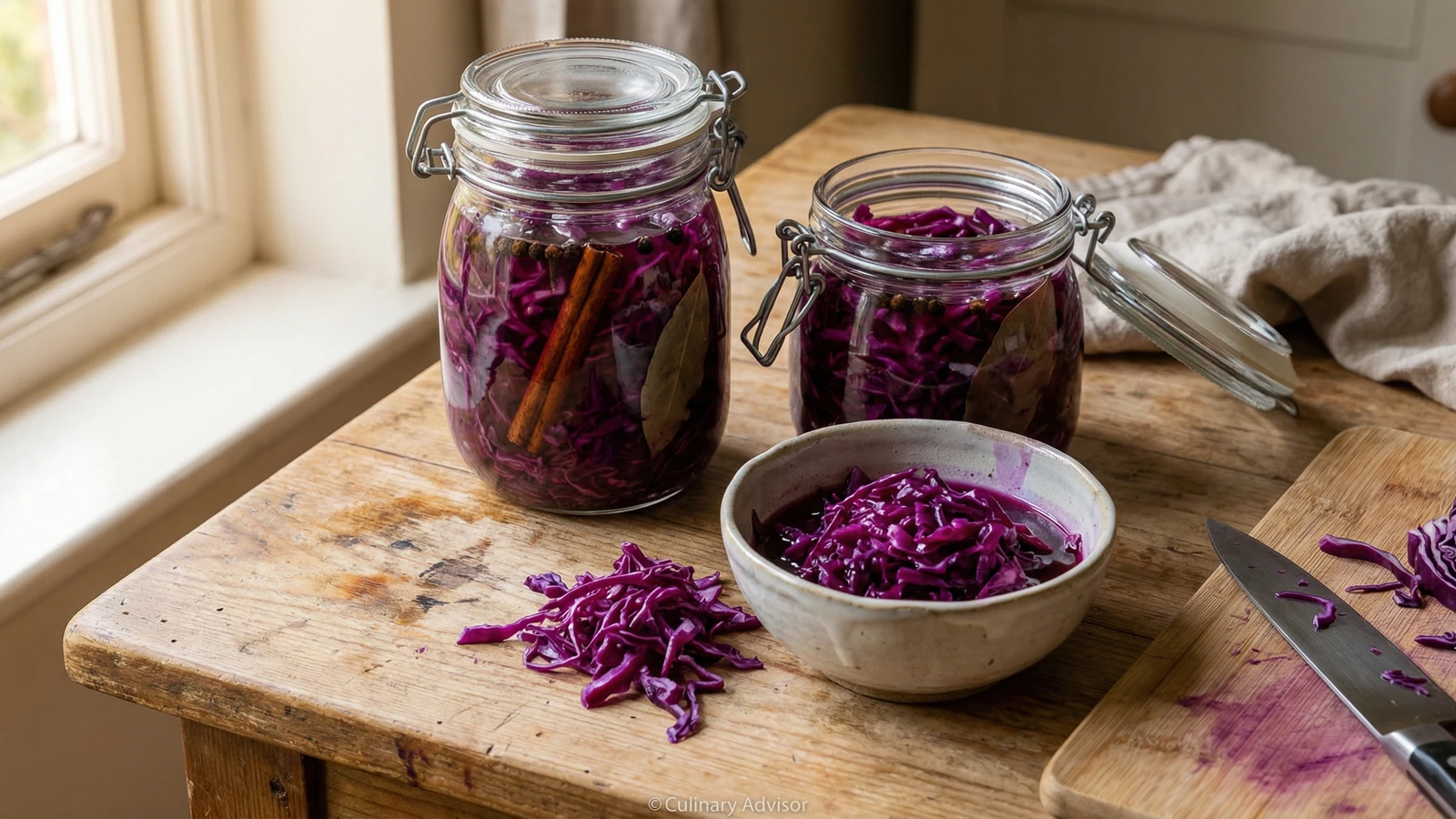
Pickled Red Cabbage
Created by Chef Thomas
A jar of red cabbage shredded in October and pressed into spiced vinegar, waiting quietly on a high shelf until Christmas, when it turns the cold table jewel-bright and earns its place beside the ham.
Imake this in late October, when the red cabbages at the market start to look serious. Heavy in the hand, tight as a fist, the colour of bruised plums. The kind that takes a proper knife and a bit of muscle to halve, and that stains your fingers and the wooden board a deep, almost theatrical purple. This is the cabbage that will sit in clean jars on a high shelf until Christmas, waiting for the cold cuts and the cheese and the slice of pork pie that doesn't know yet that it needs it.
There's a particular pleasure in making something now for a meal you can't quite picture. December feels a long way off in October. But the kitchen does well at this kind of forward thinking, and the act of shredding and salting and warming spiced vinegar on a wet autumn afternoon is its own quiet reward. The kitchen smells of cloves and cinnamon and the slightly fierce vinegar steam, and you stand at the counter with stained fingers feeling like you've done something useful with a Saturday.
Eat it within a month or so if you want it crunchy and sharp. Leave it longer and it softens, sweetens, settles into something gentler, and that's good too. I keep meaning to write down which year I preferred it crisper or more mellow, and I never do. I wrote it down in the notebook once: cabbage, vinegar, October, for later. That seemed to be enough.
A word about the vinegar. Malt is the traditional choice and the one I keep coming back to, dark and assertive enough to stand up to the spices. Red wine vinegar makes a slightly more elegant version if that's what's in the cupboard. Use what you have. A recipe is a conversation, not a contract.
The technique, the tradition, and the story behind every dish.
Discover Culinary AdvisorIngredients
red cabbage
Quantity
1 medium (about 1kg)
outer leaves removed, quartered and cored
flaky sea salt
Quantity
50g
malt vinegar
Quantity
750ml
or red wine vinegar
golden caster sugar
Quantity
100g
black peppercorns
Quantity
2 teaspoons
whole allspice berries
Quantity
1 teaspoon
whole cloves
Quantity
6
cinnamon stick
Quantity
1
snapped in half
coriander seeds
Quantity
1 teaspoon
bay leaves
Quantity
2
blade of mace (optional)
Quantity
1
fresh ginger (optional)
Quantity
small piece, sliced
| Ingredient | Quantity |
|---|---|
| red cabbageouter leaves removed, quartered and cored | 1 medium (about 1kg) |
| flaky sea salt | 50g |
| malt vinegaror red wine vinegar | 750ml |
| golden caster sugar | 100g |
| black peppercorns | 2 teaspoons |
| whole allspice berries | 1 teaspoon |
| whole cloves | 6 |
| cinnamon sticksnapped in half | 1 |
| coriander seeds | 1 teaspoon |
| bay leaves | 2 |
| blade of mace (optional) | 1 |
| fresh ginger (optional) | small piece, sliced |
Equipment Needed
- •Sharp chef's knife or mandoline
- •Large mixing bowl or colander
- •Non-reactive saucepan (stainless steel or enamel, never aluminium)
- •Two large preserving jars with vinegar-proof lids, about 750ml each
- •Clean tea towels
Instructions
- 1
Shred the cabbage
Pull off any tired outer leaves. Quarter the cabbage through the stem and cut out the hard white core. Now slice it as finely as your knife and your patience allow. Thin shreds, not chunks. The thinner you cut, the better the vinegar gets in and the prettier the finished jar. Your hands and the chopping board will be stained purple by the end. This is part of the pleasure.
A mandoline makes this quicker if you have one and trust yourself with it. Otherwise a sharp knife and a steady half hour at the counter is perfectly fine. - 2
Salt overnight
Layer the shredded cabbage in a large bowl or colander, scattering the salt as you go. Toss it through with your hands so every shred sees some salt. Cover with a tea towel and leave it overnight, somewhere cool. The salt draws out the water that would otherwise dilute your vinegar and turn the pickle limp within a week. Don't skip this step. It's the difference between cabbage that crunches and cabbage that sulks.
Set the colander over a bowl so the water that comes out has somewhere to go. By morning there will be a surprising amount of it. - 3
Spice the vinegar
While the cabbage is salting, or the next morning, put the vinegar, sugar, and all the spices into a non-reactive saucepan. Warm it gently until the sugar dissolves and the kitchen starts to smell like Christmas pudding without the pudding. Don't let it boil hard. You want to wake the spices up, not cook them. Take it off the heat and leave it to cool completely, lid on, so the spices keep working as it sits. An hour is good. Longer is better.
- 4
Rinse and dry
The next day, tip the cabbage into a colander and rinse it briefly under cold running water to wash off the excess salt. Then, and this matters, dry it as thoroughly as you can. A clean tea towel, a salad spinner, both. Any water clinging to the shreds will weaken the pickle. The cabbage should look slightly wilted now, deeper in colour, and feel pliable rather than crisp.
Taste a shred before you pack it. If it's still aggressively salty, rinse it again. It should taste seasoned, not briny. - 5
Pack the jars
Sterilize two large jars by washing them in hot soapy water and drying them in a low oven for ten minutes. Pack the cabbage into the warm jars, pressing it down firmly with the back of a spoon as you go. You want it tight but not crushed. Tuck a bay leaf and a piece of cinnamon down the side of each jar if you like the look of them visible through the glass.
- 6
Pour and seal
Pour the cooled spiced vinegar over the cabbage, spices and all, until everything is fully submerged. Tap the jars on the counter to release any trapped air. Wipe the rims clean with a damp cloth and seal with vinegar-proof lids. The colour will already be extraordinary, a deep, almost violent purple-red, like stained glass on a winter morning.
Use lids with a plastic coating on the inside. Bare metal corrodes against vinegar and will give the pickle a tinny edge that nothing can fix. - 7
Wait
Put the jars in a cool, dark cupboard and forget about them for at least a week. Two is better. The vinegar needs time to find its way into the cabbage, and the spices need time to settle into something rounded rather than sharp. Open the first jar when you feel the kitchen has earned it. A pork pie. A ham sandwich. A slice of crumbly Lancashire cheese. You'll know when.
Chef Tips
- •The salting is not optional. Skip it and the water in the cabbage will dilute the vinegar within a week, turning your beautiful pickle into a sad, slack thing. An overnight rest with salt is the difference between a jar that crunches and a jar that doesn't.
- •Use vinegar-proof lids. Standard metal jam lids will corrode where they meet the vinegar and leave a metallic note that ruins the whole jar. Kilner jars with rubber seals, or plastic-lined preserving lids, are what you want.
- •Eat it sooner rather than later. Unlike most pickles, this one is at its best within the first month, when the cabbage still has real bite. After two or three months it softens and sweetens, which some people prefer. I'm in the crunch camp, but you'll find your own preference.
- •It belongs with cold things. A Christmas Day plate of leftover ham and cheese and pork pie. A ploughman's lunch on a Sunday. A bowl of dal, oddly enough, where the sharpness cuts through the richness in a way that surprises you. Less good with hot food, where its job becomes confused.
- •Save the spiced vinegar after the cabbage is gone. It's wonderful in a salad dressing or splashed into a stew, and throwing it away feels like a small crime.
Advance Preparation
- •This recipe is entirely about advance preparation. Make it at least one week before you want to eat it, ideally two. Made in late October, it's perfectly settled by Christmas.
- •Sealed and stored in a cool, dark cupboard, the jars will keep for six months unopened. Once opened, refrigerate and eat within a month for best texture.
- •The cabbage softens and sweetens over time. If you prefer it crunchy, plan to eat it within four to six weeks of making.
Frequently Asked Questions
Nutrition Information
1 serving (about 30g)
Where cooking meets culture.
Culinary mentorship, cultural storytelling, and the editorial depth that makes cooking meaningful.
Explore Culinary Advisor