Culinary Advisor
A cooking platform built around craft, culture, and the stories behind what we eat.
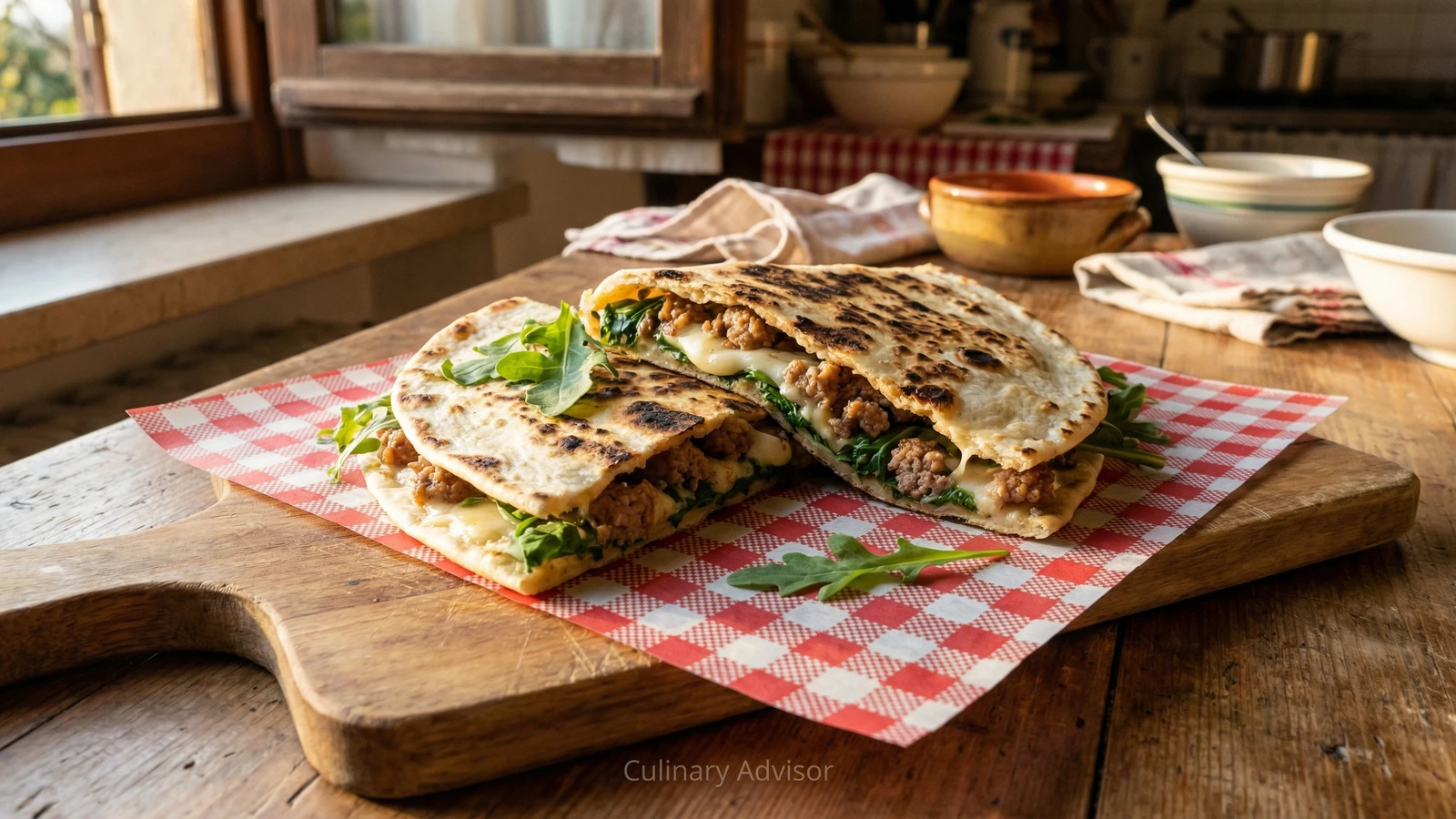
Piadina with Sausage and Stracchino
Created by Chef Graziella
The working person's lunch from Romagna, where thin, lard-enriched flatbread folds around crumbled sausage and soft, melting cheese. This is not a wrap. This is piadina.
Piadina is the bread of Romagna. Not Emilia, which has its own traditions. Romagna, the eastern half of my region, where the Adriatic coast meets the hills. Farm wives made it on terra cotta discs called testi, and their grandchildren still eat it today, folded around whatever filling suits the season.
The dough requires lard. I know this troubles some modern cooks, but there is no substitute that produces the same tender, slightly flaky texture. Olive oil makes an acceptable piadina. Lard makes the real one. The choice is yours, but you should know what you are choosing.
With sausage and stracchino, you have a piadina for autumn and winter, heartier than the summer versions with prosciutto and soft cheese. The sausage must be crumbled and cooked through, browned in places. The stracchino, that impossibly soft cheese from Lombardy, melts into the warm bread and binds everything together. A few leaves of arugula, if you like, cut through the richness. Nothing more.
Piadina appears in documents from 14th-century Romagna, though the flatbread itself is certainly older. It was food of poverty, made when wheat flour was too precious for leavened bread. The filling evolved from whatever was at hand: lard, cheese, greens. Today it has become beloved street food, sold at piadinerie from Rimini to Ravenna.
The technique, the tradition, and the story behind every dish.
Discover Culinary AdvisorIngredients
all-purpose flour or tipo 00
Quantity
300g
lard (strutto)
Quantity
60g
at room temperature
fine sea salt
Quantity
1/2 teaspoon
baking soda
Quantity
1/2 teaspoon
warm water
Quantity
120ml, plus more as needed
fresh Italian pork sausage
Quantity
400g
stracchino cheese
Quantity
200g
at room temperature
baby arugula (optional)
Quantity
2 handfuls
extra virgin olive oil
Quantity
for cooking sausage
| Ingredient | Quantity |
|---|---|
| all-purpose flour or tipo 00 | 300g |
| lard (strutto)at room temperature | 60g |
| fine sea salt | 1/2 teaspoon |
| baking soda | 1/2 teaspoon |
| warm water | 120ml, plus more as needed |
| fresh Italian pork sausage | 400g |
| stracchino cheeseat room temperature | 200g |
| baby arugula (optional) | 2 handfuls |
| extra virgin olive oil | for cooking sausage |
Equipment Needed
- •Large cast-iron skillet or flat griddle
- •Rolling pin
- •10-inch skillet for sausage
Instructions
- 1
Make the dough
Place the flour in a mound on your work surface or in a large bowl. Add the salt and baking soda and mix with your fingers. Add the lard in small pieces and work it into the flour with your fingertips until the mixture resembles coarse crumbs. Make a well in the center and add the warm water gradually, mixing with a fork, then your hands, until a shaggy dough forms. You may need slightly more or less water depending on your flour.
The lard should be at room temperature, soft enough to work into the flour but not melted. Cold lard will not incorporate properly. - 2
Knead until smooth
Turn the dough onto a lightly floured surface and knead for 5 to 7 minutes, until smooth and elastic. The dough should feel supple, not sticky or dry. Wrap it in plastic or place it under an inverted bowl and let it rest at room temperature for at least 30 minutes. This rest relaxes the gluten and makes rolling easier.
- 3
Cook the sausage
Remove the sausage from its casing if necessary. Heat a thin film of olive oil in a skillet over medium-high heat. Add the sausage meat, breaking it into small pieces with a wooden spoon. Cook, stirring occasionally, until the meat is cooked through and browned in places, about 10 minutes. The browning matters. It provides flavor. Set aside and keep warm.
- 4
Roll the piadine
Divide the rested dough into 4 equal pieces. Roll each piece into a thin round, about 8 to 9 inches in diameter and no more than 3 millimeters thick. The piadina should be thin enough to fold without cracking, thick enough to have some chew. If the dough springs back, let it rest another few minutes.
Roll all four piadine before you begin cooking. Stack them between sheets of parchment or plastic wrap to prevent sticking. - 5
Cook the piadine
Heat a large cast-iron skillet or griddle over medium-high heat. No oil is needed. When the pan is hot, lay one piadina in the pan. Cook until the bottom shows golden-brown spots and the surface begins to bubble, about 90 seconds. Flip and cook the second side until equally spotted, another 60 to 90 seconds. The piadina should remain pliable, not crisp. If it crisps, your pan is too hot or you are cooking too long.
- 6
Fill and fold
Work quickly while the piadina is still hot. Spread a quarter of the stracchino over half of the warm piadina. It will begin to soften immediately. Add a quarter of the cooked sausage, scattered in pieces. Add a small handful of arugula if using. Fold the piadina in half, pressing gently. The cheese will hold everything together as it melts.
- 7
Serve immediately
A piadina waits for no one. Serve it the moment it is folded, while the cheese is still melting and the bread still warm. Cut it in half if you must, but eat it with your hands, standing if necessary. This is how it is eaten in Romagna. Repeat with the remaining piadine, filling each as you go.
Chef Tips
- •Strutto, pork lard, is sold at Italian grocers and good butcher shops. Render it yourself from pork fat if you cannot find it. Extra virgin olive oil works but produces a different texture, less tender and slightly more chewy.
- •Stracchino is sometimes labeled crescenza in American markets. They are nearly identical. If neither is available, a very fresh, soft goat cheese or robiola makes an acceptable substitute, though purists would disagree.
- •Italian sausage in Romagna is mild, seasoned simply with salt and pepper, perhaps a little garlic. It is not the fennel-heavy sausage Americans know. Seek out mild Italian sausage from a proper butcher.
Advance Preparation
- •The dough can be made up to 24 hours ahead and refrigerated, wrapped tightly. Bring to room temperature for 30 minutes before rolling.
- •The sausage can be cooked several hours ahead and reheated gently. The piadine themselves must be cooked and filled just before serving.
Frequently Asked Questions
Nutrition Information
1 serving (about 240g)
Where cooking meets culture.
Culinary mentorship, cultural storytelling, and the editorial depth that makes cooking meaningful.
Explore Culinary Advisor