Culinary Advisor
A cooking platform built around craft, culture, and the stories behind what we eat.
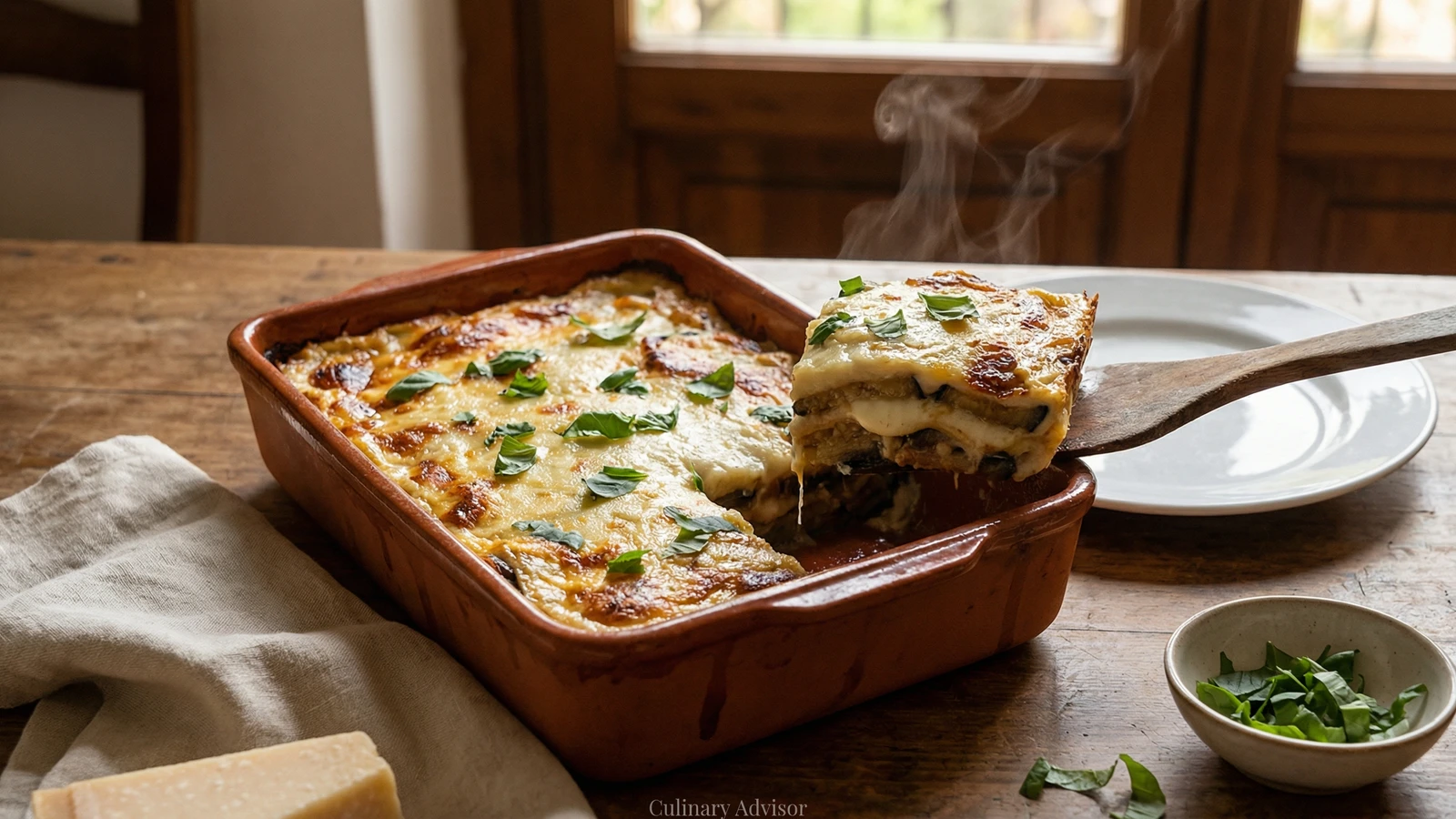
Parmigiana Bianca di Amalfi
Created by Chef Graziella
The original parmigiana of the Amalfi Coast, made as it was before tomatoes conquered Italian cooking. Layers of fried eggplant, silky besciamella, and fresh mozzarella prove that restraint creates depth.
Before tomatoes became the backbone of Southern Italian cooking, there was this. The parmigiana bianca of Amalfi represents the dish as it existed for generations before Spanish ships changed everything. Eggplant, besciamella, fresh mozzarella, Parmigiano-Reggiano. Nothing red. Nothing sharp. A dish of pure, enveloping comfort.
Americans know eggplant parmigiana as something drowning in marinara, buried under rubbery cheese. This is not that. The white parmigiana asks you to taste the eggplant itself, sweet and yielding, complemented rather than masked by the cream sauce. The mozzarella should be fresh, sliced by hand, not the shredded rubber that comes in bags. What you keep out is as significant as what you put in.
The besciamella must be made properly: butter, flour, milk, a whisper of nutmeg. It should coat a spoon and fall in ribbons. Too thick and the dish becomes stodgy. Too thin and it runs to the bottom, leaving the top layers dry. This is not difficult, but it requires attention. Simple does not mean easy.
In Amalfi, this dish appears at family gatherings, at Sunday tables, at celebrations where the hostess wants to show she has taken care. It emerges from the oven golden and bubbling, rested just long enough to set, then served in generous squares that hold their shape on the plate.
Parmigiana predates the tomato's acceptance in Italian cooking by centuries. The dish likely originated as a way to make eggplant, introduced by Arab traders, into something substantial enough for a main course. When tomatoes finally gained acceptance in Neapolitan kitchens during the 18th century, they gradually replaced the besciamella in most versions, but the Amalfi Coast preserved the original.
The technique, the tradition, and the story behind every dish.
Discover Culinary AdvisorIngredients
Italian eggplant
Quantity
3 pounds (about 4 medium)
kosher salt
Quantity
for drawing moisture
olive oil
Quantity
about 2 cups
for frying
unsalted butter
Quantity
4 tablespoons
all-purpose flour
Quantity
1/4 cup
whole milk
Quantity
3 cups
warmed
nutmeg
Quantity
1/4 teaspoon
freshly grated
fine sea salt
Quantity
to taste
white pepper
Quantity
to taste
fresh mozzarella (fior di latte)
Quantity
1 pound
sliced 1/4-inch thick
Parmigiano-Reggiano
Quantity
6 ounces (about 2 cups)
freshly grated
fresh basil leaves
Quantity
about 20
| Ingredient | Quantity |
|---|---|
| Italian eggplant | 3 pounds (about 4 medium) |
| kosher salt | for drawing moisture |
| olive oilfor frying | about 2 cups |
| unsalted butter | 4 tablespoons |
| all-purpose flour | 1/4 cup |
| whole milkwarmed | 3 cups |
| nutmegfreshly grated | 1/4 teaspoon |
| fine sea salt | to taste |
| white pepper | to taste |
| fresh mozzarella (fior di latte)sliced 1/4-inch thick | 1 pound |
| Parmigiano-Reggianofreshly grated | 6 ounces (about 2 cups) |
| fresh basil leaves | about 20 |
Equipment Needed
- •Large 12-inch skillet for frying
- •Heavy 3-quart saucepan for besciamella
- •9-by-13-inch baking dish, at least 2 inches deep
- •Wire rack set over sheet pan for draining
Instructions
- 1
Salt the eggplant
Slice the eggplants lengthwise into planks about one-third inch thick. Arrange in a single layer on sheet pans lined with paper towels. Salt generously on both sides. Let stand for one hour. The eggplant will weep brown liquid. This is the bitterness leaving. This step is not optional.
Younger, smaller eggplants contain less bitterness. If you can find them, the salting time may be reduced to 30 minutes. But do not skip it entirely. - 2
Prepare for frying
Pat the eggplant slices thoroughly dry with fresh paper towels. Press firmly. Any remaining moisture will cause the oil to splatter and prevent proper browning. The slices should feel almost leathery to the touch.
- 3
Fry the eggplant
Pour olive oil into a large skillet to a depth of one-half inch. Heat over medium-high until the oil shimmers and a small piece of eggplant sizzles immediately when added. Fry the slices in batches without crowding, about 2 minutes per side, until deep golden brown. Transfer to a rack set over a sheet pan to drain. Add oil as needed between batches.
The eggplant absorbs oil like a sponge, then releases it as it cooks. Do not add more slices until the previous batch has finished. Crowding drops the oil temperature and creates greasy, pale results. - 4
Make the besciamella
In a heavy saucepan, melt the butter over medium heat. When the foam subsides, add the flour all at once and whisk constantly for 2 minutes. The roux should be pale, not browned. Gradually add the warm milk in a thin stream, whisking continuously to prevent lumps. Cook, stirring, until the sauce thickens enough to coat the back of a spoon, about 8 minutes. Remove from heat. Stir in the nutmeg and season with salt and white pepper.
- 5
Prepare the mozzarella
Slice the fresh mozzarella and lay the slices on paper towels to absorb excess moisture. Fresh mozzarella contains liquid that would make the finished dish watery. Press gently with another layer of paper towels. Let rest while you prepare the baking dish.
- 6
Assemble the parmigiana
Heat the oven to 375 degrees Fahrenheit. Spread a thin layer of besciamella across the bottom of a 9-by-13-inch baking dish. Arrange a layer of fried eggplant slices, overlapping slightly. Spoon over one-third of the remaining besciamella. Scatter one-third of the mozzarella slices, one-third of the Parmigiano, and a few basil leaves torn into pieces. Repeat twice more, ending with besciamella and a generous layer of Parmigiano. Reserve the prettiest basil leaves for after baking.
- 7
Bake until golden
Bake uncovered until the top is deeply golden and the edges bubble, 40 to 45 minutes. If the top browns too quickly, tent loosely with foil. The internal temperature should reach at least 165 degrees. Remove from the oven and let rest for 15 minutes before cutting. This resting is essential. Cut too soon and the layers will slide apart.
- 8
Serve properly
Cut into squares with a sharp knife. Use a spatula to lift each portion cleanly. The layers should hold together but remain distinct. Scatter the reserved basil leaves over the top. Serve on warmed plates. This dish is best warm, not hot. The flavors open as it cools slightly from oven temperature.
Chef Tips
- •Fresh mozzarella is not negotiable. The pre-shredded cheese in bags is made for pizza delivery, not for this dish. Seek out fior di latte or, if you are fortunate, mozzarella di bufala from a good Italian market.
- •The besciamella should be made the consistency of heavy cream, not paste. If it becomes too thick, whisk in additional warm milk a tablespoon at a time until it flows properly.
- •Blotting the mozzarella removes the whey that would otherwise pool at the bottom of the dish. This small step prevents a watery parmigiana.
- •Some cooks in Amalfi add a single layer of thinly sliced prosciutto cotto between the eggplant layers. This is acceptable. It is not traditional, but traditions evolve.
Advance Preparation
- •The eggplant can be fried up to one day ahead. Store in a single layer, covered, at room temperature. Do not refrigerate or the eggplant becomes leathery.
- •The besciamella can be made 2 hours ahead. Press plastic wrap directly onto the surface to prevent a skin from forming. Rewarm gently before assembling.
- •The fully assembled parmigiana can be refrigerated unbaked for up to 24 hours. Add 10 minutes to the baking time if baking from cold.
- •Leftovers reheat well at 350 degrees for 20 minutes, covered with foil. The dish improves slightly after a night in the refrigerator.
Frequently Asked Questions
Nutrition Information
1 serving (about 325g)
Where cooking meets culture.
Culinary mentorship, cultural storytelling, and the editorial depth that makes cooking meaningful.
Explore Culinary Advisor