Culinary Advisor
A cooking platform built around craft, culture, and the stories behind what we eat.
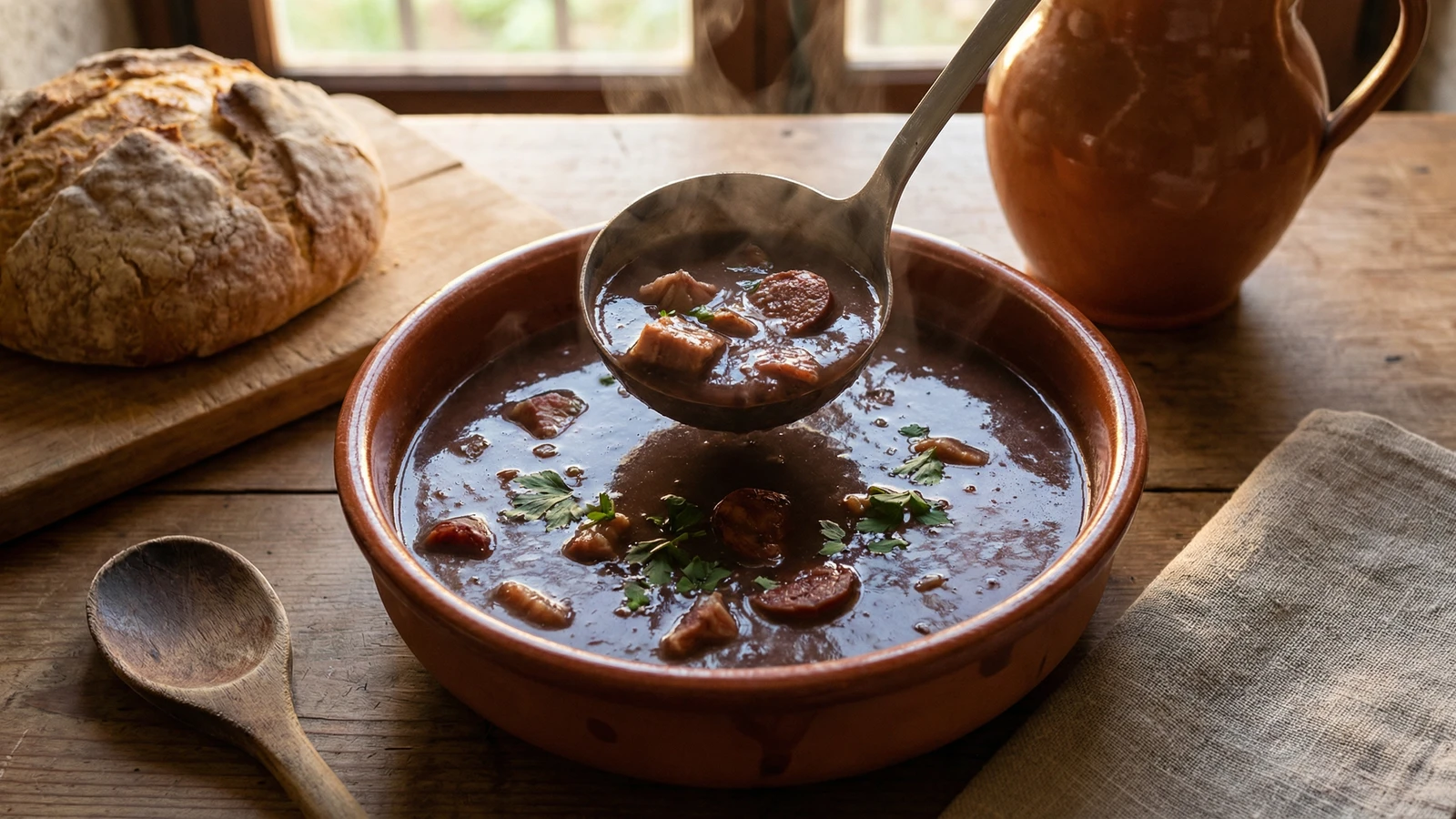
Papas de Sarrabulho
Created by
The blood porridge of Minho, born from the winter matança when families used every part of the pig. Dark, rich, perfumed with cumin, this is peasant cooking at its most honest and uncompromising.
This is not a dish for everyone. I say that with love, not gatekeeping. Papas de Sarrabulho asks something of you before you cook it: acceptance. Acceptance that our grandmothers cooked with blood, with offal, with the parts that modern squeamishness has taught us to discard. They did this not from poverty alone, but from wisdom. Nothing wasted. Everything honored.
I first tasted proper sarrabulho in Ponte de Lima, at the home of Dona Alzira, one of the grandmothers I documented for my cookbook. She was 84, had made this dish every winter since she was a young bride, and laughed when I asked for measurements. "You cook until it looks right," she said. "Your hands will know." The kitchen smelled of cumin and pork fat, and I understood immediately why this dish survived centuries of change. It is comfort made physical.
The cumin is everything. It transforms what could be heavy and metallic into something warm, almost spiced, deeply savory. Avó Leonor never made sarrabulho (she was Alentejana, and this is Minho's soul food), but she understood its principle: peasant food is genius food. The matança was a community event, a celebration of survival through winter. Sarrabulho was the first dish made, while the blood was still fresh, still warm from the animal. To waste it would be disrespectful.
At Mesa da Avó, I serve this once a year, in January, to honor the matança tradition. Some guests have never tasted blood before. Some grew up with it. Both groups leave understanding something about Portuguese food that bacalhau and pastéis de nata can never teach. This is who we are, underneath the tourist menus. This is the kitchen our grandmothers kept.
Papas de Sarrabulho emerged from the matança do porco, the annual pig slaughter that sustained rural Minho families through winter. The dish had to be made immediately after slaughter, while the blood was fresh and fluid. Cumin, unusual in Portuguese cuisine, likely arrived through medieval trade routes and became the defining spice of this region's blood cookery. The tradition persists in villages across Minho, though increasingly rare as industrial meat production replaces home slaughter.
The technique, the tradition, and the story behind every dish.
Discover Culinary AdvisorIngredients
pork shoulder
Quantity
500g
cut into 3cm cubes
pork liver
Quantity
200g
cleaned and cut into small pieces
chouriço de carne
Quantity
150g
sliced
fresh pork blood
Quantity
400ml
strained
fine corn flour (farinha de milho fina)
Quantity
150g
onions
Quantity
2 medium
finely chopped
garlic
Quantity
4 cloves
minced
dry white wine
Quantity
200ml
water or light pork broth
Quantity
1.5 liters
lard or olive oil
Quantity
3 tablespoons
ground cumin
Quantity
2 teaspoons, plus more to taste
bay leaves
Quantity
2
sea salt
Quantity
1 teaspoon
black pepper
Quantity
freshly ground, to taste
fresh parsley (optional)
Quantity
for serving
chopped
| Ingredient | Quantity |
|---|---|
| pork shouldercut into 3cm cubes | 500g |
| pork livercleaned and cut into small pieces | 200g |
| chouriço de carnesliced | 150g |
| fresh pork bloodstrained | 400ml |
| fine corn flour (farinha de milho fina) | 150g |
| onionsfinely chopped | 2 medium |
| garlicminced | 4 cloves |
| dry white wine | 200ml |
| water or light pork broth | 1.5 liters |
| lard or olive oil | 3 tablespoons |
| ground cumin | 2 teaspoons, plus more to taste |
| bay leaves | 2 |
| sea salt | 1 teaspoon |
| black pepper | freshly ground, to taste |
| fresh parsley (optional)chopped | for serving |
Equipment Needed
- •Large heavy-bottomed pot, at least 5 liters
- •Wooden spoon for constant stirring
- •Fine-mesh sieve for straining blood
- •Whisk
Instructions
- 1
Build the refogado
In a large heavy pot, heat the lard over medium heat. Add the onions and cook slowly, stirring occasionally, until soft and golden, about 12 minutes. Add the garlic and cook another minute until fragrant. This is the foundation. Não tenhas pressa.
Lard is traditional and gives the dish its authentic richness. If you must use olive oil, the dish will still be good, but different. Dona Alzira would give you a look. - 2
Brown the meats
Season the pork shoulder pieces with salt and pepper. Push the onions aside and add the pork cubes to the pot. Let them brown on all sides, about 8 minutes total. Don't crowd them. Work in batches if needed. You want color, not steam.
- 3
Add wine and broth
Pour in the white wine and scrape up any browned bits from the bottom. Let it bubble for 2 minutes. Add the water or broth, bay leaves, and 1 teaspoon of the cumin. Bring to a simmer, then reduce heat to low. Cover and cook until the pork is completely tender, about 1 hour 15 minutes. The meat should yield easily when pressed with a spoon.
- 4
Cook the liver and chouriço
Add the liver pieces and sliced chouriço to the pot. Simmer uncovered for another 15 minutes. The liver should be just cooked through, not rubbery. Taste the broth and adjust salt. Add the remaining teaspoon of cumin. The cumin should be present and assertive, the defining note of the dish.
Cumin is the soul of sarrabulho. If you can't smell it clearly, add more. In Minho, they're generous with it. - 5
Prepare the blood
If your blood has been refrigerated, let it come to room temperature. Strain it through a fine sieve to remove any clots. Whisk it smooth. Have your corn flour measured and ready. From here, you work quickly.
- 6
Add the corn flour
Reduce the heat to medium-low. While stirring constantly with a wooden spoon, sprinkle in the corn flour in a slow steady stream. Keep stirring. The mixture will begin to thicken. Continue cooking and stirring for 5 minutes until the raw flour taste cooks out and the porridge holds together but is still fluid.
Lumps form if you add the flour too fast or stop stirring. A whisk can help break up any that form, but prevention is easier than cure. - 7
Incorporate the blood
Remove the pot from direct heat. Working quickly, pour in the strained blood while stirring vigorously. Return to very low heat and continue stirring constantly for 3 to 4 minutes. The papas will darken and thicken further. Do not let it boil or the blood will curdle. You want a porridge consistency: thick enough to hold its shape on a spoon, loose enough to pour.
The blood must never boil once added. Keep the heat gentle and keep stirring. If you see the surface bubbling, pull the pot off the heat immediately. - 8
Final seasoning and serve
Taste and adjust. You may want more cumin, more salt, a grind of pepper. The flavor should be rich, deeply savory, with the warm spice of cumin cutting through the richness. Serve immediately in deep bowls, scattered with fresh parsley. In Minho, this comes to the table with rojões on the side and bread to soak up every bit. Papas de Sarrabulho waits for no one.
Chef Tips
- •Finding fresh pork blood requires a relationship with a butcher, ideally one who does their own slaughter. In Portugal, ask for sangue de porco. In diaspora communities, Portuguese or Spanish butchers may have it, especially in winter. Some Asian markets also carry fresh blood.
- •The traditional version includes more offal: heart, lungs, sometimes tongue. I've simplified here, but if you have access to quality offal and the courage to use it, add 100g of cleaned pork heart, cubed, with the shoulder.
- •Leftover sarrabulho thickens as it cools. Reheat gently with a splash of broth, stirring constantly. It's almost better the next day, the flavors deeper and more unified.
- •Rojões (fried pork cubes with garlic and white wine) are the traditional accompaniment. Together, they make a complete matança meal.
Advance Preparation
- •The pork shoulder can be braised a day ahead and refrigerated in its broth. The fat will solidify on top and can be used as cooking fat.
- •Blood must be fresh or properly stored (refrigerated, used within 2 days). It cannot be frozen successfully for this dish.
- •The fully assembled papas can be made 2 hours ahead and kept warm over very low heat, stirring occasionally. Add a splash of broth if it thickens too much.
Frequently Asked Questions
Nutrition Information
1 serving (about 320g)
Where cooking meets culture.
Culinary mentorship, cultural storytelling, and the editorial depth that makes cooking meaningful.
Explore Culinary Advisor