Culinary Advisor
A cooking platform built around craft, culture, and the stories behind what we eat.
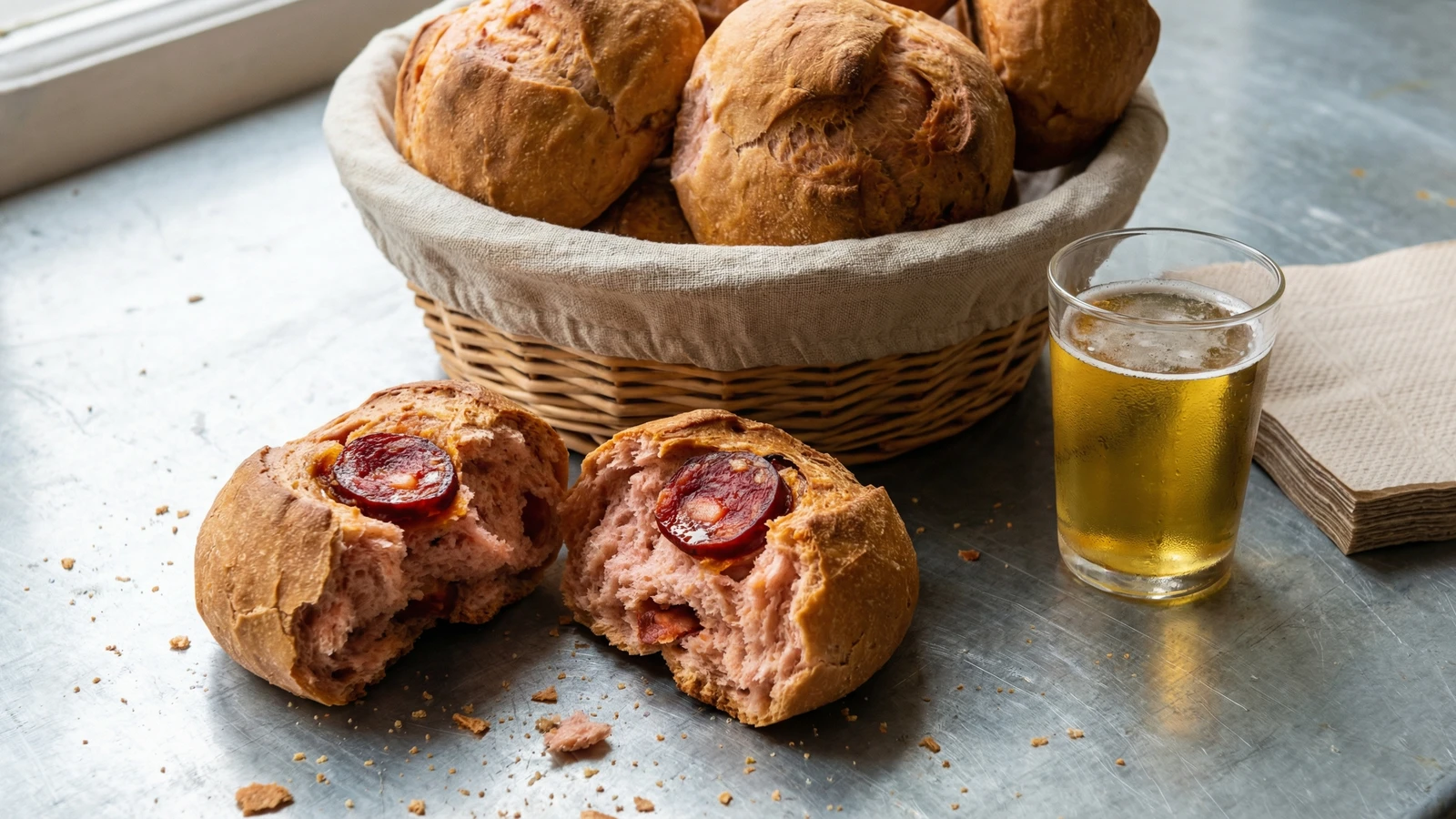
Pão com Chouriço
Created by
Smoky chouriço wrapped in soft bread dough and baked until the fat renders through every bite, the street food that fuels Portugal's festivals, late nights, and ordinary Tuesdays
The first time I understood Portuguese street food, I was seventeen, standing outside a tasca near Rossio at two in the morning, holding a pão com chouriço so hot I had to pass it hand to hand. The bread was golden. The chouriço inside had turned the crumb pink with rendered fat. I ate it in four bites and immediately bought another.
This is the food of Portugal's streets, its festivals, its late nights. You find it at padarias in the morning, still warm from the first bake. You find it at romarias and festas, handed over in paper napkins. You find it wherever people need something satisfying and unpretentious, something that costs almost nothing but delivers everything.
The technique is simple. You make bread dough. You wrap it around chouriço. You bake it. That's it. But like everything simple, the details matter. The chouriço must be Portuguese, smoky and paprika-red, not Spanish chorizo (different animal entirely). The dough must be soft enough to absorb the fat as it renders. The baking must go long enough for the crust to crisp while the inside stays tender.
Avó Leonor didn't make these often because she was an Alentejo cook, and in her kitchen bread was for açordas and migas. But when she did make them, for my cousins visiting from Lisbon, she'd shape them fat and generous, the chouriço barely contained. At Mesa da Avó, I serve them as people arrive, still warm, torn and shared. Uma cozinha sem alma é só combustível. A kitchen without soul is just fuel. This bread has soul.
Pão com chouriço emerged from the Portuguese tradition of baking meats inside bread, a technique that predates home ovens when families brought their dough to communal bakeries. The combination became street food in Lisbon and Porto during the 19th century, sold by vendors outside theaters, stadiums, and train stations. Today it remains one of Portugal's most beloved quick foods, unchanged for generations.
The technique, the tradition, and the story behind every dish.
Discover Culinary AdvisorIngredients
strong bread flour
Quantity
500g
plus more for dusting
fine sea salt
Quantity
10g
instant yeast
Quantity
7g (one packet)
warm water
Quantity
325ml
extra virgin olive oil (azeite)
Quantity
2 tablespoons
Portuguese chouriço
Quantity
250g
cut into 8 pieces
| Ingredient | Quantity |
|---|---|
| strong bread flourplus more for dusting | 500g |
| fine sea salt | 10g |
| instant yeast | 7g (one packet) |
| warm water | 325ml |
| extra virgin olive oil (azeite) | 2 tablespoons |
| Portuguese chouriçocut into 8 pieces | 250g |
Equipment Needed
- •Large mixing bowl
- •Baking sheet
- •Parchment paper
Instructions
- 1
Make the dough
In a large bowl, combine the flour, salt, and yeast. Make a well in the center. Pour in the warm water and olive oil. Stir with a wooden spoon until a shaggy dough forms, then turn it onto a floured surface. Knead for 8 to 10 minutes until smooth and elastic. The dough should spring back when you poke it. This is bread. It takes patience.
- 2
First rise
Shape the dough into a ball and place it in a lightly oiled bowl. Cover with a clean cloth and let rise in a warm spot until doubled in size, about 1 hour. Avó Leonor used to put hers near the window in summer, on top of the stove in winter. Find your warm place.
If your kitchen is cold, heat your oven for 2 minutes, turn it off, and let the dough rise inside with the door cracked open. - 3
Shape with the chouriço
Punch down the dough and divide it into 8 equal pieces. Take one piece and flatten it into a rough oval with your palm. Place a piece of chouriço in the center. Wrap the dough around it completely, pinching the seams tight. Roll gently between your hands to seal. Place seam-side down on a parchment-lined baking sheet. Repeat with the rest. Leave space between them. They'll grow.
- 4
Second rise
Cover the shaped rolls loosely with a cloth and let them rise for another 30 to 45 minutes. They should look puffy and relaxed. Meanwhile, preheat your oven to 200°C (400°F).
- 5
Bake until golden
Bake for 20 to 25 minutes until the rolls are deep golden brown. The kitchen will smell extraordinary, that mix of fresh bread and smoky pork fat that means you're somewhere good. Let them cool for just 5 minutes. Não esperes mais. Don't wait longer. These are best eaten warm, when the chouriço is still soft and the bread tears easily.
The bottom should sound hollow when you tap it. That's how you know the bread is done through.
Chef Tips
- •Portuguese chouriço is not Spanish chorizo. The Portuguese version is smoked over wood, drier, and has a distinctive flavor. Look for it at Portuguese specialty shops or online. If you can't find it, a good quality smoked Spanish chorizo will work, but know that you're making something slightly different.
- •Don't skimp on the second rise. Those extra 30 minutes make the bread lighter and help it puff around the chouriço properly.
- •These freeze beautifully. Bake, cool completely, then freeze in a single layer. Reheat in a 180°C oven for 10 minutes. They taste nearly as good as fresh.
- •Some bakers slash the top before baking to let steam escape and show off the chouriço inside. Traditional or not, it looks beautiful. Your choice.
Advance Preparation
- •The dough can be made the night before and left to rise slowly in the refrigerator. Bring to room temperature for 30 minutes before shaping.
- •Shaped rolls can be frozen before the second rise. Thaw overnight in the refrigerator, then let rise at room temperature for 1 hour before baking.
Frequently Asked Questions
Nutrition Information
1 serving (about 125g)
Where cooking meets culture.
Culinary mentorship, cultural storytelling, and the editorial depth that makes cooking meaningful.
Explore Culinary Advisor