Culinary Advisor
A cooking platform built around craft, culture, and the stories behind what we eat.
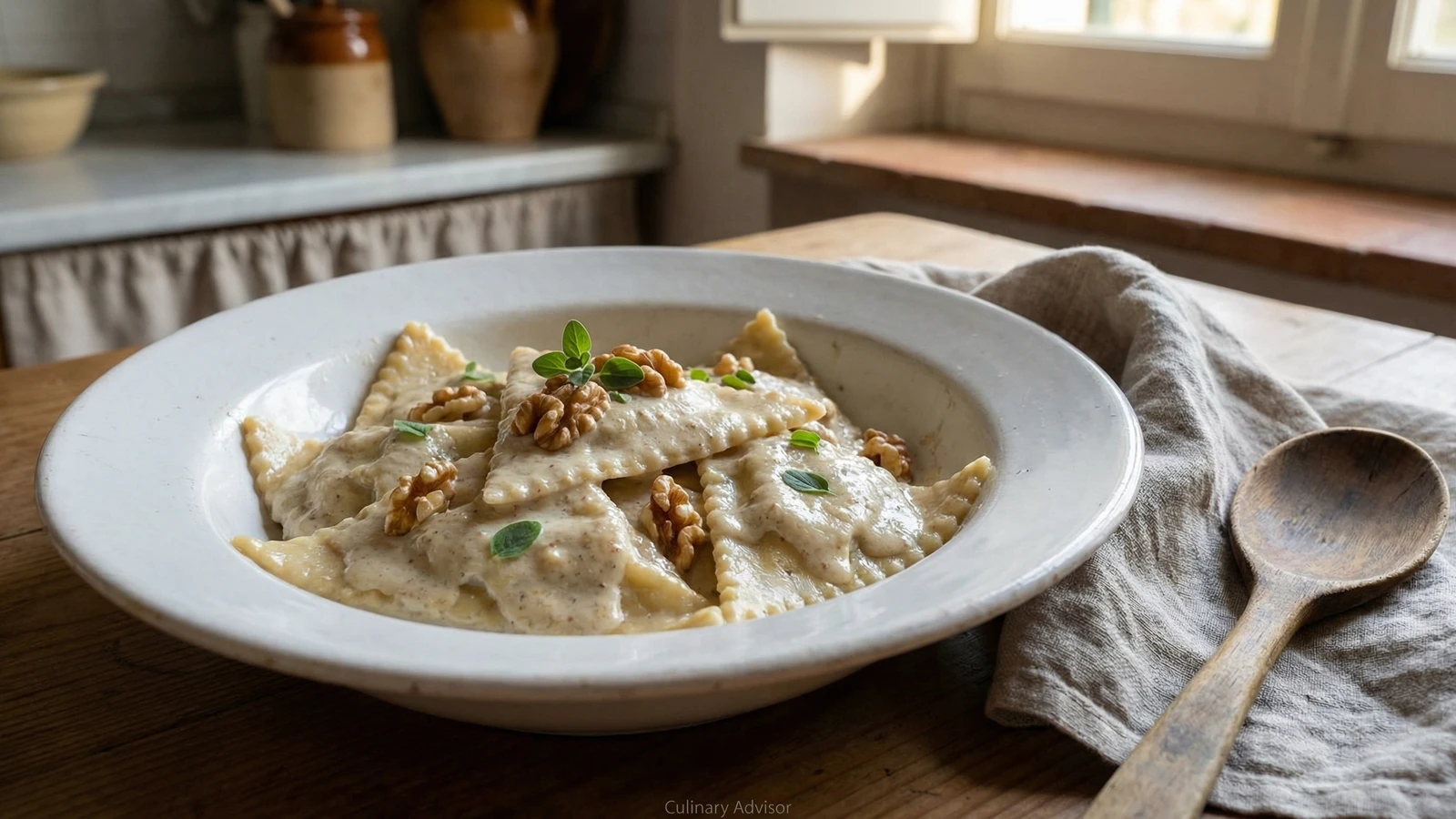
Pansoti con Salsa di Noci
Created by Chef Graziella
The treasure of the Ligurian coast, where wild herbs wrapped in delicate pasta meet a sauce of pounded walnuts. No cream, no shortcuts, only the patient work of hands that understand restraint.
Pansoti are the stuffed pasta of Liguria, and they exist nowhere else in Italy with the same meaning. The name comes from the Genoese dialect word for belly, pansa, because the little triangles swell with filling like contented stomachs. This is not ravioli. This is not tortellini. This is something particular to the steep hillsides above the Ligurian Sea, where wild herbs grow in profusion and walnuts fall from ancient trees.
The filling requires preboggion, the traditional mixture of wild greens that Ligurian women gathered from the hillsides. Borage is essential when you can find it, with its cucumber freshness and slight rasp on the tongue. Swiss chard provides body. The greens meet prescinseua, that peculiar Ligurian fresh cheese somewhere between yogurt and ricotta, tangy and light. If you cannot find prescinseua, you must approximate it. Nothing else gives the filling its proper character.
The walnut sauce contains no cream. Americans imagine that creamy means cream was added. The Ligurians know that walnuts, properly pounded with bread soaked in milk, become creamy on their own. The bread is the secret. It binds the sauce and gives it body without heaviness. You must blanch the walnuts and remove their skins, or the sauce will be bitter and brown instead of pale and sweet.
Pansoti emerged in the Fontanabuona valley behind Genoa, where preboggion grew wild on the terraced hillsides and walnut trees shaded the steep paths. The dish became associated with lean days and Lent, when meat was forbidden but eggs and cheese were permitted. Ligurian cooks, famously frugal, created something from foraged greens and stored walnuts that rivaled any meat-filled pasta in satisfaction.
The technique, the tradition, and the story behind every dish.
Discover Culinary AdvisorIngredients
all-purpose flour
Quantity
300g (2 1/3 cups)
large eggs
Quantity
3
dry white wine
Quantity
2 tablespoons
fine sea salt
Quantity
1/4 teaspoon
fresh borage leaves
Quantity
8 ounces
or substitute additional chard
Swiss chard
Quantity
12 ounces
stems removed
fresh ricotta
Quantity
1 cup
well drained
whole milk Greek yogurt
Quantity
1/2 cup
large egg
Quantity
1
Parmigiano-Reggiano
Quantity
1/2 cup
freshly grated
fresh marjoram
Quantity
1 tablespoon
minced
nutmeg
Quantity
1/4 teaspoon
freshly grated
shelled walnuts
Quantity
7 ounces (about 1 3/4 cups)
garlic clove
Quantity
1 small
day-old bread
Quantity
1 ounce
crust removed
whole milk
Quantity
1/4 cup
extra virgin olive oil
Quantity
1/2 cup
Parmigiano-Reggiano for sauce
Quantity
2 tablespoons
freshly grated
| Ingredient | Quantity |
|---|---|
| all-purpose flour | 300g (2 1/3 cups) |
| large eggs | 3 |
| dry white wine | 2 tablespoons |
| fine sea salt | 1/4 teaspoon |
| fresh borage leavesor substitute additional chard | 8 ounces |
| Swiss chardstems removed | 12 ounces |
| fresh ricottawell drained | 1 cup |
| whole milk Greek yogurt | 1/2 cup |
| large egg | 1 |
| Parmigiano-Reggianofreshly grated | 1/2 cup |
| fresh marjoramminced | 1 tablespoon |
| nutmegfreshly grated | 1/4 teaspoon |
| shelled walnuts | 7 ounces (about 1 3/4 cups) |
| garlic clove | 1 small |
| day-old breadcrust removed | 1 ounce |
| whole milk | 1/4 cup |
| extra virgin olive oil | 1/2 cup |
| Parmigiano-Reggiano for saucefreshly grated | 2 tablespoons |
Equipment Needed
- •Pasta machine or long rolling pin
- •Large wooden board or clean work surface for rolling
- •Mortar and pestle or food processor for walnut sauce
- •Spider or slotted spoon for lifting pasta
- •Large pot for cooking pasta
Instructions
- 1
Make the pasta dough
Mound the flour on a wooden board or clean work surface. Create a well in the center. Add the eggs, wine, and salt to the well. Using a fork, beat the eggs while gradually pulling flour from the inner walls of the well. When the mixture becomes too thick to stir, use your hands to bring the dough together. Knead vigorously for 10 minutes, until the dough is smooth, elastic, and springs back when pressed. Wrap tightly in plastic and rest at room temperature for 30 minutes.
The wine is traditional in Ligurian pasta. It makes the dough more supple and easier to roll thin. Do not omit it. - 2
Cook and chop the greens
Bring a large pot of salted water to a boil. Add the borage and chard leaves. Cook until completely tender, about 5 minutes. The greens must be fully cooked, not just wilted. Drain and run under cold water to stop the cooking. Squeeze the greens in your hands, pressing out every drop of water you can. Chop very fine. You should have about one and a half cups of chopped greens.
- 3
Make the filling
In a bowl, combine the ricotta and Greek yogurt. Stir until smooth. This approximates prescinseua. Add the chopped greens, egg, Parmigiano, marjoram, and nutmeg. Season with salt and mix thoroughly. The filling should hold together when pressed. If it seems wet, add another tablespoon of Parmigiano. Taste and adjust the salt.
True prescinseua is a Ligurian fresh cheese with the tang of yogurt and the richness of ricotta. The combination I give you is not authentic, but it is as close as you will come outside Liguria. - 4
Prepare the walnuts
Bring a small pot of water to a boil. Add the walnuts and blanch for 2 minutes. Drain immediately. While still warm, rub the walnuts between a clean kitchen towel to remove as much of the papery brown skin as possible. This step is tedious but essential. The skins make the sauce bitter and muddy-colored. You want the pale inner nut.
- 5
Make the walnut sauce
Soak the bread in the milk until completely soft, about 5 minutes. Squeeze out excess milk. In a mortar and pestle or food processor, pound or pulse the skinned walnuts with the garlic and a pinch of salt until you have a thick paste. Add the soaked bread and continue pounding or processing. With the machine running or while stirring constantly, drizzle in the olive oil gradually until the sauce is creamy and smooth. Stir in the Parmigiano. Taste for salt. The sauce should be the color of pale ivory, smooth but with slight texture, and pleasantly rich without being heavy.
The garlic here is restrained. One small clove for the entire sauce. This is Ligurian cooking, not American-Italian. The walnuts should speak, not the garlic. - 6
Roll and cut the pasta
Divide the rested dough into four pieces. Work with one piece at a time, keeping the rest covered. Roll each piece through a pasta machine, starting at the widest setting and working down to the second-thinnest setting. The sheets should be thin enough to see your hand through, but sturdy enough to hold the filling. Cut the sheet into 3-inch squares.
- 7
Fill and shape the pansoti
Place a generous teaspoon of filling in the center of each square. Moisten two adjacent edges with water. Fold the square diagonally to form a triangle, pressing firmly around the filling to seal and push out any air. The edges must be completely sealed or they will open during cooking. Press the tines of a fork along the sealed edges if you wish. Arrange the finished pansoti on a flour-dusted baking sheet without touching. You should have about 48 pansoti.
The pansoti should look plump, like little bellies. Do not overfill them, or they will burst. Do not underfill them, or they will be disappointing. - 8
Cook the pansoti
Bring abundant salted water to a gentle boil. Reduce to a simmer. Stuffed pasta requires gentler treatment than dried pasta. Add the pansoti in batches, stirring carefully to prevent sticking. Cook until the pasta is tender and the edges are no longer raw, about 4 minutes. They will float when nearly ready. Lift out with a slotted spoon or spider and drain briefly.
- 9
Dress and serve
Thin the walnut sauce with 3 to 4 tablespoons of the hot pasta cooking water. The sauce should flow but still coat a spoon. Toss the drained pansoti very gently with the walnut sauce, adding more pasta water if needed. The sauce should coat each triangle without pooling. Serve immediately on warmed plates. Once the pasta is sauced, invite your guests to put off talking and start eating.
Chef Tips
- •Borage has a distinctive cucumber-like freshness that chard cannot replicate. Seek it at farmers markets in spring and early summer. If unavailable, increase the chard and add a few leaves of fresh mint to approximate the brightness.
- •The walnut skins must be removed. I know it is tedious. Blanching and rubbing takes time. But the difference between a pale, sweet sauce and a bitter brown one is this step. Do not skip it.
- •Pansoti can be frozen on the baking sheet, then transferred to bags. Cook directly from frozen, adding one minute to the cooking time. The sauce should be made fresh.
- •Some Ligurian cooks add a spoonful of pine nuts or a few basil leaves to the walnut sauce. This is acceptable but not traditional. The purest version contains only walnuts, garlic, bread, oil, and cheese.
Advance Preparation
- •The filling can be made one day ahead and refrigerated. Bring to room temperature before filling the pasta.
- •Shaped pansoti can be frozen for up to one month. Freeze in a single layer on a baking sheet before transferring to bags.
- •The walnut sauce can be made several hours ahead and kept at room temperature, covered with plastic pressed directly onto the surface. Thin with warm pasta water just before serving.
Frequently Asked Questions
Nutrition Information
1 serving (about 250g)
Where cooking meets culture.
Culinary mentorship, cultural storytelling, and the editorial depth that makes cooking meaningful.
Explore Culinary Advisor