Culinary Advisor
A cooking platform built around craft, culture, and the stories behind what we eat.
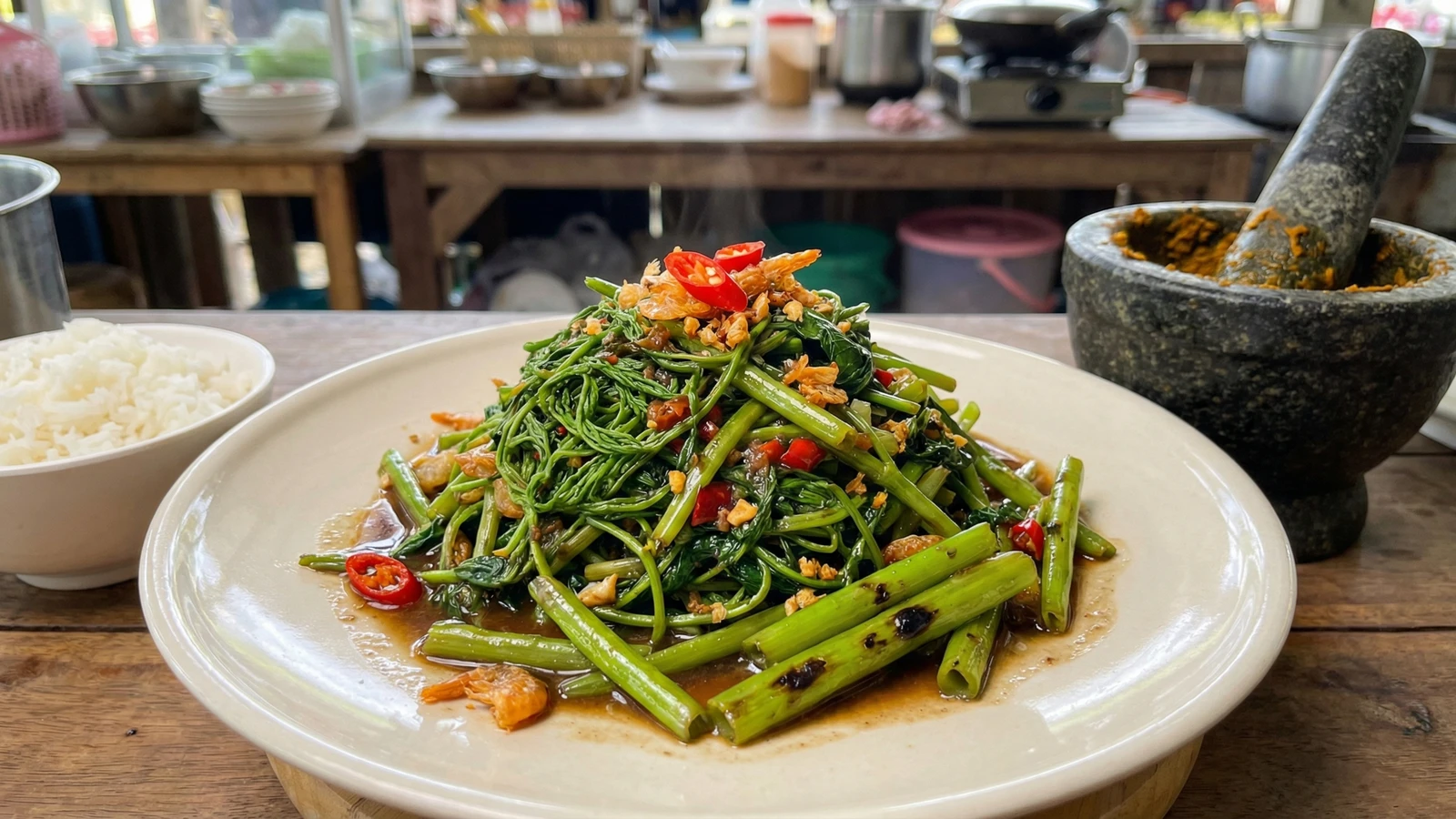
Southern Vegetable Stir-Fry (Pad Phak Tai)
Created by
Three bold Southern vegetables, a mortar with garlic, chilies, and kapi pounded to a rough paste, then thirty seconds in a screaming wok. The South doesn't need complexity. It needs conviction.
Southern Thai cooking has one rule that separates it from every other region: kapi (กะปิ, shrimp paste) isn't a background player. It's the lead.
In Central Thai cuisine, kapi hides inside curry pastes, blended with ten other aromatics. In the South, kapi stands alone. You pound garlic, chilies, and a fat knob of kapi in the mortar. That's your kreung tam. Three ingredients. That's it. And it's enough because Southern shrimp paste is dense, funky, and powerful enough to season an entire wok of vegetables by itself. Ajarn always said: "The kreung tam is everything." In the South, the kreung tam is kapi.
This is a dish built on vegetables that most people outside Thailand have never tasted. Cha-om (ชะอม, acacia leaf) is pungent, slightly bitter, almost sulfurous. Let me be honest: the first time you smell it, you might not want to eat it. The second time, you'll understand why Southern Thai cooks can't live without it. Water mimosa (ผักกระเฉด, phak krachet) is tender, grassy, with a faint crunch. Morning glory (ผักบุ้ง, phak bung) is the workhorse: hollow stems that stay crisp if you move fast enough in the wok. Three plants, three textures, one paste holding them together.
The four pillars are here, but the South plays them differently. Salt comes from kapi and nam pla together, a double hit. Sweet is barely a whisper of palm sugar. Sour is absent because these vegetables don't need it. Heat is turned up. The South leans spicy and savory, not sweet. That's not breaking the rules. That's the system being flexible. Principles, not recipes.
Southern Thai cuisine sits on the Malay Peninsula, where the Andaman Sea and the Gulf of Thailand provide the shrimp and fish that fuel the region's fermentation traditions. Kapi (shrimp paste) production is centered in coastal provinces like Ranong, Surat Thani, and Nakhon Si Thammarat, where tiny krill are salted and sun-fermented into dense purple-brown blocks. Cha-om (Acacia pennata) grows wild across the South and is one of the few vegetables whose pungent, sulfurous character defines a regional palate. Pad phak tai is not a single recipe but a family of vegetable stir-fries united by the kapi-garlic-chili kreung tam that appears on nearly every Southern Thai home table.
The technique, the tradition, and the story behind every dish.
Discover Culinary AdvisorIngredients
cha-om (acacia leaves)
Quantity
150g
picked from stems into small sprigs
water mimosa (phak krachet)
Quantity
150g
cut into 3-inch lengths, tough lower stems discarded
morning glory (phak bung)
Quantity
150g
cut into 3-inch lengths, stems and leaves separated
garlic (kratiam)
Quantity
5 cloves
bird's eye chilies (prik khi nu)
Quantity
5-8, to taste
shrimp paste (kapi)
Quantity
1 tablespoon
fish sauce (nam pla)
Quantity
1 tablespoon
palm sugar (nam tan pip)
Quantity
1 teaspoon
vegetable oil
Quantity
2 tablespoons
dried shrimp (goong haeng) (optional)
Quantity
1 tablespoon
steamed jasmine rice
Quantity
for serving
| Ingredient | Quantity |
|---|---|
| cha-om (acacia leaves)picked from stems into small sprigs | 150g |
| water mimosa (phak krachet)cut into 3-inch lengths, tough lower stems discarded | 150g |
| morning glory (phak bung)cut into 3-inch lengths, stems and leaves separated | 150g |
| garlic (kratiam) | 5 cloves |
| bird's eye chilies (prik khi nu) | 5-8, to taste |
| shrimp paste (kapi) | 1 tablespoon |
| fish sauce (nam pla) | 1 tablespoon |
| palm sugar (nam tan pip) | 1 teaspoon |
| vegetable oil | 2 tablespoons |
| dried shrimp (goong haeng) (optional) | 1 tablespoon |
| steamed jasmine rice | for serving |
Equipment Needed
- •Heavy granite mortar and pestle (krok hin)
- •Wok (carbon steel preferred)
Instructions
- 1
Pound the kreung tam
In a granite mortar (krok hin), pound the garlic and chilies to a rough paste. You want it broken, not smooth. Chunks of garlic should still be visible. Now add the kapi and pound it in until everything is incorporated, maybe ten more strikes. The smell will hit you. Fermented shrimp and raw garlic and crushed chili. That's the smell of a Southern Thai kitchen. If it doesn't make you flinch slightly, your kapi isn't strong enough.
Southern kapi is darker, denser, and funkier than the lighter Central Thai versions. If you can find kapi from Ranong or Surat Thani, use it. The difference is like comparing aged cheese to processed cheese. Same category, completely different product. - 2
Prepare the vegetables
Wash all three vegetables and shake them dry. Cha-om leaves are tiny and feathery, growing off thorny stems. Pick the leaf sprigs from the stems, discard any woody bits. Water mimosa: snap off the tough lower stems where they resist bending, keep the tender upper portions and cut into 3-inch lengths. Morning glory: separate stems from leaves. The stems go in the wok first because they take longer. The leaves go in last. This sequencing matters.
- 3
Fry the paste
Get your wok hot over high heat. Add the oil. When it shimmers, drop in the pounded kreung tam. Stir it fast for about fifteen seconds. The kapi will darken, the garlic will sizzle, and the kitchen will smell intensely of fermented shrimp and toasted chili. That's what you want. If you have dried shrimp, toss them in now and let them crisp for five seconds. They add a salty crunch that ties the whole dish together.
Don't let the kapi burn. There's a fifteen-second window between 'toasted and fragrant' and 'acrid and bitter.' Watch the color. When it goes from purple-brown to a shade darker, you're there. Move on. - 4
Stir-fry the vegetables
Morning glory stems first. Toss them in and stir-fry for thirty seconds until they turn bright green and start to soften. Next, the water mimosa. Another twenty seconds. Then the cha-om sprigs and the morning glory leaves together. Ten seconds, tossing constantly. The cha-om wilts fast and its pungent, slightly bitter aroma will bloom the moment it hits the heat. That bitterness is the point. It's the taste of Southern Thai home cooking.
- 5
Season and serve
Add the fish sauce and palm sugar. Toss twice. The palm sugar isn't here for sweetness. It's here to round the edges of the kapi's salt and the chili's heat. One teaspoon. No more. The South doesn't do sweet. Taste. The kapi and nam pla should give you a deep, savory salinity. The chilies should build heat at the back of your throat. The cha-om should be slightly bitter and pungent. If it all makes sense together, plate it. If the salt is shy, a splash more nam pla. Over jasmine rice. Done.
Chef Tips
- •Cha-om (Acacia pennata) is the vegetable that defines Southern Thai home cooking. It's pungent, slightly bitter, and sulfurous when raw. Cooking tames it, but the signature funk remains. If you've never eaten it, start with this dish. The kapi and chilies frame the bitterness so it makes sense. Don't substitute it with something milder. The whole character of the dish changes.
- •If you can't find all three vegetables, morning glory (phak bung) alone with the kapi kreung tam is still a legitimate Southern Thai stir-fry. Every market in Nakhon Si Thammarat sells phak bung pad kapi. Start there. Add cha-om and water mimosa when you find them.
- •Nam budu (น้ำบูดู), the Southern fermented fish sauce, can replace nam pla here for a more intensely funky, regional flavor. Budu is thicker and darker than standard fish sauce, closer to a condiment than a seasoning liquid. Use it sparingly if you go that route. A teaspoon of budu does the work of a tablespoon of nam pla.
- •Kapi quality is everything in this dish. There's no curry paste to hide behind, no coconut cream to soften the edges. The shrimp paste is exposed. Cheap kapi tastes like salt and nothing else. Good Southern kapi has depth: briny, funky, almost sweet, with a long finish. Find a Thai or Southeast Asian grocery that stocks the good stuff. It keeps indefinitely in the fridge.
Advance Preparation
- •The kreung tam can be pounded an hour or two ahead and left covered at room temperature. Kapi doesn't degrade quickly.
- •Vegetables should be washed, dried, and cut just before cooking. Morning glory and water mimosa oxidize and wilt fast once cut. Cha-om sprigs can be picked from stems and kept in a damp towel for a few hours.
- •This dish cannot be made ahead. Like all stir-fries, it lives in the thirty seconds between wok and plate. Reheated Southern vegetables are limp and sad. Cook it when you're ready to eat.
Frequently Asked Questions
Nutrition Information
1 serving (about 100g)
Where cooking meets culture.
Culinary mentorship, cultural storytelling, and the editorial depth that makes cooking meaningful.
Explore Culinary Advisor