Culinary Advisor
A cooking platform built around craft, culture, and the stories behind what we eat.
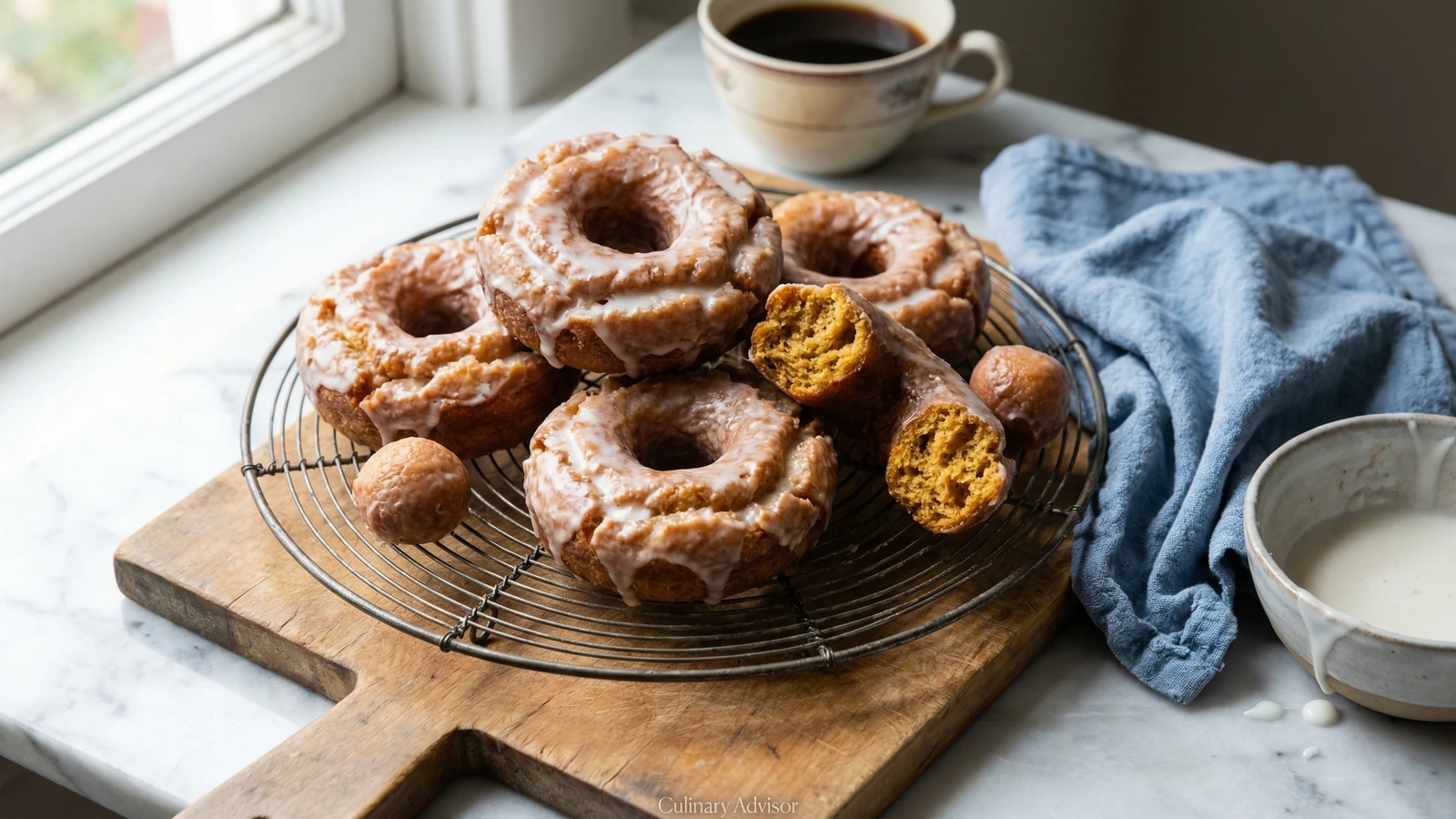
Old-Fashioned Cake Donuts
Created by
Tender, nutmeg-scented cake donuts with that distinctive crackled glaze, fried golden in a heavy pot the way your grandmother made them on those unhurried Saturday mornings when the whole house smelled like possibility.
The cake donut predates the yeasted variety by decades. Dutch settlers brought olykoeks to New Amsterdam in the 1600s, little balls of sweetened dough fried in pork fat. By the time American cookbooks started cataloging regional recipes, the cake donut had established itself as the honest, unpretentious cousin to its lighter, airier relative.
This is not a quick breakfast. This is a Saturday morning ritual that rewards patience with golden rings of tender, nutmeg-perfumed cake surrounded by a glaze that cracks when you bite through. The dough comes together in minutes, but it needs time in the refrigerator to firm up enough to roll and cut without sticking to everything in your kitchen.
I learned to fry donuts from a woman in coastal Maine who kept a pot of lard on her stove from September through April. She measured nothing, worked by feel, and produced donuts so tender they practically dissolved on your tongue. The recipe I'm giving you is more precise, because precision helps when you're learning. But her lesson stayed with me: respect the oil temperature, don't crowd the pot, and never apologize for the smell of frying dough filling your home.
The technique, the tradition, and the story behind every dish.
Discover Culinary AdvisorIngredients
all-purpose flour
Quantity
3 1/2 cups (440g)
plus more for rolling
granulated sugar
Quantity
1 cup (200g)
baking powder
Quantity
2 teaspoons
baking soda
Quantity
1 teaspoon
nutmeg
Quantity
1 1/2 teaspoons
freshly grated
fine sea salt
Quantity
1 teaspoon
ground cinnamon
Quantity
1/2 teaspoon
large eggs
Quantity
2
at room temperature
buttermilk
Quantity
3/4 cup (180ml)
at room temperature
sour cream
Quantity
1/4 cup (60g)
unsalted butter
Quantity
4 tablespoons (56g)
melted and cooled
pure vanilla extract (for dough)
Quantity
1 teaspoon
vegetable oil or refined coconut oil
Quantity
about 2 quarts
for frying
powdered sugar
Quantity
3 cups (360g)
sifted
whole milk
Quantity
1/4 cup (60ml)
pure vanilla extract (for glaze)
Quantity
1 teaspoon
fine sea salt (for glaze)
Quantity
pinch
| Ingredient | Quantity |
|---|---|
| all-purpose flourplus more for rolling | 3 1/2 cups (440g) |
| granulated sugar | 1 cup (200g) |
| baking powder | 2 teaspoons |
| baking soda | 1 teaspoon |
| nutmegfreshly grated | 1 1/2 teaspoons |
| fine sea salt | 1 teaspoon |
| ground cinnamon | 1/2 teaspoon |
| large eggsat room temperature | 2 |
| buttermilkat room temperature | 3/4 cup (180ml) |
| sour cream | 1/4 cup (60g) |
| unsalted buttermelted and cooled | 4 tablespoons (56g) |
| pure vanilla extract (for dough) | 1 teaspoon |
| vegetable oil or refined coconut oilfor frying | about 2 quarts |
| powdered sugarsifted | 3 cups (360g) |
| whole milk | 1/4 cup (60ml) |
| pure vanilla extract (for glaze) | 1 teaspoon |
| fine sea salt (for glaze) | pinch |
Equipment Needed
- •Heavy Dutch oven or deep pot (5-quart minimum)
- •Deep-fry or candy thermometer
- •3-inch round cutter
- •1-inch round cutter (or use a bottle cap)
- •Wire cooling rack
- •Spider strainer or slotted spoon
Instructions
- 1
Combine dry ingredients
Whisk together the flour, sugar, baking powder, baking soda, nutmeg, salt, and cinnamon in a large bowl. Take a moment to smell the nutmeg. If it doesn't perfume the air with warmth, your nutmeg is too old. Grate it fresh from whole nuts if you have them. This is the soul of a proper cake donut.
Pre-ground nutmeg loses its volatile oils within weeks. Whole nutmeg keeps for years and reveals its true character only when freshly grated. - 2
Mix wet ingredients
In a medium bowl, whisk the eggs until uniform. Add the buttermilk, sour cream, melted butter, and vanilla, whisking until smooth. The sour cream adds tang and tenderness. Don't skip it. Don't substitute yogurt. The fat content matters here.
- 3
Form the dough
Pour the wet ingredients into the dry and stir with a wooden spoon or sturdy spatula until just combined. The dough will be soft, sticky, and shaggy. Do not overmix. The moment you no longer see dry flour, stop. Overworked dough produces tough, dense donuts that fight back when you bite them.
- 4
Chill the dough
Press plastic wrap directly onto the surface of the dough, eliminating air pockets. Refrigerate for at least two hours, or overnight. This rest firms the butter, hydrates the flour, and makes rolling possible. Skip this step and you'll curse everything as dough clings to your hands, your counter, your rolling pin.
Overnight rest produces superior donuts. The flavors meld and the texture improves. Plan accordingly. - 5
Roll and cut
Flour your work surface generously. Turn out the cold dough and pat it into a rough rectangle. Roll to 1/2-inch thickness, rotating the dough and adding flour beneath as needed. Cut rounds with a 3-inch cutter, then punch centers with a 1-inch cutter. Work quickly. Warm dough becomes uncooperative. Transfer donuts and holes to a parchment-lined sheet, spaced apart.
- 6
Gather and re-roll scraps
Gather scraps gently, press together, and refrigerate for fifteen minutes before rolling again. You'll get two or three more donuts from the scraps. These re-rolled donuts will be slightly denser than the first batch. My grandmother served them to children who didn't know the difference.
- 7
Heat the frying oil
Pour oil into a heavy Dutch oven or deep pot to a depth of three inches. Clip a deep-fry thermometer to the side. Heat over medium-high until the oil reaches 350°F. This takes longer than you expect, fifteen minutes or more. Do not rush it. Consistent temperature is everything.
A cast iron Dutch oven holds temperature better than thin-walled pots. The heavy mass absorbs heat and releases it slowly, preventing wild temperature swings. - 8
Prepare the cooling station
Set a wire rack over a rimmed baking sheet. Line another sheet with paper towels for initial draining. Have your thermometer, spider or slotted spoon, and a plate of donuts ready beside the stove. Once frying begins, you'll work continuously. Organization prevents panic.
- 9
Fry in batches
Slide two or three donuts into the oil, using a spatula to guide them gently. They'll sink briefly, then bob to the surface as steam inflates the interior. Fry until deeply golden on the bottom, about ninety seconds to two minutes. Flip once using chopsticks or a spider. Cook the second side another ninety seconds. The cracks and crevices that form are your signature. Embrace them.
- 10
Drain and monitor temperature
Transfer fried donuts to paper towels for thirty seconds, then move to the wire rack. Check your oil temperature between batches. It will drop after each round. Let it recover to 350°F before adding more. Fry the donut holes last, about sixty seconds total, turning once.
- 11
Make the glaze
Whisk together the powdered sugar, milk, vanilla, and salt in a wide, shallow bowl until perfectly smooth. The glaze should flow like heavy cream. Too thick and it won't coat evenly. Too thin and it slides off. Add milk by the teaspoon to adjust.
- 12
Glaze while warm
When donuts have cooled just enough to handle, about five minutes, dip the top of each donut into the glaze. Twist your wrist slightly as you lift to let excess drip back into the bowl. Set glazed side up on the rack. The warmth helps the glaze set with that characteristic crackle. Work through all donuts and holes.
For a thicker coating, let the first glaze set for ten minutes, then dip again. The double layer produces an even more dramatic crackle. - 13
Rest and serve
Let glaze set for ten minutes. The surface will dry to a matte finish that cracks satisfyingly when you press through to the tender cake beneath. Serve the same morning. Cake donuts are ephemeral pleasures. By afternoon they're merely good. By evening they're history.
Chef Tips
- •The cracks in old-fashioned donuts aren't flaws. They're caused by the baking powder reacting rapidly in hot oil, splitting the surface as the interior expands. This is what distinguishes cake donuts from their smooth yeasted cousins.
- •Frying temperature matters more than anything else. Below 340°F, donuts absorb oil and turn greasy. Above 365°F, the exterior browns before the interior cooks through. Buy a reliable thermometer. It will change your frying forever.
- •Strain and save your frying oil. After cooling, pour through a fine-mesh strainer lined with cheesecloth into a clean container. Refrigerated, it keeps for several uses. Label it. Donut oil should only fry sweet things.
- •For chocolate lovers: replace two tablespoons of flour with Dutch-process cocoa powder and add it to the dry ingredients. The chocolate cake donuts that result deserve an even simpler glaze of just powdered sugar and cream.
Advance Preparation
- •Dough can be made and refrigerated up to 24 hours ahead. The longer rest actually improves texture and makes rolling easier.
- •Cut donuts can rest on a parchment-lined sheet in the refrigerator for up to 2 hours before frying, covered loosely with plastic wrap.
- •Glaze can be made up to 3 days ahead and stored covered at room temperature. Whisk smooth before using.
- •Fried, glazed donuts are best within 4 hours. They cannot be stored successfully. Plan to serve them soon after making, which is precisely the excuse you need for a leisurely Saturday morning.
Frequently Asked Questions
Nutrition Information
1 donut (about 65g)
Where cooking meets culture.
Culinary mentorship, cultural storytelling, and the editorial depth that makes cooking meaningful.
Explore Culinary Advisor