Culinary Advisor
A cooking platform built around craft, culture, and the stories behind what we eat.
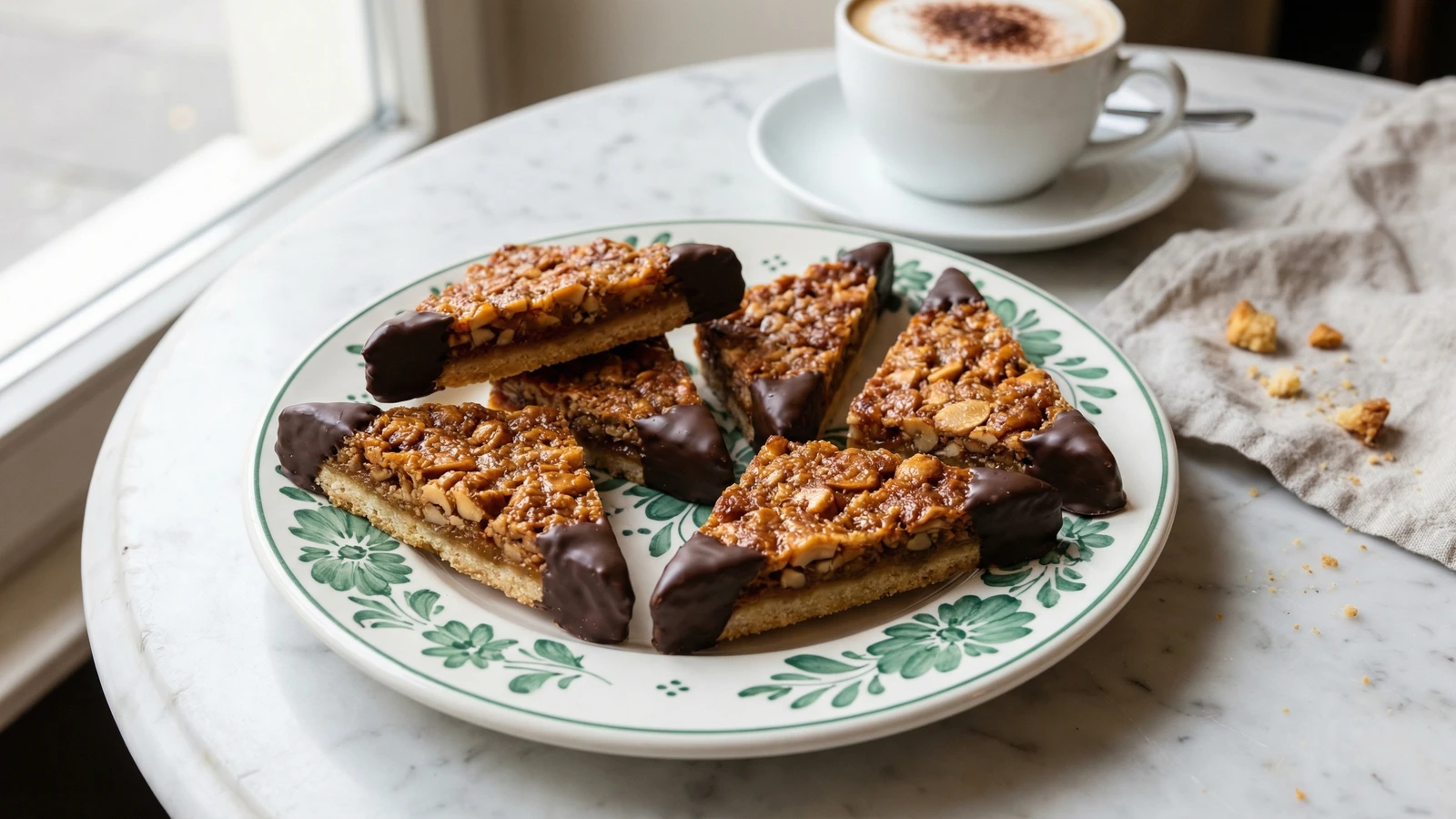
Nussecken (Chocolate-Dipped Nut Wedges)
Created by Chef Elsa
Buttery shortcrust spread with apricot jam, buried under a sticky caramelized nut topping, cut into triangles, and dipped twice in dark chocolate. The Konditorei classic you can make at home.
Gretel always said that the mark of a good Konditorei is how many things they get right in a small space. A Sachertorte is one test. A Nussecke is another. It's a small thing, a triangle of pastry you eat in four bites, but every layer has to work: the short, sandy base that snaps cleanly, the thin streak of apricot jam that keeps everything from being too rich, the caramelized nut topping that shatters and sticks to your teeth in equal measure, and the dark chocolate on both tips holding the whole thing together like bookends.
I remember the first time I made these at GAFA in Vienna. Our instructor told us that Nussecken look simple but expose every mistake. If your Mürbteig is tough, you'll taste it. If the nut layer isn't cooked enough, it'll be chewy instead of crunchy. If you rush the chocolate, it blooms white and dull within a day. He was right. These are small pastries that demand real technique.
The good news is that the technique isn't complicated. It's just precise. You make a proper shortcrust, bake it with its jam and nut layers in one go, cut it while warm, and dip the corners in tempered chocolate once everything has cooled. The result is something you'd find in every serious bakery case in Salzburg and Vienna, sitting in neat rows behind the glass, catching the light on their chocolate tips. Now you can make them in your own kitchen, and I promise they'll disappear faster than you think possible.
Nussecken belong to the broader Austrian and Central European tradition of Teebäckerei, the small, fine pastries and cookies served alongside coffee and tea in the Kaffeehaus and Konditorei. The combination of Mürbteig with nut toppings stretches back centuries in Austrian baking, where hazelnuts and almonds have always been pantry staples. The chocolate-dipped corners are a later refinement, likely from the early 20th century when couverture chocolate became widely available to Konditoren, turning a humble bakery square into something that looked as polished as it tasted.
The technique, the tradition, and the story behind every dish.
Discover Culinary AdvisorIngredients
plain flour
Quantity
300g
unsalted butter (for dough)
Quantity
150g
cold and cubed
granulated sugar (for dough)
Quantity
100g
egg
Quantity
1 large
vanilla sugar (Vanillezucker, for dough)
Quantity
1 teaspoon
salt
Quantity
pinch
apricot jam (Marillenmarmelade)
Quantity
150g
hazelnuts
Quantity
200g
roughly chopped
blanched almonds
Quantity
100g
roughly chopped
unsalted butter (for nut topping)
Quantity
100g
granulated sugar (for nut topping)
Quantity
100g
honey
Quantity
2 tablespoons
water
Quantity
2 tablespoons
vanilla sugar (Vanillezucker, for nut topping)
Quantity
1 teaspoon
dark chocolate (minimum 60% cocoa)
Quantity
200g
for dipping
| Ingredient | Quantity |
|---|---|
| plain flour | 300g |
| unsalted butter (for dough)cold and cubed | 150g |
| granulated sugar (for dough) | 100g |
| egg | 1 large |
| vanilla sugar (Vanillezucker, for dough) | 1 teaspoon |
| salt | pinch |
| apricot jam (Marillenmarmelade) | 150g |
| hazelnutsroughly chopped | 200g |
| blanched almondsroughly chopped | 100g |
| unsalted butter (for nut topping) | 100g |
| granulated sugar (for nut topping) | 100g |
| honey | 2 tablespoons |
| water | 2 tablespoons |
| vanilla sugar (Vanillezucker, for nut topping) | 1 teaspoon |
| dark chocolate (minimum 60% cocoa)for dipping | 200g |
Equipment Needed
- •Baking tray (30x40cm)
- •Parchment paper
- •Rolling pin
- •Wide saucepan for nut caramel
- •Sharp heavy knife for cutting
- •Heatproof bowl for melting chocolate
Instructions
- 1
Make the Mürbteig
Combine the flour, cold cubed butter, sugar, Vanillezucker, and salt in a large bowl. Rub the butter into the flour with your fingertips until the mixture looks like coarse breadcrumbs. Work quickly. The butter needs to stay cold or your dough will be tough instead of sandy. Add the egg and bring everything together into a smooth dough. Don't knead it. Press it together, give it two or three gentle folds, and stop the moment it holds. Wrap it in cling film and rest it in the fridge for thirty minutes.
If the dough feels greasy or soft, you've overworked it and the butter has warmed up. Put it straight into the fridge for twenty minutes and try again. Mürbteig forgives you once. - 2
Roll and line the tin
Heat your oven to 175°C (350°F). Line a 30x40cm baking tray with parchment paper. Roll the chilled dough out directly onto the parchment, pressing it into an even layer about half a centimeter thick. Push it right into the corners. If it cracks, press it back together with your fingers. Mürbteig is forgiving this way. Prick the surface all over with a fork. This stops the dough puffing up unevenly under the nut topping.
- 3
Spread the jam
Warm the apricot jam gently in a small saucepan until it loosens. If it's very chunky, press it through a sieve. Spread a thin, even layer over the entire surface of the dough. Thin is the word here. The jam is a bridge between the buttery base and the sticky nut layer, not a thick filling. You want just enough to taste, about two millimeters.
Use proper Marillenmarmelade if you can get it. Austrian apricot jam has a sharper, more complex flavor than the sweet, candy-like versions you find elsewhere. That tartness is what cuts through all the butter and sugar above it. - 4
Cook the nut topping
Melt the butter in a wide saucepan over medium heat. Add the sugar, honey, water, and Vanillezucker. Stir until the sugar dissolves and the mixture begins to bubble. Let it cook for two minutes, stirring constantly. It will turn a pale golden caramel. Take it off the heat and fold in the chopped hazelnuts and almonds. Stir until every piece is coated. The mixture should be sticky and glistening, not dry.
- 5
Top and bake
Spread the hot nut mixture evenly over the jam-covered dough. Use the back ofa spoon or an offset spatula, working quickly before the caramel sets. Press it gently so it bonds with the jam layer. Bake for 22 to 25 minutes, until the nut topping is a deep golden brown and the edges of the pastry are pulling away slightly from the tray. The kitchen will smell like toasted hazelnuts and honey. That's how you know you're close.
Watch the color carefully in the last five minutes. The nuts can go from golden to burnt faster than you'd expect, and there's no rescuing a burnt nut topping. If the edges are darkening faster than the center, rotate the tray. - 6
Cut while warm
Remove from the oven and let the slab cool in the tray for exactly ten minutes. Not longer. Cut it while it's still warm, or the caramel will harden and your pieces will shatter instead of slicing cleanly. First, cut the slab into 12 equal rectangles. Then cut each rectangle diagonally to make 24 triangles. Use a sharp, heavy knife and press straight down in one firm motion. Don't saw at it. Let the pieces cool completely in the tray.
- 7
Dip in chocolate
Melt the dark chocolate gently in a heatproof bowl set over barely simmering water. The bottom of the bowl should not touch the water. Stir until smooth and glossy. Dip two corners of each triangle into the chocolate, letting the excess drip back into the bowl. Place them on parchment paper to set. If your kitchen is warm, put the tray in the fridge for ten minutes to firm the chocolate. When the chocolate sets with a clean snap and a slight sheen, you've done it right.
If a single drop of water gets into the chocolate, it will seize into a grainy mess. Dry your bowl, dry your spoon, and keep the water beneath at a bare simmer. Chocolate is vain. It doesn't like being rushed or getting wet.
Chef Tips
- •Toast the hazelnuts lightly in a dry pan before chopping them. Five minutes over medium heat, shaking the pan, until they smell fragrant and the skins start to loosen. This deepens the flavor and makes the finished Nussecken taste like they came from a Konditorei, not a home kitchen.
- •Chop the nuts by hand with a heavy knife, not in a food processor. You want irregular pieces, some coarse, some fine. The variety gives you texture. A food processor turns half of them to dust before the other half is chopped.
- •These keep beautifully in a tin for two weeks, which makes them perfect for Advent baking. Layer them between sheets of parchment paper. The flavors actually improve after a day or two as the jam softens into the base and the caramel mellows.
- •Use the best dark chocolate you can find for dipping. At least 60% cocoa. Austrian brands like Zotter are ideal if you can get them. The chocolate is the first thing your teeth hit, so it sets the tone for the whole bite.
Advance Preparation
- •The Mürbteig can be made a day ahead and refrigerated. Let it sit at room temperature for ten minutes before rolling, or it will crack.
- •The fully assembled Nussecken keep in an airtight tin for up to two weeks at room temperature. They're ideal for making well in advance of Christmas.
- •Undipped Nussecken can be frozen for up to three months. Thaw completely before dipping in chocolate.
Frequently Asked Questions
Nutrition Information
1 serving (about 60g)
Where cooking meets culture.
Culinary mentorship, cultural storytelling, and the editorial depth that makes cooking meaningful.
Explore Culinary Advisor