Culinary Advisor
A cooking platform built around craft, culture, and the stories behind what we eat.
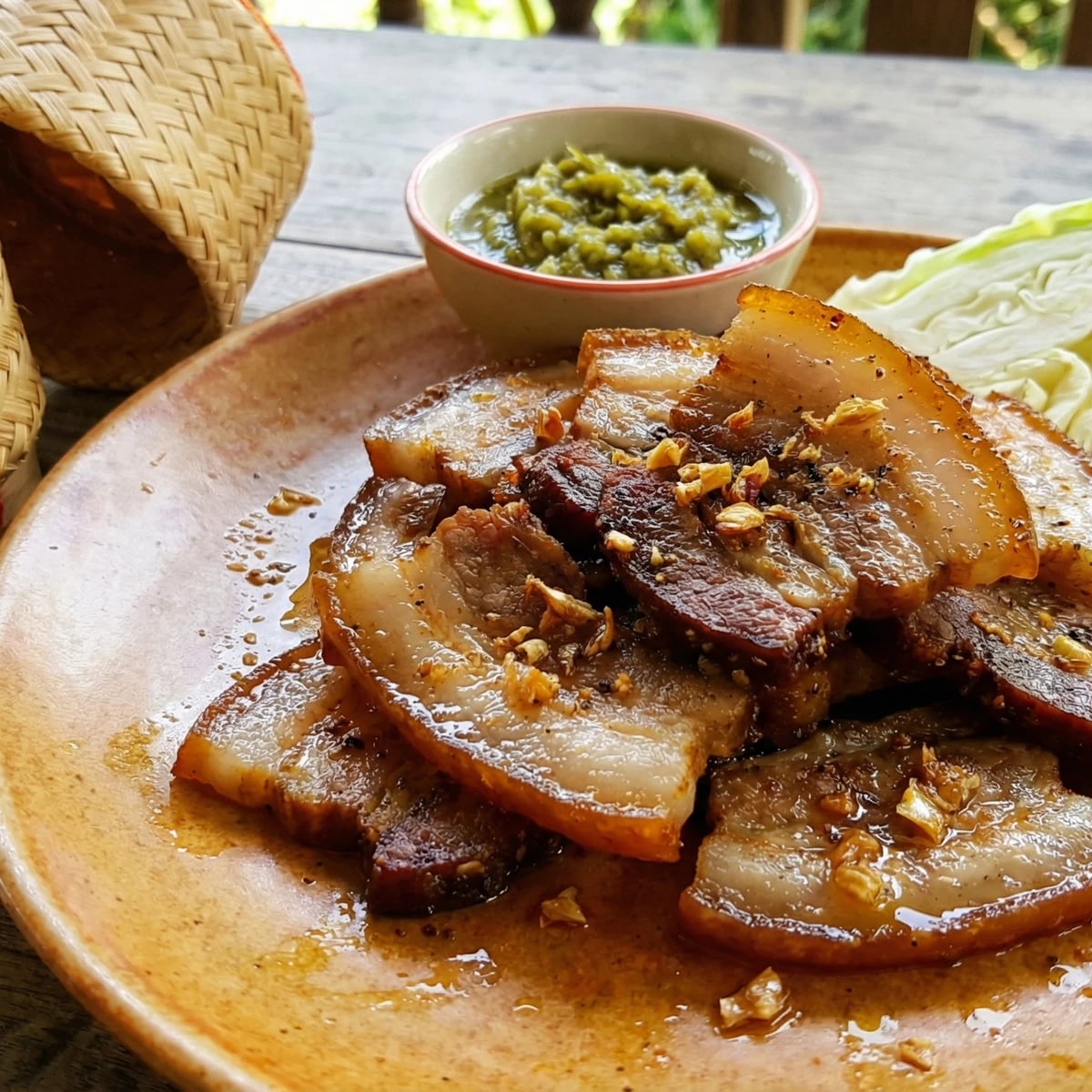
Northern Fried Pork Belly (Moo Tod)
Created by Chef Fai
Three ingredients pounded into a paste, rubbed into pork belly, fried until the skin shatters. The kreung tam doesn't always mean curry. Sometimes it means the simplest marinade doing all the work.
Strip Thai cooking down to its bones and you get moo tod. Garlic. White peppercorns. Cilantro root. Pounded in the krok, rubbed into pork belly, left to do its work overnight. That's a kreung tam. Not every paste is a curry paste. Ajarn always said the kreung tam is the foundation of Thai cooking, and he meant all of it: marinades, dips, dressings, everything that starts with pounding aromatics together until the cell walls break and the oils merge. Moo tod is that principle at its most minimal.
In the North, pork is king. The mountains of Lanna aren't cattle country. Pigs thrive in the hills, and Northern Thai cooks built an entire cuisine around them: sai oua, laab khua, jin som, kab moo, and this. Moo tod. Fried pork belly that shows up on every khan tok tray, every night bazaar stall, every family table in Chiang Mai. It's not glamorous. It doesn't need to be. The fat renders, the skin crisps, the garlic and pepper penetrate deep into the meat during the overnight marinade. Fish sauce (nam pla) provides the salt. A touch of palm sugar helps the exterior caramelize in the oil. That's it. Two of the four pillars, salt and sweet, doing their job.
I learned to fry pork belly from a vendor at Warorot Market who'd been making moo tod for longer than I've been alive. She told me the secret isn't the recipe. It's patience. You marinate it long enough. You fry it twice: once slow, once hot. The first fry cooks the meat through and starts rendering the fat. The second fry, at screaming-hot temperature, is what makes the skin shatter like glass. Two passes. No shortcuts.
Every Fai Thai workshop, I start with moo tod. Not because it's impressive. Because it teaches you that the kreung tam works even when it's just three ingredients. If you can pound garlic, peppercorns, and cilantro root into a paste and understand why that paste transforms a piece of pork, you can understand every other Thai dish that follows the same logic. Principles, not recipes.
Ingredients
pork belly (moo sam chan)
Quantity
500g
skin-on, cut into strips about 1.5 inches wide and 3 inches long
garlic (kratiam)
Quantity
1 head, about 10 cloves
white peppercorns (prik thai khao)
Quantity
1 tablespoon
| Ingredient | Quantity |
|---|---|
| pork belly (moo sam chan)skin-on, cut into strips about 1.5 inches wide and 3 inches long | 500g |
| garlic (kratiam) | 1 head, about 10 cloves |
| white peppercorns (prik thai khao) | 1 tablespoon |