Culinary Advisor
A cooking platform built around craft, culture, and the stories behind what we eat.
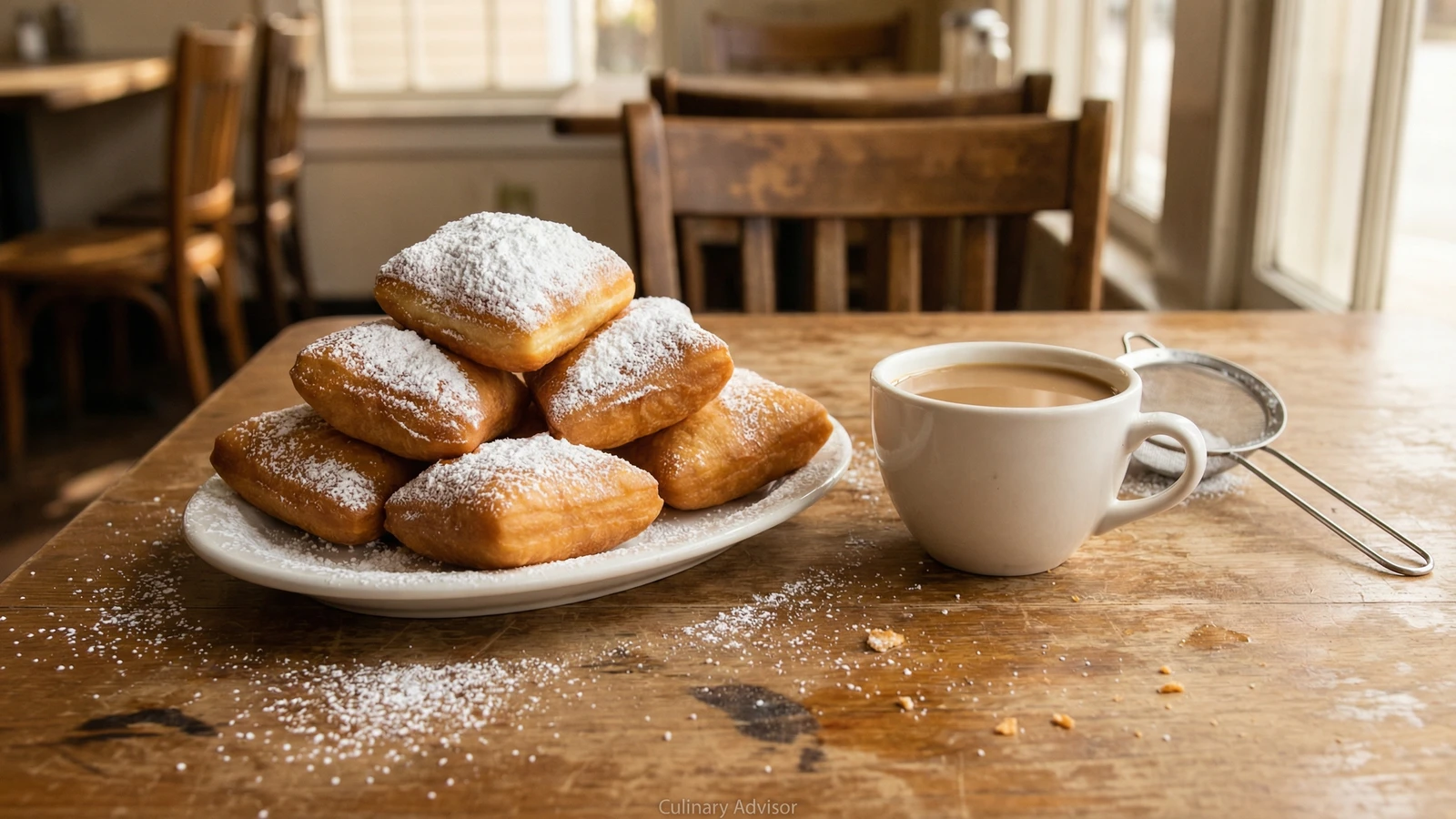
New Orleans Beignets
Created by Chef Remy
Puffy squares of yeast-risen dough, fried until golden and buried under a snowdrift of powdered sugar, served hot with café au lait the way they've done it in the French Quarter for two hundred years.
Some foods belong to a place so completely that eating them anywhere else feels like borrowing. Beignets belong to New Orleans. They are the taste of the French Quarter at dawn, the smell of hot oil and powdered sugar drifting through Jackson Square, the first thing tourists eat and the last thing locals ever tire of.
The technique is humble. Yeast dough, cut into squares, fried until golden. Nothing fancy. But the magic lives in the details: dough that's soft and slightly sticky, oil at exactly the right temperature, sugar applied with abandon while the beignets are still warm enough to make it stick. At Lagniappe, we serve them as dessert sometimes, but the truth is beignets belong to breakfast. Hot coffee, hot beignets, powdered sugar on your black shirt. That's the bayou way.
My grandmother Evangeline made these on special mornings, Christmas and birthdays and the first day of summer vacation. She'd have the dough rising before dawn, and we'd wake up to the smell of frying and the sight of her dusting sugar from a small sieve she kept just for this purpose. She taught me that good beignets aren't about precision. They're about feel: dough that springs back, oil that sizzles just right, sugar that falls like snow. You'll know when you've got it. The first bite tells you everything.
The technique, the tradition, and the story behind every dish.
Discover Culinary AdvisorIngredients
whole milk
Quantity
1 cup (240ml)
warmed to 110°F
granulated sugar
Quantity
1/4 cup (50g)
active dry yeast
Quantity
1 packet (2 1/4 teaspoons)
large egg
Quantity
1
at room temperature
unsalted butter
Quantity
2 tablespoons
melted and cooled
pure vanilla extract
Quantity
1/2 teaspoon
all-purpose flour
Quantity
3 1/2 cups (440g), plus more for rolling
fine sea salt
Quantity
1/2 teaspoon
vegetable oil or peanut oil
Quantity
about 2 quarts
for frying
powdered sugar
Quantity
2 cups or more
for dusting
| Ingredient | Quantity |
|---|---|
| whole milkwarmed to 110°F | 1 cup (240ml) |
| granulated sugar | 1/4 cup (50g) |
| active dry yeast | 1 packet (2 1/4 teaspoons) |
| large eggat room temperature | 1 |
| unsalted buttermelted and cooled | 2 tablespoons |
| pure vanilla extract | 1/2 teaspoon |
| all-purpose flour | 3 1/2 cups (440g), plus more for rolling |
| fine sea salt | 1/2 teaspoon |
| vegetable oil or peanut oilfor frying | about 2 quarts |
| powdered sugarfor dusting | 2 cups or more |
Equipment Needed
- •Large Dutch oven or heavy pot (at least 5-quart)
- •Candy or deep-fry thermometer
- •Rolling pin
- •Spider strainer or slotted spoon
- •Wire cooling rack
Instructions
- 1
Wake up the yeast
Pour the warm milk into a large mixing bowl. It should feel like a warm bath on your wrist, around 110°F. Sprinkle the sugar and yeast over the surface and let it sit undisturbed for five to ten minutes. You're waiting for the yeast to bloom. It should turn foamy and smell like fresh bread. If nothing happens, your yeast is dead or your milk was too hot. Start over with fresh yeast.
Yeast dies above 120°F. When in doubt, go cooler rather than hotter. The yeast will still activate, just a bit slower. - 2
Build the dough
Once the yeast is bubbling happily, whisk in the egg, melted butter, and vanilla until combined. Add two cups of the flour and the salt, stirring with a wooden spoon until you have a shaggy, sticky mess. This is exactly what you want. Now add the remaining flour, half a cup at a time, mixing until the dough comes together and pulls away from the sides of the bowl. It will still be tacky. That's the bayou way.
- 3
Knead until smooth
Turn the dough out onto a lightly floured surface. Knead for eight to ten minutes, adding flour only when absolutely necessary. You're developing gluten, building the structure that creates that pillowy chew. The dough is ready when it feels smooth and elastic, springs back when you poke it, and no longer sticks aggressively to your hands. A little tackiness is fine. Dry, stiff dough makes tough beignets.
If using a stand mixer, use the dough hook on medium-low for five to six minutes. Watch for the dough to clean the sides of the bowl and wrap around the hook. - 4
Let the dough rise
Lightly oil a clean bowl and place the dough inside, turning once to coat. Cover tightly with plastic wrap and set it somewhere warm, about 75°F. Let it rise until doubled in size, one and a half to two hours. My grandmother Evangeline used to set her bowl on top of the stove while something else simmered. Find your warm spot. The dough should look puffy and full of air when you pull back the plastic.
- 5
Roll and cut
Punch down the risen dough to release the gas. Turn it out onto a floured surface and roll it into a rectangle about a quarter-inch thick. Don't obsess over perfect geometry. These are meant to be rustic. Cut into roughly two-inch squares using a sharp knife or pizza cutter. You'll get about twenty-four pieces, maybe more. Let the cut squares rest on the floured surface, loosely covered, for fifteen minutes. This relaxes the gluten and helps them puff when they hit the oil.
Resist the urge to re-roll scraps more than once. Overworked dough gets tough. Those wonky edge pieces will fry up just as delicious. - 6
Heat the oil
Pour oil into a large Dutch oven or deep heavy pot to a depth of three inches. Heat over medium until it reaches 360°F. This temperature is critical. Too hot and the outside burns before the inside cooks. Too cool and the beignets absorb oil and turn greasy. Use a thermometer. I've been frying for forty years and I still use a thermometer for beignets.
- 7
Fry until golden
Working in batches of three or four, gently lower the dough squares into the hot oil. Don't crowd the pot or the temperature drops. The beignets will sink briefly, then bob to the surface and puff dramatically. Fry for about one minute per side until deep golden brown, flipping once with a slotted spoon or spider strainer. They should look like golden pillows, irregular and beautiful. Adjust your heat between batches to maintain 360°F.
The beignets puff best when the oil temperature stays consistent. Let it recover between batches if needed. - 8
Drain and sugar immediately
Transfer the fried beignets to a wire rack set over a sheet pan, or to a plate lined with paper towels. Let them drain for about thirty seconds. While they're still warm and slightly oily (that's what makes the sugar stick), pile them on a serving plate and bury them in powdered sugar. I mean bury. The mountain of white sugar is not optional. It's how we do things in New Orleans.
- 9
Serve hot
Beignets wait for no one. Serve them immediately with strong coffee, preferably chicory-laced café au lait if you want the full French Quarter experience. The first bite should release a puff of powdered sugar that coats your shirt. That's how you know you're doing it right. Don't apologize for the mess. Embrace it.
Chef Tips
- •The dough can be refrigerated overnight after the first rise. Cold dough is actually easier to roll and cut. Let it come to room temperature for thirty minutes before frying.
- •Peanut oil has a higher smoke point and cleaner flavor than vegetable oil. It's worth the extra cost for frying.
- •Don't skip the resting time after cutting. Those fifteen minutes let the gluten relax, which means puffier beignets.
- •Sift your powdered sugar through a fine-mesh strainer for the lightest coverage. Clumps are for amateurs.
- •Leftover beignets don't keep well, so only fry what you'll eat. The good news is they disappear fast.
Advance Preparation
- •Dough can be made through the first rise, then refrigerated overnight in a covered bowl. The cold fermentation actually improves flavor.
- •Cut beignets can rest on a floured sheet pan, covered, for up to one hour before frying.
- •Once fried, beignets must be served immediately. There is no make-ahead for the final product.
Frequently Asked Questions
Nutrition Information
1 beignet (about 45g)
Where cooking meets culture.
Culinary mentorship, cultural storytelling, and the editorial depth that makes cooking meaningful.
Explore Culinary Advisor