Culinary Advisor
A cooking platform built around craft, culture, and the stories behind what we eat.
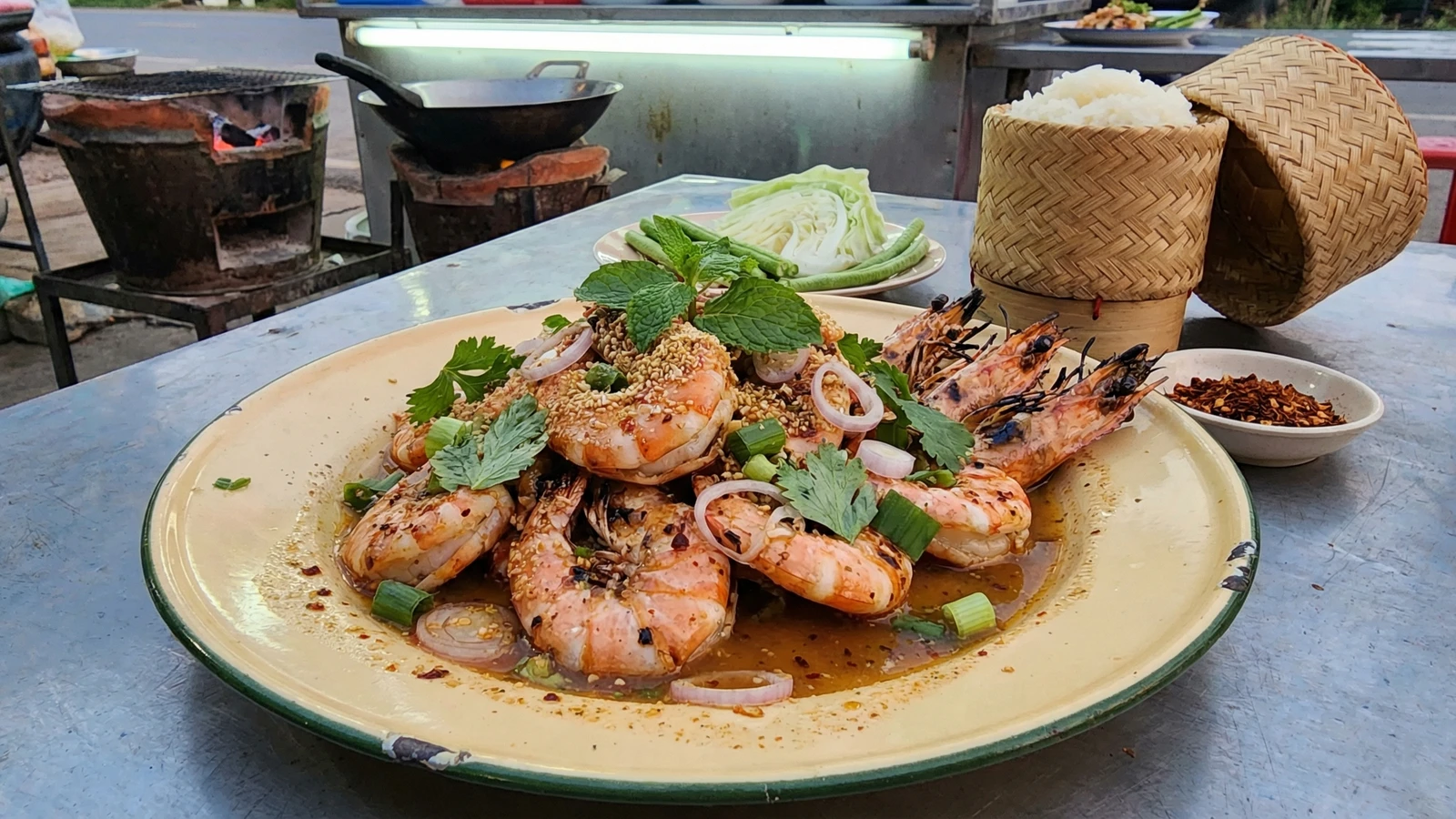
Grilled Shrimp Waterfall Salad (Nam Tok Kung)
Created by
Charcoal-grilled shrimp sliced warm and hit with the Isan dressing that has no sugar, no sweetness, no compromise: fish sauce, lime, khao khua, and prik pon. The waterfall runs clean.
No sugar. That's the rule. That's what separates Isan from Central Thai, and if you forget it, you're making a different dish from a different region. Nam tok means "waterfall," and the name comes from the juices that run off freshly grilled meat when you slice it. Those juices hit the cutting board, mix with the dressing, and become part of the dish. The waterfall is the flavor.
Ajarn always said: understand the regional systems, not just the national one. Central Thai cooking uses the four pillars in balance: fish sauce, palm sugar, lime, chili. Isan strips one pillar out. No palm sugar. No sugar of any kind. What you're left with is sharper, more direct, more honest. Sour hits first. Salt catches you. Heat builds. Khao khua (toasted sticky rice powder) provides the texture and a deep, smoky nuttiness that does the work sweetness would do in a Central Thai salad. That's the genius of the Isan flavor system: it doesn't need sweetness because the khao khua fills that space with something better.
Nam tok kung takes the classic beef or pork waterfall salad and applies it to shrimp. The principle is identical. Grill over high heat (charcoal if you have it, always charcoal if you can), slice while still warm, dress immediately. The warmth of the protein opens its pores to the dressing. Cold protein resists it. Warm protein absorbs it. That's not tradition for tradition's sake. That's physics.
Shrimp cook faster than beef, so your timing changes, but the method doesn't. Grill whole, shell on, until the shells char and the flesh is just opaque. Peel, slice thick on the bias, and dress while steam is still rising off the cutting board. Lime juice first, then fish sauce, then the dry ingredients: khao khua, prik pon (roasted dried chili), shallots, green onions, mint, sawtooth coriander. Toss once. Serve on a plate with sticky rice and raw vegetables. That's it. Isan doesn't complicate things. It trusts the ingredients.
Nam tok (น้ำตก, "waterfall") is a cornerstone of Isan (northeastern Thai) cuisine, closely related to larb but distinguished by its use of grilled, sliced protein rather than minced. The name refers to the juices that drip from freshly grilled meat onto the cutting board, a "waterfall" that becomes part of the dressing. While beef nam tok (nam tok neua) is the most common version across Isan, shrimp and fish variations appear frequently along the Mekong River corridor where freshwater prawns are abundant. The dish's defining absence of sugar reflects the Isan palate's preference for sharp, unmediated contrasts between sour, salty, and spicy, a flavor philosophy distinct from the balanced sweet-sour-salty approach of Central Thai cooking.
The technique, the tradition, and the story behind every dish.
Discover Culinary AdvisorIngredients
large shrimp (goong)
Quantity
500g (about 20 pieces)
shell-on, head-on if available
fish sauce (nam pla)
Quantity
2 tablespoons
fresh lime juice (nam manao)
Quantity
3 tablespoons (about 3 limes)
khao khua (toasted sticky rice powder)
Quantity
2 tablespoons
freshly toasted and pounded
prik pon (roasted dried chili flakes)
Quantity
1 tablespoon
shallots (hom daeng)
Quantity
4 small
sliced paper-thin
green onions (ton hom)
Quantity
3
sliced thin on the bias
fresh mint leaves (bai saranae)
Quantity
1 large handful
sawtooth coriander (pak chi farang)
Quantity
1 handful
cut into 1-inch pieces
fresh cilantro leaves (pak chi)
Quantity
1 handful
uncooked sticky rice (khao niew)
Quantity
1/4 cup
for making khao khua
| Ingredient | Quantity |
|---|---|
| large shrimp (goong)shell-on, head-on if available | 500g (about 20 pieces) |
| fish sauce (nam pla) | 2 tablespoons |
| fresh lime juice (nam manao) | 3 tablespoons (about 3 limes) |
| khao khua (toasted sticky rice powder)freshly toasted and pounded | 2 tablespoons |
| prik pon (roasted dried chili flakes) | 1 tablespoon |
| shallots (hom daeng)sliced paper-thin | 4 small |
| green onions (ton hom)sliced thin on the bias | 3 |
| fresh mint leaves (bai saranae) | 1 large handful |
| sawtooth coriander (pak chi farang)cut into 1-inch pieces | 1 handful |
| fresh cilantro leaves (pak chi) | 1 handful |
| uncooked sticky rice (khao niew)for making khao khua | 1/4 cup |
Equipment Needed
- •Charcoal grill or cast iron pan
- •Heavy granite mortar and pestle (krok hin) for pounding khao khua
- •Dry wok or skillet for toasting rice
- •Large mixing bowl
Instructions
- 1
Make the khao khua
Set a dry wok or skillet over medium heat. Add the uncooked sticky rice and toast, shaking the pan constantly. The grains will go from translucent to opaque to golden to deep amber. You want deep amber, not pale gold. This takes about 5 to 7 minutes and you cannot walk away. The moment you stop watching, it burns. When the rice is the color of dark honey and the kitchen smells smoky and nutty, pull it off the heat and let it cool for a minute. Pound it in a mortar to a coarse powder. Not flour. Not dust. You want texture: some grains fully crushed, some cracked into halves. That uneven grind is what gives khao khua its signature crunch in the finished dish.
Store-bought toasted rice powder is stale and flavorless. Don't use it. Fresh khao khua takes seven minutes and the difference is night and day. Toast it dark. Light khao khua has no character. You want the smoky, almost burnt edge. That's where the flavor lives. - 2
Prep the shrimp
If your shrimp have heads, leave them on. The heads char beautifully on the grill and the fat inside caramelizes. Devein the shrimp by cutting a shallow slit along the back through the shell and pulling the vein out with the tip of your knife. Don't peel them. The shell is your armor against overcooking and it concentrates the smoky flavor from the grill. Brush lightly with oil. No marinade. No seasoning. The dressing does all the work after.
- 3
Grill the shrimp
Get your grill screaming hot. Charcoal is the ideal here. The smoke from real charcoal adds a layer of flavor that a gas grill or broiler simply can't replicate. Lay the shrimp on the grate and don't touch them. Two minutes per side for large shrimp. You want the shells blistered and black in spots, the flesh just opaque, the heads (if you have them) dark and crisp. The flesh should be firm but still have a slight bounce when you press it. If it feels tight and rubbery, you went too far. Pull them off the grill and let them rest for one minute, just long enough to handle them.
If you don't have a charcoal grill, a cast iron pan over the highest heat your stove can produce is your best backup. Get it smoking hot, lay the shrimp flat, press them down with a spatula. You won't get the smoke, but you'll get the char. A broiler with the shrimp 3 inches from the element also works. What doesn't work: a lukewarm grill pan with pretty marks and no actual heat. - 4
Peel and slice warm
Peel the shrimp while they're still warm. The shells slip off easier when hot. If the heads are on, twist them off and set them on the serving plate as garnish (Isan style, nothing wasted). Slice each shrimp in half lengthwise, or for larger shrimp, cut thick pieces on the bias. Work fast. The shrimp need to be warm when they meet the dressing. That warmth is the waterfall: the juices from the cut shrimp run into the dressing and become part of the sauce. Cold shrimp won't release those juices. Warm shrimp will.
- 5
Build the dressing
In a mixing bowl, combine the fish sauce and lime juice. Stir once. Taste it. This is your base: salty and sour. There is no sugar. There is no sweetness. If your instinct is to add something to soften it, resist. The Isan palate is direct. Sour leads. Salt supports. That's the framework. Add the sliced shrimp while still warm and toss gently to coat. The warm shrimp will drink in the dressing immediately.
Ajarn always said: "Add sour last, add sour slowly." In this case, lime is mixed into the base dressing, so start with 2 tablespoons and build up. You can always squeeze in more lime. You can never take it back. Taste as you go. - 6
Dress and finish
Add the khao khua, prik pon, shallots, green onions, mint, sawtooth coriander, and cilantro. Toss everything together gently. You're not stirring a stew. You're folding delicate ingredients into dressed shrimp. One or two tosses. The khao khua will start absorbing moisture immediately, so don't let this sit. Taste a piece of shrimp with some dressing, a shallot ring, a mint leaf. Sour first? Good. Salty right behind it? Good. Heat building? Good. Smoky crunch from the khao khua? Good. If something is off, adjust: more lime, more fish sauce, more prik pon. Transfer to a plate immediately. Serve at room temperature with sticky rice and raw vegetables. Never from the fridge. Never cold. This dish is alive at room temperature. The fridge kills it.
Chef Tips
- •No sugar. I'll say it again: no sugar. Not palm sugar, not white sugar, not honey, not sweet chili sauce. The Isan nam tok formula is sour, salty, spicy, with khao khua for texture. The absence of sweet is what defines this as Isan. The moment you add sugar, you've crossed into Central Thai territory. That's a different dish with different rules. If the lime-fish sauce base tastes too sharp for you, the answer is more khao khua, not sugar. The toasted rice softens the edges without sweetening.
- •Khao khua must be freshly made. Toast raw sticky rice (not jasmine, sticky rice) in a dry pan until deep amber, almost burnt-looking at the edges, then pound it coarse. Store-bought toasted rice powder has been sitting in a bag losing its soul for months. Seven minutes of your time gives you a completely different ingredient. Toast it darker than you think you should. The smokiness is the point.
- •Dress the shrimp while warm. This is the nam tok principle. "Waterfall" refers to the juices that run from freshly grilled, sliced protein. Those juices blend with the lime and fish sauce dressing and become part of the flavor. If you let the shrimp cool completely before dressing, you lose that exchange. The protein tightens, the pores close, the dressing sits on the surface instead of penetrating. Warm protein, immediate dressing. That's the method.
- •Serve this with sticky rice (khao niew) only. Not jasmine rice. Sticky rice is the Isan staple and it's designed to be eaten by hand: pinch off a piece, press it flat, use it to scoop the nam tok. The stickiness holds the dressing. Jasmine rice grains are separate and loose, they can't do the same job. This isn't preference. It's engineering. The Isan table was designed around sticky rice.
- •The herbs are structural ingredients, not garnish. Mint (bai saranae), sawtooth coriander (pak chi farang), cilantro (pak chi), and green onions are tossed into the salad as equal participants. You should get herb in every bite, not just as decoration on top. Tear the mint leaves if they're large. Cut the sawtooth coriander into pieces you can eat. These herbs cool the heat from the prik pon and brighten every bite.
Advance Preparation
- •Khao khua can be toasted and pounded up to 2 hours ahead. Any longer and it starts losing its aroma. Store in a sealed container at room temperature if you must, but fresh is always better.
- •Shallots can be sliced and herbs can be washed and picked up to an hour ahead. Keep herbs wrapped in damp paper in the fridge.
- •Do not grill the shrimp ahead of time. The entire nam tok method depends on dressing the protein while warm. Grilled, cooled, and redressed shrimp is not nam tok. It's a cold shrimp salad. Plan your timing so the shrimp come off the grill and go straight into the dressing bowl.
- •Sticky rice should be soaked for at least 4 hours (overnight is best) and steamed just before serving. It stiffens as it cools. Warm, pliable sticky rice is part of the experience.
Frequently Asked Questions
Nutrition Information
1 serving (about 150g)
Where cooking meets culture.
Culinary mentorship, cultural storytelling, and the editorial depth that makes cooking meaningful.
Explore Culinary Advisor