Culinary Advisor
A cooking platform built around craft, culture, and the stories behind what we eat.
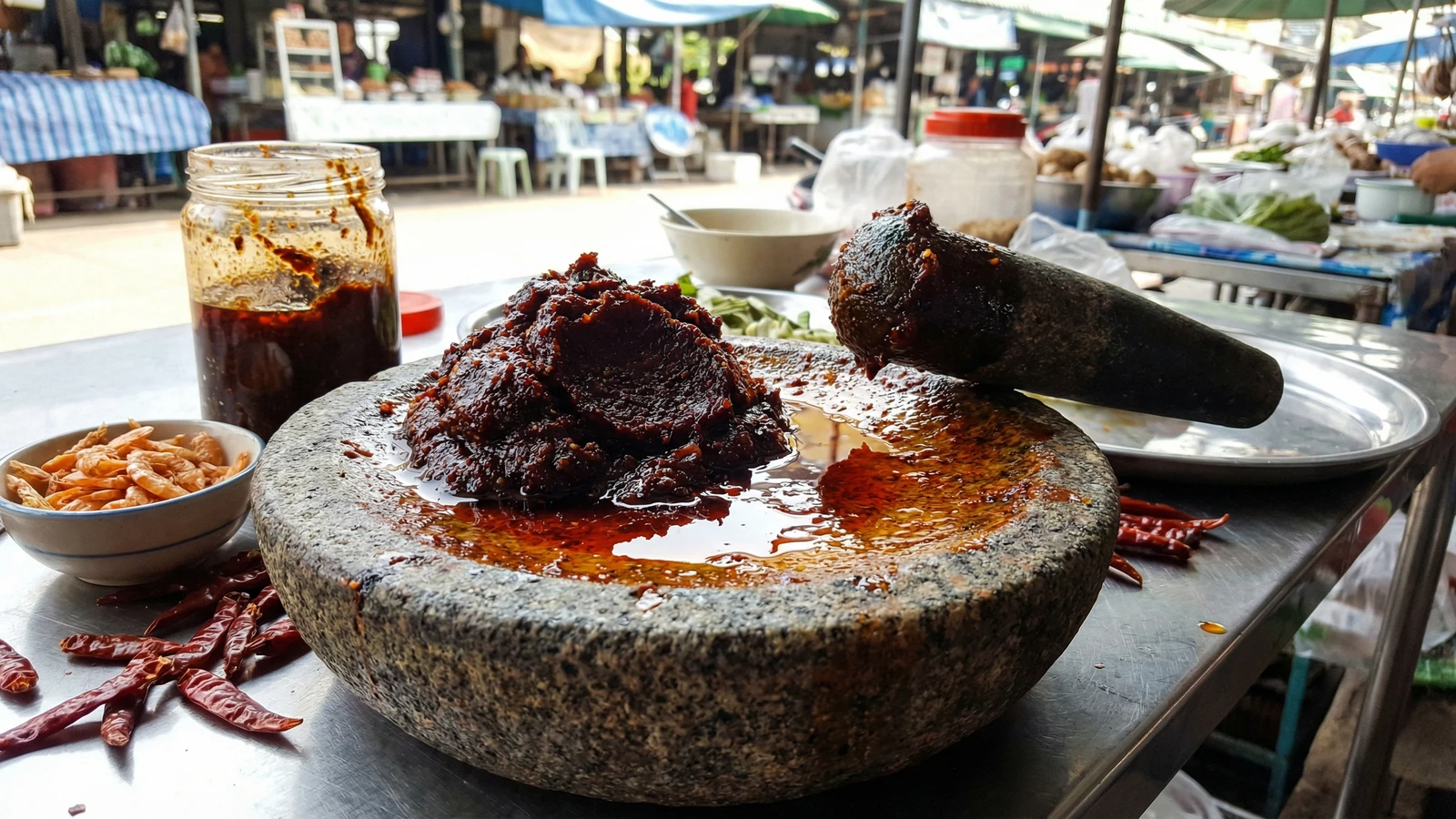
Roasted Chili Jam (Nam Prik Pao)
Created by
Not a curry paste but a charred condiment paste: every ingredient fried to a different shade of dark, then pounded and cooked down with tamarind, fish sauce, and palm sugar. The four pillars in a jar.
Nam prik pao is the kreung tam that lives in your fridge. Every other paste you pound gets cooked into a dish immediately. This one gets cooked into itself. You char the ingredients, pound them, then simmer the paste in its own frying oil until it becomes something entirely new: dark, smoky, sweet, salty, sour, with a slow-building heat that hums under everything else. It's a condiment, a stir-fry base, and the reason tom yam nam khon has that signature crimson slick.
Ajarn always said the kreung tam is the foundation of Thai cooking. Nam prik pao proves it. Dried chilies, shallots, garlic, dried shrimp, kapi (shrimp paste): all roasted individually, each to a different degree of char, then pounded in the krok and cooked down with nam pla (fish sauce) for salt, nam tan pip (palm sugar) for sweet, and makham (tamarind) for sour. All four pillars, built into a single paste that lasts for weeks.
Here's what separates a good nam prik pao from a bad one: patience with the frying. Every ingredient goes into the oil separately because they char at different rates. Garlic burns in two minutes. Shallots need five. Dried chilies need thirty seconds of attention or they turn bitter. You can't throw everything in at once and hope for the best. Each ingredient gets its own moment in the oil, its own transformation. Then the mortar brings them together.
I teach this at every Fai Thai workshop because once you have a jar of nam prik pao, you're dangerous. Stir it into fried rice. Swirl it on top of tom yam. Toss it with noodles. Spread it on toast with a fried egg. It's the Thai pantry staple that turns ordinary food into something with depth. My mother always had a jar at the stall. Not for sale. For us. Because even a som tam vendor needs nam prik pao in her life.
Nam prik pao (น้ำพริกเผา, literally "burned chili water") is a Central Thai condiment with roots in the broader nam prik (chili relish) tradition that predates written Thai cookbooks. It gained international recognition as the key ingredient in tom yam nam khon (the creamy version of tom yam), but in Thai households it has always been a standalone condiment eaten with rice. The commercial bottled version, popularized by brands like Maepranom in the 1970s, introduced sugar and soybean oil to extend shelf life, creating a sweeter, milder product that bears little resemblance to the deeply charred, tamarind-sour homemade original.
The technique, the tradition, and the story behind every dish.
Discover Culinary AdvisorIngredients
large dried red chilies (prik haeng)
Quantity
15 (about 30g)
stems removed, seeds shaken out
shallots (hom daeng)
Quantity
100g (about 8 small)
peeled
garlic (kratiam)
Quantity
60g (about 1 head)
cloves peeled
dried shrimp (goong haeng)
Quantity
30g (about 3 tablespoons)
shrimp paste (kapi)
Quantity
1 tablespoon
vegetable oil
Quantity
1 cup
for frying
palm sugar (nam tan pip)
Quantity
3 tablespoons
chopped if from a disc
fish sauce (nam pla)
Quantity
3 tablespoons
tamarind paste (makham piak)
Quantity
2 tablespoons
dissolved in warm water and strained
| Ingredient | Quantity |
|---|---|
| large dried red chilies (prik haeng)stems removed, seeds shaken out | 15 (about 30g) |
| shallots (hom daeng)peeled | 100g (about 8 small) |
| garlic (kratiam)cloves peeled | 60g (about 1 head) |
| dried shrimp (goong haeng) | 30g (about 3 tablespoons) |
| shrimp paste (kapi) | 1 tablespoon |
| vegetable oilfor frying | 1 cup |
| palm sugar (nam tan pip)chopped if from a disc | 3 tablespoons |
| fish sauce (nam pla) | 3 tablespoons |
| tamarind paste (makham piak)dissolved in warm water and strained | 2 tablespoons |
Equipment Needed
- •Heavy granite mortar and pestle (krok hin)
- •Wok or deep saucepan for frying
- •Slotted spoon or spider strainer
- •Clean glass jar with lid for storage
Instructions
- 1
Fry the dried chilies
Set a wok over medium heat and add the oil. When the oil shimmers, add the dried chilies. This is the step where most people panic. The chilies will darken fast, going from bright red to a deep mahogany in about 30 to 45 seconds. Stir constantly. You want them dark but not black. Black means bitter, and bitter nam prik pao is dead nam prik pao. The moment they darken and the kitchen smells smoky and roasted, scoop them out with a slotted spoon or spider and drain on paper. Keep the oil in the wok. That oil is now chili oil. Everything that follows cooks in it.
Shake the seeds out of the dried chilies before frying. The seeds add bitterness, not heat. The heat lives in the flesh and the veins. Seeds are dead weight in nam prik pao. - 2
Fry the shallots and garlic
In the same chili oil, fry the shallots whole over medium heat. Stir occasionally. They need about 5 to 7 minutes to turn deep golden brown all the way through, not just on the surface. Cut one in half to check. Golden center means done. Pale center means keep going. Remove and drain. Now the garlic. Lower the heat slightly. Garlic burns faster than anything else in this recipe. Fry the cloves until they're golden and fragrant, about 2 to 3 minutes. Watch them like you'd watch a child near a hot stove. Remove and drain the moment they color.
Every ingredient fries at a different rate. That's why they go in separately. Chilies need 30 seconds. Shallots need 5 minutes. Garlic needs 2. If you dump them all in together, something burns and something stays raw. Patience is the technique. - 3
Fry the dried shrimp
Add the dried shrimp to the oil. They'll puff slightly and turn orange-gold in about 1 to 2 minutes. You'll hear them crackle. When the crackling slows and they smell intensely savory, like concentrated ocean, they're done. Scoop them out and drain. Reserve about 4 tablespoons of the frying oil. Set the rest aside. You'll use some of the reserved oil to cook the finished paste, and the rest goes into the jar with the nam prik pao for storage.
- 4
Pound the kreung tam
Let everything cool for a few minutes. Trying to pound hot ingredients in a granite mortar is a way to burn yourself and get a bad paste. Start with the dried chilies in the krok. They're the hardest. Pound them to rough flakes first, then keep going until they break down into a fibrous paste. It takes effort. Your arm will know. Add the dried shrimp next and pound until they integrate. Then the garlic. Then the shallots. Then the kapi (shrimp paste). Pound after each addition until the paste is cohesive but still has texture. You're not making baby food. You want a rough, jammy consistency with visible flecks of chili and shrimp.
Ajarn always said: hardest ingredients first, most delicate last. The order matters because you're building the paste in layers. Each new ingredient gets pounded into what's already broken down. The dried chilies create the base. Everything else folds in. - 5
Cook the paste
Heat 3 tablespoons of the reserved frying oil in a clean wok or saucepan over medium-low heat. Add the pounded paste and stir. It'll sizzle and the oil will start turning red. Cook, stirring constantly, for about 3 minutes. The paste will deepen in color and the raw shrimp paste smell will mellow into something roasted and complex. Now add the palm sugar. Stir until it dissolves and the paste turns glossy. Add the fish sauce. Stir. Add the tamarind paste. Stir. The paste should now taste: sweet first, then salty, then sour, with a smoky chili warmth underneath. Taste it. Adjust. More sugar if the tamarind is too sharp. More fish sauce if it needs depth. More tamarind if it's too sweet.
- 6
Finish and store
Cook for another 5 to 8 minutes on low heat, stirring frequently, until the oil starts to separate from the paste and pool at the edges. That separation is your signal. The nam prik pao is done when it looks like a dark, glossy jam with red oil bleeding out around it. Remove from heat. Let it cool completely in the wok. Transfer to a clean glass jar and top with a thin layer of the remaining chili frying oil. This oil seal keeps air out and extends the life of the paste. Lid on. Refrigerator. It keeps for a month, easily. If it lasts that long.
Chef Tips
- •The frying oil is not waste. It's an ingredient. That oil has absorbed the essence of every component you fried in it: chili, shallot, garlic, dried shrimp. Use it to cook the paste. Use it to top the jar. Some vendors sell the chili oil separately. It's that valuable.
- •Use large dried red chilies (prik haeng), not bird's eye chilies. You want the fruity, smoky sweetness of the large dried variety, not the face-melting heat of prik khi nu. The heat in nam prik pao should be a warm hum, not a punch. If you want more heat, add a few dried bird's eye chilies to the mix, but the base should be the large ones.
- •Commercial nam prik pao in a jar (the kind with the smiling woman on the label) uses soybean oil, white sugar, and preservatives. It's fine for convenience, but it tastes like a different product. The homemade version has a depth, a smokiness, and a tamarind sourness that bottled versions can't replicate. Once you make it yourself, you'll understand why your grandmother never bought the jar.
- •Nam prik pao is the reason tom yam nam khon has its signature color and body. Swirl a tablespoon into your finished tom yam broth. It transforms clear soup into something richer and more complex. It's also the base for khao pad nam prik pao (chili jam fried rice), one of the most underrated Thai dishes. Toss it with hot rice, an egg, and whatever protein you have. Five minutes. Incredible.
- •Kapi (shrimp paste) smells aggressive when it goes into the mortar. That's normal. The fermented funk mellows dramatically during cooking. Don't reduce the amount because the smell scares you. It provides the umami backbone. Without it, the paste is flat.
Advance Preparation
- •Nam prik pao is a make-ahead condiment by nature. Once cooled and jarred with an oil seal, it keeps refrigerated for up to a month. The flavor actually deepens after a day or two as the ingredients marry.
- •Tamarind paste should be prepared ahead: break a piece from a block of seedless tamarind, soak in warm water for 10 minutes, then mash and strain out the fibers. Fresh tamarind concentrate gives a rounder, more complex sourness than bottled tamarind paste.
Frequently Asked Questions
Nutrition Information
1 serving (about 18g)
Where cooking meets culture.
Culinary mentorship, cultural storytelling, and the editorial depth that makes cooking meaningful.
Explore Culinary Advisor