Culinary Advisor
A cooking platform built around craft, culture, and the stories behind what we eat.
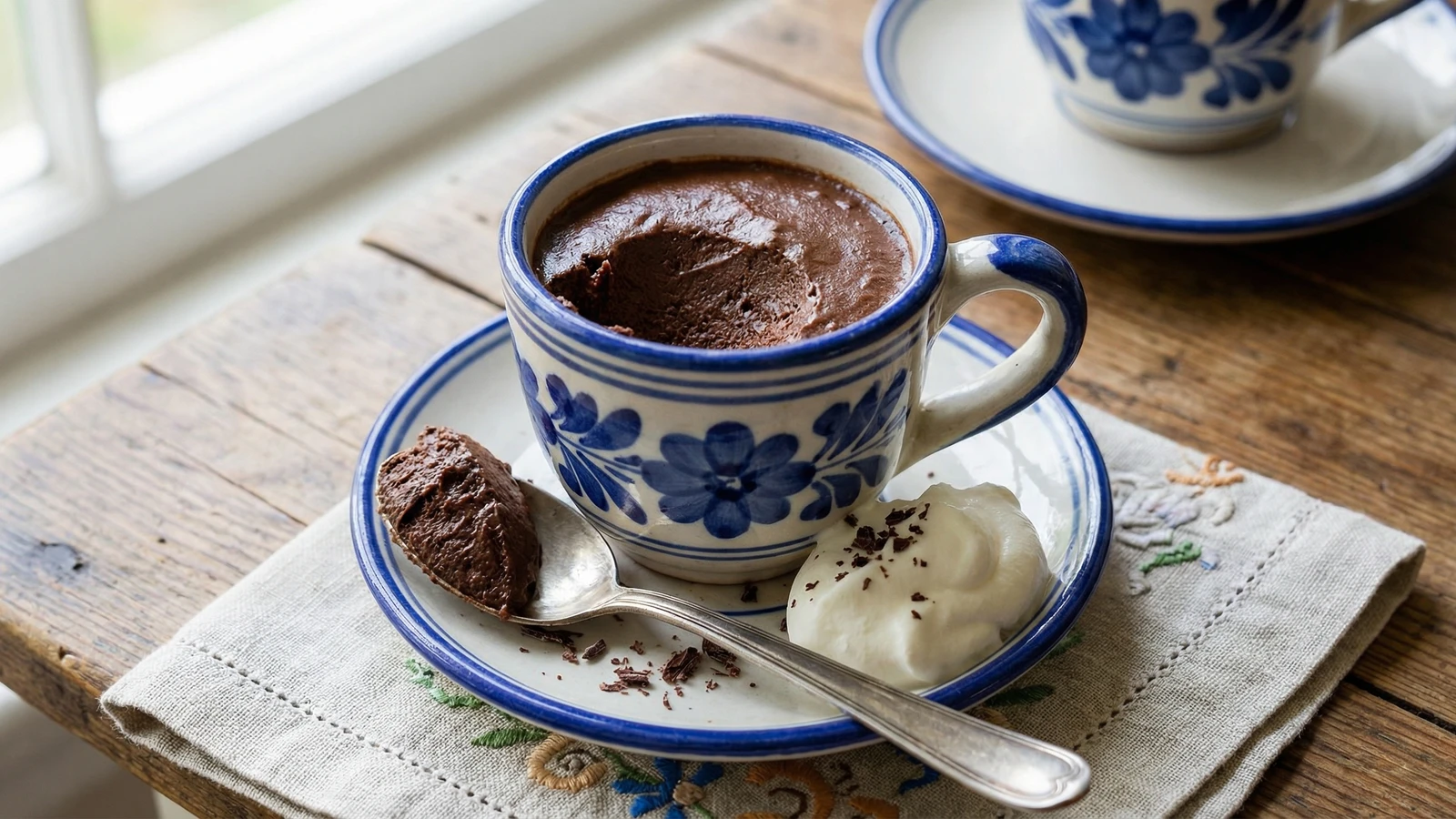
Mousse de Chocolate Português
Created by
The chocolate mousse of Portuguese dinner tables, dense with egg yolks in the convent tradition, dark and intense and absolutely unapologetic about its richness. This is not French mousse. This is ours.
Every Portuguese dinner party ends the same way. The table is littered with crumbs and wine glasses, the conversation has turned to family gossip, and someone brings out the mousse de chocolate.
This isn't the airy French mousse you find in restaurants. Portuguese mousse is denser, darker, almost truffle-like in its intensity. More egg yolks. More chocolate. More everything. It's the kind of dessert that makes you close your eyes with the first spoonful.
Avó Leonor made hers in small terracotta cups, the same ones she used for baked rice pudding. She'd whip it by hand with a wooden spoon, no electric mixer, her arm never tiring. "Bate, bate, bate," she'd say. Beat, beat, beat. The secret is in the beating.
The richness comes from our convent tradition. For centuries, Portuguese nuns used egg whites to starch their habits, leaving mountains of yolks that became the foundation of our most beloved sweets. That heritage lives in this mousse. When you taste the density, you're tasting history.
At Mesa da Avó, we serve this in mismatched vintage cups, each one different, each one with a story. Because mousse de chocolate isn't just dessert. It's the sweet full stop at the end of a meal, the moment when everyone sighs and says they couldn't possibly eat more, and then they do.
Portuguese mousse de chocolate reflects the doce conventual tradition, where surplus egg yolks from convent laundries (whites were used to starch religious habits) became the foundation of intensely rich sweets. While chocolate mousse itself is a 20th-century creation, the Portuguese instinct to add more yolks, more intensity, more soul connects directly to this centuries-old heritage of abundance born from resourcefulness.
The technique, the tradition, and the story behind every dish.
Discover Culinary AdvisorIngredients
dark chocolate (70% cacao)
Quantity
200g
chopped
eggs
Quantity
6 large
separated, at room temperature
caster sugar
Quantity
100g
unsalted butter
Quantity
60g
cut into cubes
strong espresso or coffee
Quantity
2 tablespoons
cooled
aguardente or brandy (optional)
Quantity
1 tablespoon
fine sea salt
Quantity
pinch
whipped cream (optional)
Quantity
for serving
chocolate shavings (optional)
Quantity
for serving
| Ingredient | Quantity |
|---|---|
| dark chocolate (70% cacao)chopped | 200g |
| eggsseparated, at room temperature | 6 large |
| caster sugar | 100g |
| unsalted buttercut into cubes | 60g |
| strong espresso or coffeecooled | 2 tablespoons |
| aguardente or brandy (optional) | 1 tablespoon |
| fine sea salt | pinch |
| whipped cream (optional) | for serving |
| chocolate shavings (optional) | for serving |
Equipment Needed
- •Heatproof bowl for melting chocolate
- •Medium pot for the bain-marie
- •Large mixing bowls (2, completely dry)
- •Whisk or electric hand mixer
- •Flexible spatula
- •6 small serving cups, ramekins, or vintage glasses (150ml capacity)
Instructions
- 1
Melt the chocolate
Set a heatproof bowl over a pot of barely simmering water. The bowl should not touch the water. Add the chopped chocolate and butter. Let them melt slowly, stirring occasionally with a spatula until smooth and glossy. Remove from heat and stir in the coffee and aguardente if using. Let it cool until warm but not hot. You should be able to touch the bottom of the bowl comfortably.
Patience with the chocolate. If it seizes from too much heat or a drop of water, you'll have to start over. Low heat, dry equipment, no rushing. - 2
Beat the yolks
In a large bowl, whisk the egg yolks with half the sugar until thick, pale, and doubled in volume. This takes 3 to 4 minutes by hand, longer if your arm is tired. The mixture should fall in thick ribbons when you lift the whisk. This is where the richness builds. Bate, bate, bate. The yolks need air.
- 3
Combine yolks and chocolate
Pour the warm (not hot) chocolate mixture into the yolks in a slow stream, folding gently as you go. Work in one direction, from the bottom up, rotating the bowl. The mixture should be uniform and glossy, dark as good earth. Set aside.
- 4
Whip the whites
In a clean, dry bowl, beat the egg whites with the salt until they hold soft peaks. Add the remaining sugar gradually, beating until the whites are glossy and hold firm peaks but aren't dry. They should look like satin, not cotton.
Any trace of yolk in your whites and they won't whip properly. Separate eggs one at a time over a small bowl first, then transfer whites to your mixing bowl. One broken yolk shouldn't ruin the whole batch. - 5
Fold everything together
Add one third of the whites to the chocolate mixture and fold vigorously to lighten. This first addition can be rough. Then add the remaining whites in two additions, folding gently each time. Use a spatula, cut through the center, sweep under and up, rotate the bowl. Stop the moment you no longer see white streaks. Overmixing is the enemy. Every extra fold costs you air.
- 6
Chill and serve
Divide the mousse among six small cups, ramekins, or vintage glasses. Cover loosely and refrigerate for at least 4 hours, preferably overnight. The mousse needs time to set and the flavors to deepen. Serve cold with a spoonful of whipped cream and chocolate shavings if you like. Or serve it bare, the way Avó Leonor did, letting the chocolate speak for itself.
Chef Tips
- •Room temperature eggs are not optional. Cold eggs don't whip properly and cold yolks seize when they hit warm chocolate. Take them out of the fridge an hour before you start.
- •Use the best chocolate you can afford. You're eating it almost straight, with nothing to hide behind. Portuguese chocolate from brands like Regina or Imperial works beautifully, but any 70% cacao with good flavor will do.
- •The coffee doesn't make the mousse taste like coffee. It deepens the chocolate, makes it more itself. A Portuguese tradition that works. Trust it.
- •This mousse is denser than what you might expect. That's correct. We use more yolks than the French. More yolks means more richness, more silk, more history. Don't let anyone tell you it's wrong.
Advance Preparation
- •The mousse must chill for at least 4 hours, but overnight is better. Plan accordingly.
- •It keeps beautifully in the refrigerator for up to 3 days, covered. The flavor deepens as it sits.
- •Bring the serving cups out 10 minutes before serving. Slightly less cold lets the chocolate flavor bloom.
Frequently Asked Questions
Nutrition Information
1 serving (about 115g)
Where cooking meets culture.
Culinary mentorship, cultural storytelling, and the editorial depth that makes cooking meaningful.
Explore Culinary Advisor