Culinary Advisor
A cooking platform built around craft, culture, and the stories behind what we eat.
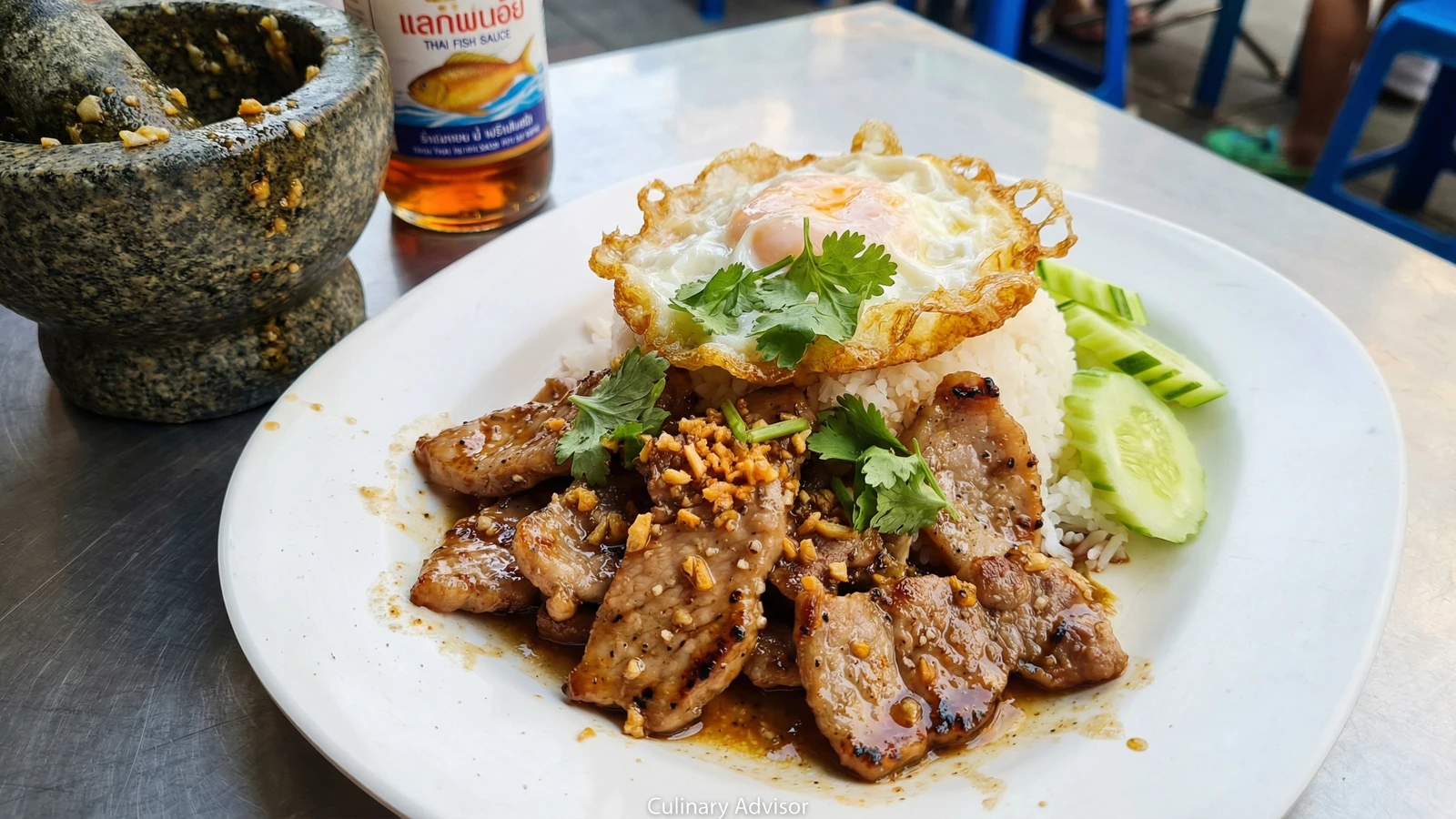
Garlic Pepper Pork Stir-Fry (Moo Pad Gra Tiem Prik Thai)
Created by
Three ingredients in the mortar, thirty seconds in the wok. This is the kreung tam stripped to its bones: garlic, white pepper, cilantro root. The first paste every Thai cook learns, and the one that teaches you everything.
Every kreung tam starts here. Garlic, white peppercorns, cilantro root. Three ingredients. That's it. Pound them together in the krok until they become a rough, fragrant paste, and you've built the foundation that holds up half of Central Thai wok cooking.
Ajarn always said: "If you understand the simplest paste, you understand the system." Gra tiem prik thai is that paste. It's the skeleton. Green curry paste is the same skeleton with fifteen more ingredients layered on top. But the bones are always garlic, always pepper, always cilantro root. Learn this one and the rest makes sense.
Here's why it works. Garlic provides pungent heat that mellows and sweetens in hot oil. White peppercorns give a clean, sharp bite that's completely different from black pepper (which has the outer hull intact and tastes earthier). Cilantro root, the part most people throw away, delivers a deep, musky herbal flavor that neither the leaves nor the stems can replicate. When you pound these three together, the cell walls rupture. The allicin from the garlic, the piperine from the pepper, and the essential oils from the cilantro root merge into something none of them are alone. That's the kreung tam at work. A blender chops them. A mortar marries them.
The wok does the rest. Screaming hot oil, paste in first, pork seared on contact, fish sauce and oyster sauce splashed in at the end. The whole thing takes less time than ordering delivery. This is the dish I teach on the first day of every Fai Thai workshop, because if you can pound this paste and fire a wok properly, you can cook Thai food. Principles, not recipes.
Gra tiem prik thai (กระเทียมพริกไทย) is one of the oldest flavor bases in Central Thai cooking, predating the arrival of chili peppers from the Americas in the 16th century. Before chilies, white and black peppercorns were the primary source of heat in Siamese cuisine. The three-ingredient paste of garlic, peppercorn, and cilantro root remains the structural foundation from which more complex kreung tam are built, a fact Ajarn McDang emphasizes as evidence that Thai cuisine is a principled system, not a random collection of flavors.
The technique, the tradition, and the story behind every dish.
Discover Culinary AdvisorIngredients
pork loin or pork shoulder
Quantity
300g
sliced 1/4 inch thick against the grain
garlic
Quantity
1 head (about 10 cloves)
peeled
white peppercorns (prik thai khao)
Quantity
1 teaspoon
cilantro roots (rak pak chi)
Quantity
4
cleaned and trimmed
vegetable oil
Quantity
2 tablespoons
fish sauce (nam pla)
Quantity
1 tablespoon
oyster sauce
Quantity
1 tablespoon
dark soy sauce (si ew dam)
Quantity
1/2 teaspoon
palm sugar (nam tan pip) or granulated sugar
Quantity
1 teaspoon
chicken stock or water
Quantity
2 tablespoons
steamed jasmine rice
Quantity
for serving
fried egg
Quantity
1 per serving
fresh cilantro leaves (optional)
Quantity
for garnish
sliced cucumber (optional)
Quantity
for serving
| Ingredient | Quantity |
|---|---|
| pork loin or pork shouldersliced 1/4 inch thick against the grain | 300g |
| garlicpeeled | 1 head (about 10 cloves) |
| white peppercorns (prik thai khao) | 1 teaspoon |
| cilantro roots (rak pak chi)cleaned and trimmed | 4 |
| vegetable oil | 2 tablespoons |
| fish sauce (nam pla) | 1 tablespoon |
| oyster sauce | 1 tablespoon |
| dark soy sauce (si ew dam) | 1/2 teaspoon |
| palm sugar (nam tan pip) or granulated sugar | 1 teaspoon |
| chicken stock or water | 2 tablespoons |
| steamed jasmine rice | for serving |
| fried egg | 1 per serving |
| fresh cilantro leaves (optional) | for garnish |
| sliced cucumber (optional) | for serving |
Equipment Needed
- •Heavy granite mortar and pestle (krok), at least 6 inches diameter
- •Wok (carbon steel preferred)
- •Wok spatula
Instructions
- 1
Pound the kreung tam
Put the white peppercorns in the mortar first. They're the hardest ingredient and need to be cracked before anything else goes in. Pound until they're broken into coarse fragments, not dust. Add the cilantro roots and pound them into the pepper until fibrous and bruised. Then the garlic. Pound everything together into a rough, wet paste. You should see chunks of garlic. You should smell the peppercorns burning your nostrils. If the paste is smooth and uniform, you went too far. Rustic is correct.
Cilantro root is not cilantro stem. The root is the thick, pale base attached below the stems. It has a deep, earthy flavor that the leaves and stems don't have. If your grocery store sells cilantro with roots attached, that's gold. Wash them well, there's dirt in the crevices. If you truly cannot find cilantro root, use the bottom two inches of the stems, but know that you're losing depth. - 2
Marinate the pork
Take about a third of the pounded paste and rub it into the sliced pork along with half the fish sauce. Let it sit for ten minutes while you get everything else ready. This isn't optional. The paste needs time to penetrate the meat. The fish sauce seasons the pork from the inside while the garlic and pepper coat the surface. Ten minutes is the minimum. Thirty is better if you have it.
Slice the pork against the grain, about 1/4 inch thick. Too thin and it'll dry out. Too thick and it won't sear fast enough to get wok hei before the inside overcooks. Pork shoulder has more fat than loin and stays juicier, but either works. - 3
Fire the wok
Get the wok screaming hot over your highest flame. Add the oil and wait until it shimmers and just barely smokes. Drop the remaining two-thirds of the gra tiem prik thai paste into the oil. It should explode with noise. Stir it for five seconds, just enough for the garlic to start turning golden. The raw peppercorn smell shifts to something nutty and warm. That's the moment.
The paste goes in the wok before the protein. This is the rule for all Thai stir-fries that use a paste. The oil fries the paste, blooming the aromatics and building the flavor base. Protein on top of raw paste is a mistake you'll taste. - 4
Sear the pork
Spread the marinated pork slices across the wok in a single layer. Don't touch them for thirty seconds. Let the wok do its job. You want the pork to make hard contact with the metal so it chars and gets color. Wok hei lives in that moment of stillness. Then flip and sear the other side. Another thirty seconds. The pork should be golden-brown on the edges with bits of fried garlic clinging to the surface.
- 5
Season and finish
Add the remaining fish sauce, oyster sauce, dark soy sauce, sugar, and the chicken stock. Toss everything together. The sauces will hit the hot wok and reduce almost instantly into a glossy, slightly sticky coating on the pork. Fifteen seconds of tossing, that's all. Taste. It should be savory and peppery with a faint sweetness underneath. The fish sauce provides the salt. The oyster sauce gives body and gloss. The sugar just rounds the edges. If it needs more salt, a splash more fish sauce. Never table salt. Plate over jasmine rice. Fried egg on top. Cilantro leaves and sliced cucumber on the side. Done.
Chef Tips
- •This is the first kreung tam every Thai cook should learn. Three ingredients: garlic, white peppercorns, cilantro root. Master this paste and you understand the foundation that every other Thai paste is built on. Green curry paste? Same skeleton plus chilies, lemongrass, galangal, shrimp paste, kaffir lime zest. But the bones are gra tiem prik thai. Ajarn always said: start here.
- •White pepper and black pepper are not interchangeable. They come from the same plant, but white peppercorns have the outer hull removed, giving a sharper, cleaner heat that defines Central Thai cooking. Black pepper is earthier, more complex, and belongs in different food. Use white. It's the pepper of the Thai kitchen.
- •The amount of garlic in this dish is not a typo. A full head. Ten cloves. Gra tiem means garlic. It's in the name. The garlic fries in the oil, clings to the pork, and becomes sweet and nutty on the surface. If you're worried about garlic breath, you're cooking the wrong dish.
- •Oyster sauce quality matters here because you're using so few ingredients. Cheap oyster sauce is mostly corn syrup with artificial color. Look for brands where oyster extract is the first ingredient (Megachef and Maekrua are solid). The good stuff tastes like concentrated shellfish. The bad stuff tastes like sweet brown paint.
Advance Preparation
- •The gra tiem prik thai paste can be pounded hours ahead and kept covered at room temperature, or refrigerated overnight. The flavors actually deepen with a little time.
- •Pork can be marinated with the paste and fish sauce for up to 4 hours in the fridge. Longer than that and the fish sauce starts to cure the meat too aggressively.
- •Have jasmine rice cooked and fried eggs ready before you touch the wok. The stir-fry is done in under two minutes once the wok is hot. It will not wait for you.
Frequently Asked Questions
Nutrition Information
1 serving (about 390g)
Where cooking meets culture.
Culinary mentorship, cultural storytelling, and the editorial depth that makes cooking meaningful.
Explore Culinary Advisor