Culinary Advisor
A cooking platform built around craft, culture, and the stories behind what we eat.
Melting Moments
Created by Chef Thomas
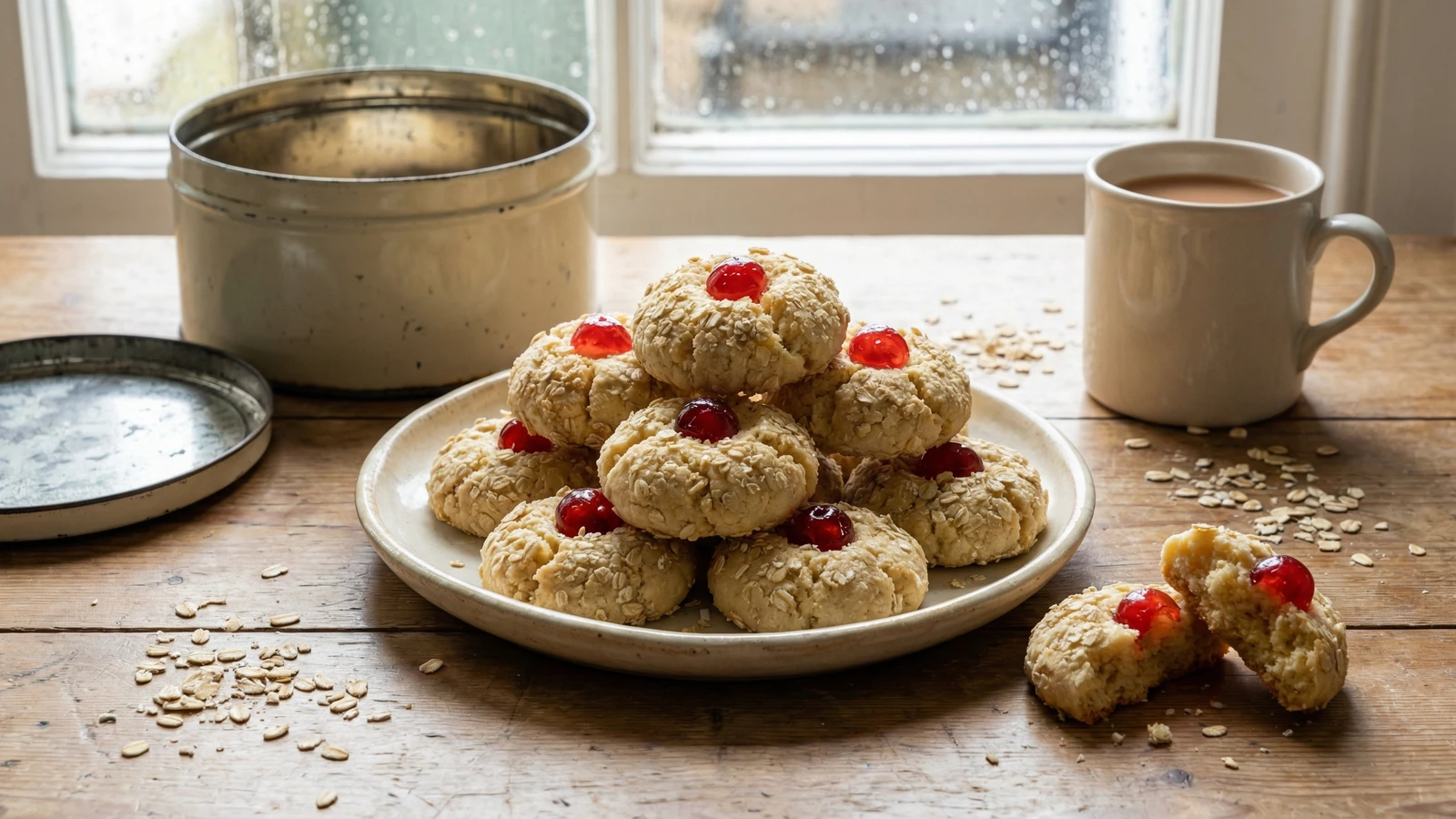
A small, oat-jacketed biscuit with a cherry on its head, the kind of thing you make on a wet afternoon when the kettle has been on twice already and the radio is muttering away in the corner.
There's a particular afternoon these are for. Outside is grey, the rain has set in for the day, and you've already had two cups of tea without anything to go with them. The biscuit tin is empty. Nobody is coming round. You make these anyway, because making them is the point.
Melting Moments come from the old Be-Ro flour book, the small red one that lived in everybody's mother's kitchen drawer. I have one somewhere myself, the pages soft with use and a little spotted with butter from years of being open on the counter. The recipe inside hasn't really changed in a hundred years, and there's a reason for that. It works. It uses what's already in the cupboard. It asks almost nothing of you and gives back a biscuit that does exactly what its name promises.
The trick is the oats. They don't go in the dough; they go round it, a rough little jacket that crisps in the oven and gives you the contrast that makes the whole thing work. Crunchy outside, tender within, and a glace cherry on top that's mostly there for the look of the thing. We're only making biscuits. But there are few better feelings than carrying a plate of these through to someone in the next room, still warm, on a wet Wednesday in November.
I wrote it down in the notebook the first time I made them as an adult, after years of not thinking about them at all. The note just says: "Be-Ro book. Rain. The right biscuit." That's the whole entry. Some things don't need more explaining than that.
The technique, the tradition, and the story behind every dish.
Discover Culinary AdvisorIngredients
unsalted butter
Quantity
150g
softened, but not greasy
caster sugar
Quantity
100g
large egg yolk
Quantity
1
vanilla extract
Quantity
1/2 teaspoon
self-raising flour
Quantity
200g
fine sea salt
Quantity
pinch
rolled oats
Quantity
75g
the proper porridge sort, not jumbo
glace cherries
Quantity
9
halved
| Ingredient | Quantity |
|---|---|
| unsalted buttersoftened, but not greasy | 150g |
| caster sugar | 100g |
| large egg yolk | 1 |
| vanilla extract | 1/2 teaspoon |
| self-raising flour | 200g |
| fine sea salt | pinch |
| rolled oatsthe proper porridge sort, not jumbo | 75g |
| glace cherrieshalved | 9 |
Equipment Needed
- •Two flat baking trays
- •Baking parchment
- •Mixing bowl and wooden spoon
- •Wire cooling rack
Instructions
- 1
Cream the butter and sugar
Set the oven to 180C/160C fan and line two baking trays with parchment. Put the soft butter and sugar into a bowl and beat them together until pale and fluffy. A wooden spoon will do this perfectly well; you don't need a machine. You're looking for a colour change, from yellow to almost ivory, and a texture that holds a soft peak when you lift the spoon.
The butter needs to be properly soft. Not melted, not greasy, but soft enough that your finger leaves an easy dent. Take it out of the fridge an hour before you want to bake. - 2
Add yolk and vanilla
Beat in the egg yolk and the vanilla. The mixture will look briefly curdled and then come back together. Don't worry about it. The flour will tidy everything up.
- 3
Bring in the flour
Sift in the flour and salt, then fold gently with the spoon until you have a soft dough. Stop the moment the flour disappears. Overworking it now will give you tough biscuits, and the whole point of a melting moment is that it shouldn't be tough at all.
- 4
Shape and roll in oats
Tip the oats into a shallow bowl. Take pieces of dough about the size of a walnut, roll them lightly between your palms into balls, then drop them into the oats and turn them about until they're properly coated. It should look like the dough has put on a tweed coat. Place them on the trays with a generous gap between each, because they spread.
Cold hands help. If the dough starts sticking to your palms, run your wrists under the tap for a moment and dry them. A small thing, but it makes the rolling much easier. - 5
Crown with cherries
Press a cherry half, cut side down, gently into the top of each ball. Don't squash the dough flat. Just enough pressure to anchor the cherry so it doesn't go skidding off in the oven.
- 6
Bake until pale gold
Bake for twelve to fifteen minutes. You're not after deep brown. The biscuits should be the colour of pale honey at the edges and still look slightly underdone in the middle. Trust this. They firm as they cool, and an extra minute in the oven turns a melting moment into something altogether crisper and less generous.
- 7
Cool on the tray
Leave them on the trays for five minutes after they come out. They're fragile while warm and will break if you try to move them too soon. Then lift them gently onto a wire rack to finish cooling. The kettle goes on now. This is not optional.
Chef Tips
- •Use proper rolled porridge oats, not the big jumbo flakes and not the powdery instant sort. The medium ones cling to the dough best and crisp up beautifully in the oven without going leathery.
- •Glace cherries are not fashionable and I don't care. They're the right thing here. If you genuinely can't bear them, a half-pecan or a blanched almond does the job, but you're making something slightly different and I'd rather you went with the cherry.
- •These keep in an airtight tin for about four days, though they're at their best on the first and second. After that they're still good with a cup of tea, just a little less melting in the moment, if you take my meaning.
- •If you want to make them feel a bit more grown up, add the finely grated zest of an orange to the dough along with the vanilla. It lifts the cherry in a way that feels almost intentional.
Advance Preparation
- •The dough can be made a day ahead and kept covered in the fridge. Let it sit out for twenty minutes before rolling, otherwise it cracks.
- •Unbaked, oat-rolled balls freeze well on a tray. Once frozen solid, tip them into a bag and bake straight from the freezer, adding a couple of minutes to the cooking time.
Frequently Asked Questions
Nutrition Information
1 serving (about 33g)
Where cooking meets culture.
Culinary mentorship, cultural storytelling, and the editorial depth that makes cooking meaningful.
Explore Culinary Advisor