Culinary Advisor
A cooking platform built around craft, culture, and the stories behind what we eat.
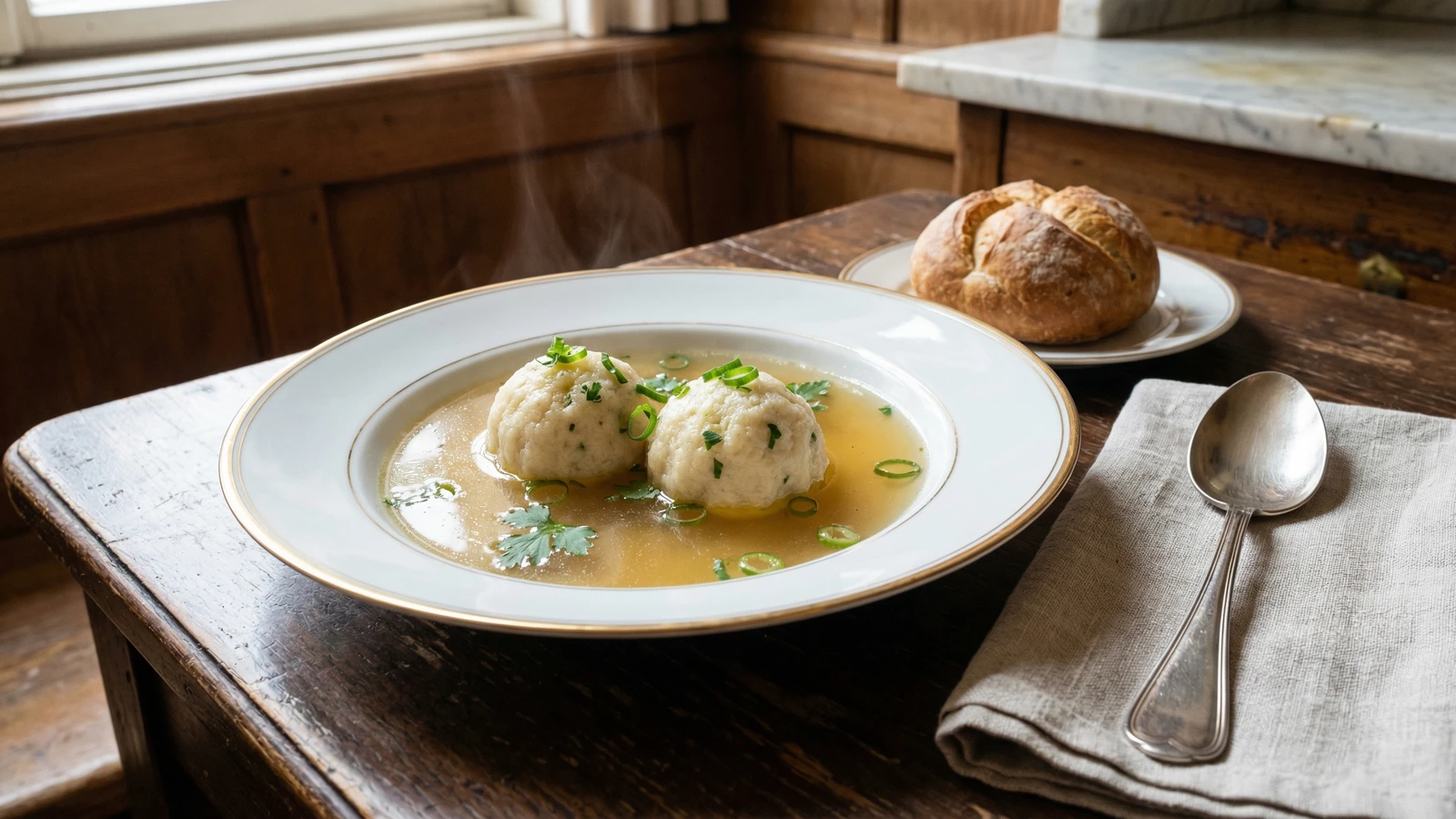
Markknödelsuppe
Created by Chef Elsa
Silky bone marrow dumplings poached in clear golden Rindssuppe, the kind of first course that makes the table go quiet for a moment before someone says 'this is real soup.'
Gretel always said you can tell everything about an Austrian cook from their broth. Not from their Torten, not from their Schnitzel. The broth. Because a good clear Rindssuppe takes patience and attention and honest ingredients, and you can't fake any of those things. Markknödelsuppe is what happens when that broth meets the richest Einlage in the Austrian kitchen: dumplings made from beef bone marrow.
I remember watching Gretel scoop marrow from bones in my grandmother Eva's kitchen in Deal. She'd push it out with her thumb like it was the most natural thing in the world, mash it with a fork, work in breadcrumbs and egg and a snowfall of chopped parsley. The Knödel went into the broth raw and came out ten minutes later, swollen and silky and impossibly rich. The marrow melts into the dumpling as it poaches, so what you taste is not fat but a deep, round, beefy warmth that coats your mouth and makes you close your eyes.
This is not a difficult soup. It asks for good bones, a few hours of simmering, and a light hand with the Knödel. The technique is gentle. You don't boil, you don't rush, you don't try to make it complicated. Austrians have been serving Markknödel in clear broth for generations, and the recipe hasn't changed because it doesn't need to. The marrow does all the talking. Your job is to give it a stage worthy of the performance.
At my restaurant in Salzburg, I serve Markknödelsuppe as a first course when the weather turns cold. Two golden Knödel floating in broth so clear you can see the bottom of the bowl. Fresh chives scattered on top. Nothing else. When you get it right, it's one of the most satisfying things you can put in front of a person.
Markknödel belong to Vienna's vast tradition of Suppeneinlagen, the soup garnishes that transform a bowl of clear broth into a named dish. The Viennese developed dozens of these, from Leberknödel (liver) to Griesnockerl (semolina) to Frittaten (pancake strips), each turning the same base broth into something distinct. Bone marrow dumplings sit near the top of the hierarchy because marrow was considered a luxury ingredient. In 19th-century Viennese Bürgerlich kitchens, the choice of Einlage signaled the importance of the occasion: Griesnockerl for Tuesday, Markknödel for when you wanted to impress.
The technique, the tradition, and the story behind every dish.
Discover Culinary AdvisorIngredients
beef marrow bones (for broth)
Quantity
1.5 kg
cut into 8cm lengths
beef shin or chuck
Quantity
500g
cold water
Quantity
3 liters
carrots
Quantity
2 medium
peeled
parsnip
Quantity
1
peeled
celeriac
Quantity
1/4
peeled
onion
Quantity
1 medium
halved and charred
leek
Quantity
1
cleaned and halved
whole black peppercorns
Quantity
6
bay leaves
Quantity
2
fresh parsley (for broth)
Quantity
3 sprigs
salt (for broth)
Quantity
1 tablespoon
beef bone marrow (for Knödel)
Quantity
150g
scooped from approximately 4 marrow bones, brought to room temperature
egg
Quantity
1 large
fine dry breadcrumbs (Semmelbrösel)
Quantity
80g
fresh flat-leaf parsley (for Knödel)
Quantity
2 tablespoons
very finely chopped
nutmeg
Quantity
1/4 teaspoon
freshly grated
salt and white pepper
Quantity
to taste
fresh chives
Quantity
for garnish
finely cut
| Ingredient | Quantity |
|---|---|
| beef marrow bones (for broth)cut into 8cm lengths | 1.5 kg |
| beef shin or chuck | 500g |
| cold water | 3 liters |
| carrotspeeled | 2 medium |
| parsnippeeled | 1 |
| celeriacpeeled | 1/4 |
| onionhalved and charred | 1 medium |
| leekcleaned and halved | 1 |
| whole black peppercorns | 6 |
| bay leaves | 2 |
| fresh parsley (for broth) | 3 sprigs |
| salt (for broth) | 1 tablespoon |
| beef bone marrow (for Knödel)scooped from approximately 4 marrow bones, brought to room temperature | 150g |
| egg | 1 large |
| fine dry breadcrumbs (Semmelbrösel) | 80g |
| fresh flat-leaf parsley (for Knödel)very finely chopped | 2 tablespoons |
| nutmegfreshly grated | 1/4 teaspoon |
| salt and white pepper | to taste |
| fresh chivesfinely cut | for garnish |
Equipment Needed
- •Large stockpot (8-liter minimum)
- •Fine-mesh sieve and muslin cloth
- •Mixing bowl
- •Box grater or microplane (for nutmeg)
- •Slotted spoon
Instructions
- 1
Start the Rindssuppe
Place the beef marrow bones and shin in your largest pot. Cover with three liters of cold water. This must be cold. Hot water seals the proteins inside the bone and the meat, which means they never release into the liquid, and you end up with pale, thin broth that tastes like nothing much. Cold water coaxes everything out slowly. Bring the pot to a gentle simmer over medium heat. Gray, foamy scum will rise to the surface. Skim it patiently, again and again, until the foam turns white and fine. This takes fifteen to twenty minutes and you cannot skip it. Every bit of scum you leave behind is cloudiness in your finished soup.
Gretel always said the difference between phony soup and real soup is patience. Real soup starts cold and takes its time. If you're in a hurry, make something else. - 2
Add the soup vegetables
Once the scum is cleared, add the carrots, parsnip, celeriac, charred onion, leek, peppercorns, bay leaves, parsley sprigs, and salt. The charred onion is doing real work here. It gives the broth that deep golden color you see in every proper Austrian soup bowl. Cut it in half and hold the cut side directly over a gas flame or under the hottest grill you have until it's nearly black. Reduce the heat until the surface of the broth barely trembles. You want lazy, occasional bubbles, not a rolling boil. A rolling boil makes beef broth cloudy and greasy. Let it simmer uncovered for two to two and a half hours.
- 3
Extract and prepare the marrow
While the broth simmers, prepare your marrow. Take four fresh marrow bones (separate from the broth bones) and push the raw marrow out with your thumb or the handle of a wooden spoon. If the bones are cold from the fridge, soak them in warm water for ten minutes first and the marrow will slide right out. Place the marrow in a bowl and let it come to room temperature. It should be soft and spreadable, like cold butter that's been sitting on the counter for an hour. If it's still stiff, it won't incorporate into the mixture and you'll end up with greasy pockets in your Knödel.
Ask your butcher to cut the marrow bones lengthwise for you. This makes extracting the marrow much easier and you won't feel like you're wrestling a bone across your kitchen counter. - 4
Mix the Knödel mass
Mash the softened marrow with a fork until it's smooth and creamy, with no lumps remaining. Beat in the egg until fully combined. Add the Semmelbrösel, finely chopped parsley, grated nutmeg, a good pinch of salt, and a few grinds of white pepper. White pepper, not black. Black pepper leaves dark specks in the Knödel that look like dirt. Mix everything together gently but thoroughly. The mixture should hold together when you press it but still feel soft and slightly sticky. If it feels too loose, add another tablespoon of breadcrumbs. If it's too stiff, the Knödel will be heavy. Cover the bowl and refrigerate for thirty minutes. The resting is not optional. The breadcrumbs need time to absorb the moisture from the marrow and egg, and the cold firms everything up so you can shape the Knödel without them falling apart in your hands.
- 5
Shape the Markknödel
Wet your hands with cold water. Take a walnut-sized portion of the mixture and roll it gently between your palms into a smooth ball. Don't press too hard. You want the Knödel compact enough to hold together in the broth but not packed tight like a meatball. They should be about three centimeters across, roughly the size of a large cherry tomato. You're aiming for six to eight Knödel from this mixture. Set them on a plate as you go, not touching each other, and keep your hands wet between each one to prevent sticking.
If you're nervous about the Knödel holding together, do a test. Poach one in simmering salted water for a few minutes. If it falls apart, your mixture needs another tablespoon of breadcrumbs. Better to test one than lose all eight. - 6
Strain the broth
Strain the finished broth through a fine-mesh sieve lined with muslin or a clean kitchen cloth into a clean pot. Press the cloth gently but don't squeeze. Squeezing forces cloudy particles through and ruins two hours of patient simmering. The broth should be clear and deeply golden, the colour of dark honey held up to the light. Taste it. It should taste like beef, clean and rich. If it's bland, add salt in small increments until the flavor lifts. Discard the spent vegetables and bones. Bring the strained broth back to a very gentle simmer.
- 7
Poach the Markknödel
Carefully lower the Knödel into the barely simmering broth, one at a time. Do not let the broth boil. A hard boil will tear the Knödel apart and you'll have expensive marrow-flavored breadcrumb soup instead of the beautiful clear broth with whole dumplings you're after. Poach them gently for twelve to fifteen minutes. They'll sink first, then slowly rise to the surface as they cook through. When they float and have swelled slightly, they're done. They should feel firm on the outside but give a little when you press them with a spoon.
- 8
Serve the soup
Ladle the clear broth into warmed soup plates. Use a slotted spoon to place one or two Markknödel in each bowl. Scatter fresh chives over the surface. The golden broth, the pale dumplings, the green chives. It looks simple because it is simple. That's the whole point. Serve immediately. Mahlzeit!
Chef Tips
- •Buy your marrow bones the day before and ask the butcher to cut them lengthwise. Soak them in cold salted water overnight in the fridge. This draws out any blood and impurities, and the marrow will be clean and ivory-colored when you scoop it out.
- •The nutmeg must be freshly grated. Pre-ground nutmeg tastes like dust. You need the sharp, warm, almost peppery hit of a whole nutmeg run across a fine grater. A quarter teaspoon sounds like nothing, but it lifts the entire Knödel.
- •If your broth is good but not great, float a small piece of raw marrow in each bowl as you ladle. It will melt into the hot liquid and give the broth an extra layer of richness. This is the kind of thing you'd never see in a recipe book, but Gretel did it every time.
- •Semmelbrösel means fine dry breadcrumbs, not the coarse panko you see everywhere now. If you can't find proper Semmelbrösel, take a stale Semmel or white bread roll and grate it on the fine side of a box grater, then dry the crumbs in a low oven for ten minutes.
Advance Preparation
- •The Rindssuppe can be made three days ahead and refrigerated. The fat will solidify on top and act as a seal. Remove it before reheating. The broth often tastes even better the next day.
- •The Knödel mixture can be made and shaped up to six hours ahead and refrigerated on a plate covered with cling film. Poach them just before serving.
- •Do not poach the Knödel ahead of time. They lose their silky texture when reheated and become dense. They take fifteen minutes in the broth. Plan for that.
Frequently Asked Questions
Nutrition Information
1 serving (about 450g)
Where cooking meets culture.
Culinary mentorship, cultural storytelling, and the editorial depth that makes cooking meaningful.
Explore Culinary Advisor