Culinary Advisor
A cooking platform built around craft, culture, and the stories behind what we eat.
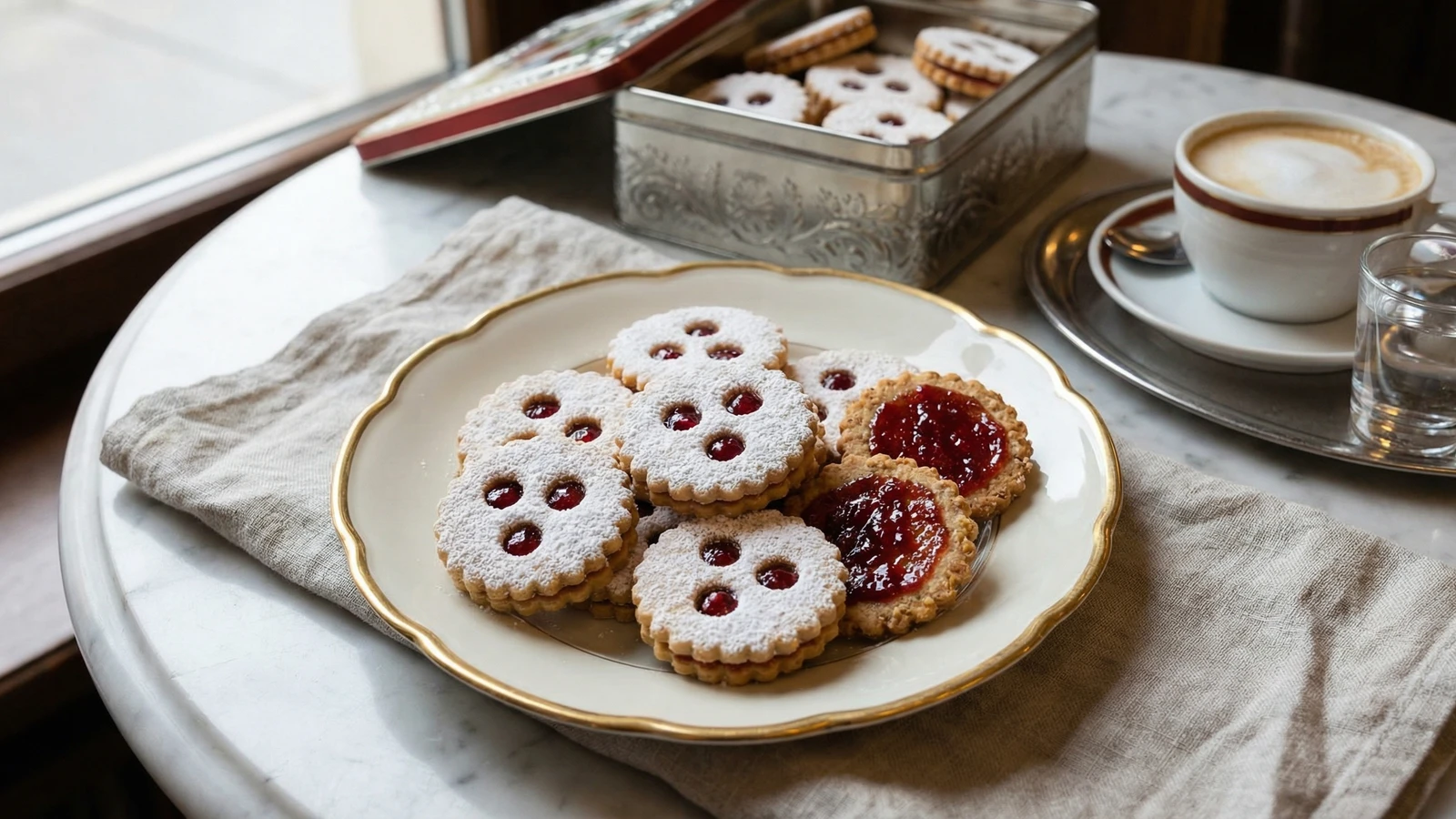
Linzer Augen
Created by Chef Elsa
Nutty, spiced sandwich cookies with three tiny windows of ruby red currant jam peeking through a snowfall of powdered sugar, the jewels of every Austrian Christmas tin.
In my grandmother Eva's kitchen in Kent, the Christmas tins came out in late November. Gretel always said you couldn't call it Advent without at least five kinds of Weihnachtskekse, and Linzer Augen were always first. They were her test batch, the cookie that told her whether this year's ground almonds were fresh enough and whether the butter was behaving.
Linzer Augen means 'Linzer eyes,' and the name is literal. You cut three small holes in the top cookie, dust it with powdered sugar, then sandwich it over a layer of ruby red Ribiselmarmelade, the sharp, jewel-bright currant jam that is the only correct filling. When you're done, three little windows stare up at you from a field of white, and the red underneath looks like something precious glimpsed through frosted glass. They're the most beautiful cookies in any Austrian tin, and they know it.
The dough is a close cousin of Linzer Torte dough: ground almonds worked into butter and flour with cinnamon, cloves, and lemon zest. It's sandy and fragile and wants to be handled as little as possible. If you've made shortbread, you understand the principle. Cold butter. Light hands. Rest the dough before you roll it. The nuts make it tender but also make it crack if you rush. Don't rush. These are Christmas cookies. You have all of Advent.
Linzer Augen belong to the same family as the Linzer Torte, which has a claim to being the oldest named cake in the world, with recipes dating to the mid-17th century. The cookie version adapted the Torte's signature nut dough and currant jam filling into something small enough for a Keksdose, the cookie tin that anchors Austrian Christmas baking. Linz, the capital of Upper Austria, lends its name to the entire family of almond-spiced, jam-filled pastries, and locals will tell you that no other city's Ribiselmarmelade tastes quite right for the job.
The technique, the tradition, and the story behind every dish.
Discover Culinary AdvisorIngredients
plain flour
Quantity
200g
ground almonds (unblanched)
Quantity
100g
unsalted butter
Quantity
130g
cold and cubed
powdered sugar
Quantity
80g, plus extra for dusting
Vanillezucker (vanilla sugar)
Quantity
1 packet (8g)
egg yolk
Quantity
1 large
lemon
Quantity
1
zested
ground cinnamon
Quantity
1/2 teaspoon
ground cloves
Quantity
1/4 teaspoon
salt
Quantity
pinch
Ribiselmarmelade (red currant jam)
Quantity
150g
| Ingredient | Quantity |
|---|---|
| plain flour | 200g |
| ground almonds (unblanched) | 100g |
| unsalted buttercold and cubed | 130g |
| powdered sugar | 80g, plus extra for dusting |
| Vanillezucker (vanilla sugar) | 1 packet (8g) |
| egg yolk | 1 large |
| lemonzested | 1 |
| ground cinnamon | 1/2 teaspoon |
| ground cloves | 1/4 teaspoon |
| salt | pinch |
| Ribiselmarmelade (red currant jam) | 150g |
Equipment Needed
- •Rolling pin
- •5cm fluted round cookie cutter
- •Small round cutter or piping tip (about 1cm) for the 'eyes'
- •Fine-mesh sieve for dusting
- •Two baking trays
- •Parchment paper
- •Wire cooling rack
Instructions
- 1
Make the Linzer dough
Combine the flour, ground almonds, cinnamon, cloves, and salt in a large bowl. Add the cold cubed butter and work it in with your fingertips until the mixture resembles coarse sand. You want flat little flakes of butter distributed through the dry ingredients, not a smooth paste. Add the powdered sugar, Vanillezucker, egg yolk, and lemon zest. Bring the dough together quickly with your hands, pressing it into a flat disc. Stop the moment it holds together. Overworking this dough activates the gluten and you'll lose the sandy, crumbly texture that makes a Linzer cookie what it is.
Use unblanched almonds if you can find them. The skins give the dough a warmer, nuttier flavor and those little brown flecks are part of how Linzer Augen are supposed to look. - 2
Rest the dough
Wrap the dough disc tightly in cling film and refrigerate for at least one hour. This is not a suggestion you can skip. The butter needs to firm up completely so the cookies hold their shape when cut, and the dough needs to relax so it rolls without cracking. If you try to roll warm Linzer dough, it will stick to everything and fall apart when you lift it. Patience now saves frustration later.
You can make the dough the day before and refrigerate overnight. If it's very firm the next morning, let it sit at room temperature for ten minutes before rolling. It should give slightly when you press it with your thumb. - 3
Roll and cut the cookies
Preheat your oven to 170°C (340°F). Line two baking trays with parchment. Lightly flour your work surface and roll the dough to about three millimeters thick. This is thinner than you might expect for a cookie, but it needs to be delicate. Cut rounds with a 5cm fluted cutter. For half the rounds, use a small cutter or the back of a piping tip to punch three tiny holes in a triangle pattern. These are the 'eyes.' Gather the scraps gently, press them together, chill briefly, and re-roll once. The second re-roll will be tougher in texture, so use those as bottoms.
If the dough softens and sticks while you're cutting, slide the whole sheet onto a tray and pop it back in the fridge for ten minutes. Working in batches is better than fighting warm dough. - 4
Bake until just golden
Transfer the cut rounds carefully to the lined trays, spacing them about two centimeters apart. They won't spread much, but they need air around them. Bake for 10 to 12 minutes, rotating the trays halfway through. You're looking for the palest golden color at the edges. The centers should still look almost underdone. These cookies firm up considerably as they cool, and if you bake them until they look done in the oven, they'll be dry and crumbly by the time you fill them. Pull them slightly early. Trust the carry-over.
The tops with the cut-out holes bake faster than the solid bottoms because there's less dough. Watch them carefully. You may need to pull the tops out a minute earlier. - 5
Cool completely
Let the cookies cool on the trays for five minutes, then transfer to a wire rack. Don't touch them while they're hot. They're fragile when warm and will break in your hands. Once they've cooled to room temperature and feel firm and dry to the touch, they're ready to assemble. Not before.
- 6
Dust the tops
Take only the top cookies, the ones with the three little holes, and lay them face-up on a sheet of parchment. Dust them generously with powdered sugar through a fine sieve. Be generous. You want a proper snowfall, not a light frost. The contrast between the white sugar and the red jam beneath is the whole beauty of these cookies. Set them aside.
- 7
Fill and assemble
Warm the Ribiselmarmelade gently in a small saucepan, stirring until it loosens. If it has seeds, press it through a sieve. You want it smooth and spreadable but not hot. Spread a thin, even layer of jam onto each bottom cookie, about half a teaspoon per cookie. Go right to the edges. Then carefully place a sugared top onto each jam-covered bottom and press down very gently. The jam should peek through the three little eyes, ruby red against white. Let them set for an hour before packing.
Ribiselmarmelade is the correct jam for Linzer Augen. Its tartness cuts through the rich, buttery dough. If you truly cannot find red currant jam, a good seedless raspberry jam is the closest substitute, but it's sweeter and you'll notice the difference.
Chef Tips
- •Grind your own almonds if you can. Pre-ground almonds from the supermarket dry out quickly. Buy whole unblanched almonds and pulse them in a food processor until fine but not oily. A few slightly coarser pieces are fine. They add texture.
- •Vanillezucker is not vanilla extract. It's sugar infused with real vanilla, and it gives Austrian baking a rounded, warm sweetness that extract can't replicate. Make your own by burying two split vanilla pods in a kilo jar of caster sugar. After a week, it's ready. You'll use it constantly.
- •Store the assembled cookies in a single layer in a tin with parchment between layers. They keep for two weeks and actually improve after a day or two as the jam softens into the dough. Gretel always said Linzer Augen on the first day are good, but on the third day they're better.
- •The cloves are quiet but essential. A quarter teaspoon is enough. More than that and the cookies taste like a dentist's office. Less and the spice blend feels flat. Measure it.
Advance Preparation
- •The dough can be made up to three days ahead and refrigerated, or frozen for up to a month. Thaw overnight in the fridge before rolling.
- •Baked but unfilled cookies can be stored in an airtight container for up to a week. Dust and fill on the day you want to serve them, or up to three days before.
- •Assembled Linzer Augen keep beautifully in a tin for two weeks. They travel well and improve with a day or two of resting as the jam softens the dough slightly.
Frequently Asked Questions
Nutrition Information
1 serving (about 22g)
Where cooking meets culture.
Culinary mentorship, cultural storytelling, and the editorial depth that makes cooking meaningful.
Explore Culinary Advisor