Culinary Advisor
A cooking platform built around craft, culture, and the stories behind what we eat.
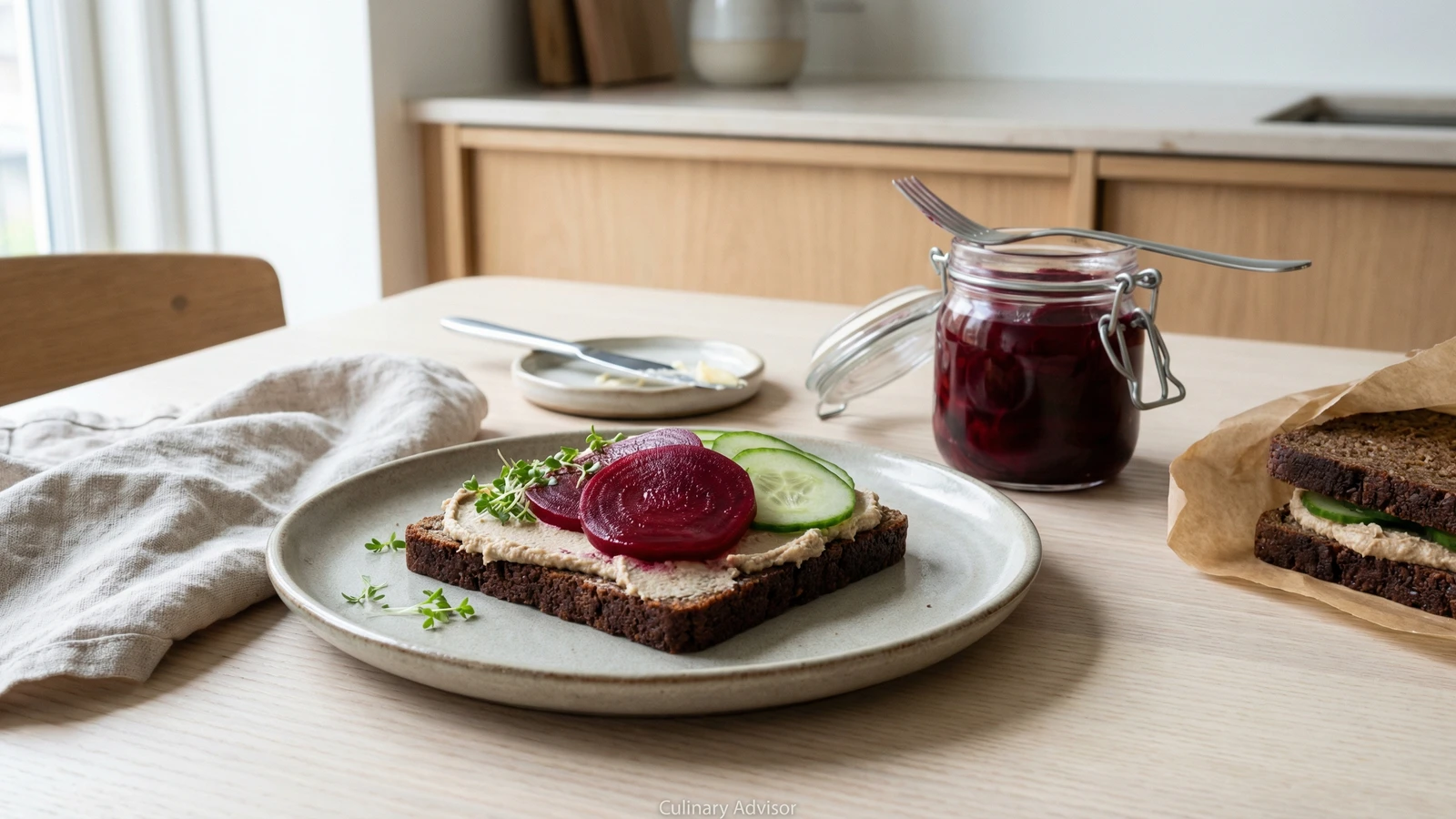
Leverpostejmad med Syltede Rodbeder
Created by Chef Freja
The everyday Danish open sandwich that raised a generation: cold leverpostej on dark rugbrod, jewel-bright pickled beetroot, cool cucumber, and a small pinch of cress to finish.
Every Danish childhood has a madpakke, the lunch box of open sandwiches wrapped in parchment and carried to school in a satchel. And in every madpakke, sooner or later, there is leverpostejmad. Cold liver pate on dark rugbrod with pickled beetroot and cucumber. Not a special dish. The opposite. The one that shows up so often it stops being noticed, until you move away from Denmark and suddenly you'd give anything for a slice.
This is the cold everyday version, the one you build from a pate that's been chilling in the fridge since last night and a jar of beetroots that's been pickling on a shelf for a few days. The pate itself is nothing mysterious. Pork liver, pork fat, onion, anchovy, and a seasoned milk-and-egg batter that binds everything into silk. It bakes in a water bath because that's what keeps the texture gentle, and it cools slowly because leverpostej rewards patience the way most good things do. The pickled beetroots belong to autumn, when the Danish beet harvest comes in and every household jar comes down from the cupboard for refilling, but the jar itself lasts through the winter and into the spring.
What I want you to understand before you start is that this sandwich has a quiet grammar. Butter the rugbrod properly, because the butter carries the flavor. Slice the pate cold, because warm leverpostej is a different dish. Keep the cucumber on one side and the beetroot on the other, because otherwise the beet juice bleeds into the cucumber and turns it a sad pink. These are not rules a recipe taught me. They are things I learned watching my mother pack my lunch, and now I'm telling you, and that's how Danish home cooking has always moved from one kitchen to the next.
Leverpostej arrived in Denmark in the late 1800s through the French terrine tradition, refined by German butchers working in Copenhagen, and was first sold commercially by the Stryhn family in 1899. Within a few decades it had moved from a restaurant delicacy to the default madpakke filling of every Danish household, and today the country consumes roughly seven million kilograms of leverpostej a year, an astonishing number for a population of six million. The pairing with syltede rodbeder comes from the older preservation kitchen, when vinegar-pickled root vegetables were how every Danish family stretched the autumn harvest through the dark months, and the sharp magenta of the beet against the pale pate became one of the most recognisable color combinations in the Danish culinary vocabulary.
The technique, the tradition, and the story behind every dish.
Discover Culinary AdvisorIngredients
pork liver
Quantity
500g
trimmed and roughly chopped
pork back fat or fatty pork belly
Quantity
500g
roughly chopped
yellow onion
Quantity
1 medium
peeled and quartered
anchovy fillets in oil
Quantity
2
plain flour
Quantity
40g
whole milk
Quantity
250ml
eggs
Quantity
2 large
fine sea salt
Quantity
1 teaspoon
ground allspice
Quantity
1/2 teaspoon
ground white pepper
Quantity
1/2 teaspoon
dried thyme
Quantity
1/4 teaspoon
butter for the tin
Quantity
small knob
small red beetroots
Quantity
500g
scrubbed
white wine vinegar
Quantity
300ml
caster sugar
Quantity
150g
bay leaf
Quantity
1
whole cloves
Quantity
4
whole black peppercorns
Quantity
6
dark rugbrod
Quantity
6 to 8 thick slices
soft unsalted butter
Quantity
for spreading
cucumber
Quantity
1/2
sliced paper-thin
fresh cress or dill
Quantity
small bunch
to finish
| Ingredient | Quantity |
|---|---|
| pork livertrimmed and roughly chopped | 500g |
| pork back fat or fatty pork bellyroughly chopped | 500g |
| yellow onionpeeled and quartered | 1 medium |
| anchovy fillets in oil | 2 |
| plain flour | 40g |
| whole milk | 250ml |
| eggs | 2 large |
| fine sea salt | 1 teaspoon |
| ground allspice | 1/2 teaspoon |
| ground white pepper | 1/2 teaspoon |
| dried thyme | 1/4 teaspoon |
| butter for the tin | small knob |
| small red beetrootsscrubbed | 500g |
| white wine vinegar | 300ml |
| caster sugar | 150g |
| bay leaf | 1 |
| whole cloves | 4 |
| whole black peppercorns | 6 |
| dark rugbrod | 6 to 8 thick slices |
| soft unsalted butter | for spreading |
| cucumbersliced paper-thin | 1/2 |
| fresh cress or dillto finish | small bunch |
Equipment Needed
- •Meat grinder or food processor
- •Loaf tin, 22cm by 12cm
- •Larger roasting dish for the water bath
- •Clean glass jar with lid, about 750ml
- •Mandoline or sharp knife for cucumber and beetroot
Instructions
- 1
Cook the beetroots
Put the scrubbed beetroots whole into a pot of cold salted water. Bring toa simmer and cook until a knife slides in with no resistance, thirty to forty minutes depending on size. Drain and let them cool just enough to handle. The skins will rub off under your thumbs in soft sheets. Do this over the sink and wear an apron. Beet juice writes its name on everything.
Leave the root tail and about 2cm of stem on while boiling. This keeps the beets from bleeding out into the water and holding on to their color. - 2
Pickle the beetroots
Slice the peeled beetroots into rounds about 3mm thick and pack them into a clean jar. In a small pot, combine the vinegar, sugar, bay leaf, cloves, and peppercorns with 100ml of water. Bring to a gentle boil, stir until the sugar dissolves, then pour the hot brine over the beets until they are completely covered. Let the jar cool on the counter, then refrigerate. They are edible after two hours and at their best after a day. The vinegar softens, the sugar rounds out, and the color deepens to the deep magenta that makes this sandwich look the way it should.
- 3
Mince the leverpostej mixture
Heat the oven to 170C. Put the pork liver, pork fat, onion, and anchovies through a meat grinder on the finest setting twice. If you don't have a grinder, a food processor works, but pulse in stages until the mixture is a smooth paste. The double grind is what gives leverpostej its silky texture. A rougher grind gives you something closer to a country terrine, which is a good thing in its own right but not what we're making today.
Chill the grinder parts in the freezer for fifteen minutes before using. Cold metal keeps the fat from smearing and holds the structure together. - 4
Build the batter
In a separate bowl, whisk the flour into the milk until completely smooth. No lumps. Lumps in the milk become lumps in the finished pate. Whisk in the eggs, then the salt, allspice, white pepper, and thyme. Fold this mixture into the ground meat until fully combined. The batter should be loose, almost pourable. That looseness is correct. It sets as it bakes.
- 5
Bake in a water bath
Butter a loaf tin, about 22cm by 12cm, and pour in the leverpostej mixture. Smooth the top. Set the tin inside a larger roasting dish and pour hot water into the outer dish until it comes halfway up the sides of the loaf tin. This is a bain-marie, and it matters. The surrounding water keeps the heat gentle and the pate silky. Without it, the edges go dry and grainy before the center is done. Bake for one hour to one hour fifteen minutes, until a knife inserted into the center comes out clean and the top is lightly golden.
- 6
Cool completely
Take the tin out of the water bath and let it cool on the counter for an hour. Then refrigerate for at least three hours, or overnight if you can. Leverpostej eaten warm from the oven is a different dish altogether, softer and looser. For madpakke leverpostej, you want it cold and sliceable, firm enough to hold its shape on the bread but still spreadable at the edges. The joy of waiting applies here.
- 7
Butter the rugbrod
Take the butter out twenty minutes before you assemble. Spread each slice of rugbrod with a thin, even layer of soft butter, going right to the edges. The butter is not optional and it is not a garnish. It is a barrier between the dense rye and the cold pate, and it carries the flavor across the whole bite. A dry slice of rugbrod under leverpostej tastes like homework. A buttered one tastes like lunch.
- 8
Assemble the smorrebrod
Cut the cold leverpostej into slices about 1cm thick and lay one generous slice on each piece of buttered rugbrod, covering most of the surface. Arrange two or three slices of pickled beetroot on top, slightly overlapping, letting the pink-red color sit proudly against the pale beige of the pate. Tuck a few paper-thin cucumber slices alongside, and finish with a small pinch of fresh cress or dill. Don't overload. The architecture matters, and each layer should be visible from the side.
The cucumber goes on half the sandwich, the beetroot on the other half, so the beet juice doesn't bleed into the cucumber and turn it pink. This is a madpakke rule that every Danish parent knows. - 9
Serve or pack
Eat immediately with a knife and fork, or wrap in parchment for the madpakke. If you're packing a lunch box, the rugbrod and butter do the heavy lifting of keeping the bread intact until midday. You'll know when it's right because the first bite will taste exactly like someone's childhood, whether it's yours or not. Tak for mad.
Chef Tips
- •If you don't want to make the leverpostej from scratch, a good Danish brand from a proper deli is entirely legitimate. Most Danes buy it, and nobody thinks less of the sandwich for it. But the homemade version has a gentleness you cannot buy, and once you've made it you'll understand the difference.
- •The pickled beetroots keep for at least a month in the fridge and only get better for the first two weeks. Make a double batch. They belong on Christmas lunch tables, next to cold cuts, and anywhere else a bright, sharp note is needed.
- •Danish rugbrod is not optional here. A seeded sourdough or a pale rye will taste wrong under leverpostej. The density of proper dark rugbrod is what holds the weight of the pate and the moisture of the beet. If you can't buy it, bake it. A homemade rugbrod keeps for a week.
- •A cold Danish pilsner is the right drink alongside. An aquavit if the lunch is formal. A strong coffee afterwards, never during.
Advance Preparation
- •The pickled beetroots can be made up to a month ahead and stored in the fridge. They are at their best after one to two days of pickling.
- •The leverpostej needs to chill for at least three hours after baking, ideally overnight. It keeps well in the fridge for five days, covered, and slices more cleanly on day two than day one.
- •Both components can be made the weekend before and assembled fresh each morning for a week of madpakker. This is how generations of Danish parents have done it.
Frequently Asked Questions
Nutrition Information
1 serving (about 155g)
Where cooking meets culture.
Culinary mentorship, cultural storytelling, and the editorial depth that makes cooking meaningful.
Explore Culinary Advisor