Culinary Advisor
A cooking platform built around craft, culture, and the stories behind what we eat.
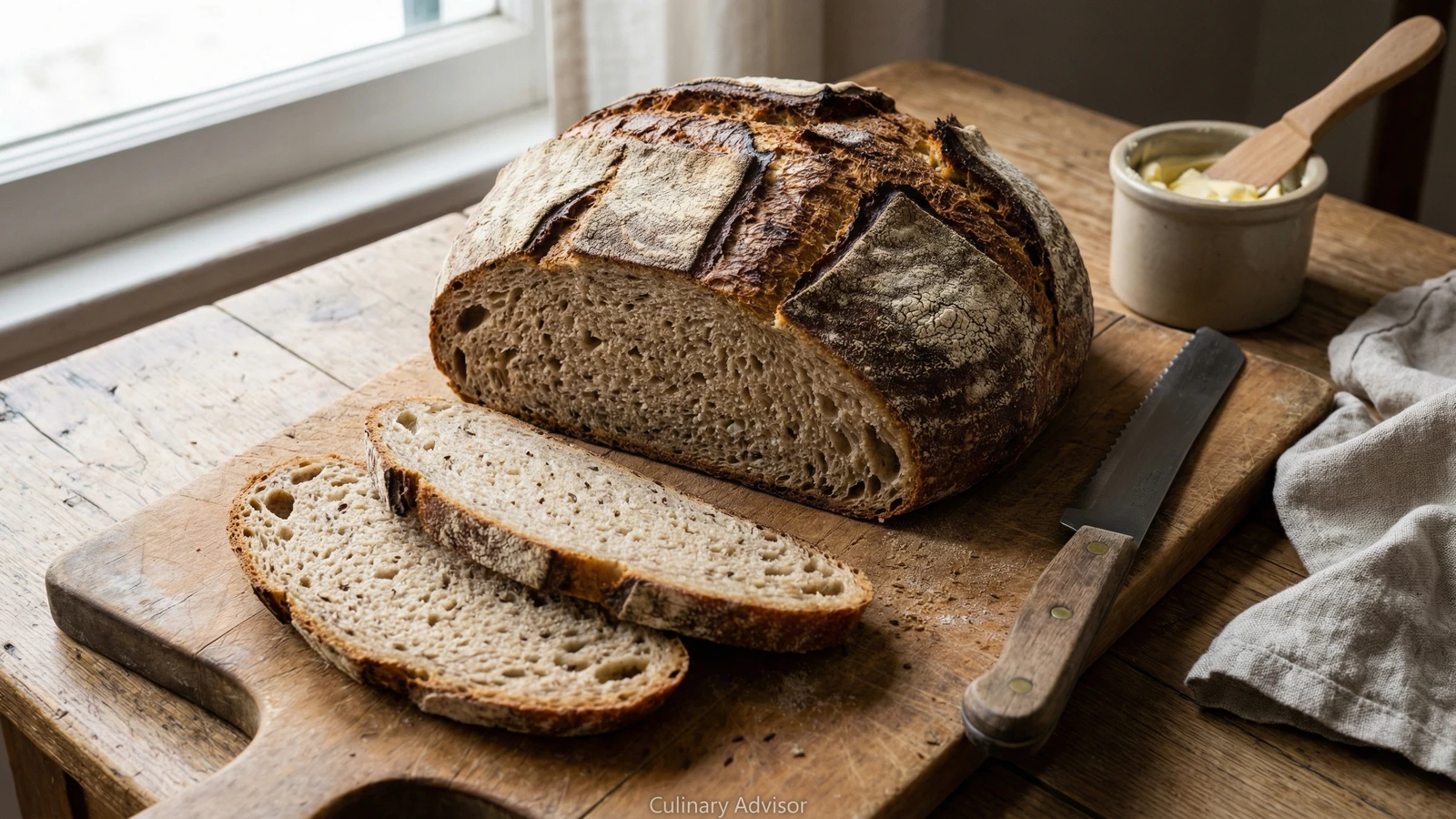
Landbrot (Austrian Country Loaf)
Created by Chef Elsa
A rustic rye-wheat loaf built on a Dampfl pre-ferment, with a dark crackling crust, caraway running through the crumb, and enough character to carry you from breakfast through evening Jause.
The bread I remember most clearly from our trips to Austria isn't from a famous bakery. It's from a wooden board at a Gasthaus table in the Salzkammergut, sliced thick and served alongside butter and a pot of Liptauer. Dark crust, flour-dusted top, a crumb that held together when you spread cold butter across it but still had enough give to feel alive under your teeth. That was Landbrot. Country bread. The kind every Austrian household keeps on the counter under a cloth, slicing from it all week until it's time to bake or buy another.
Landbrot is not a white bread and it's not a heavy black rye. It sits between the two: a blend of rye and wheat flour that gives you the earthy, slightly sour depth of rye with enough wheat gluten to hold a proper shape and slice cleanly. The balance is everything. Too much rye and the loaf goes dense and sticky. Too much wheat and you've lost the character that makes this Austrian and not just another country bread.
What makes this recipe work is the Dampfl. That's the Austrian term for a pre-ferment, a small mixture of rye flour, water, yeast, and a touch of honey that you let bubble and rise before mixing your main dough. The Dampfl gives the crumb its soft, open character and develops a gentle tang that deepens over the days the loaf sits on your counter. Gretel always said good bread needs time. The Dampfl is how you give it that time without spending your whole day in the kitchen.
Austrian bread traditions reflect the country's position at the crossroads of Alpine and Central European grain cultures. Rye thrived in the cooler mountain regions while wheat dominated the lowland plains, and the practice of blending the two flours into mixed Mischbrot and Landbrot goes back centuries. Every Austrian province has its own bread identity: Tyrol favors dense, dark rye loaves, Styria is known for its pumpkin seed breads, and the Salzburg region produces a lighter rye-wheat blend that sits comfortably on the table from breakfast through evening Jause, the Austrian tradition of a light meal built around bread, cold cuts, and cheese.
The technique, the tradition, and the story behind every dish.
Discover Culinary AdvisorIngredients
rye flour (Roggenmehl), for the Dampfl
Quantity
100g
warm water (about 38°C/100°F), for the Dampfl
Quantity
130ml
fresh yeast (or 3g active dry yeast)
Quantity
7g
honey
Quantity
1 teaspoon
rye flour (Roggenmehl), for the main dough
Quantity
200g
strong bread flour (or Austrian Type W700)
Quantity
350g
warm water, for the main dough
Quantity
280ml
fine salt
Quantity
12g
caraway seeds
Quantity
1 tablespoon
lightly crushed
| Ingredient | Quantity |
|---|---|
| rye flour (Roggenmehl), for the Dampfl | 100g |
| warm water (about 38°C/100°F), for the Dampfl | 130ml |
| fresh yeast (or 3g active dry yeast) | 7g |
| honey | 1 teaspoon |
| rye flour (Roggenmehl), for the main dough | 200g |
| strong bread flour (or Austrian Type W700) | 350g |
| warm water, for the main dough | 280ml |
| fine salt | 12g |
| caraway seedslightly crushed | 1 tablespoon |
Equipment Needed
- •Large mixing bowl
- •Kitchen scale (precision matters with bread)
- •Proving basket (Gärkörbchen) or medium bowl with tea towel
- •Baking stone or heavy baking tray
- •Sharp knife or razor blade for scoring
- •Roasting tin for steam
- •Wire cooling rack
Instructions
- 1
Make the Dampfl
Crumble the fresh yeast into a medium bowl (or sprinkle dry yeast over the surface). Add 130ml warm water and the honey, stir gently until dissolved. Mix in the 100g of rye flour until you have a thick, paste-like batter. Cover with a clean tea towel and let it sit in a warm spot for 30 minutes. When it's ready, the surface will be bubbly and slightly domed. It should smell yeasty and faintly sweet. This is your Dampfl, the pre-ferment that gives the bread its character. Don't skip it. Without the Dampfl, you'll have bread. With it, you'll have Landbrot.
The water should feel warm against your wrist, not hot. If it's too hot, you'll kill the yeast. If it's too cool, the Dampfl will take forever to wake up. Body temperature is what you're after. - 2
Build the dough
Combine the remaining 200g rye flour and the 350g bread flour in a large bowl. Make a well in the center and scrape in the risen Dampfl. Add 280ml warm water, the salt, and the crushed caraway seeds. Mix everything together with a wooden spoon or your hand until a shaggy, rough dough forms. It will look unpromising. That's fine. Rye dough never looks elegant at this stage.
Keep the salt away from the yeast when you add them. Salt directly on yeast slows it down. Pour the salt onto the flour at the edge of the well, not into the Dampfl. - 3
Knead the dough
Turn the dough onto a lightly floured surface and knead for ten minutes. Rye dough behaves differently than pure wheat. It's stickier, denser, and won't develop the same elastic stretch. Don't add flour by the fistful trying to fight the stickiness. Wet your hands with a little water instead. You're looking for a dough that's smooth, slightly tacky to the touch, and holds its shape when you stop working it. The caraway seeds will press into the surface and disappear into the crumb. That's where you want them.
- 4
First rise
Place the dough in a lightly oiled bowl, turn it once so the surface is coated, and cover tightly with cling film or a damp towel. Let it rise in a warm place for one hour. It won't double the way a white bread dough does. Rye ferments differently. Expect it to grow by roughly half its original size. The surface should look pillowy and feel soft when you press it gently with a floured finger.
- 5
Shape the loaf
Turn the dough onto a lightly floured surface. Press it gently to release the larger gas bubbles, then pull the edges toward the center, rotating as you go, to form a tight round. Flip it seam-side down and cup your hands around the ball, rotating it against the counter to build surface tension on the outside. The surface should feel taut, like a drum skin. Place the shaped loaf seam-side up in a well-floured proving basket (Gärkörbchen) or a bowl lined with a heavily floured tea towel. Rye flour is best for dusting here because it won't absorb into the dough the way wheat flour does. Cover and let it prove for 45 minutes.
If you don't have a proving basket, a medium mixing bowl lined with a tea towel rubbed generously with rye flour works perfectly. The towel gives the loaf something to hold onto as it rises. - 6
Prepare the oven
While the loaf proves, place a baking stone or a heavy baking tray upside down on the middle rack of your oven. Set an empty roasting tin on the bottom rack. Preheat to 230°C (450°F). You want the stone screaming hot before the bread goes in. This initial blast of heat is what drives the oven spring, that dramatic rise in the first ten minutes that gives Landbrot its rounded shape and crackling crust.
- 7
Score and bake
Turn the proved loaf onto a sheet of baking parchment, seam-side down. The flour pattern from the proving basket should be sitting on top now, pale against the dark dough. Using a sharp knife or a razor blade, score the top with a deep cross or three confident parallel slashes, about one centimeter deep. Don't be timid. The scores control where the bread opens as it expands in the oven. Slide the loaf on its parchment onto the hot baking stone. Pour a cup of water into the roasting tin below and close the oven door immediately. That burst of steam is what gives Landbrot its thick, blistered crust. Bake at 230°C for 15 minutes, then reduce to 200°C (400°F) and bake for another 35 minutes. The loaf is done when it sounds hollow if you tap the bottom with your knuckle. Let it cool completely on a wire rack for at least one hour. I know the smell makes this difficult. But the crumb needs time to set. Cut too early and it will be gummy and dense. This is the last act of patience the bread asks of you.
Chef Tips
- •Fresh yeast gives the best results for bread. Look for it in the refrigerated section of your supermarket, often near the butter. If you can only find dry yeast, use less than half the weight and dissolve it in the warm water for five minutes before adding the flour.
- •Crush the caraway seeds lightly with the flat of a knife or a mortar and pestle. Whole seeds tend to roll off the tongue intact. A gentle crush opens them up so the flavor actually gets into the bread instead of sitting on top of it.
- •If you want to push the flavor further, replace half a tablespoon of the caraway with ground coriander and a pinch of fennel seed. This combination, called Brotgewürz (bread spice), is what Austrian bakers use in their best Landbrot. You can buy Brotgewürz ready-mixed at Austrian grocery shops or online.
- •This bread improves over two to three days. On day one the crust is at its crispest. By day two the crumb has softened and the rye flavor has deepened. By day five it's still good for toast or bread dumplings. Wrap it in a linen cloth or a paper bag, never plastic. Plastic traps moisture and turns the crust to leather.
- •Landbrot is the foundation of a proper Jause, the Austrian evening snack. Slice it, lay out butter, radishes, cold cuts, maybe a pot of Liptauer cheese spread, and let everyone build their own. That's good Austrian home cooking at its most honest.
Advance Preparation
- •The Dampfl can be made the night before and left to ferment slowly in the fridge for 8 to 12 hours. Cold-fermented Dampfl develops a deeper, slightly more sour flavor. Pull it out an hour before mixing to take the chill off.
- •The fully baked loaf keeps well for five to six days stored in a linen cloth or paper bag at room temperature. Never refrigerate bread. It stales faster in the cold.
- •Sliced Landbrot freezes beautifully for up to three months. Separate slices with parchment so you can pull out exactly what you need. Toast from frozen.
Frequently Asked Questions
Nutrition Information
1 serving (about 80g)
Where cooking meets culture.
Culinary mentorship, cultural storytelling, and the editorial depth that makes cooking meaningful.
Explore Culinary Advisor