Culinary Advisor
A cooking platform built around craft, culture, and the stories behind what we eat.
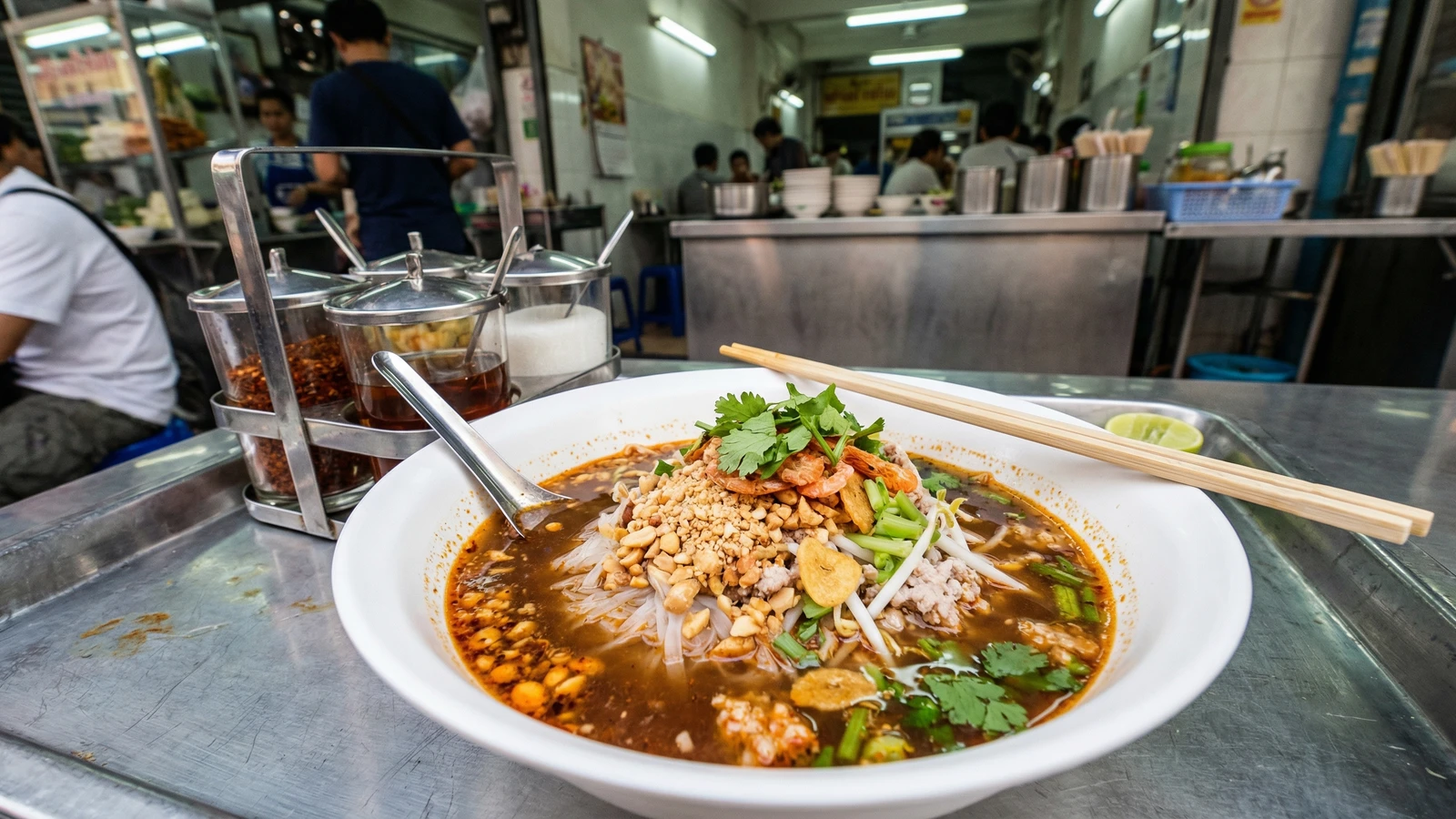
Spicy Noodle Soup (Kuay Tiew Tom Yum)
Created by
The four pillars built into a noodle bowl: nam prik pao for depth, nam pla for salt, nam tan pip for sweet, manao for sour. Bangkok noodle shops have been doing this for decades. Now you understand why it works.
Nam prik pao is a kreung tam. People forget that. Roasted dried chilies, shallots, garlic, dried shrimp, all pounded and cooked down into a dark, smoky jam. When a noodle shop vendor spoons it into the bottom of your bowl, she's putting a paste foundation into a soup. That's the kreung tam at work, even in a dish most people think of as "just noodles."
Tom yum as a soup breaks the kreung tam rule. Ajarn taught me that. Whole herbs, infused into broth, no mortar. But kuay tiew tom yum brings the paste back. The nam prik pao sits in the bottom of the bowl like a flavor bomb waiting for hot broth to unlock it. Lemongrass and galangal might show up in the stock, but the soul of this bowl is that spoonful of roasted chili jam dissolving into pork broth. That's where the smokiness comes from. That's where the color comes from. That's where the depth comes from.
Fish sauce for salt. Palm sugar for sweet. Lime for sour. Chili through the nam prik pao and through the fresh prik khi nu you crush on top. All four pillars, one bowl, five minutes of assembly. This is what Bangkok eats for lunch when it's too hot to think and too hungry to wait. You slide onto a plastic stool, point at the noodle type you want, and the vendor builds your bowl in sixty seconds. Sen lek for me. Always sen lek.
The peanuts and dried shrimp on top aren't garnish. They're structure. The peanuts give fat and crunch. The dried shrimp give umami and salt. Fried garlic adds sweetness. Chinese celery adds a green, herbal bite that cuts through the richness. Every element has a job. Nothing is decorative. That's the system talking.
Kuay tiew (ก๋วยเตี๋ยว) arrived in Thailand through Chinese immigration, primarily Teochew merchants who brought their noodle soup traditions to Bangkok in the 19th century. Thai cooks adapted the format by applying their own flavor principles to the Chinese noodle soup structure, creating hybrids like kuay tiew tom yum, which layers the sour-spicy tom yum profile onto a pork broth base. The dish became a Bangkok noodle shop standard by the mid-20th century, distinct from the herbal tom yam soup in that it reintroduces a paste element (nam prik pao) and is built per bowl rather than simmered as a communal pot.
The technique, the tradition, and the story behind every dish.
Discover Culinary AdvisorIngredients
dried thin flat rice noodles (sen lek)
Quantity
200g
ground pork
Quantity
150g
pork broth
Quantity
4 cups
roasted chili jam (nam prik pao)
Quantity
2 tablespoons
fish sauce (nam pla)
Quantity
2 tablespoons
palm sugar (nam tan pip)
Quantity
1 tablespoon
lime juice (nam manao)
Quantity
3 tablespoons (about 2-3 limes)
dried shrimp (goong haeng)
Quantity
2 tablespoons
crushed roasted peanuts
Quantity
2 tablespoons
fried garlic (kratiam jiaw)
Quantity
2 tablespoons
fried garlic oil
Quantity
1 tablespoon
reserved from frying garlic
Chinese celery (kheun chai)
Quantity
2 stalks
chopped
bean sprouts (thua ngok)
Quantity
1 cup
bird's eye chilies (prik khi nu)
Quantity
2
bruised
fresh cilantro leaves
Quantity
for garnish
lime wedges
Quantity
for serving
| Ingredient | Quantity |
|---|---|
| dried thin flat rice noodles (sen lek) | 200g |
| ground pork | 150g |
| pork broth | 4 cups |
| roasted chili jam (nam prik pao) | 2 tablespoons |
| fish sauce (nam pla) | 2 tablespoons |
| palm sugar (nam tan pip) | 1 tablespoon |
| lime juice (nam manao) | 3 tablespoons (about 2-3 limes) |
| dried shrimp (goong haeng) | 2 tablespoons |
| crushed roasted peanuts | 2 tablespoons |
| fried garlic (kratiam jiaw) | 2 tablespoons |
| fried garlic oilreserved from frying garlic | 1 tablespoon |
| Chinese celery (kheun chai)chopped | 2 stalks |
| bean sprouts (thua ngok) | 1 cup |
| bird's eye chilies (prik khi nu)bruised | 2 |
| fresh cilantro leaves | for garnish |
| lime wedges | for serving |
Equipment Needed
- •Medium pot for broth
- •Separate pot for blanching noodles
- •Noodle strainer basket or spider skimmer
- •Small pan for frying garlic
Instructions
- 1
Fry the garlic
Slice 6-8 cloves of garlic thinly and evenly. In a small pan, add enough vegetable oil to submerge the slices and set it over medium-low heat. Add the garlic to cool oil and let it come up to temperature slowly. This is critical: if you throw garlic into hot oil it goes from golden to burnt in three seconds. Let it fry gently, stirring occasionally, until the slices turn light gold. Pull them out with a slotted spoon onto paper. They'll darken a shade as they cool. Reserve the garlic oil. That oil is flavored gold and it goes into the bowl.
Start garlic in cool oil. The slow fry gives you even, crispy chips every time. Rush it and you get bitter, dark flakes. Patience here, speed later. - 2
Cook the ground pork
Bring the pork broth to a boil in a medium pot. Break the ground pork into small pieces and drop them into the boiling broth. Stir to separate the meat so it doesn't clump into one mass. You want small, loose bits that will tangle with the noodles. Cook for 3-4 minutes until the pork is cooked through and the broth has absorbed some of its flavor. Skim any scum that rises to the surface. Reduce heat and keep the broth at a gentle simmer.
- 3
Soak the noodles
While the broth simmers, soak the sen lek in room-temperature water for 15-20 minutes until they're pliable but still firm. Don't use hot water. Hot water makes the outside gummy while the inside stays hard. Room temperature gives you even hydration. When they bend without snapping, they're ready. Drain them.
Sen lek (เส้นเล็ก) means "small noodle." These are the thin, flat rice noodles you see in pad thai and most Bangkok noodle shops. If you can find fresh sen lek, skip the soaking. Fresh noodles just need a quick blanch. - 4
Blanch noodles and bean sprouts
Bring a separate pot of water to a rapid boil. Blanch the soaked noodles for 30-45 seconds, just until they go from opaque to translucent and turn slippery. Pull them out fast. Overcooked rice noodles become a starchy, sticky mess. In the same water, blanch the bean sprouts for 10 seconds. You want them barely wilted, still with crunch. Divide the noodles and bean sprouts between two bowls.
- 5
Build the flavor base in each bowl
This is where the dish comes together. In each bowl, on top of the noodles, add: 1 tablespoon nam prik pao, 1 tablespoon fish sauce, half a tablespoon palm sugar, and a bruised bird's eye chili. This is the kreung tam moment. The paste sits in the bowl waiting for the broth to unlock it. Every noodle vendor in Bangkok does it this way. The bowl is the mixing vessel. The broth is the activator.
- 6
Ladle broth and assemble
Bring the pork broth back to a rolling boil. Ladle it over the seasoning base in each bowl, making sure to scoop up plenty of the ground pork with each ladle. Stir once to dissolve the nam prik pao and palm sugar into the broth. The liquid should turn a dark reddish-brown with a sheen of chili oil on the surface. That color is the nam prik pao doing its job. Now taste the broth. Sour first from the lime juice (add it now: about 1.5 tablespoons per bowl), salty second, sweet barely there, smoky heat building underneath. Adjust. More lime if it's flat. More fish sauce if it needs backbone.
- 7
Top and serve immediately
Scatter the crushed peanuts, dried shrimp, fried garlic, and chopped Chinese celery over each bowl. Drizzle half a tablespoon of the reserved garlic oil on top. Add a few cilantro leaves and serve with a lime wedge on the side. Set out the krueng prung (condiment caddy) with four jars: sugar, dried chili flakes (phrik pon), fish sauce, and vinegar with sliced chilies (prik nam som). Every noodle shop in Thailand has this caddy. The cook gives you the foundation. You fine-tune at the table. That's the system.
The condiment caddy isn't optional. Sugar to round the broth, phrik pon for extra heat, fish sauce for more salt, vinegar for sharper acidity. Adjusting at the table is part of the Thai eating tradition. The cook builds the base. You finish the job.
Chef Tips
- •Nam prik pao is the backbone of this bowl. If you're buying it jarred, read the label. Maesri and Pantai are decent. Mae Pranom is the classic. The ingredients should be dried chilies, shallots, garlic, dried shrimp, palm sugar, fish sauce, and oil. If it lists tomato paste or weird thickeners, put it back. Better yet, make your own: pound dried chilies, fried shallots, fried garlic, and dried shrimp in a mortar, then cook the paste in oil until it darkens. That's it. That's a kreung tam.
- •Sen lek is the standard noodle for kuay tiew tom yum, but you can ask for any type at a Bangkok shop. Ba mee (egg noodles) are great if you want more chew. Woon sen (glass noodles) soak up the broth beautifully. Sen yai (wide rice noodles) work but can get heavy. Stick with sen lek your first time. It's the workhorse.
- •The dried shrimp (goong haeng) on top are not garnish. They're a salt and umami hit that your teeth release with each bite. Buy the medium-sized ones, not the tiny pink dust that comes in cheap bags. Good dried shrimp should smell like the sea and be slightly chewy, not rock-hard.
- •If you have time, make proper pork broth: simmer pork neck bones or spare ribs with a smashed cilantro root, white peppercorns, and a piece of daikon for 45 minutes to an hour. Skim the surface. That's the foundation. Store-bought pork stock works in a pinch, but homemade broth has body and collagen that transforms the bowl.
Advance Preparation
- •Pork broth can be made up to 3 days ahead and refrigerated, or frozen for a month. The fat cap that forms on top when chilled is fine. Leave it in. It melts into the broth and adds body.
- •Fried garlic keeps in an airtight jar for a week at room temperature. Make a big batch. You'll use it on everything.
- •Noodles must be blanched fresh. Don't cook them ahead. Leftover rice noodles turn into a solid, gummy brick. The blanch takes 30 seconds. Do it right before serving.
- •The lime juice goes in at the last moment. Citrus loses its brightness fast, especially in hot liquid. Squeeze, stir, serve. That's the order.
Frequently Asked Questions
Nutrition Information
1 serving (about 750g)
Where cooking meets culture.
Culinary mentorship, cultural storytelling, and the editorial depth that makes cooking meaningful.
Explore Culinary Advisor