Culinary Advisor
A cooking platform built around craft, culture, and the stories behind what we eat.
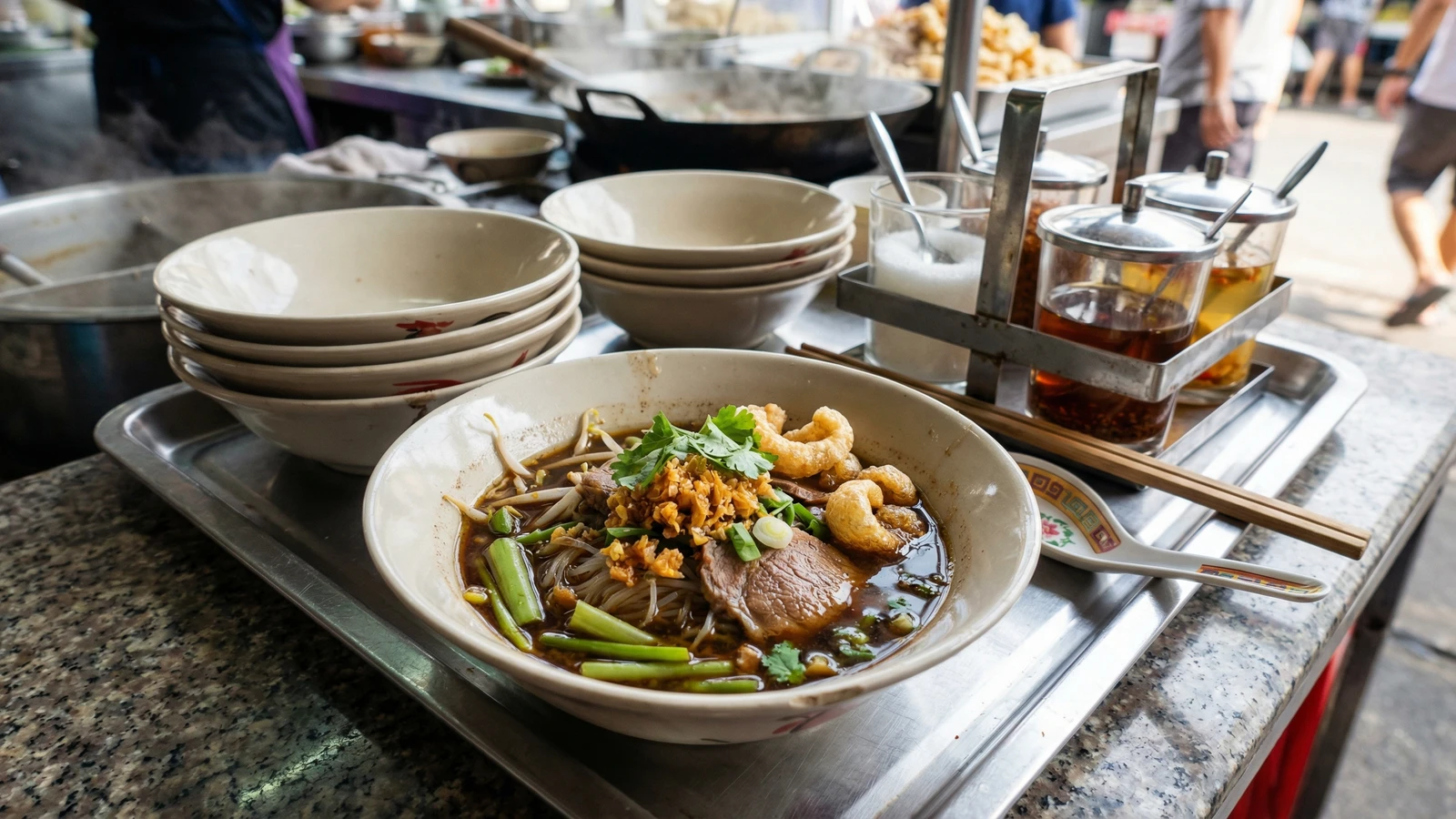
Boat Noodles (Kuay Tiew Reua)
Created by
The darkest broth in Bangkok, built over hours with pork bones, star anise, and cinnamon, then thickened with nam tok (blood) for body no cornstarch can fake. This is the soup that fed a city from its canals.
The broth is the principle. That's the lesson of kuay tiew reua.
Most noodle soups around the world build flavor fast: a stock, some aromatics, done. Boat noodles don't work that way. This broth is a slow extraction. Pork bones simmered for hours with cinnamon bark, star anise, cilantro root, and white peppercorns until every molecule of collagen and marrow has surrendered into the liquid. Then dark soy for color. Fish sauce for salt. Palm sugar for sweetness. The four pillars are all here, built into the bones of the soup itself.
Ajarn always said the kreung tam is the foundation of Thai cooking. Boat noodles are the proof that the principle extends beyond the mortar. The spice bundle simmered in this broth functions exactly like a kreung tam: a concentrated delivery system for aromatics. Cinnamon, star anise, cilantro root, garlic, white pepper. You're not pounding them, you're extracting them through time and heat. Different method, same governing logic.
Then there's the nam tok. The blood. This is where most people flinch, and this is where the dish becomes itself. A tablespoon of pork or beef blood stirred into each bowl right before serving. It thickens the broth, darkens it to that near-black color, and adds a mineral richness that nothing else replicates. Without it, you have a good noodle soup. With it, you have boat noodles. If you skip it, I won't pretend it's the same dish. It's not. The blood is structural.
I took a group of university students on a Fai Thai workshop to Rangsit last year. We sat at a boat noodle alley, plastic stools, thirty-baht bowls the size of your fist, stacks of empty bowls piling up on the table like trophies. One kid told me he'd never tasted a broth that dark before. He'd been eating instant noodles for three years of university. Three years. That's the gap I'm trying to close. This broth took someone four hours to build. The least you can do is understand why it tastes the way it does.
Kuay tiew reua (ก๋วยเตี๋ยวเรือ) literally translates to "boat noodles" because the dish was originally sold from small wooden boats along Bangkok's canal network (khlongs) from the 1940s through the 1970s. As canal traffic declined with road development, vendors moved to shophouses, concentrating famously along Victory Monument and later in Rangsit, north of Bangkok. The use of blood (nam tok) to thicken the broth reflects a time when no part of the animal was wasted, and the Chinese-influenced spice profile (star anise, cinnamon) traces the dish's lineage to Chinese-Thai cooks who adapted Teochew beef noodle traditions to Thai flavoring principles. The traditional serving size is deliberately tiny, roughly a cup per bowl, because vendors on rocking boats could only fill small portions without spilling.
The technique, the tradition, and the story behind every dish.
Discover Culinary AdvisorIngredients
pork neck bones and spare ribs
Quantity
1 kg
cut into pieces
pork shoulder
Quantity
300g
sliced thin against the grain
water
Quantity
4 liters
star anise pods
Quantity
3
cinnamon stick
Quantity
1 (about 3 inches)
white peppercorns
Quantity
1 teaspoon
cracked
cilantro roots (rak phak chi)
Quantity
4
bruised
garlic
Quantity
6 cloves
smashed
dark soy sauce (si ew dam)
Quantity
3 tablespoons
fish sauce (nam pla)
Quantity
3 tablespoons
palm sugar (nam tan pip)
Quantity
1 tablespoon
fermented bean curd (tao hu yi)
Quantity
2 tablespoons
mashed
Thai sweet soy sauce (si ew wan)
Quantity
1 tablespoon
vegetable oil
Quantity
2 tablespoons
pork or beef blood (nam tok) (optional)
Quantity
3 tablespoons
thin rice noodles (sen lek)
Quantity
400g
fresh or soaked if dried
morning glory (pak bung)
Quantity
200g
cut into 3-inch pieces
bean sprouts
Quantity
100g
fried garlic (kratiem jiaw)
Quantity
for topping
fried pork rinds (kaep moo)
Quantity
for topping
fresh cilantro leaves
Quantity
for topping
sliced green onions
Quantity
for topping
| Ingredient | Quantity |
|---|---|
| pork neck bones and spare ribscut into pieces | 1 kg |
| pork shouldersliced thin against the grain | 300g |
| water | 4 liters |
| star anise pods | 3 |
| cinnamon stick | 1 (about 3 inches) |
| white peppercornscracked | 1 teaspoon |
| cilantro roots (rak phak chi)bruised | 4 |
| garlicsmashed | 6 cloves |
| dark soy sauce (si ew dam) | 3 tablespoons |
| fish sauce (nam pla) | 3 tablespoons |
| palm sugar (nam tan pip) | 1 tablespoon |
| fermented bean curd (tao hu yi)mashed | 2 tablespoons |
| Thai sweet soy sauce (si ew wan) | 1 tablespoon |
| vegetable oil | 2 tablespoons |
| pork or beef blood (nam tok) (optional) | 3 tablespoons |
| thin rice noodles (sen lek)fresh or soaked if dried | 400g |
| morning glory (pak bung)cut into 3-inch pieces | 200g |
| bean sprouts | 100g |
| fried garlic (kratiem jiaw) | for topping |
| fried pork rinds (kaep moo) | for topping |
| fresh cilantro leaves | for topping |
| sliced green onions | for topping |
Equipment Needed
- •Large stockpot (at least 6 liters)
- •Muslin bag or cheesecloth for spice bundle
- •Noodle strainer or spider skimmer
- •Small serving bowls (150-200ml for traditional size)
Instructions
- 1
Blanch the bones
Bring a large pot of water to a rolling boil. Add the pork bones and ribs. Let them boil hard for 5 minutes. Scum, blood, and impurities will rise to the surface in a grey foam. Drain everything. Rinse the bones under cold water, scrubbing off any clinging residue. This step is not optional. If you skip the blanch, your broth will be cloudy and taste murky. You want a clean foundation. Everything that follows depends on it.
Run your thumb over each bone after rinsing. If it feels slimy, scrub again. The broth clarity starts here. - 2
Build the spice bundle
In a dry pan over medium heat, toast the star anise, cinnamon stick, and cracked white peppercorns until fragrant, about 90 seconds. You'll smell the star anise first, sweet and sharp. The cinnamon follows. Don't let anything blacken. Transfer to a muslin bag or a piece of cheesecloth tied with kitchen string. Add the bruised cilantro roots and smashed garlic to the bag. This is your aromatic core. It functions like a kreung tam: a concentrated delivery system for flavor. The method is different, extraction over hours instead of pounding, but the principle is identical.
- 3
Simmer the broth
Return the blanched bones to a clean pot with 4 liters of fresh water. Bring to a boil, then immediately drop to a low simmer. Bubbles should barely break the surface. Add the spice bundle. Simmer for at least 2.5 hours, skimming any foam or fat that rises. The broth will slowly turn golden, then amber. Patience. You can't rush collagen extraction. The gelatin from the bones is what gives boat noodle broth its body, that slight viscosity that coats the noodles. After 2.5 hours, fish out the spice bag and the bones. The bones have given everything they have.
Ajarn always said: a broth tells you when it's ready by how it moves. Tilt the pot. If the liquid slides like water, keep going. If it moves slower, clings slightly to the sides, the collagen has done its work. - 4
Season the broth
With the broth strained and simmering gently, add the dark soy sauce, fish sauce, palm sugar, mashed fermented bean curd, and sweet soy sauce. Stir to dissolve. The broth will darken dramatically. The dark soy gives it that near-black color. The fermented bean curd adds a funky, salty depth that rounds out the spice. The fish sauce and palm sugar do what they always do: salt and sweet, the first two pillars. Taste. The broth should be savory, slightly sweet, deeply aromatic, with the spices present but not overpowering. Adjust fish sauce for salt, palm sugar for sweetness.
- 5
Cook the pork slices
Bring a small pot of water to a boil. Blanch the thin pork shoulder slices for 30 seconds, just until they turn white and firm. Pull them out immediately. These go into the bowl at assembly. You're not braising them. You want tender, barely-cooked slices that will finish gently in the hot broth when served. Overcooked pork in a noodle soup is a crime. Keep them pink at the center and they'll be perfect by the time you eat.
- 6
Prepare the noodles and greens
If using dried sen lek, soak them in room temperature water for 30 minutes, then drain. Blanch the noodles in boiling water for 15 to 20 seconds, just until pliable. Pull them out with a noodle strainer and shake off the water. Blanch the morning glory and bean sprouts for 10 seconds each. Everything is fast here. The noodles and greens should be tender, not soft. They'll continue to absorb heat from the broth.
- 7
Assemble with nam tok
Here's where it becomes boat noodles. Place about half a tablespoon of nam tok (blood) in the bottom of each serving bowl. Lay the blanched noodles over it. Arrange the pork slices, morning glory, and bean sprouts on top. Ladle the hot broth directly over everything. The heat of the broth will cook the blood instantly, thickening the soup and turning it that signature dark, almost opaque color. Stir once from the bottom to incorporate. Top with fried garlic, fried pork rinds, cilantro, and sliced green onions.
If you can't source fresh blood, the dish still tastes good. But it's a different dish. The nam tok adds mineral richness, body, and that darkness that makes boat noodles unmistakable. If you can get it, use it. Your Asian butcher is the place to ask. - 8
Serve with condiments
Set out the krueng prung (condiment caddy) with four jars: granulated sugar, dried chili flakes (phrik pon), fish sauce (nam pla), and chili vinegar (prik nam som). Every noodle shop in Bangkok has this caddy. The diner adjusts their own bowl. A pinch of sugar, a spoonful of chili flakes, a splash of vinegar. This is Thai dining philosophy in four jars: the cook builds the foundation, the eater finishes the balance.
Chef Tips
- •The spice profile of boat noodles is Chinese-Thai. Star anise, cinnamon, and white pepper are not typical Central Thai curry spices. They trace directly to Teochew Chinese immigrants who ran noodle boats on Bangkok's canals. Understanding this lineage helps you understand the broth: it's a Thai-seasoned Chinese stock. Fish sauce replaces light soy as the primary salt. Palm sugar provides the sweetness. The principles are Thai. The technique is borrowed and perfected.
- •Traditional boat noodle bowls are tiny, maybe 150ml. That's not an accident. Vendors on rocking boats couldn't fill large bowls without spilling. The small size also meant each bowl was a fresh assembly: hot broth, fresh blood, perfectly blanched noodles. No sitting around going cold. At home, you can serve larger portions, but if you want the real experience, use small bowls and stack empties on the table like we did in Rangsit.
- •Fermented bean curd (tao hu yi) is the ingredient most home cooks don't know about. It comes in small jars, white cubes in brine, and it adds a deep, funky salinity that fish sauce alone can't provide. It's the secret layer in boat noodle broth. Half a jar costs twenty baht. No excuses.
- •Fried pork rinds (kaep moo) are not a garnish. They're structural. They absorb the dark broth and become chewy, rich sponges of flavor. Buy them from a Thai grocery or fry your own from pork skin. Crush them slightly before dropping into the bowl. They should shatter, then soften.
Advance Preparation
- •The broth can and should be made a day ahead. Refrigerate overnight. The fat will solidify on top for easy removal, and the flavors will deepen. Reheat gently before serving.
- •Fried garlic (kratiem jiaw) keeps in an airtight jar at room temperature for up to a week. Make a big batch. You'll use it on everything.
- •Pork slices can be blanched and refrigerated up to 4 hours ahead. The noodles must be blanched fresh at serving time. Cold noodles in hot broth is a textural disaster.
Frequently Asked Questions
Nutrition Information
1 serving (about 480g)
Where cooking meets culture.
Culinary mentorship, cultural storytelling, and the editorial depth that makes cooking meaningful.
Explore Culinary Advisor