Culinary Advisor
A cooking platform built around craft, culture, and the stories behind what we eat.
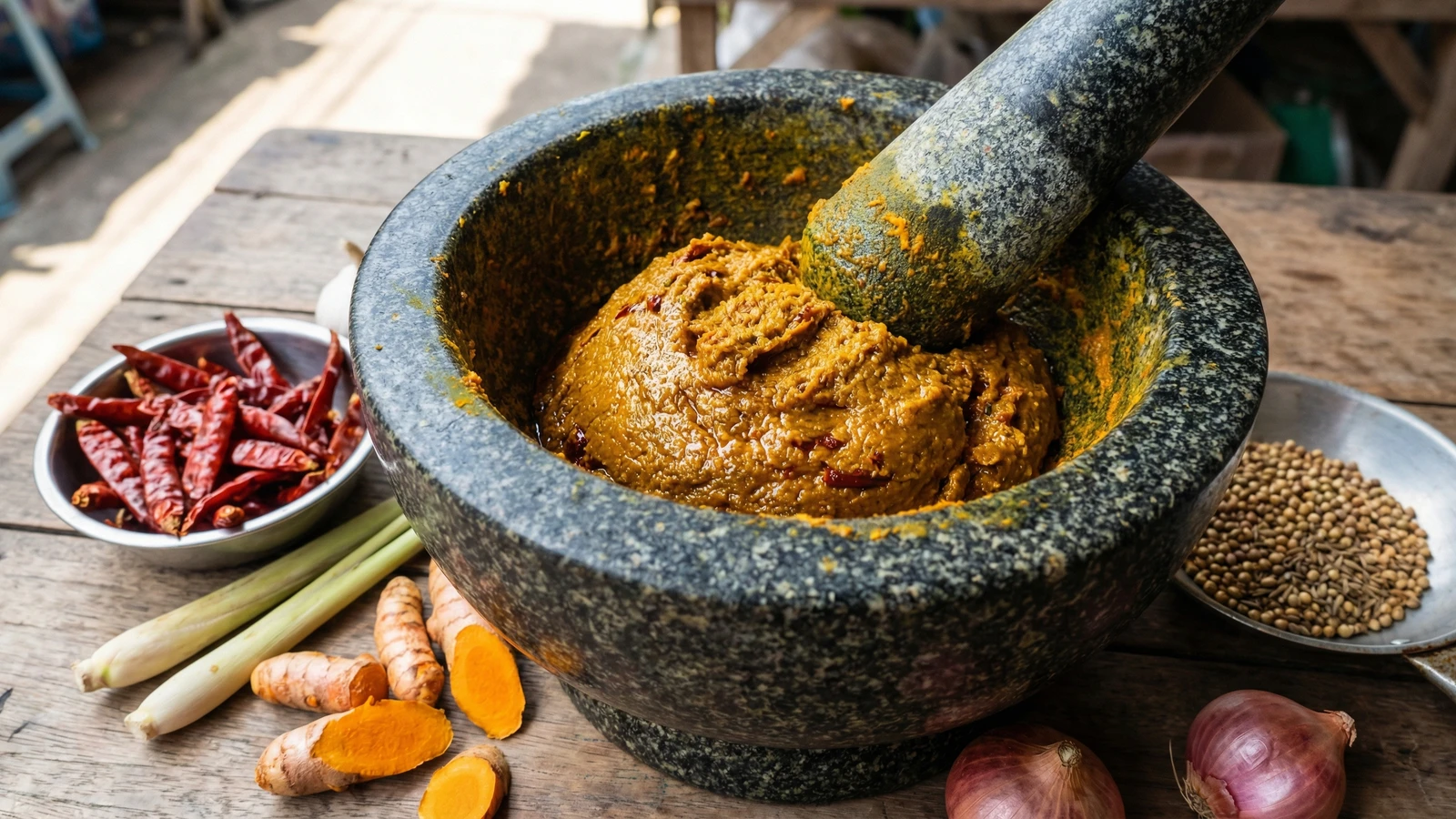
Southern Dry-Fry Paste (Kreung Khua Kling)
Created by
The south's kreung tam is pure confrontation: turmeric-stained, chili-loaded, and built to stand alone in a hot wok with nothing but minced meat and fish sauce. No coconut milk. Nowhere to hide.
The south doesn't soften anything. If Central Thai cuisine is balance, Southern Thai cuisine is a dare. Every flavor cranked to ten. No coconut milk to round the edges. No sugar to smooth things over. And khua kling paste is the purest expression of that philosophy: a kreung tam so fierce it can carry an entire dish with nothing but minced pork and a splash of fish sauce.
Ajarn always said: understand the paste, understand Thai food. But what he also drilled into me is that every region builds its kreung tam differently. Central Thai pastes are aromatic, calibrated, diplomatic. Northern pastes borrow dried spices from the Myanmar borderlands. The south? The south leads with kha min (fresh turmeric) and buries you in dried chilies. Where a Central Thai green curry paste uses maybe eight dried chilies, khua kling paste uses twenty. That ratio tells you everything about Southern Thai cooking.
This is a mortar recipe. Every ingredient enters the krok hin in a specific order: hardest first, most delicate last. You toast the coriander and cumin seeds to crack open their essential oils. You soak the dried chilies just long enough to make them poundable without washing out their heat. Then you pound. Twenty minutes of rhythmic, deliberate pounding until the paste is smooth, fragrant, and stained deep gold from the turmeric. Your hands will be yellow for days. That's not a warning. That's a badge. Every Southern Thai cook has turmeric-stained fingers.
The finished paste is the dish. It goes into a screaming hot wok with minced protein for khua kling, the south's signature dry-fried curry. Nam pla for salt. Maybe a kaffir lime leaf torn in at the end. That's it. The paste does every bit of the work because the paste IS the flavor. The kreung tam is everything. In the south, they mean that literally.
Khua kling is native to Thailand's deep south, particularly the provinces of Songkhla, Nakhon Si Thammarat, Pattani, and Trang, where the technique of dry-frying paste with minced meat (no coconut milk, no broth) is a defining regional method. The heavy use of fresh turmeric root, rarely dominant in Central or Northern Thai pastes, reflects centuries of maritime trade with Malay, Indian, and Muslim spice traditions along the Andaman coast. The word "khua" means to dry-fry or toast, and "kling" refers to the rolling, tumbling motion of the meat in the wok as it absorbs the paste, a technique with no real equivalent elsewhere in the Thai repertoire.
The technique, the tradition, and the story behind every dish.
Discover Culinary AdvisorIngredients
dried red spur chilies (prik haeng)
Quantity
20
stems removed, soaked in warm water for 15 minutes, drained and squeezed dry
coriander seeds (look pak chi)
Quantity
1 tablespoon
cumin seeds (yira)
Quantity
1 teaspoon
white peppercorns (prik thai khao)
Quantity
1 teaspoon
fine sea salt
Quantity
1 teaspoon
lemongrass (takhrai)
Quantity
3 stalks
tender inner parts only, thinly sliced
galangal (kha)
Quantity
2-inch piece
thinly sliced
fresh turmeric root (kha min)
Quantity
3-inch piece
peeled and thinly sliced
kaffir lime zest (phiu makrut)
Quantity
from 2 fruits
finely sliced
garlic (kratiam)
Quantity
10 cloves
roughly sliced
shallots (hom daeng)
Quantity
8
thinly sliced
shrimp paste (kapi)
Quantity
1 tablespoon
| Ingredient | Quantity |
|---|---|
| dried red spur chilies (prik haeng)stems removed, soaked in warm water for 15 minutes, drained and squeezed dry | 20 |
| coriander seeds (look pak chi) | 1 tablespoon |
| cumin seeds (yira) | 1 teaspoon |
| white peppercorns (prik thai khao) | 1 teaspoon |
| fine sea salt | 1 teaspoon |
| lemongrass (takhrai)tender inner parts only, thinly sliced | 3 stalks |
| galangal (kha)thinly sliced | 2-inch piece |
| fresh turmeric root (kha min)peeled and thinly sliced | 3-inch piece |
| kaffir lime zest (phiu makrut)finely sliced | from 2 fruits |
| garlic (kratiam)roughly sliced | 10 cloves |
| shallots (hom daeng)thinly sliced | 8 |
| shrimp paste (kapi) | 1 tablespoon |
Equipment Needed
- •Heavy granite mortar and pestle (krok hin), at least 7 inches diameter
- •Small dry pan for toasting spices
Instructions
- 1
Soak the dried chilies
Remove the stems from the dried red spur chilies and shake out most of the seeds. Soak them in warm water for 15 minutes, just until pliable. Not soft. You're hydrating the flesh so it can be pounded, not making chili soup. Drain, then squeeze each chili firmly to remove excess water. Wet chilies dilute the paste. You want them flexible, not waterlogged.
Twenty chilies sounds extreme. It's not. This is Southern Thai. The dried spur chilies (prik haeng) are moderately hot, not volcanic. Their job is twofold: heat and deep red color. If you use fewer, the paste loses its identity. Start here. Adjust next time if you must. - 2
Toast the whole spices
In a small dry pan over medium-low heat, toast the coriander seeds and cumin seeds separately. Coriander first: shake the pan gently for 2-3 minutes until the seeds turn a shade darker and the kitchen smells warm, citrusy, almost floral. Transfer them out. Then the cumin: 1-2 minutes, until fragrant and barely darkened. Cumin burns fast, so keep your eyes on it. Toasting cracks open the essential oils locked inside the seed coat. Raw coriander is grassy. Toasted coriander is complex. That's the science.
Toast them separately because they have different burn points. Coriander is forgiving. Cumin is not. Thirty seconds of inattention and your cumin is bitter charcoal. Ajarn always said: the nose tells you before the eyes do. When you smell it, it's done. - 3
Pound the dry foundation
Add the salt to your granite mortar (krok hin). Drop in the white peppercorns. Pound until the peppercorns are cracked and ground. The salt acts as an abrasive, gripping the peppercorns so they break instead of bouncing. Now add the toasted coriander and cumin seeds. Pound until everything is a fine, sandy powder. This is the dry spice base of the paste. No chunks. The aromatics need to be fully broken so they integrate evenly into the wet ingredients that follow.
Coriander seeds and cumin are not typical in Central Thai pastes. Their presence here is the fingerprint of Southern Thai cuisine, a reflection of Indian and Malay spice traditions that entered through the southern ports. Regional attribution matters. This is not a Bangkok paste. - 4
Pound the dried chilies
Add the drained, squeezed dried chilies to the mortar in two batches. Pound the first batch down before adding the second. The chilies are fibrous and resistant. They'll fight you. Keep pounding. You need to break every fiber until the chilies become a rough, damp mass that merges with the spice powder below. This takes 3-4 minutes of steady work. When the chili mass is uniform with no large flakes remaining, you're ready for the next stage.
The reason chilies enter early (while the paste is still dry) is physics. Fibrous ingredients need maximum contact with the stone surface to break down. A wet mortar lets them slide. A dry mortar lets the stone grip and shred. Hardest first. That's the law of the krok. - 5
Pound the fibrous aromatics
Now the aromatics, in order. First the lemongrass: pound it into the chili mass until the fibers break and you can smell the sharp, citral brightness filling the room. Lemongrass provides the top note, the high-pitched citrus that lifts the paste. Next the galangal: harder than ginger, piney, almost medicinal. Pound until no pieces remain visible. Then the star: fresh turmeric root. The moment it enters the mortar, everything turns gold. Turmeric provides earthy depth, gentle bitterness, and the color that defines every Southern Thai paste. Pound until the paste is a uniform deep yellow-orange. Finally, the kaffir lime zest: those intensely perfumed strips of green. Pound them in and the aroma shifts, suddenly brighter, more alive. Each ingredient changes the paste. You can smell the transformation happening in layers.
Fresh turmeric is not powdered turmeric. Not even close. Fresh turmeric root has a muddy, peppery earthiness that the powder completely lacks. The powder is a ghost of the real thing. If you can find fresh turmeric (Asian grocers, Indian markets), you have no excuse to use powder. This ingredient is why the south tastes like the south. - 6
Pound garlic and shallots
Add the sliced garlic and pound it into the paste. Garlic breaks down quickly because it's high in moisture and low in fiber. Thirty seconds and it should be incorporated. Now the shallots, which are the sweetness of the paste. Not sugar-sweet. The gentle, allium sweetness that rounds out the chili and turmeric. Pound the shallots in batches if your mortar is getting full. The paste is getting wetter now, which is normal. The shallot moisture helps everything bind. Keep pounding until the texture is smooth and cohesive. You should not be able to identify any individual ingredient by sight.
- 7
Finish with shrimp paste
Add the kapi (shrimp paste) last. This is the umami anchor. One tablespoon of fermented shrimp that provides a deep, savory bass note underneath all that chili and turmeric. Pound it in for another minute until the paste is completely uniform. The color should be a deep golden-orange with red undertones from the chilies. The aroma should be intense: turmeric, chili, lemongrass, shrimp paste, toasted spices all hitting you at once. If the smell fills the room, you're done. If it doesn't, keep pounding.
Kapi is last because it's already soft. It needs integration, not breaking down. Ajarn always said: the order of the mortar is a principle, not a suggestion. Hardest to softest. Every time. Krok ก่อน, krok ก่อน. - 8
Test the paste
Take a small pinch of the finished paste and fry it in a dry wok or pan for thirty seconds. Taste it. You should get immediate chili heat, then the earthy turmeric middle, then the lingering funk of kapi at the back. If it tastes flat, you probably didn't toast your spices well enough. If it tastes one-dimensional, you didn't pound long enough for the ingredients to merge. A properly pounded kreung tam doesn't taste like a list of ingredients. It tastes like one thing: Southern Thai fire.
Chef Tips
- •This paste builds three of the south's greatest dishes. Khua kling: dry-fry the paste with minced pork (moo), chicken (gai), or beef (neua) in a screaming hot wok, add nam pla, tear in kaffir lime leaves at the end. No coconut milk. No liquid. The paste coats the meat completely. That's the dish. You can also use this paste as the base for gaeng luang (Southern sour curry with fish) by thinning it with tamarind water, or stir it into gaeng tai pla (fermented fish innard curry) for the deep south's most notorious preparation.
- •Dried red spur chilies (prik haeng) are the standard for Southern pastes. They're 3-4 inches long, moderately hot, and provide deep red color. Don't substitute with bird's eye (too small, too sharp) or guajillo (wrong flavor profile entirely, that's Mexican). If you can only find generic dried red chilies at an Asian grocer, those will work. The point is quantity: twenty is not excessive for the south.
- •Fresh turmeric stains everything it touches. Your mortar, your fingers, your cutting board, your shirt. Wear gloves if you care about your hands. I don't. The yellow fingers tell people you've been cooking Southern Thai. But scrub your granite mortar with baking soda paste after you're done, or the next paste you make will have a turmeric ghost in it.
- •The difference between a good kreung tam and a great one is pounding time. Most people stop too early. When you think you're done, pound for three more minutes. The paste should be smooth enough that you can't distinguish individual ingredients, and the oil from the spices and aromatics should make it slightly glossy. If it's still grainy, you're not there yet.
Advance Preparation
- •The finished paste keeps in an airtight container in the refrigerator for up to 5 days. Press plastic wrap directly onto the surface to prevent oxidation and color loss.
- •For longer storage, freeze the paste in ice cube trays or small containers for up to 3 months. Each cube is roughly one serving of khua kling. Frozen paste goes directly into the hot wok. No need to thaw.
- •Do not make the paste in advance and leave it at room temperature. The fresh turmeric and shallot moisture will turn it in hours. Refrigerate immediately after pounding.
Frequently Asked Questions
Nutrition Information
1 serving (about 63g)
Where cooking meets culture.
Culinary mentorship, cultural storytelling, and the editorial depth that makes cooking meaningful.
Explore Culinary Advisor