Culinary Advisor
A cooking platform built around craft, culture, and the stories behind what we eat.
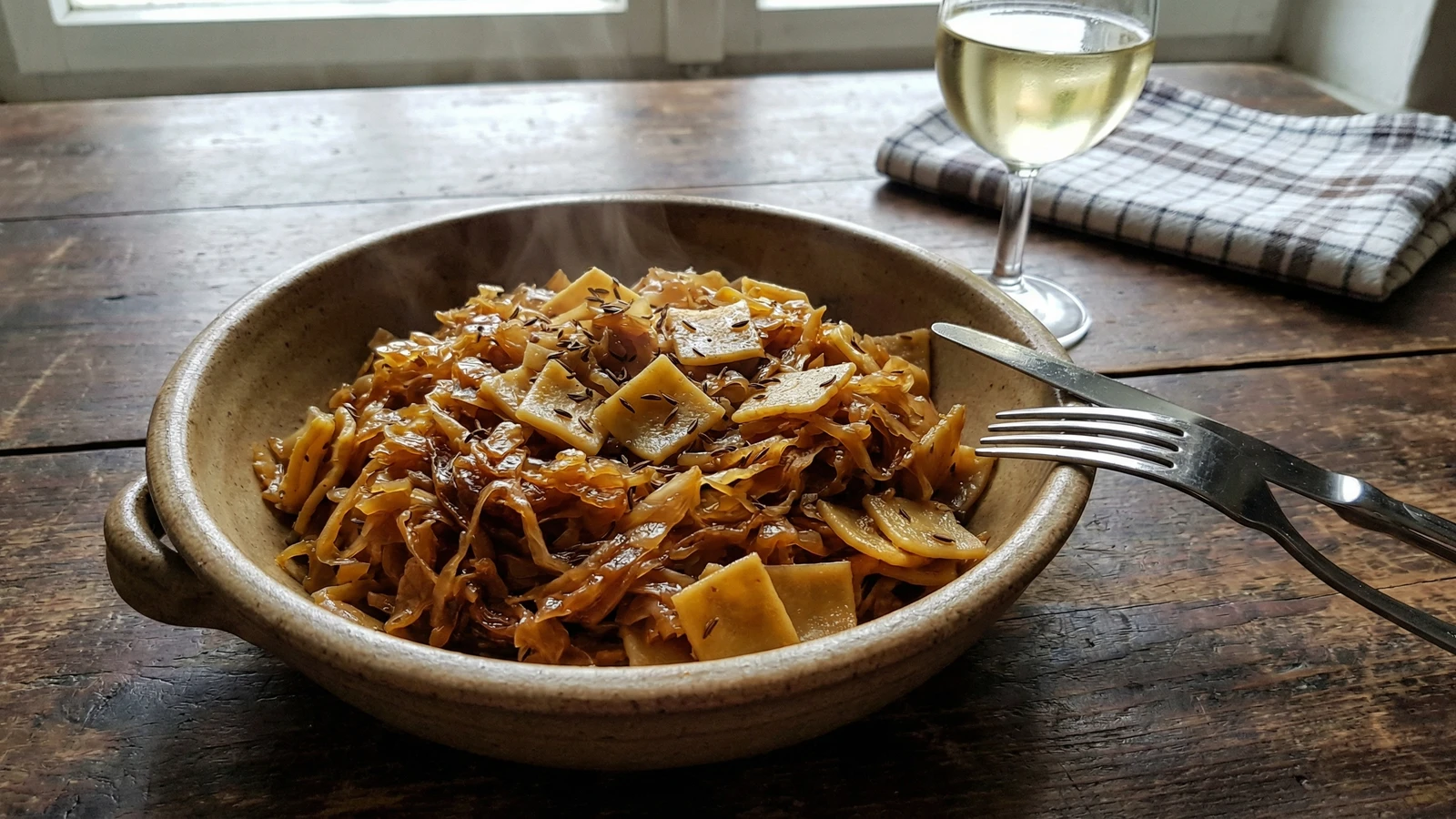
Krautfleckerl
Created by Chef Elsa
Slowly caramelized cabbage tossed with square-cut Fleckerl pasta, flavored with caraway and a splash of vinegar. Viennese home cooking at its most honest and satisfying.
Gretel always said that the dishes which survive longest in a country's kitchen are the ones that cost almost nothing and taste like everything. Krautfleckerl is the proof. Cabbage, onions, a handful of pasta, butter, caraway. That's your shopping list. That's also one of the finest things to come out of a Viennese home kitchen.
I remember eating this at a Gasthaus outside Salzburg on one of those autumn trips with Gretel and my grandmother Eva. I must have been nine or ten. The bowl arrived looking plain, almost dull, just brown cabbage tangled with little squares of pasta. I remember thinking it didn't look like much. Then I tasted it. The cabbage had gone sweet and deep from slow cooking, the caraway seeds caught in your teeth, and the pasta had soaked up all that buttery, caramelized warmth until every piece tasted like it had been thinking about cabbage its whole life. I cleaned the bowl and asked for more. Gretel laughed and said, "Now she understands."
The secret is time, not technique. You cook the cabbage slowly, past soft, past golden, all the way to a deep amber that borders on brown. Most people pull it off the heat too early because they get nervous. Don't. The dish lives in that last ten minutes of caramelization, when the natural sugars concentrate and the cabbage stops tasting like cabbage and starts tasting like something you'd be happy to eat three nights a week. Which, in Vienna, people do.
Krautfleckerl belongs to the tradition of Austrian Mehlspeisen in its broadest sense, where flour-based dishes served as the main course for working families across the Habsburg lands. The dish reflects the Bohemian and Hungarian influences woven into Viennese cooking: Fleckerl pasta likely entered Austrian kitchens through Bohemian cooks, while the generous use of caraway and paprika points east toward Hungary. In Catholic Austria, Krautfleckerl was a staple on meatless Fridays, a day when even the most modest kitchen could put something warm and filling on the table for the cost of a cabbage.
The technique, the tradition, and the story behind every dish.
Discover Culinary AdvisorIngredients
Fleckerl pasta (small square-cut egg noodles)
Quantity
400g
white cabbage
Quantity
1 medium head (about 800g)
onions
Quantity
2 large
finely diced
unsalted butter
Quantity
60g
lard or sunflower oil
Quantity
1 tablespoon
granulated sugar
Quantity
2 teaspoons
caraway seeds
Quantity
1 teaspoon
lightly crushed
white wine vinegar or cider vinegar
Quantity
1 tablespoon
salt
Quantity
to taste
freshly ground black pepper
Quantity
to taste
sweet paprika (optional)
Quantity
pinch
| Ingredient | Quantity |
|---|---|
| Fleckerl pasta (small square-cut egg noodles) | 400g |
| white cabbage | 1 medium head (about 800g) |
| onionsfinely diced | 2 large |
| unsalted butter | 60g |
| lard or sunflower oil | 1 tablespoon |
| granulated sugar | 2 teaspoons |
| caraway seedslightly crushed | 1 teaspoon |
| white wine vinegar or cider vinegar | 1 tablespoon |
| salt | to taste |
| freshly ground black pepper | to taste |
| sweet paprika (optional) | pinch |
Equipment Needed
- •Wide heavy-bottomed pan or skillet (30cm, the widest you have)
- •Large pot for cooking pasta
- •Sharp knife or mandoline for shredding cabbage
Instructions
- 1
Prepare the cabbage
Quarter the cabbage and cut out the hard core. Shred the leaves into strips about half a centimeter wide. You want them fine enough to soften and collapse in the pan, but not so thin they dissolve into nothing. A little texture matters in Krautfleckerl. The cabbage looks like a mountain right now. It won't be. It cooks down to a quarter of its raw volume.
Some cooks salt the raw cabbage and let it sit for twenty minutes to draw out water, then squeeze it dry. Gretel didn't bother, and neither do I. If your pan is hot enough and you're patient enough, the moisture cooks off just fine on its own. - 2
Caramelize the onions
Melt the butter with the lard in your widest, heaviest pan over medium heat. Add the diced onions and cook them slowly, stirring now and then, until they turn soft and deep golden. This takes a good ten to twelve minutes. Don't rush it. The onions are building the flavor base for the entire dish. If they're still pale and crunchy, you haven't gone far enough.
- 3
Start the cabbage
Add the shredded cabbage to the onions in batches. It won't all fit at once, and that's fine. Let each handful wilt down before adding the next. Once it's all in the pan, sprinkle the sugar over the top. The sugar isn't there to make it sweet. It helps the cabbage caramelize properly, coaxing out those deep, nutty, golden-brown flavors that make this dish what it is. Stir, then lower the heat to medium-low.
The sugar trick is old Viennese home cooking wisdom. A small amount of sugar accelerates the Maillard reaction on the cabbage without making the dish taste sweet. You won't notice it in the finished Krautfleckerl. You'll notice if you leave it out. - 4
Slow-cook the cabbage
Add the crushed caraway seeds and a generous pinch of salt. Cover the pan and let the cabbage cook for twenty-five to thirty minutes, stirring every five minutes or so. You want it to go past soft, past golden, all the way to a deep amber brown. The cabbage should look collapsed and deeply caramelized, almost jammy in places. If it starts to catch on the bottom, add a splash of water, not more than a tablespoon, and scrape up those brown bits. They're flavor. Don't waste them.
This is the step where most people give up too early. Pale, limp cabbage is not Krautfleckerl. You're looking for the color of dark honey, with some edges going nearly brown-black. That's where the sweetness and depth live. Be patient. - 5
Cook the Fleckerl
While the cabbage finishes, bring a large pot of well-salted water to the boil. Cook the Fleckerl according to the packet, but pull them out one minute early. They'll finish cooking when you toss them with the hot cabbage. Drain them, but save a cup of the starchy pasta water. You'll want it.
- 6
Finish with vinegar
Once the cabbage is deeply caramelized, splash in the vinegar. It will hiss and the smell will hit you. That's good. The acid brightens everything, cutting through the richness of the butter and the sweetness of the cooked cabbage. Stir it through and let it cook off for thirty seconds. Add the paprika now if you're using it.
- 7
Combine and serve
Tip the drained Fleckerl into the pan with the cabbage. Toss everything together over medium heat for two minutes, adding a splash of pasta water if it looks dry. The starch in the water helps the cabbage cling to every surface of the pasta. Season with plenty of black pepper and taste for salt. Pile it into warm bowls. Krautfleckerl doesn't need anything on top, no herbs, no cheese, no garnish. The cabbage is the whole story. Mahlzeit!
Chef Tips
- •If you can't find Fleckerl, cut fresh lasagne sheets into rough two-centimeter squares, or use farfalle in a pinch. The shape matters because you want flat surfaces for the cabbage to stick to. Round pasta like penne won't give you the same effect.
- •Lard gives this dish its traditional flavor. If you don't keep lard in the kitchen, use butter alone, but know that Austrian grandmothers would raise an eyebrow. A single tablespoon of lard makes a difference you can taste.
- •Crush the caraway seeds lightly with the flat of your knife or in a mortar. Whole seeds are too aggressive and roll off the pasta. Ground caraway disappears. You want them cracked open, releasing their oil but still visible.
- •Krautfleckerl reheats beautifully. In fact, it might be better the next day. Fry leftovers in a hot pan with a little extra butter until the pasta edges crisp up. That's a meal in itself.
Advance Preparation
- •The caramelized cabbage can be made up to two days ahead and refrigerated. Reheat gently in a pan before tossing with freshly cooked Fleckerl.
- •The complete dish keeps well in the fridge for three days. Reheat in a hot pan with a knob of butter to restore the texture.
Frequently Asked Questions
Nutrition Information
1 serving (about 350g)
Where cooking meets culture.
Culinary mentorship, cultural storytelling, and the editorial depth that makes cooking meaningful.
Explore Culinary Advisor