Culinary Advisor
A cooking platform built around craft, culture, and the stories behind what we eat.
Korvelsuppe
Created by Chef Freja
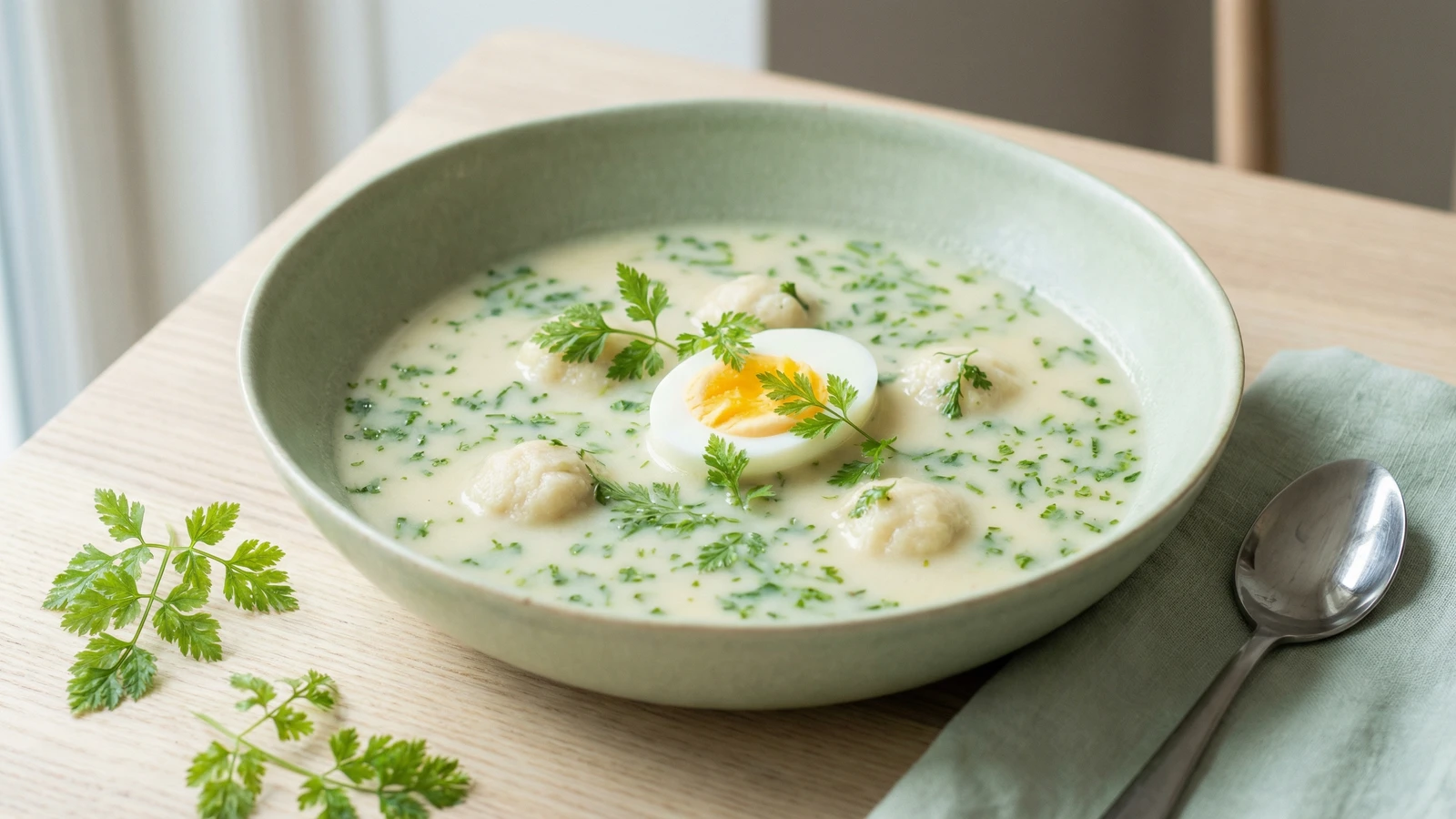
The herald of Danish spring. Delicate chervil stirred into a light broth just before serving to keep its bright green color, finished with little flour dumplings called melboller and halved boiled eggs.
There's a week in April when the chervil comes back. You notice it first at the market: small bunches of feathery pale green leaves, more delicate than parsley, smelling faintly of anise and something that might be hay or might be memory. This is the herb that tells Danish cooks the winter is over, and korvelsuppe is the bowl we make to mark the moment.
Korvelsuppe belongs to Easter. It belongs to the long tables where families come together after a winter of dark evenings and root vegetables, and it carries on its surface everything the spring has promised. A light chicken broth, thickened just enough with a white roux, finished with cream and a generous handful of finely chopped chervil stirred in off the heat. Small poached dumplings called melboller, made from choux dough and the size of hazelnuts. Halved boiled eggs, one of the oldest symbols of the season. Nothing here is difficult. Everything here is timed with care.
The one thing I want you to hold in your mind is this: chervil cannot boil. The second it touches heat that's too high, the color goes grey and the anise note disappears. So the soup is built first, seasoned first, and held off the heat when the chervil goes in. The residual warmth does the work. You'll see the whole pot turn green in front of you, and you'll understand why this dish only exists at the beginning of spring. The season decides, and in April the season says chervil. That's not a rule, it's a gift.
Chervil has grown in Danish monastery and farmhouse gardens since the Middle Ages, when it arrived with the herbal knowledge of Cistercian monks who cultivated it for both kitchen and apothecary. Korvelsuppe became associated with Easter specifically because chervil is one of the first herbs to push through the soil after the Danish winter, and its early appearance made it a natural emblem of resurrection and return on the paaskefrokost table. The addition of melboller, the small choux-paste dumplings that float in the finished bowl, is a borrowing from the French-influenced court cookery that reached Danish households through the cookbooks of the late 19th century, when the Danish bourgeoisie began to refine peasant soups with techniques from the professional kitchen.
The technique, the tradition, and the story behind every dish.
Discover Culinary AdvisorIngredients
chicken stock
Quantity
1.2 litres
good quality, ideally homemade
unsalted butter (for the soup)
Quantity
50g
plain flour (for the soup)
Quantity
2 tablespoons
single cream
Quantity
100ml
fresh chervil
Quantity
large bunch, about 50g
leaves picked and finely chopped
fine sea salt
Quantity
to taste
white pepper
Quantity
freshly ground, to taste
eggs (for garnish)
Quantity
3 large
hard-boiled, peeled and halved lengthways
unsalted butter (for the melboller)
Quantity
50g
water (for the melboller)
Quantity
100ml
plain flour (for the melboller)
Quantity
75g
eggs (for the melboller)
Quantity
2 large
fine sea salt
Quantity
pinch
caster sugar
Quantity
pinch
freshly grated nutmeg
Quantity
pinch
| Ingredient | Quantity |
|---|---|
| chicken stockgood quality, ideally homemade | 1.2 litres |
| unsalted butter (for the soup) | 50g |
| plain flour (for the soup) | 2 tablespoons |
| single cream | 100ml |
| fresh chervilleaves picked and finely chopped | large bunch, about 50g |
| fine sea salt | to taste |
| white pepper | freshly ground, to taste |
| eggs (for garnish)hard-boiled, peeled and halved lengthways | 3 large |
| unsalted butter (for the melboller) | 50g |
| water (for the melboller) | 100ml |
| plain flour (for the melboller) | 75g |
| eggs (for the melboller) | 2 large |
| fine sea salt | pinch |
| caster sugar | pinch |
| freshly grated nutmeg | pinch |
Equipment Needed
- •Heavy-bottomed pot, 3 litre
- •Small saucepan for the melboller dough
- •Wide pan for poaching the melboller
- •Wooden spoon
- •Whisk
- •Slotted spoon
- •Two small teaspoons for shaping
Instructions
- 1
Make the melboller dough
Bring the water and butter for the melboller to a gentle boil in a small saucepan with the salt, sugar, and nutmeg. When the butter has melted completely, tip in the flour all at once and beat hard with a wooden spoon. The mixture will come together into a smooth ball that pulls cleanly away from the sides of the pan. Keep stirring for another minute over a low heat to dry the dough out slightly. This is the same method as French pate a choux, and the Danes borrowed it long ago because it gives the lightest dumplings you can make.
The dough is ready when a thin film forms on the bottom of the pan. That's the sign the flour has cooked and the water has evaporated enough. - 2
Finish the dough
Take the pan off the heat and let the dough cool for three minutes. If you add the eggs too soon, they will scramble. Beat in the eggs one at a time, working each one in completely before adding the next. The dough will look slippery and broken at first, then tighten back into a glossy paste. You want a dough that holds a soft peak when you lift the spoon.
- 3
Shape and poach the melboller
Bring a wide pan of lightly salted water to a bare simmer. Never a rolling boil. A rolling boil tears the dumplings apart. Using two small teaspoons, shape little ovals of dough the size of hazelnuts and slip them gently into the water. Work in batches so the pan isn't crowded. The melboller will sink at first, then rise to the surface after about three minutes. Let them cook for another minute, then lift them out with a slotted spoon onto a plate. Set aside.
Dip the spoons in the simmering water between each dumpling. The dough will release cleanly instead of sticking. - 4
Build the roux
Melt the butter in a heavy pot over a medium heat. When it foams, scatter in the flour and whisk it into a smooth paste. Cook the roux for two minutes, stirring constantly. You're not trying to brown it, just to cook out the raw flour taste. A white roux keeps the soup pale so the green of the chervil can sing through at the end.
- 5
Add the stock
Pour in the chicken stock a ladleful at a time, whisking constantly. Go slowly at the start. If you add too much stock too quickly, the roux will form lumps that you'll spend the next ten minutes chasing around the pan. Once you have a smooth base, add the rest of the stock in a steady stream. Bring the soup to a gentle simmer and cook for fifteen minutes, skimming any foam that rises to the top. The soup should thicken slightly but stay light. This is a delicate broth, not a heavy cream soup.
- 6
Finish with cream and season
Stir in the cream and warm it through without letting the soup boil. Boiling splits cream and flattens its richness. Season with salt and white pepper. White pepper is the right choice here, not black. Black pepper leaves dark flecks that muddy the appearance. Taste and adjust. The soup should be rich but light, rounded but bright.
- 7
Stir in the chervil
Take the pot off the heat. This is the moment that matters most. Add the chopped chervil and stir it through. Do not let the soup boil after the chervil goes in. Chervil is a fragile herb, nothing like parsley. Heat will turn it grey and rob it of its delicate anise perfume within seconds. The residual warmth of the soup is enough to release the flavor and keep the color bright green. You'll see the whole pot come alive with green the moment the leaves go in.
Reserve a small handful of chervil leaves whole, not chopped, to scatter on top at the table. The chopped chervil gives the flavor; the whole leaves give the final gesture. - 8
Serve at the table
Warm the melboller gently in the soup for thirty seconds, no more. Ladle into wide shallow bowls. Place half a boiled egg in each bowl, yolk-side up, and scatter the reserved whole chervil leaves over the top. Serve at once with good bread alongside. Tak for mad.
Chef Tips
- •Chervil is the whole point, and it must be fresh. Dried chervil tastes of nothing. If you can't find chervil at your market in April or May, don't make this soup with parsley or dill as a substitute. Make something else and wait for next spring. The joy of waiting is part of the dish.
- •The stock is the foundation. A homemade chicken stock made from a carcass and a few hours of gentle simmering gives you a bowl that tastes of something. A stock cube gives you salt water with ambition. If you don't have time to make stock from scratch, buy the best fresh chilled stock you can find.
- •Korvelsuppe is traditionally served as a first course at the Danish Easter lunch, before the cold table of smorrebrod and pickled herring arrives. A small bowl is enough. This is a soup of welcome, not of weight.
Advance Preparation
- •The melboller can be shaped and poached a few hours ahead. Keep them on a plate covered with a damp cloth at room temperature, and warm them through in the soup just before serving.
- •The soup base, up to the point of adding the chervil, can be made earlier in the day. Gently reheat it without letting it boil, then stir in the chervil off the heat the moment before the bowls go to the table. The chervil is always the last gesture, never the first.
Frequently Asked Questions
Nutrition Information
1 serving (about 450g)
Where cooking meets culture.
Culinary mentorship, cultural storytelling, and the editorial depth that makes cooking meaningful.
Explore Culinary Advisor