Culinary Advisor
A cooking platform built around craft, culture, and the stories behind what we eat.
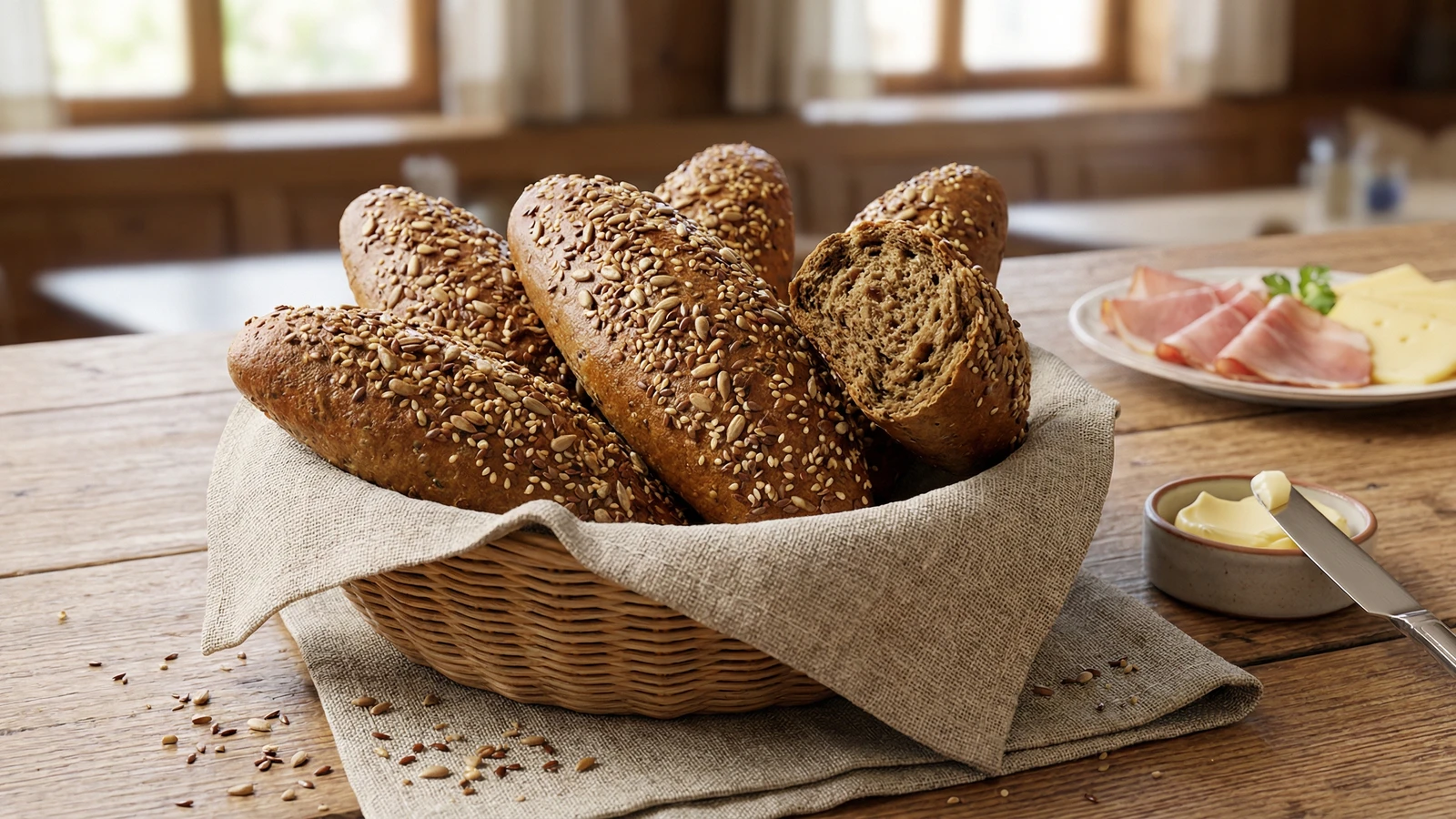
Kornspitz (Seeded Multigrain Rolls)
Created by Chef Elsa
Dark, nutty rye-wheat rolls with pointed ends and a crunchy seed crust, the roll Austrians reach for when a Semmel is too polite for the occasion.
Every Austrian bakery has a basket of Semmeln and a basket of Kornspitz, and the one you choose tells people something about you. The Semmel is light, white, all about the crust. The Kornspitz is its darker, earthier cousin: a rye-wheat roll shaped like a spindle with pointed ends, coated in sunflower seeds and flaxseeds and sesame, with a crumb that actually tastes like grain. When I was a child on those trips to Austria with Gretel and my grandmother Eva, I'd stand at the bakery counter in Salzburg and point at the Kornspitz every single time. Gretel would laugh and say it figured, because I never did anything the easy way.
Kornspitz is the roll you want for Jause, the Austrian afternoon meal that's somewhere between a snack and a light supper. You split it open, lay good butter on one half, pile Schinken or Bergkäse on the other, and eat it with a few cornichons and maybe some radishes. The seeds on the crust crunch against the soft, slightly sour crumb inside. It's a roll with personality. A Semmel politely holds your sandwich together. A Kornspitz has opinions about what goes on it.
At my restaurant in Salzburg, we bake these every morning. The kitchen smells like toasted seeds and rye by seven o'clock. The dough is simple: rye flour, wheat flour, a touch of malt syrup for color and depth, good butter, and a seed mixture pressed into the surface before baking. The shape takes a little practice, those pointed ends aren't decorative, they crisp up in the oven and give you something to tear off with your fingers. Once you've made a batch, you won't go back to buying them.
The name Kornspitz, meaning 'grain point,' was trademarked by the Austrian baking company backaldrin in 1985, but the style of seeded rye-wheat roll with tapered ends is far older, rooted in the mixed-grain baking traditions of Austria's Alpine provinces. In 2012, the EU General Court ruled that Kornspitz had become a generic term in Austria, stripping the trademark protection. It was a bread-naming dispute that would have made the Viennese proud, given their fondness for food-related legal battles.
The technique, the tradition, and the story behind every dish.
Discover Culinary AdvisorIngredients
strong bread flour (Austrian Type 700 if available)
Quantity
300g
dark rye flour (Austrian Type 960 or 1150)
Quantity
200g
fine salt
Quantity
10g
dried yeast
Quantity
7g
barley malt syrup (or dark honey)
Quantity
1 tablespoon
unsalted butter
Quantity
25g
softened
lukewarm water
Quantity
300ml
around 38°C
sunflower seeds
Quantity
30g
flaxseeds (linseeds)
Quantity
20g
sesame seeds
Quantity
20g
pumpkin seeds (optional)
Quantity
10g
water
Quantity
for brushing
| Ingredient | Quantity |
|---|---|
| strong bread flour (Austrian Type 700 if available) | 300g |
| dark rye flour (Austrian Type 960 or 1150) | 200g |
| fine salt | 10g |
| dried yeast | 7g |
| barley malt syrup (or dark honey) | 1 tablespoon |
| unsalted buttersoftened | 25g |
| lukewarm wateraround 38°C | 300ml |
| sunflower seeds | 30g |
| flaxseeds (linseeds) | 20g |
| sesame seeds | 20g |
| pumpkin seeds (optional) | 10g |
| water | for brushing |
Equipment Needed
- •Large mixing bowl
- •Kitchen scale
- •Baking tray with parchment paper
- •Sharp knife or bread lame for scoring
- •Wire cooling rack
- •Shallow bowl or plate for seed mixture
- •Oven-safe tray or cast iron pan (for steam)
Instructions
- 1
Mix the seed coating
Combine the sunflower seeds, flaxseeds, sesame seeds, and pumpkin seeds if using in a shallow bowl or plate. Set this aside. You'll press the shaped rolls into this mixture later, so spread it out wide enough to roll a piece of dough across.
Toast the seeds lightly in a dry pan first if you want a deeper, nuttier flavor on the crust. Let them cool completely before using. At the restaurant we do this every time, but the rolls are good either way. - 2
Build the dough
In a large bowl, combine the bread flour, rye flour, and salt. Make a well in the center. If you're using fresh yeast, crumble it into the lukewarm water and stir until dissolved. For dried yeast, just sprinkle it in and let it sit for a minute. Pour the yeast water into the well along with the malt syrup and softened butter. Mix everything together with a wooden spoon until a shaggy dough forms, then turn it out onto a clean work surface.
Barley malt syrup gives Kornspitz their characteristic dark color and a subtle sweetness that balances the rye. You'll find it at health food shops or online. Dark honey works if you can't source it, but the flavor will be slightly different. - 3
Knead the dough
Knead for eight to ten minutes. This dough will feel different from a pure wheat dough because the rye flour absorbs water more slowly and doesn't develop gluten the same way. It will be slightly sticky and denser. That's right. Don't add extra flour unless it's truly unworkable. You want a dough that's smooth and just slightly tacky to the touch. If it sticks to your hands, wet them instead of flouring them. The rye needs that moisture to develop the crumb you're after.
Rye flour contains pentosans, a type of starch that makes the dough behave differently from wheat. It stays stickier, it doesn't become as elastic, and it holds more water. This is not a problem. This is why Kornspitz have that dense, moist crumb instead of the open, airy structure of a Semmel. - 4
First rise
Shape the dough into a ball, place it back in the bowl, and cover with a clean tea towel or cling film. Leave it in a warm spot for one hour, or until it has grown by about half its size. Rye doughs don't double the way white doughs do. Don't wait for that. If it looks noticeably puffed and feels airy when you press it gently, it's ready.
- 5
Shape the Kornspitz
Turn the risen dough onto a lightly floured surface and divide it into eight equal pieces. A kitchen scale helps here. Each piece should weigh about 95 to 100 grams. Take one piece and roll it under your palms into a cylinder about 15 centimeters long. Now apply more pressure at the ends than in the center, tapering each end to a point. The finished shape should look like a spindle or a fat cigar with sharpened tips. Those pointed ends are not decorative. They bake up crisp and crunchy while the thicker center stays soft. Repeat with the remaining pieces.
If the dough keeps springing back when you try to taper the ends, let the pieces rest under a towel for five minutes and try again. The gluten just needs to relax. - 6
Coat with seeds
Brush each shaped roll lightly with water on all sides. You want the surface damp, not dripping. Roll each one through the seed mixture, pressing gently so the seeds stick to the entire surface. The water acts as glue. Place the coated rolls on a baking tray lined with parchment, leaving a few centimeters between them. They'll spread slightly as they proof.
- 7
Second rise
Cover the tray loosely with a tea towel and let the rolls proof for thirty to forty minutes. They should look visibly puffed but still hold their pointed shape. While they proof, preheat your oven to 220°C (430°F) with a baking tray or cast iron pan on the bottom rack. You'll need that for creating steam.
- 8
Score and bake
Using a sharp knife or a razor blade, make one long diagonal slash down the center of each roll, about half a centimeter deep. This controls where the roll opens as it bakes and gives Kornspitz their signature split down the middle. Slide the tray into the oven and immediately pour a cup of water onto the hot tray below. Close the door fast. The burst of steam is what gives the crust its initial stretch and shine. Without it, the rolls set too early and you'll get a thick, dull crust instead of a thin, crackling one.
After ten minutes, crack the oven door open for a few seconds to release the remaining steam. This lets the crust dry out and crisp up properly for the second half of baking. - 9
Check and cool
Bake for 22 to 25 minutes total, until the rolls are deep golden brown and the seeds are toasted and fragrant. Pick one up and knock on the bottom. It should sound hollow, like tapping on a small drum. If it sounds dense and flat, give them another three minutes. Transfer to a wire rack and let them cool for at least fifteen minutes before eating. The crumb is still setting during this time. Cut into one too early and it will be gummy in the center. I know it's hard to wait when the kitchen smells like this. Wait anyway.
Chef Tips
- •The ratio of rye to wheat matters. Too much rye and the rolls will be dense and heavy, too little and they lose the earthy flavor that makes a Kornspitz a Kornspitz. The 40/60 split in this recipe is what we use at the restaurant and it gives you the best balance of flavor and structure.
- •If you can find Austrian Type 960 rye flour, use it. It's darker and more flavorful than the light rye flour sold in most supermarkets outside Austria. Whole rye flour is your next best option, or a dark rye from a specialty mill.
- •These rolls freeze beautifully. Let them cool completely, bag them tightly, and freeze for up to three months. Reheat from frozen in a 180°C oven for eight to ten minutes. They come back almost as good as fresh, which is more than you can say for most bread.
- •Kornspitz are Jause bread. Split one open, spread good butter on the cut side, and pile it with thinly sliced Schinken, sharp Bergkäse, or even just radishes and coarse salt. A Kornspitz with butter and a cup of strong coffee is a whole meal if you let it be.
Advance Preparation
- •The dough can be mixed and kneaded the evening before, then left to rise slowly overnight in the fridge. Pull it out an hour before shaping to take the chill off. Cold-fermented Kornspitz have a slightly more developed, tangier flavor.
- •Shaped and seed-coated rolls can be frozen on the tray before baking. Once solid, transfer to a bag. Bake from frozen at 220°C, adding three to four minutes to the bake time.
- •Baked Kornspitz stay good at room temperature in a paper bag for two days. After that, refresh them in a hot oven for five minutes.
Frequently Asked Questions
Nutrition Information
1 serving (about 105g)
Where cooking meets culture.
Culinary mentorship, cultural storytelling, and the editorial depth that makes cooking meaningful.
Explore Culinary Advisor