Culinary Advisor
A cooking platform built around craft, culture, and the stories behind what we eat.
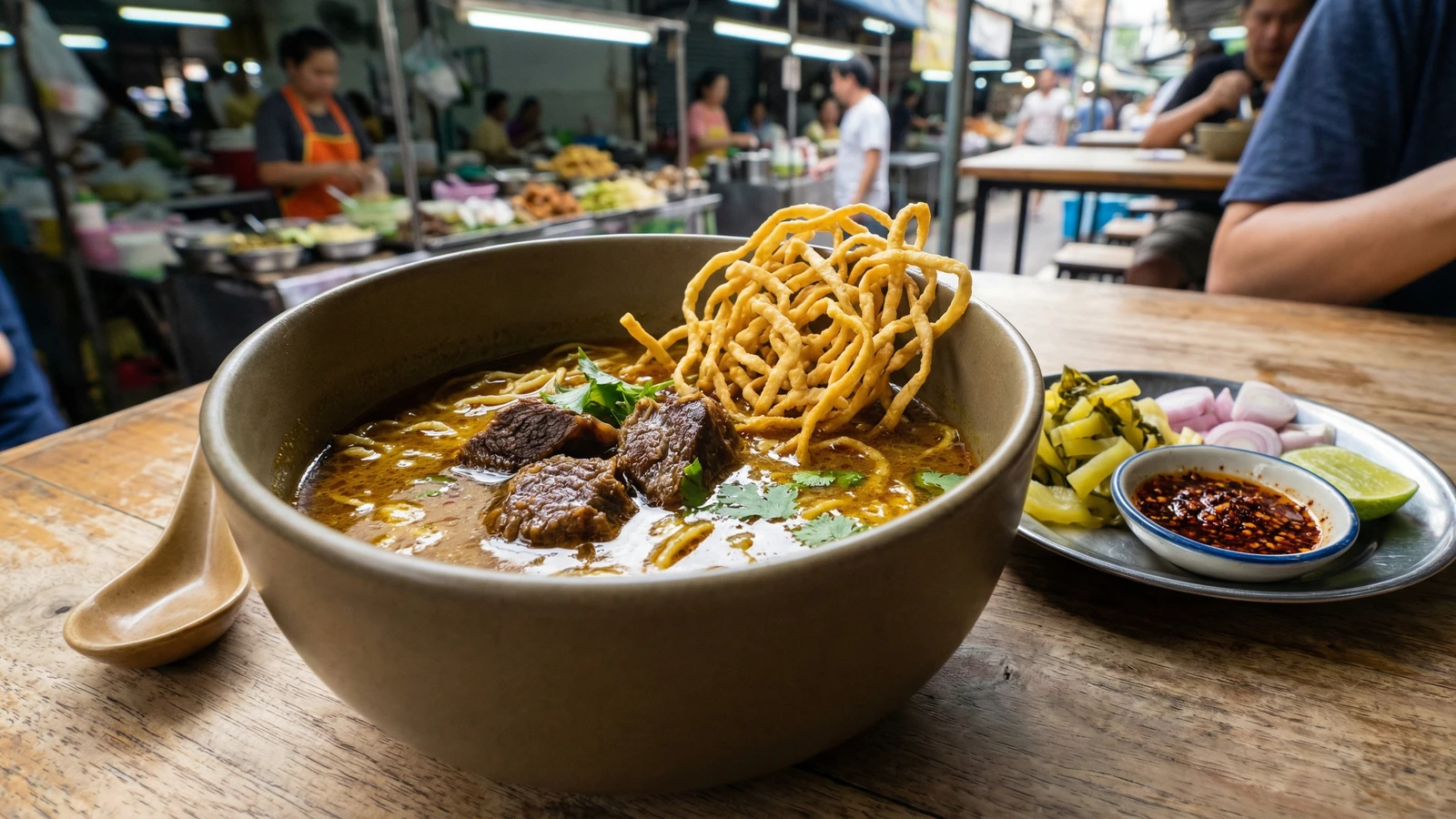
Muslim Curry Noodle Soup (Khao Soi Islam)
Created by
No coconut milk. No Central Thai curry paste. This is the older khao soi, the one the Chin Haw traders carried over the mountains from Yunnan into Lanna. Dried spices pounded into a kreung tam, beef braised until it surrenders, and a broth that tastes like the trade route itself.
Most people hear "khao soi" and think coconut curry noodles. That's the version that got famous. This isn't that.
Khao soi Islam is the older dish. No coconut milk. No cracking coconut cream in a wok. This is a spiced beef broth, built on a kreung tam of dried chilies, cumin, coriander seed, turmeric, and ginger. The paste foundation still holds, but the ingredients tell a different story. These are the dried spices of the overland trade routes, the aromatics that traveled well on mule caravans from Yunnan into Northern Thailand. When the Chin Haw (จีนฮ่อ), the Yunnanese Muslim traders, settled in Chiang Mai and the surrounding valleys, they brought this noodle soup with them. The kreung tam adapted. It always does.
Ajarn always said: the kreung tam is everything. Even here, where the paste looks nothing like a green curry or a gaeng hung lay, the principle is identical. You pound aromatics in the mortar until the cell walls break, the essential oils release, and the flavors merge into something greater than the sum. Cumin and coriander seed replace some of the fresh herbs. Ginger stands where galangal would in a Central Thai paste. Turmeric (kha min) turns the whole thing golden. But the method? The method is the same. Krok ก่อน.
The four pillars still govern. Fish sauce for salt. Palm sugar for sweet, just enough to round the edges of the spice. Lime squeezed at the table for sour. Dried chili flakes in oil for heat. The system doesn't care whether you're Muslim, Buddhist, or anything else. The principles are the principles. That's what makes Thai food a system and not just a collection of recipes.
At the Fai Thai workshop, I use this dish to teach the idea that the kreung tam travels. It crosses borders. It absorbs influences. But it never stops being a pounded paste foundation. If you understand that, you understand why a Muslim noodle soup from Chiang Mai and a Buddhist green curry from Bangkok are cousins, not strangers.
Khao soi Islam traces to the Chin Haw (จีนฮ่อ), Yunnanese Muslim traders who migrated into Northern Thailand along the old caravan routes connecting Yunnan province to Lanna during the 19th century. The dish predates the now-famous coconut curry version (khao soi kai), which likely developed later as Thai cooks adapted the original spiced broth with local coconut milk. The Muslim community around Chang Khlan Road in Chiang Mai still serves this version, and the word "khao soi" itself may derive from a Shan or Yunnanese term for cut noodles, reflecting its origins north of the Thai border.
The technique, the tradition, and the story behind every dish.
Discover Culinary AdvisorIngredients
dried long red chilies (prik haeng)
Quantity
8
seeds removed, soaked in warm water 15 minutes
shallots (hom daeng)
Quantity
4
roughly chopped
garlic (krathiam)
Quantity
6 cloves
fresh turmeric (kha min)
Quantity
2-inch piece
sliced (or 1½ teaspoons ground turmeric)
fresh ginger
Quantity
1-inch piece
sliced
cumin seeds (yira)
Quantity
1½ teaspoons
toasted
coriander seeds (luk phak chi)
Quantity
1½ teaspoons
toasted
black peppercorns (prik thai)
Quantity
½ teaspoon
shrimp paste (kapi)
Quantity
1 teaspoon
beef shank
Quantity
500g
cut into large chunks
beef bones
Quantity
250g
water
Quantity
6 cups
star anise
Quantity
2
cinnamon stick
Quantity
1 (about 3 inches)
cardamom pods
Quantity
2
lightly crushed
vegetable oil
Quantity
3 tablespoons
fish sauce (nam pla)
Quantity
2½ tablespoons, plus more to taste
palm sugar (nam tan pip)
Quantity
1 tablespoon
fresh egg noodles (ba mee)
Quantity
400g
divided: 300g for boiling, 100g for frying
vegetable oil for deep-frying
Quantity
as needed
pickled mustard greens (phak kad dong)
Quantity
½ cup
chopped
shallots for serving
Quantity
4
thinly sliced into rings
limes
Quantity
2
cut into wedges
dried chili flakes in oil
Quantity
for serving
fresh cilantro leaves (phak chi)
Quantity
for garnish
| Ingredient | Quantity |
|---|---|
| dried long red chilies (prik haeng)seeds removed, soaked in warm water 15 minutes | 8 |
| shallots (hom daeng)roughly chopped | 4 |
| garlic (krathiam) | 6 cloves |
| fresh turmeric (kha min)sliced (or 1½ teaspoons ground turmeric) | 2-inch piece |
| fresh gingersliced | 1-inch piece |
| cumin seeds (yira)toasted | 1½ teaspoons |
| coriander seeds (luk phak chi)toasted | 1½ teaspoons |
| black peppercorns (prik thai) | ½ teaspoon |
| shrimp paste (kapi) | 1 teaspoon |
| beef shankcut into large chunks | 500g |
| beef bones | 250g |
| water | 6 cups |
| star anise | 2 |
| cinnamon stick | 1 (about 3 inches) |
| cardamom podslightly crushed | 2 |
| vegetable oil | 3 tablespoons |
| fish sauce (nam pla) | 2½ tablespoons, plus more to taste |
| palm sugar (nam tan pip) | 1 tablespoon |
| fresh egg noodles (ba mee)divided: 300g for boiling, 100g for frying | 400g |
| vegetable oil for deep-frying | as needed |
| pickled mustard greens (phak kad dong)chopped | ½ cup |
| shallots for servingthinly sliced into rings | 4 |
| limescut into wedges | 2 |
| dried chili flakes in oil | for serving |
| fresh cilantro leaves (phak chi) | for garnish |
Equipment Needed
- •Heavy granite mortar and pestle (krok hin) for pounding the kreung tam
- •Heavy-bottomed pot or Dutch oven for braising
- •Wok or deep pan for frying the crispy noodles
- •Spider strainer for lifting fried noodles
Instructions
- 1
Toast and pound the kreung tam
In a dry wok or small pan over medium heat, toast the cumin seeds and coriander seeds until they're fragrant and a shade darker, about 2 minutes. Keep them moving. The moment you smell them, they're done. Let them cool briefly. In a heavy granite mortar (krok hin), pound the toasted cumin and coriander seeds with the black peppercorns until they're a rough powder. Add the drained soaked chilies and pound to a paste. Then the shallots. Then garlic. Then ginger. Then turmeric. Each ingredient goes in after the previous one is broken down. Finish with the shrimp paste (kapi) and pound until everything is integrated: a rough, golden-orange paste that smells warm, earthy, and nothing like a Central Thai curry paste. That's the point. This kreung tam traveled a different road.
Ajarn always said: the order matters in the mortar. Hard and dry ingredients first (seeds, peppercorns), then fibrous aromatics (chilies, shallots, garlic), then soft and wet (ginger, turmeric). Each layer gets broken down before the next goes in. Rush the order and the paste will be uneven. - 2
Sear the beef
Pat the beef shank pieces dry with a towel. Season lightly with a pinch of salt. Heat 1 tablespoon of vegetable oil in a heavy pot or Dutch oven over high heat until it shimmers. Sear the beef in batches, getting a deep brown crust on at least two sides, about 3 minutes per side. Don't crowd the pot. Crowding drops the temperature and you steam the meat instead of searing it. Set the browned beef aside. This browning isn't decoration. It's the Maillard reaction building the base flavor of your broth.
- 3
Fry the paste
In the same pot, reduce heat to medium. Add the remaining 2 tablespoons of oil. Scrape in all of the kreung tam. Fry the paste, stirring constantly, for 3 to 4 minutes. The paste will darken slightly and the oil will start to separate at the edges. The kitchen will fill with cumin and turmeric and roasted chili. That's the transformation happening. The raw spice smell cooks out and the deep, rounded aroma comes in. If it starts to stick, lower the heat. Burnt paste is dead paste.
This step is where the kreung tam goes from raw ingredients to flavor foundation. You'll know it's ready when the oil pools at the edges of the paste and the color deepens from bright orange to a rich, burnished gold. Your nose will tell you before your eyes do. - 4
Build the broth and braise
Return the seared beef and bones to the pot. Add the star anise, cinnamon stick, and crushed cardamom pods. Pour in the 6 cups of water. The liquid should just cover the meat. Bring to a boil, then immediately drop to the lowest possible simmer. Skim any foam that rises in the first 10 minutes. Add the fish sauce and palm sugar. Stir once. Cover with the lid slightly cracked and let it braise for 1½ to 2 hours. The beef is done when it pulls apart under gentle pressure from a fork but still holds its shape. The broth should be golden-brown, clear but deeply flavored, with a slick of spiced oil on the surface. Taste. Adjust salt with more fish sauce. The balance should lean savory and warm, with just enough palm sugar to round the spice. Remove the star anise, cinnamon stick, and cardamom pods before serving.
Low and slow. A hard boil makes the broth cloudy and the beef tough. You want the surface barely trembling, a lazy bubble every few seconds. That's the temperature that breaks down collagen into gelatin and gives the broth its body. - 5
Fry the crispy noodles
While the broth simmers, separate 100g of the fresh egg noodles and spread them out on a towel to dry for 10 minutes. Excess moisture will splatter in the oil. Heat about 2 inches of vegetable oil in a wok or deep pan to 180°C (350°F). Drop the dried noodles in small handfuls. They'll puff and curl within seconds, turning golden and crispy. Pull them out with a spider strainer the moment they stop bubbling aggressively, about 30 seconds per batch. Drain on paper. These go on top of the soup at the very end. They should shatter when you bite down. If they're chewy, the oil wasn't hot enough.
- 6
Cook the fresh noodles
Bring a separate pot of water to a rolling boil. Cook the remaining 300g of fresh egg noodles for 60 to 90 seconds, until they're just tender but still have bite. Fresh ba mee cooks fast. Don't walk away. Drain, shake off excess water, and divide among four bowls immediately.
- 7
Assemble and serve
Place the cooked noodles in deep bowls. Lay two or three chunks of braised beef on top of each portion. Ladle the hot broth generously over the noodles and beef, making sure each bowl gets some of that spiced oil from the surface. Crown each bowl with a nest of crispy fried noodles. Scatter cilantro leaves on top. Serve with the krueng prung (condiment tray) on the side: pickled mustard greens (phak kad dong), sliced raw shallots, lime wedges, and chili flakes in oil. The condiments are not optional. They're the final calibration. The lime goes in at the table, sour added last, sour added slowly. The pickled greens cut through the richness. The raw shallots add bite. The chili oil brings the heat to wherever you want it. That's the Northern Thai tradition: the cook builds the foundation, the eater finishes the dish.
Chef Tips
- •This is not the coconut khao soi. If you add coconut milk, you've made a different dish entirely. The Muslim version is a clear, spiced broth. It's lighter in body but deeper in spice. The warmth comes from cumin, coriander, cinnamon, and star anise, the trade-route aromatics that the Chin Haw brought overland from Yunnan. Respect the distinction.
- •Ginger, not galangal. This is one of the few Northern Thai dishes where ginger (khing) takes the lead instead of galangal (kha). The Yunnanese influence shows here. Galangal is a Southeast Asian rhizome. Ginger crossed the mountains. The paste tells you the dish's history if you know how to read it.
- •The crispy noodle topping is structural, not decorative. It gives you texture contrast in every bite: soft boiled noodles on the bottom, tender braised beef in the middle, shattering crispy noodles on top, all in a spiced broth. If the crispy noodles go soggy, you waited too long. They go on last, right before serving.
- •Pickled mustard greens (phak kad dong) are essential. They cut through the richness of the beef broth with their sharp, fermented sourness. If you can't find them, don't substitute with random pickles. Make them yourself: it's salt, water, and mustard greens fermented for 3 days. The simplicity is the point.
- •If you have access to a Chiang Mai night market, find the Muslim vendors near Chang Khlan Road. They've been making this version for generations. The broth is thinner, cleaner, more aromatic than the coconut version. That's your benchmark. Everything else is adaptation.
Advance Preparation
- •The kreung tam can be pounded a day ahead and refrigerated in an airtight container. The flavors deepen overnight. Bring to room temperature before frying.
- •The braised beef and broth can be made a day in advance. Cool, refrigerate, and reheat gently. The broth often tastes better the next day as the spices continue to infuse. Skim any solidified fat from the surface or stir it back in, your choice.
- •Do not fry the crispy noodles ahead. They lose their crunch within 30 minutes. Fry them while you reheat the broth and boil the fresh noodles.
Frequently Asked Questions
Nutrition Information
1 serving (about 500g)
Where cooking meets culture.
Culinary mentorship, cultural storytelling, and the editorial depth that makes cooking meaningful.
Explore Culinary Advisor