Culinary Advisor
A cooking platform built around craft, culture, and the stories behind what we eat.
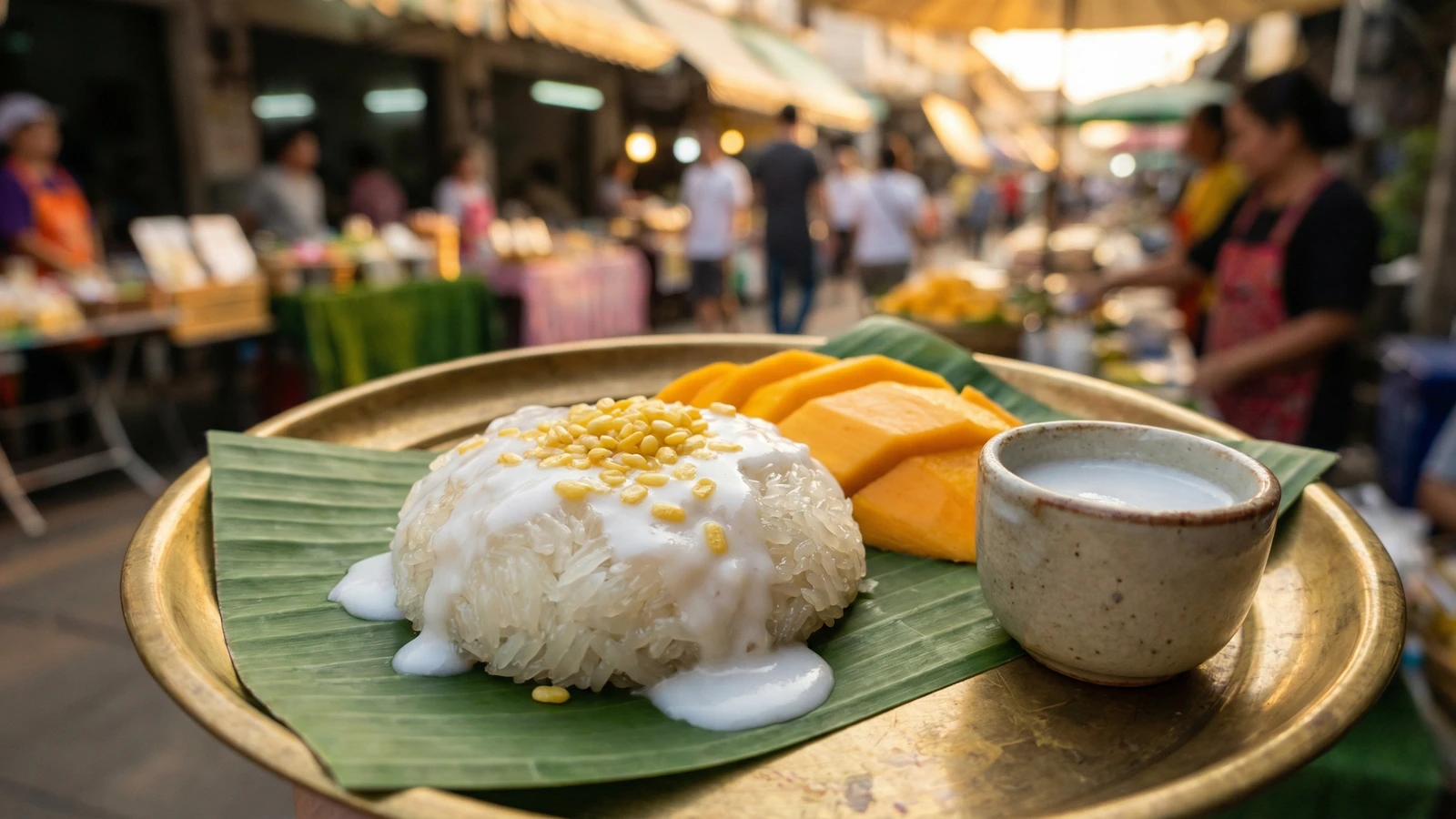
Mango Sticky Rice (Khao Niew Mamuang)
Created by
The sweet pillar isn't decoration. Palm sugar for sweetness, coconut cream for richness, pandan for fragrance, a pinch of salt to anchor it all. Thai dessert follows the same system as every savory dish. Principles, not recipes.
The sweet pillar governs this dish. Palm sugar for sweet. That's the law, and it doesn't stop applying just because you've moved from the savory side of the stall to the dessert cart.
Ajarn always said Thai cuisine is a system, not a menu. The four pillars don't vanish when you make khanom (ขนม, sweets). They transform. In khao niew mamuang, the sweet pillar moves to the center. Palm sugar (nam tan pip) provides a caramel warmth that granulated white sugar can never touch. Coconut cream (hua kathi) delivers fat and body. Pandan leaf (bai toey) gives that unmistakable green, floral fragrance that is to Thai desserts what vanilla is to French pastry. And then salt. A full pinch of it in the coconut sauce. That salt is what separates a great khao niew mamuang from a forgettable one. Without it, the sweetness is flat. With it, every flavor lifts.
Here's where people go wrong: the rice. Sticky rice (khao niew) is not jasmine rice. It's not long-grain anything. It's a glutinous short-grain rice that must be soaked overnight and steamed, never boiled. Boiling waterlogged sticky rice gives you porridge. Steaming it in a bamboo steamer basket over a tall pot (the huad and mo neung, the conical basket and pot that every Isan household owns) gives you individual grains that are tender, chewy, and ready to absorb the coconut cream mixture. The rice drinks the sauce. That absorption is the entire point. If your rice can't absorb, you've cooked it wrong.
I watched my mother make this for temple fairs in April, right at the peak of mango season. She'd steam the khao niew in the morning, mix the coconut cream sauce while it was still hot, fold them together, and let the rice sit under a banana leaf cover for an hour. Not in the fridge. Room temperature. The banana leaf wasn't garnish. It trapped moisture and kept the rice from drying out while the coconut cream soaked in. When she pulled that leaf back, the rice was glossy, fragrant, and ready. That's technique. That's the system at work, even in dessert.
Khao niew mamuang became Thailand's most internationally recognized dessert in the late 20th century, but sticky rice with coconut cream is an ancient Central Thai preparation that predates the modern mango pairing. The dish depends on the Nam Dok Mai mango (มะม่วงน้ำดอกไม้), a cultivar prized for its fiberless flesh, honey-like sweetness, and floral aroma, available only from March to June. Thailand's dessert tradition is notably distinct from the Portuguese-influenced egg sweets (foi thong, thong yip, thong yod) introduced by Maria Guyomar de Pinha in the 17th-century Ayutthaya court; khao niew mamuang represents the purely Thai lineage of khanom, built on coconut, palm sugar, and rice flour rather than egg yolks and cane sugar.
The technique, the tradition, and the story behind every dish.
Discover Culinary AdvisorIngredients
Thai sticky rice (khao niew)
Quantity
2 cups
soaked overnight in cold water, drained
coconut cream (hua kathi)
Quantity
400ml
freshly pressed or first-press canned
palm sugar (nam tan pip)
Quantity
100g
chopped
salt
Quantity
1/2 teaspoon
pandan leaves (bai toey)
Quantity
2
knotted
ripe Nam Dok Mai mangoes
Quantity
2
peeled and sliced
coconut cream for topping
Quantity
1 tablespoon
mung beans (thua khieo) (optional)
Quantity
1 tablespoon
split, toasted
banana leaf
Quantity
1 piece
for covering
| Ingredient | Quantity |
|---|---|
| Thai sticky rice (khao niew)soaked overnight in cold water, drained | 2 cups |
| coconut cream (hua kathi)freshly pressed or first-press canned | 400ml |
| palm sugar (nam tan pip)chopped | 100g |
| salt | 1/2 teaspoon |
| pandan leaves (bai toey)knotted | 2 |
| ripe Nam Dok Mai mangoespeeled and sliced | 2 |
| coconut cream for topping | 1 tablespoon |
| mung beans (thua khieo) (optional)split, toasted | 1 tablespoon |
| banana leaffor covering | 1 piece |
Equipment Needed
- •Bamboo steamer basket or traditional Thai huad (หวด, conical bamboo basket) with tall pot (mo neung)
- •Medium saucepan for coconut cream sauce
- •Wide shallow bowl or tray for mixing rice and coconut
- •Banana leaf for covering
Instructions
- 1
Soak the sticky rice
The night before, rinse the sticky rice (khao niew) in several changes of cold water until the water runs clear. Cover with cold water by at least two inches and let it soak for a minimum of eight hours, overnight is ideal. This is not optional. Sticky rice that hasn't soaked won't steam properly. The grains need to be fully hydrated before they ever touch heat. Skipping the soak gives you crunchy, undercooked rice in the center and mushy rice on the outside. No shortcut works here.
Use Thai glutinous rice (khao niew), not Japanese sweet rice, not regular long-grain. The starch composition is different. Glutinous rice is almost entirely amylopectin, which is what gives it that sticky, chewy texture when steamed. Regular rice has amylose, which makes it fluffy and separate. Wrong rice, wrong dish. - 2
Steam the rice
Drain the soaked rice and spread it in an even layer in a bamboo steamer basket or a cheesecloth-lined steamer. If you have a traditional Thai huad (หวด, the conical bamboo basket) set over a tall pot (mo neung), use that. It's designed for exactly this. Steam over high heat for 20 to 25 minutes. Flip the rice halfway through by turning the mass over with a spatula so the top layer gets equal steam. The rice is done when every grain is translucent, tender, and chewy. No white chalky cores. Bite a grain. It should be soft but still have a gentle resistance, not mushy.
Never boil sticky rice. Boiling floods the grains with water, destroys their structure, and gives you congee. Steaming hydrates through vapor, keeping each grain intact and able to absorb the coconut sauce. This is physics, not tradition for tradition's sake. - 3
Make the coconut cream sauce
While the rice steams, gently heat the coconut cream in a saucepan over medium-low heat. Do not boil. Add the chopped palm sugar, salt, and knotted pandan leaves. Stir slowly until the palm sugar dissolves completely. The sauce should be warm, fragrant, and slightly thick. Taste it. It should be sweet with a definite savory edge from the salt. That salt is critical. Without it, the sweetness has no dimension. With it, you get the full flavor of the coconut and palm sugar singing together. Remove the pandan leaves.
Palm sugar (nam tan pip) comes from the sap of the palmyra or coconut palm. It has caramel depth, butterscotch undertones, and a complexity that granulated white sugar cannot replicate. White sugar is pure sucrose, one-dimensional sweetness. Palm sugar contains minerals, trace aromatics, and a flavor profile that has defined Thai sweets for centuries. This is the sweet pillar. Don't substitute it. - 4
Combine rice and coconut sauce
Transfer the hot steamed rice to a wide, shallow bowl or tray. Pour about three-quarters of the warm coconut cream sauce over the rice. Fold gently with a spatula or large spoon. Don't stir aggressively or you'll break the grains and get paste. Gentle folding. The rice will absorb the coconut cream like a sponge. This is the moment where the dish comes together. Cover the surface with a piece of banana leaf, pressing it gently against the rice. Let it rest for 30 minutes at room temperature. Not in the fridge. The banana leaf traps moisture and fragrance. When you lift it, the rice should be glossy, plump, and coconut-scented throughout.
The rice must be hot when the coconut sauce goes in. Hot rice absorbs liquid. Room-temperature rice sits in it. This isn't a matter of preference. It's how starch works. The amylopectin in glutinous rice is most receptive to liquid absorption immediately after steaming. Wait too long and you get coconut cream pooling at the bottom of the bowl instead of inside the grain. - 5
Prepare the mango
Peel the mangoes and slice the cheeks off the pit in thick, clean slices. You can fan the slices or cut them into bite-sized pieces, whatever feels right. The mango should be dead ripe. Not firm. Not slightly underripe. Dead ripe. When you press a finger into it, it should give like a ripe avocado. The flesh should be deep golden-orange, fragrant, and almost custardy. An unripe mango with sticky rice is a missed opportunity. The whole point is the contrast: warm, salty-sweet coconut rice against cold, bright, honey-sweet mango.
- 6
Plate and serve
Remove the banana leaf from the rice. Mound the sticky rice on a plate or banana leaf. Arrange the mango slices alongside. Drizzle the remaining coconut cream sauce over the rice. Spoon a final tablespoon of thick, unheated coconut cream on top so it sits like a rich white pool on the surface. Scatter a few toasted mung beans over everything for crunch. Serve at room temperature. Not hot. Not cold. The rice should be warm and tender, the mango cool and bright. That temperature contrast is part of the design.
Street vendors in Bangkok serve khao niew mamuang on a small styrofoam plate with the mango sliced right there in front of you. No garnish fuss. Just rice, mango, sauce, and maybe those toasted mung beans. The simplicity is the elegance. Don't overthink the presentation.
Chef Tips
- •Coconut cream matters here more than almost any other Thai dish. Fresh-pressed coconut cream (squeezed from grated mature coconut) gives you a richness and natural sweetness that canned cannot match. If you use canned, buy a brand with no additives, no guar gum, no stabilizers. Shake the can. If it sloshes like water, it's thin. You want the can that's heavy, dense, and when you open it, there's a thick white layer on top. That's the hua kathi, the head of the coconut. That's what you use.
- •Mango season in Thailand runs from March to June. Nam Dok Mai (น้ำดอกไม้) is the gold standard: fiberless flesh, intense honey sweetness, floral perfume. Outside Thailand, Ataulfo (honey mango) is your best substitute. Avoid Tommy Atkins mangoes, they're bred for shelf stability, not flavor. If the mango isn't perfect, wait. This dish is seasonal for a reason.
- •The banana leaf cover during the resting stage isn't decoration. Banana leaf is a cooking tool. It traps moisture, prevents the surface from drying out, and contributes a subtle green, grassy fragrance to the rice. Plastic wrap doesn't do the same thing. If you can get banana leaf, use it.
- •Thai desserts reveal something important about the system: even sweets follow the four pillars. The sweet pillar (palm sugar) is dominant, but salt is there in every coconut sauce, balancing and lifting. Thai khanom (sweets) are never one-dimensionally sweet. They're sweet and salty, sweet and fragrant, sweet and textured. That's the system governing dessert. Ajarn always said: 'If it's only sweet, it's not Thai.'
- •The Portuguese connection in Thai desserts is real but often misunderstood. Maria Guyomar de Pinha, a woman of mixed Japanese-Portuguese-Bengali heritage, introduced egg yolk-based sweets to the Ayutthaya court in the 17th century. Foi thong (golden threads), thong yip (pinched gold), thong yod (golden drops) all trace back to her. But here's what matters: the Thai court took those techniques and made them follow Thai rules, replacing cane sugar with palm sugar, adding jasmine water, adapting the methods. Khao niew mamuang, however, has no Portuguese ancestry. It's purely Thai: coconut, palm sugar, sticky rice, pandan. The indigenous sweet tradition.
Advance Preparation
- •Sticky rice must soak overnight, minimum 8 hours. This is non-negotiable. Set it the night before and forget about it until morning.
- •The coconut cream sauce can be made while the rice steams. It takes 5 minutes. But it should be warm when it meets the hot rice, so don't make it too far ahead.
- •Once assembled, the rice can rest covered with banana leaf for up to 2 hours at room temperature. After that, the texture starts to harden as the starch retrogrades. This dish does not refrigerate well. The cold turns the sticky rice into a dense, chalky brick. Make it, rest it, eat it. Same day. That's the rule.
Frequently Asked Questions
Nutrition Information
1 serving (about 380g)
Where cooking meets culture.
Culinary mentorship, cultural storytelling, and the editorial depth that makes cooking meaningful.
Explore Culinary Advisor