Culinary Advisor
A cooking platform built around craft, culture, and the stories behind what we eat.
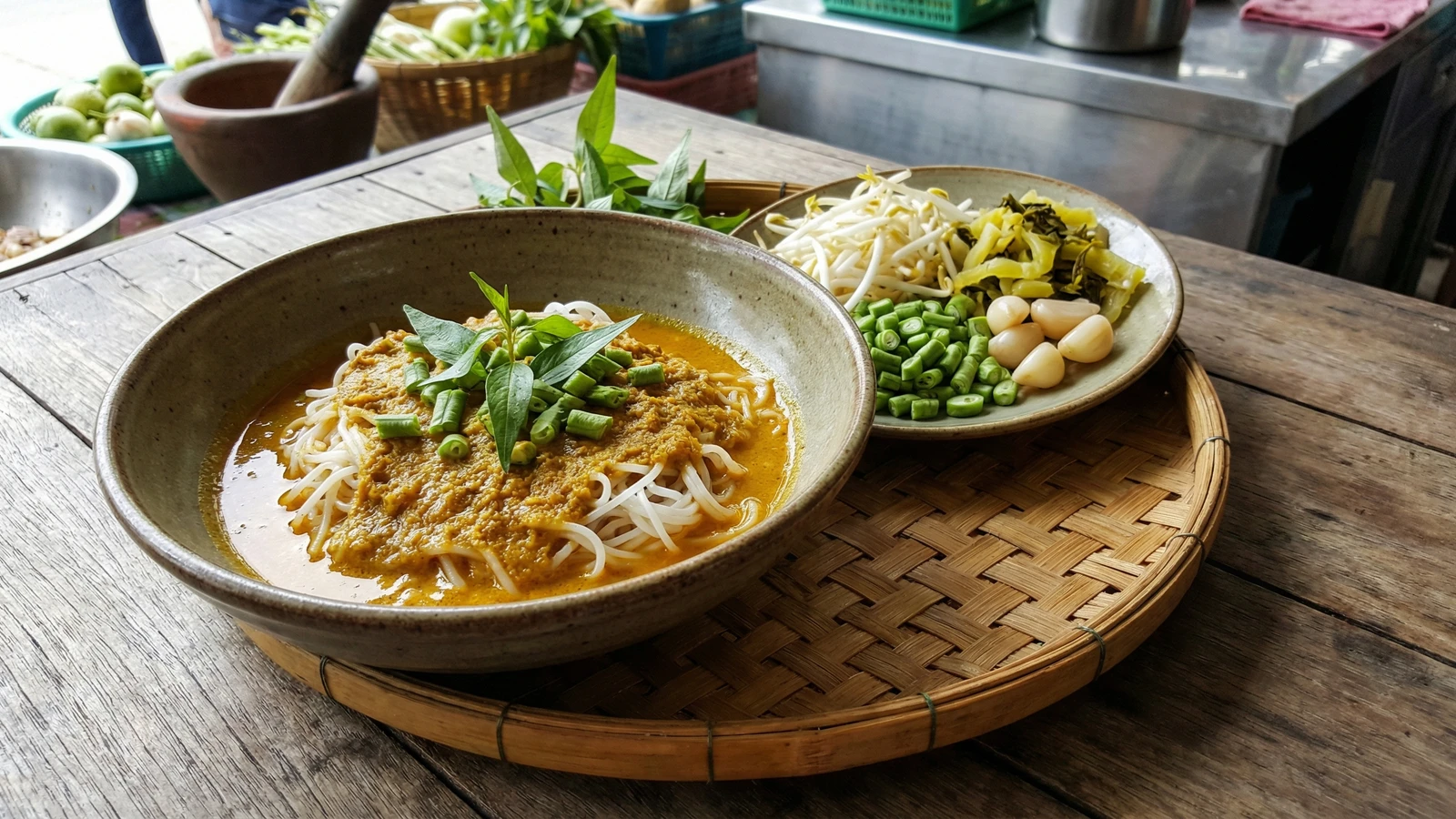
Rice Noodles with Fish Curry (Khanom Jeen Nam Ya)
Created by
The kreung tam doesn't sit beside the dish. It IS the dish. Fish pounded into the paste itself, dissolved into coconut milk, ladled over fermented rice noodles. This is the principle made visible.
This dish is the kreung tam in its purest form. Not hiding behind the protein. Not supporting it. Becoming it.
Ajarn always said: understand the paste, understand Thai food. Khanom jeen nam ya takes that lesson and makes it literal. You pound the kreung tam (galangal, lemongrass, krachai, shallots, garlic, dried chilies, shrimp paste, turmeric) and then you pound the fish right into it. The protein joins the paste. The paste becomes the sauce. The sauce is the entire point. There is no separate curry here, no broth on one side and protein on the other. It's all one thing, thick and aromatic, ladled over cool fermented rice noodles.
In Chiang Mai and Lamphun, khanom jeen nam ya lives in the shadow of khao soi. That's a mistake. Khao soi gets the tourist attention, the Instagram posts, the night market queues. But ask a Lanna grandmother what she wants for lunch on a Tuesday, and there's a good chance she'll point to the woman pressing fresh khanom jeen through a brass sieve at the morning market, a pot of nam ya simmering behind her. This is home food. Unhurried, deeply satisfying, built on technique that predates any recipe book.
The krachai (กระชาย, fingerroot) is what separates this paste from every other Thai curry paste you've made. It's not galangal. It's not ginger. It's a cluster of thin, finger-shaped rhizomes with an earthy, slightly medicinal flavor that softens into something warm and complex when pounded and cooked. If you skip it, you don't have nam ya. You have a fish curry. The ingredient is the identity.
Khanom jeen is among the oldest noodle traditions in mainland Southeast Asia. The name likely derives from the Mon language (khà-nǒm jīn means 'cooked/boiled food'), reflecting the dish's pre-Thai origins in the Mon-Khmer culinary world. The fermented rice noodles are pressed through a perforated mold into boiling water, a technique shared across Mon, Khmer, and Tai cultures. In Lanna, nam ya became the dominant khanom jeen topping alongside nam ngiew, with each Northern province claiming its own paste ratio. The Lamphun version is known for using more krachai and less chili than the Chiang Mai style, producing a milder, more aromatic sauce.
The technique, the tradition, and the story behind every dish.
Discover Culinary AdvisorIngredients
khanom jeen noodles (fermented rice noodles)
Quantity
500g
fresh, portioned into nests
snakehead fish or firm white freshwater fish
Quantity
400g
bone-in, whole or large pieces
thick coconut milk (hua kathi)
Quantity
400ml
thin coconut milk (hang kathi)
Quantity
400ml
dried red chilies (prik haeng)
Quantity
8
soaked 15 minutes, seeded
krachai (fingerroot/wild ginger)
Quantity
3 tablespoons
sliced
lemongrass (takhrai)
Quantity
3 stalks
tender part only, sliced thin
galangal (kha)
Quantity
5 slices
1/4 inch thick
shallots (hom daeng)
Quantity
5
sliced
garlic (krathiam)
Quantity
6 cloves
shrimp paste (kapi)
Quantity
1 tablespoon
fresh turmeric (khamin)
Quantity
1 tablespoon
sliced (or 1 teaspoon dried)
fish sauce (nam pla)
Quantity
3 tablespoons
palm sugar (nam tan pip)
Quantity
1 tablespoon
shredded cabbage (optional)
Quantity
1 cup
bean sprouts (optional)
Quantity
1 cup
long beans (thua fak yao) (optional)
Quantity
4
cut into 1-inch pieces
pickled mustard greens (phak kad dong) (optional)
Quantity
1/2 cup
roughly chopped
pickled garlic (krathiam dong) (optional)
Quantity
for serving
Vietnamese coriander (phak phai) (optional)
Quantity
1 small handful
| Ingredient | Quantity |
|---|---|
| khanom jeen noodles (fermented rice noodles)fresh, portioned into nests | 500g |
| snakehead fish or firm white freshwater fishbone-in, whole or large pieces | 400g |
| thick coconut milk (hua kathi) | 400ml |
| thin coconut milk (hang kathi) | 400ml |
| dried red chilies (prik haeng)soaked 15 minutes, seeded | 8 |
| krachai (fingerroot/wild ginger)sliced | 3 tablespoons |
| lemongrass (takhrai)tender part only, sliced thin | 3 stalks |
| galangal (kha)1/4 inch thick | 5 slices |
| shallots (hom daeng)sliced | 5 |
| garlic (krathiam) | 6 cloves |
| shrimp paste (kapi) | 1 tablespoon |
| fresh turmeric (khamin)sliced (or 1 teaspoon dried) | 1 tablespoon |
| fish sauce (nam pla) | 3 tablespoons |
| palm sugar (nam tan pip) | 1 tablespoon |
| shredded cabbage (optional) | 1 cup |
| bean sprouts (optional) | 1 cup |
| long beans (thua fak yao) (optional)cut into 1-inch pieces | 4 |
| pickled mustard greens (phak kad dong) (optional)roughly chopped | 1/2 cup |
| pickled garlic (krathiam dong) (optional) | for serving |
| Vietnamese coriander (phak phai) (optional) | 1 small handful |
Equipment Needed
- •Heavy granite mortar and pestle (krok hin) for the kreung tam
- •Medium stockpot for boiling fish
- •Heavy-bottomed pot or wok for the sauce
Instructions
- 1
Boil and flake the fish
Bring a pot of water to a boil. Add the whole fish (or large pieces, bone-in) and simmer for 12 to 15 minutes until the flesh is cooked through and flakes easily. Pull the fish out, let it cool enough to handle, then pick every last bit of flesh off the bones. Discard the bones and skin. Reserve about a cup of the poaching liquid. You'll need it later. Break the fish into rough flakes. Don't shred it to nothing yet. The mortar will do that work.
Snakehead fish (pla chon) is the traditional choice. Its firm, clean-flavored flesh holds up to pounding and gives the sauce body. If you can't find it, use mackerel or another oily, firm white fish. The fish needs to have enough structure to become the sauce, not dissolve into mush. - 2
Pound the kreung tam
Start in your granite mortar (krok hin). Pound the soaked dried chilies first until they break down into a rough paste. Then add the lemongrass, galangal, krachai, turmeric, shallots, and garlic. Pound everything together. The order matters: hard fibrous aromatics first, softer ones after. Work the pestle in a firm, steady rhythm. You're not smashing. You're grinding. The paste should become fragrant and relatively smooth, with no large chunks of lemongrass remaining. That takes ten to fifteen minutes. Your arm will know. Then add the shrimp paste (kapi) and pound it in until fully integrated. The aroma should fill the room: earthy krachai, sharp lemongrass, funky kapi, warm turmeric. That's the paste telling you it's ready.
The krachai is non-negotiable. It's what makes nam ya nam ya. Earthy, peppery, slightly medicinal. Nothing else tastes like it. Fresh krachai comes in clusters of thin, finger-shaped roots. If you can only find frozen, that works. Dried is a last resort. But skipping it entirely means you're making a different dish. - 3
Pound the fish into the paste
Here's where nam ya separates from every other Thai curry. Add the flaked fish to the mortar in batches. Pound it directly into the kreung tam. You're not keeping the fish separate. You're making the fish part of the paste itself. The protein becomes the sauce. Pound until the fish and paste are fully merged into a thick, cohesive mixture. It should look like a dense, textured curry paste with visible fiber from the fish but no separate flakes. This is the principle made physical: the kreung tam IS the dish.
Ajarn always said the kreung tam is everything. In most dishes, the paste is a component. In nam ya, the paste is the entire sauce. The fish doesn't sit in a curry. The fish becomes the curry. That's why this dish teaches the principle better than almost any other. - 4
Build the sauce
Heat the thick coconut milk (hua kathi) in a pot over medium heat. Stir continuously. After about 5 minutes, the oil will begin to separate and float on the surface. You'll see it crack, translucent pools of coconut oil forming on top. That's the signal. Add the fish-paste mixture and stir it into the cracked coconut cream. Keep stirring. The paste will dissolve into the fat and become incredibly aromatic. Cook for 3 to 4 minutes until the oil rises around the paste and the color deepens.
Cracking the coconut cream is the same technique used in green curry and red curry. The fat must separate before the paste goes in. If you dump everything together cold, the sauce tastes flat. The science is simple: fat-soluble flavor compounds in the paste need hot fat to release. No crack, no flavor extraction. - 5
Thin and season
Add the thin coconut milk (hang kathi) and about half a cup of the reserved fish poaching liquid. Stir well. The sauce should be the consistency of a thick gravy: it coats the back of a spoon but pours easily. If it's too thick, add more poaching liquid. Too thin and it won't cling to the noodles. Season with fish sauce (nam pla) and palm sugar (nam tan pip). The balance here is savory and rich, not sweet. The palm sugar is there to round the edges, not to announce itself. Taste. Adjust. Simmer on low heat for another 8 to 10 minutes, stirring occasionally, until the flavors meld and the raw kapi smell disappears entirely. What remains is deep, earthy, warm.
- 6
Serve over khanom jeen
Arrange nests of khanom jeen noodles in individual bowls. The noodles should be at room temperature, soft and slightly tangy from fermentation. Ladle the warm nam ya generously over the top. The sauce should pool around and over the noodles, thick enough to coat each strand. Arrange the accompaniments on the side or on a shared plate: shredded cabbage, bean sprouts, long beans, pickled mustard greens (phak kad dong), pickled garlic (krathiam dong), and Vietnamese coriander (phak phai). The vegetables are raw and crunchy. They cut through the richness. That contrast is the design. Each person builds their own bowl: a bite of noodle dragged through the sauce, a piece of pickled mustard green, a leaf of phak phai. That's how Lanna eats this.
Chef Tips
- •Khanom jeen noodles are fermented rice noodles with a slightly sour tang. They're pressed fresh, not dried. If you can find them at a Thai or Southeast Asian market, buy them fresh. They come in tangled nests and should smell faintly of rice and fermentation, not sour or off. If fresh khanom jeen is unavailable, thin rice vermicelli (sen mee) soaked in warm water is the closest backup. But know that you lose the fermented character that makes the dish what it is.
- •The accompaniment plate is not optional. It's structural. The raw crunch of cabbage and bean sprouts, the sour bite of pickled mustard greens (phak kad dong), the sweetness of pickled garlic (krathiam dong): these are all designed to balance the rich, heavy sauce. Eating nam ya without the vegetables is like eating larb without sticky rice. You're missing half the dish.
- •In Lanna markets, the nam ya vendor and the khanom jeen maker are often two different people sitting side by side. One presses noodles fresh all morning. The other simmers the sauce. They're a unit. That's how fundamental this pairing is. The noodle is made for this sauce. The sauce is made for this noodle.
- •Krachai (กระชาย, fingerroot) looks like a small cluster of brown fingers. Don't confuse it with galangal or ginger. The flavor is completely different: earthy, slightly peppery, almost woody. It's available fresh or frozen at Thai grocery stores. Frozen works well. The paste-pounding process breaks it down either way.
Advance Preparation
- •The kreung tam (with fish pounded in) can be made up to a day ahead and refrigerated. The flavors actually deepen overnight. Bring to room temperature before cooking in the coconut milk.
- •The finished nam ya sauce keeps well for 2 days refrigerated. Reheat gently with a splash of coconut milk or water to loosen it back to the right consistency. This makes it a genuine weeknight option: pound the paste on Sunday, eat nam ya on Tuesday.
- •Accompaniment vegetables can be prepped and stored separately in the fridge for several hours. Keep the pickled mustard greens and pickled garlic in their brine until ready to serve.
Frequently Asked Questions
Nutrition Information
1 serving (about 500g)
Where cooking meets culture.
Culinary mentorship, cultural storytelling, and the editorial depth that makes cooking meaningful.
Explore Culinary Advisor