Culinary Advisor
A cooking platform built around craft, culture, and the stories behind what we eat.
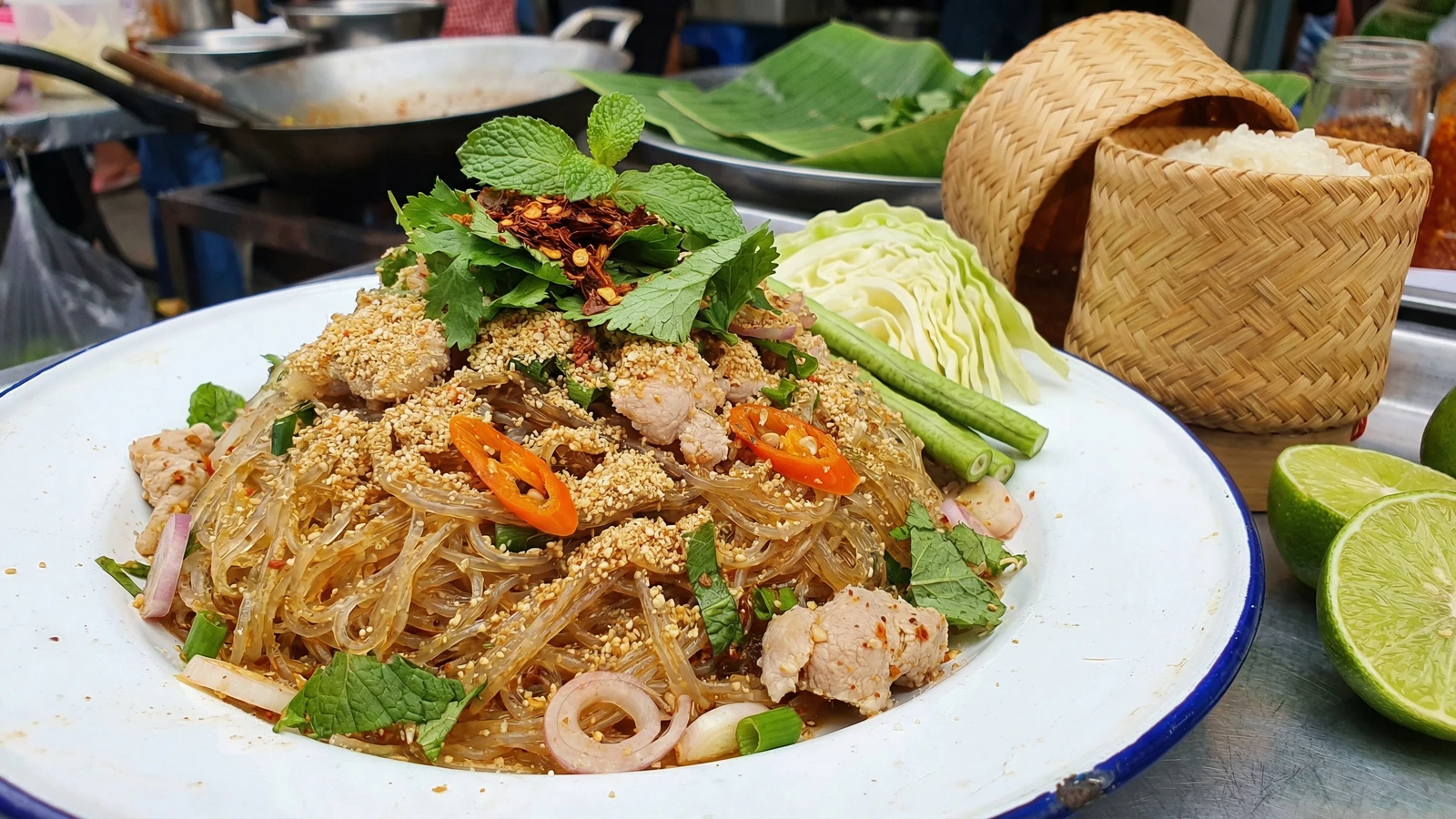
Isan Glass Noodle Larb (Larb Wun Sen)
Created by
Isan larb with glass noodles instead of meat: nam pla for salt, manao for sour, khao khua for that smoky crunch, prik pon for heat. No sugar. The absence of sweet is the principle that separates Isan from Central Thai.
No sugar. That's the rule. Say it again so it sticks: no sugar.
This is the principle that separates Isan larb from everything Central Thai. In Bangkok, they sweeten their yam wun sen with palm sugar or granulated sugar, round off the edges, make it polite. In Isan, the dressing is blunt. Fish sauce (nam pla) for salt. Lime (manao) for sour. Dried roasted chili (prik pon) for heat. Khao khua (toasted sticky rice powder) for texture. That's it. Four elements doing four jobs. No sweetness softening the blow. The sour leads, the salt anchors, the chili builds, and the khao khua ties it all together with a smoky, nutty crunch that nothing else in Thai cooking replicates.
Ajarn always said the four pillars define Thai cuisine: fish sauce, palm sugar, tropical acids, and the paste foundation. Isan larb deliberately drops one pillar. Palm sugar is absent. That's not an accident or a shortcut. It's a regional philosophy. On the Isan plateau, the flavors are sharper, more direct, less negotiated. The food hits you and doesn't apologize. When you understand that the absence of an ingredient can be as defining as its presence, you understand how regional Thai food actually works. The system is flexible. Principles, not recipes.
Larb wun sen takes the larb technique and swaps protein for glass noodles (wun sen). The noodles are slippery, neutral, and they absorb dressing like a sponge. Which means your dressing has to be right. There's nowhere to hide. If the lime is weak, you'll taste it. If the fish sauce is cheap, you'll taste it. If you skip the khao khua, the whole thing falls flat. The noodles demand that every other element shows up at full strength.
I teach this at Fai Thai workshops as a gateway larb. It's fast, it's cheap, and it forces you to understand the Isan dressing system without the distraction of grilling or mincing meat. Get this right and you can dress anything: pork, chicken, mushrooms, grilled beef. The noodles are the training ground. The dressing is the lesson.
Larb is the signature preparation of Isan (northeastern Thailand) and Laos, where it predates written recipes by centuries. The word 'larb' (ลาบ) refers to minced or chopped protein dressed with a sour-salty-spicy vinaigrette and finished with khao khua, a technique unique to Isan and Lao cuisine. Larb wun sen is a more recent adaptation that applies the same Isan dressing principles to glass noodles (wun sen, made from mung bean starch), likely emerging as an affordable weeknight variation in Isan households where meat was not always available. It should not be confused with yam wun sen, a Central Thai glass noodle salad that uses a different dressing formula including sugar.
The technique, the tradition, and the story behind every dish.
Discover Culinary AdvisorIngredients
dried glass noodles (wun sen)
Quantity
100g
minced pork
Quantity
150g
fish sauce (nam pla)
Quantity
3 tablespoons
fresh lime juice (nam manao)
Quantity
4 tablespoons (about 3-4 limes)
khao khua (toasted sticky rice powder)
Quantity
1 tablespoon
freshly toasted and pounded
dried roasted chili flakes (prik pon)
Quantity
1 tablespoon
shallots (hom daeng)
Quantity
3
sliced thin
green onions (ton hom)
Quantity
3
sliced into 1-inch pieces
fresh mint leaves (bai saranae)
Quantity
1 large handful
fresh cilantro (pak chi)
Quantity
1 handful
roughly torn
sawtooth coriander (pak chi farang)
Quantity
1 handful
sliced thin
chicken stock or water
Quantity
2 tablespoons
raw vegetables for serving
Quantity
as needed
cabbage wedges, long beans, Thai eggplant, mint sprigs
sticky rice (khao niew)
Quantity
for serving
| Ingredient | Quantity |
|---|---|
| dried glass noodles (wun sen) | 100g |
| minced pork | 150g |
| fish sauce (nam pla) | 3 tablespoons |
| fresh lime juice (nam manao) | 4 tablespoons (about 3-4 limes) |
| khao khua (toasted sticky rice powder)freshly toasted and pounded | 1 tablespoon |
| dried roasted chili flakes (prik pon) | 1 tablespoon |
| shallots (hom daeng)sliced thin | 3 |
| green onions (ton hom)sliced into 1-inch pieces | 3 |
| fresh mint leaves (bai saranae) | 1 large handful |
| fresh cilantro (pak chi)roughly torn | 1 handful |
| sawtooth coriander (pak chi farang)sliced thin | 1 handful |
| chicken stock or water | 2 tablespoons |
| raw vegetables for servingcabbage wedges, long beans, Thai eggplant, mint sprigs | as needed |
| sticky rice (khao niew) | for serving |
Equipment Needed
- •Granite mortar and pestle (krok hin) for pounding khao khua
- •Dry wok or skillet for toasting rice
- •Large mixing bowl
- •Small pot for blanching noodles and poaching pork
- •Kitchen scissors for cutting noodles
Instructions
- 1
Make the khao khua
Set a dry wok or skillet over medium heat. Add a handful of raw sticky rice (khao niew, uncooked grains). Toast, shaking the pan constantly, until the grains turn deep golden brown and the kitchen smells like popcorn and smoke. This takes 5 to 8 minutes. Don't rush it. Pale khao khua tastes like nothing. You want it the color of dark peanut butter. Let it cool completely, then pound it in a mortar to a coarse powder. Not dust. You want grit and texture. Store-bought toasted rice powder is stale and flavorless. Make it fresh. Every time.
Ajarn always said khao khua is the signature of the Isan table. It's not a garnish. It's a structural ingredient. Without it, you have a dressed salad. With it, you have larb. Make it fresh or don't make larb. - 2
Soak the glass noodles
Soak the dried glass noodles in room-temperature water for 10 minutes until they're pliable but not soft. You want them flexible, not mushy. While they soak, bring a small pot of water to a boil. Drain the soaked noodles, drop them into the boiling water, and cook for exactly 60 seconds. No more. Glass noodles go from perfect to gluey in the time it takes you to check your phone. Drain immediately and rinse with cool water to stop the cooking. Cut them into shorter lengths with scissors, roughly 4 to 5 inches. Nobody wants to wrestle a meter of slippery noodles into their mouth.
- 3
Cook the pork
In a small pot, bring the chicken stock or water to a simmer. Crumble the minced pork into the liquid and stir, breaking it into small pieces. Cook just until the pork is no longer pink, about 2 minutes. You're not browning. You're poaching. The pork should be tender and loose, not seared. Don't drain the liquid. It carries flavor into the dressing.
This is larb wun sen, not larb moo. The pork is supporting cast, not the star. Some versions skip the pork entirely for a vegetarian version with mushrooms, or add cooked shrimp instead. The dressing is what makes it larb. The protein is the variable. - 4
Build the Isan dressing
In a large mixing bowl, combine the fish sauce and lime juice. That's your dressing. Two ingredients. No sugar. I'll say it again: no sugar. Taste it. It should be aggressively sour with a salty backbone. If it tastes balanced already, you used too much fish sauce or not enough lime. The sour should lead. Add the prik pon (dried roasted chili flakes). Stir. The dressing should be sharp, salty, sour, and hot. If your eyes don't widen a little when you taste it, push it further.
Fresh limes only. Not bottled lime juice. Not vinegar. Not lemon. Fresh manao, squeezed right now. Bottled lime juice has a flat, metallic taste that ruins the dressing. You can taste the difference in the first bite. Ajarn always said: 'Add sour last, add sour slowly.' With larb, the sour goes in first and sets the tone for everything. - 5
Dress the larb
Add the warm poached pork (with its liquid) to the dressing bowl. Then the glass noodles. Toss. The noodles will drink up the dressing immediately. This is why the dressing needs to be aggressive. Add the sliced shallots, green onions, sawtooth coriander, cilantro, and mint. Toss again. The herbs are not garnish. They're structural. Every bite should include a leaf or a stem. Sprinkle the khao khua over the top and toss one final time. Taste. Adjust: more lime if it's flat, more fish sauce if it needs depth, more prik pon if you want more heat. The larb should be sour first, salty second, spicy building, with the smoky crunch of khao khua in every bite.
- 6
Serve at the Isan table
Transfer to a plate. Serve at room temperature or slightly warm, never cold from a fridge. Cold kills the aromatics. Set out a plate of raw vegetables alongside: cabbage wedges, long beans, Thai eggplant slices, extra mint. Sticky rice (khao niew) from a kratip basket is the only accompaniment. Not jasmine rice. Sticky rice. You tear off a piece, pinch some larb on top, add a raw vegetable or herb leaf. That's a bite. The combination is the point. Everything on the table is part of the dish.
Chef Tips
- •No sugar. I keep saying it because people keep adding it. Central Thai yam wun sen uses sugar in the dressing. Isan larb does not. The absence of sweet is the entire identity of the Isan dressing. If you add sugar, you've crossed from Isan into Central Thai territory. Both are valid cuisines. They are not the same cuisine. Know which one you're cooking.
- •Khao khua (toasted sticky rice powder) must be made fresh from raw sticky rice grains toasted in a dry pan until deeply browned, then pounded in a mortar to a coarse powder. Not fine dust. You want sandy grit that crunches between your teeth and releases that smoky, nutty aroma. Store-bought khao khua powder has been sitting on a shelf losing flavor for months. Toast it yourself. It takes ten minutes and it changes the entire dish.
- •Glass noodles (wun sen) are made from mung bean starch. They're slippery, neutral, and absorbent. That neutrality is both the advantage and the danger. They'll absorb whatever you give them, so the dressing must be strong. Under-seasoned dressing makes bland noodles. Over-cooked noodles make a gummy mess. Sixty seconds in boiling water. Set a timer.
- •Serve with sticky rice (khao niew), never jasmine rice. This is Isan food. Sticky rice is the grain of the northeast. It's eaten with the hands, torn into small balls, used to pinch and scoop. Jasmine rice is a Central Thai grain. Eating Isan larb with jasmine rice is like eating sushi with a fork. It works, but you're missing the design.
- •The herbs are structural. Mint, cilantro, sawtooth coriander (pak chi farang), green onions, raw shallots: these aren't a sprinkle on top. They should make up a third of every bite. If you can eat a spoonful of your larb without getting a leaf or stem, you didn't add enough.
Advance Preparation
- •Khao khua can be toasted and pounded up to 2 hours ahead. After that it starts losing its aroma. Same-day only. Never overnight.
- •Glass noodles can be soaked (but not boiled) up to 30 minutes ahead. Boil them right before dressing.
- •Herbs should be washed, dried, and prepped ahead of time but do not slice or tear them until the moment of assembly. Cut herbs oxidize and lose their bite.
- •Larb wun sen cannot be made ahead. The lime juice breaks down the noodles and the herbs wilt. Dress it, serve it, eat it. That's the rule.
Frequently Asked Questions
Nutrition Information
1 serving (about 300g)
Where cooking meets culture.
Culinary mentorship, cultural storytelling, and the editorial depth that makes cooking meaningful.
Explore Culinary Advisor