Culinary Advisor
A cooking platform built around craft, culture, and the stories behind what we eat.
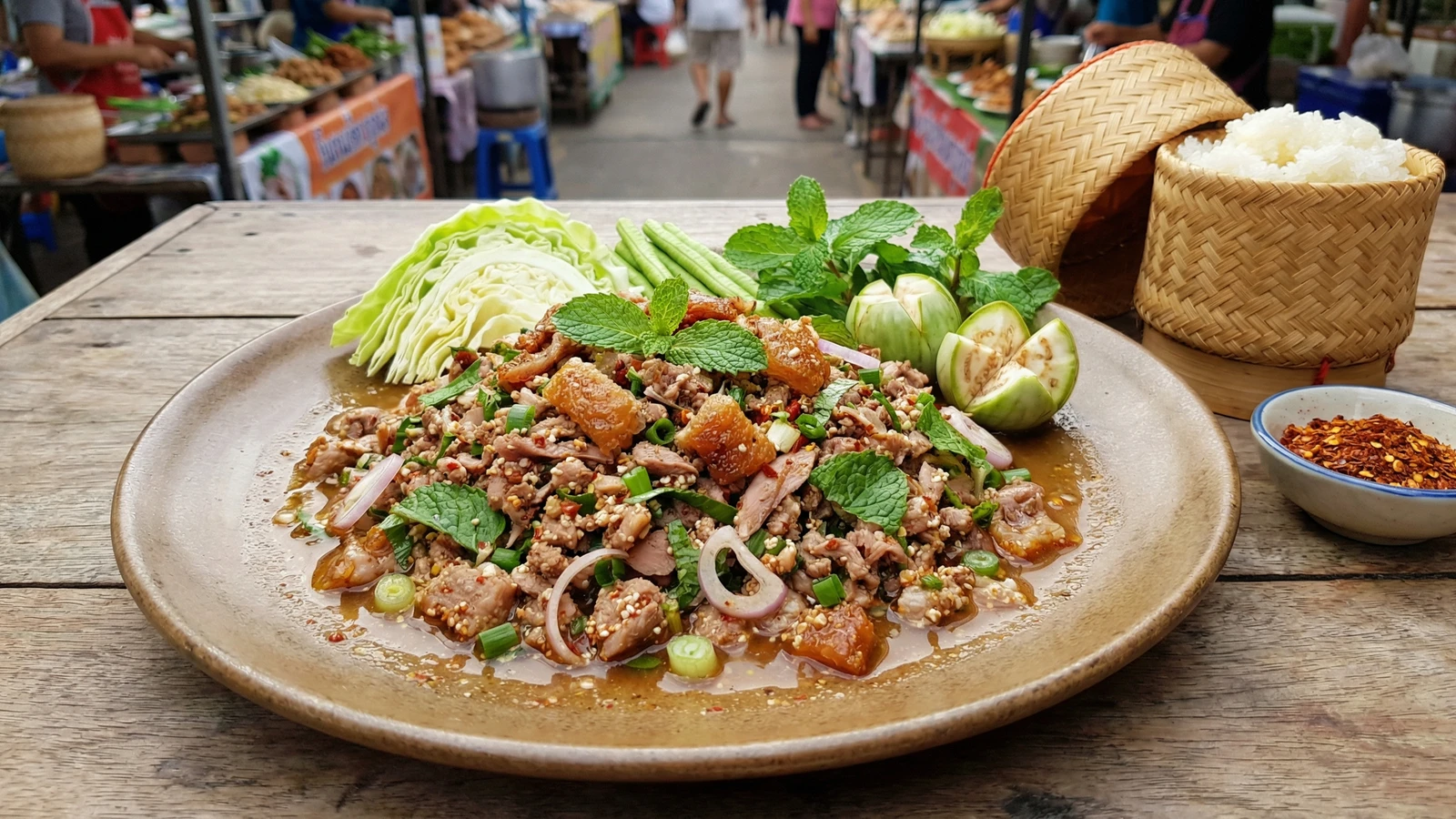
Isan Duck Larb (Larb Ped)
Created by
Duck brings gamey depth to the Isan larb formula. No sugar. Lime, fish sauce, khao khua, prik pon, and a wall of fresh herbs. This is the celebration table standard, and the governing rule is restraint.
No sugar. That's the rule. If you remember one thing about Isan larb, remember that. The absence of sweet is what separates Isan from Central Thai cooking, and it's the principle that defines everything on this table. Central Thai cooks reach for palm sugar to round out a dish. Isan cooks don't. The balance here is sour, salty, spicy, and the nutty crunch of khao khua. Four forces, no sweetener softening the edges. That's the system.
Ajarn always said the four pillars of Thai cuisine are fish sauce, palm sugar, tropical fruit acids, and the paste foundation. Isan larb strips one pillar out entirely and still stands. That tells you something about the strength of the remaining three. Lime juice (nam manao) does the heavy lifting on sour. Fish sauce (nam pla) handles salt and umami. Prik pon (roasted dried chili) brings heat. And khao khua, toasted sticky rice pounded to a coarse powder, provides a smoky nuttiness that ties the whole thing together. No kreung tam in this dish. No paste. Larb is a dressing technique: chop the protein, dress it, toss it with herbs. The herbs aren't garnish. Mint, sawtooth coriander, green onion, cilantro, raw shallots. These are structural. They're half the dish.
Now, duck. Most larb you'll eat in Isan is pork or catfish. Duck is the rich one, the one that shows up when there's something to celebrate. The gamey depth of duck fat and dark meat changes the balance. You need more acid to cut through it, more chili to stand up to it. The khao khua does double duty here: its gritty texture absorbs the duck fat and its toasty flavor matches the richness. When I teach this at Fai Thai workshops, I tell people: duck larb is where you learn that larb isn't a recipe. It's a technique. Once you understand how the dressing interacts with the protein, you can larb anything. But duck is the one that teaches you the most, because duck fights back. It's rich, it's fatty, it demands that your acid and salt be dialed up. You learn to taste.
My mother's side is from Isan. She'd tell you that larb is eaten with your hands: a pinch of sticky rice from the kratip, a scoop of larb, a leaf of mint, all in one bite. That's how the dish is designed. The sticky rice is the vehicle. Not jasmine rice. Never jasmine rice. Khao niew or nothing.
Larb is the national dish of Laos and the definitive preparation of Thailand's Isan (northeastern) plateau, a region that shares deep linguistic and culinary ties with its Lao neighbors across the Mekong. While pork and catfish are everyday larb proteins, duck larb (larb ped) has historically been reserved for celebrations, weddings, and merit-making feasts where a whole duck would be butchered for the occasion. The strict absence of sugar in Isan larb distinguishes it sharply from Central Thai adaptations, which softened the flavor profile for Bangkok palates as Isan migrant workers brought the dish south in the mid-20th century.
The technique, the tradition, and the story behind every dish.
Discover Culinary AdvisorIngredients
duck breast or boneless duck leg
Quantity
500g
skin on
fish sauce (nam pla)
Quantity
3 tablespoons
plus more to taste
fresh lime juice (nam manao)
Quantity
4 tablespoons (about 4 limes)
plus more to taste
khao khua (toasted sticky rice powder)
Quantity
3 tablespoons
freshly made (see step 1)
prik pon (roasted dried chili flakes)
Quantity
1 tablespoon
shallots (hom daeng)
Quantity
4
sliced thin
green onion (ton hom)
Quantity
3 stalks
sliced into thin rounds
fresh mint leaves (bai saranae)
Quantity
1 cup
fresh cilantro leaves and stems (pak chi)
Quantity
1/2 cup
sawtooth coriander (pak chi farang)
Quantity
1/2 cup
sliced thin crosswise
uncooked sticky rice (khao niew)
Quantity
1/4 cup
for toasting into khao khua
dried red chilies (prik haeng)
Quantity
5
for toasting with rice
sticky rice (khao niew)
Quantity
for serving
raw vegetables
Quantity
for serving
cabbage wedges, long beans, Thai eggplant, mint sprigs
| Ingredient | Quantity |
|---|---|
| duck breast or boneless duck legskin on | 500g |
| fish sauce (nam pla)plus more to taste | 3 tablespoons |
| fresh lime juice (nam manao)plus more to taste | 4 tablespoons (about 4 limes) |
| khao khua (toasted sticky rice powder)freshly made (see step 1) | 3 tablespoons |
| prik pon (roasted dried chili flakes) | 1 tablespoon |
| shallots (hom daeng)sliced thin | 4 |
| green onion (ton hom)sliced into thin rounds | 3 stalks |
| fresh mint leaves (bai saranae) | 1 cup |
| fresh cilantro leaves and stems (pak chi) | 1/2 cup |
| sawtooth coriander (pak chi farang)sliced thin crosswise | 1/2 cup |
| uncooked sticky rice (khao niew)for toasting into khao khua | 1/4 cup |
| dried red chilies (prik haeng)for toasting with rice | 5 |
| sticky rice (khao niew) | for serving |
| raw vegetablescabbage wedges, long beans, Thai eggplant, mint sprigs | for serving |
Equipment Needed
- •Heavy granite mortar and pestle (krok hin) for pounding khao khua
- •Wok or heavy cast-iron skillet for rendering duck
- •Large mixing bowl for dressing the larb
- •Heavy cleaver or chef's knife for mincing
Instructions
- 1
Toast the khao khua
Put the sticky rice in a dry wok or skillet over medium heat. No oil. Toss it constantly. After a few minutes, add the dried chilies to the pan and keep them moving together. The rice will go from white to golden to deep amber. You want it darker than you think: the color of a monk's robe, not a manila envelope. It takes about 8 to 10 minutes. The smell should be nutty, toasty, almost like popcorn. Pull it off the heat before it crosses into burnt. Let it cool for a minute, then pound it in a mortar to a coarse powder. Not fine. You want grit. The texture is half the point. Pick out the chilies and pound them separately into flakes, or combine them with the rice for a spicier khao khua. Your call.
Store-bought toasted rice powder is dead. It's been sitting in a bag losing flavor since the day it was ground. Toast your own. Every single time. Khao khua must be freshly toasted and freshly pounded. This is non-negotiable. - 2
Cook the duck
Score the duck skin in a crosshatch pattern without cutting into the meat. Place the duck skin-side down in a cold wok or heavy pan, then turn the heat to medium. Let the fat render slowly. This takes 8 to 10 minutes. Don't rush it. The skin should get deeply golden and crispy, and there should be a pool of clear duck fat in the pan. Flip the duck and cook the meat side for another 3 to 4 minutes until just cooked through. Duck for larb should not be pink, but it should not be dry either. Pull it at medium, still juicy. Rest it for 5 minutes on a cutting board.
Save that rendered duck fat. Strain it into a jar. It keeps for weeks in the fridge and it's gold for frying eggs, cooking sticky rice, or starting any stir-fry. Throwing it away is a crime. - 3
Mince the duck
Slice the duck thinly against the grain, then chop it into a rough mince with a heavy knife or cleaver. You're not going for baby food. You want irregular pieces, some fine, some chunky, so the dressing hits every surface differently. Keep the crispy skin. Chop it separately into small crunchy bits. That skin is textural gold in the finished larb. Scrape all the duck and its juices into a large mixing bowl while it's still warm. Warm meat absorbs the dressing better. Cold meat resists it.
Some Isan cooks mince the duck raw and then cook it briefly in a splash of its own broth. Both methods are correct. Pan-rendering and mincing gives you the bonus of crispy skin and rendered fat, which is why I prefer it for duck specifically. - 4
Dress the larb
Add the fish sauce to the warm duck first. Toss. Then the lime juice. Toss again. Taste it right now, before anything else goes in. It should be sharply sour and deeply salty. If it's not sour enough, add more lime. If it's not salty enough, more fish sauce. The acid and salt need to be aggressive because everything you add next will dilute them. Now add the khao khua and the prik pon. Toss. The khao khua will start absorbing the dressing immediately, thickening everything and adding that smoky crunch. Taste again. Adjust. This is the method: dress, taste, adjust. Ajarn always said: "Add sour last, add sour slowly." With duck, I break that rule slightly because the fat needs the acid upfront to cut through. But still: taste as you go.
No sugar. Not a pinch, not a teaspoon, not "just to balance." Isan larb does not use sugar. The absence of sweet is the defining principle. If your larb tastes like it needs sugar, your lime and fish sauce balance is wrong. Fix the acid and salt. Don't reach for the sugar bowl. - 5
Add the herbs and shallots
Add the sliced shallots, green onion, mint, cilantro, and sawtooth coriander to the bowl. Toss everything together with your hands or a spoon. The herbs should be distributed evenly throughout the duck, not piled on top. Every bite should have meat, herb, crunch, and heat. The shallots are raw and sharp. The mint is cool and bright. The sawtooth coriander has a deeper, more resinous flavor than regular cilantro, almost medicinal. Together they form a wall of freshness that stands up to the rich duck. Taste one final time. The finished larb should be: sour first, salty second, spicy building, with the smoky crunch of khao khua in every bite. Serve at room temperature on a plate, not in a bowl. Sticky rice in a kratip on the side. Raw vegetables alongside. That's the table.
Chef Tips
- •The no-sugar rule is the single most important thing about Isan larb. Central Thai versions add sugar. Isan does not. When people tell me their larb tastes "off" and they followed an Isan recipe, the first thing I ask is whether they added sugar. Nine times out of ten, they did. The sour-salty-spicy balance of Isan larb is its identity. Sugar erases that identity.
- •Duck fat changes the game. Pork larb is lean and direct. Duck larb is rich and demands more acid to compensate. Start with the lime juice quantity in the recipe, but expect to add more. The fat coats your palate and mutes the sour. Push the lime harder than you think you need to. Taste after every addition.
- •Sawtooth coriander (pak chi farang) is not optional in a proper Isan larb. It has a deeper, more intense herbaceous flavor than cilantro, with a resinous, almost astringent quality that cuts through fatty proteins. If your Asian market carries it (and most do), use it. It's the herb that separates a good larb from an Isan larb.
- •Khao khua loses its magic within hours. Toast it, pound it, use it. If you made it yesterday, make it again. The volatile aromatics in toasted rice dissipate quickly. Fresh khao khua smells like a rice field after harvest. Day-old khao khua smells like nothing. The difference is everything.
- •Serve larb at room temperature or slightly warm. Never cold from the fridge. Cold mutes every flavor in the dish: the lime goes flat, the fish sauce becomes one-dimensional, the herbs lose their aromatic punch. If you have leftovers, let them come to room temperature before eating. Better yet, don't have leftovers. Make the right amount and eat it all.
Advance Preparation
- •Sticky rice must be soaked at least 4 hours or overnight before steaming. Plan ahead. No shortcut here.
- •Herbs can be washed, dried, and stored wrapped in damp paper towels for up to a day. Slice the sawtooth coriander and green onion just before assembling.
- •Khao khua must be toasted and pounded fresh the same day. Do not make it ahead. It loses its aroma within hours.
- •The duck can be rendered and rested up to 30 minutes before mincing and dressing. Do not refrigerate it. The larb must be dressed while the meat is still warm.
Frequently Asked Questions
Nutrition Information
1 serving (about 160g)
Where cooking meets culture.
Culinary mentorship, cultural storytelling, and the editorial depth that makes cooking meaningful.
Explore Culinary Advisor