Culinary Advisor
A cooking platform built around craft, culture, and the stories behind what we eat.
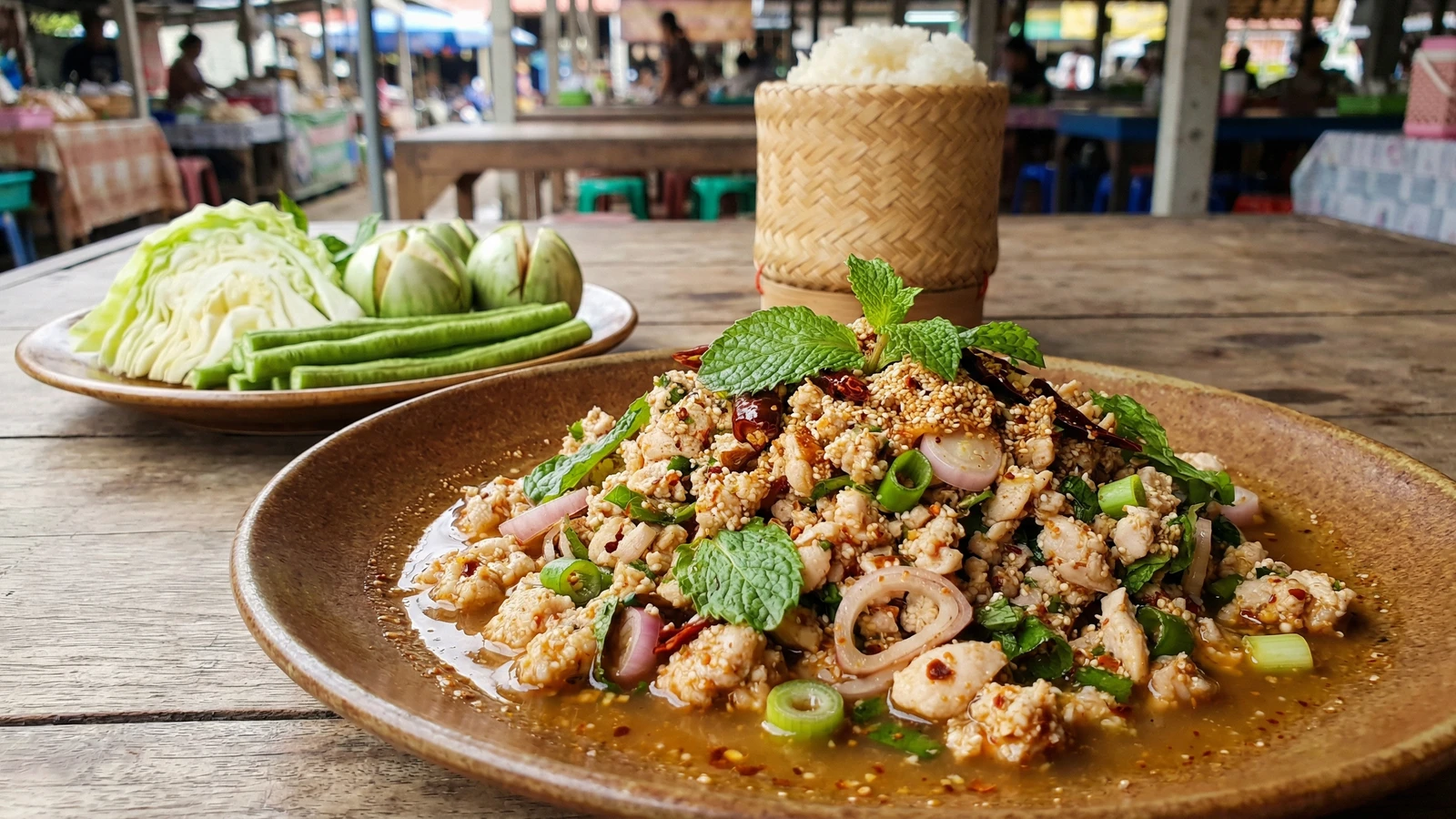
Isan Chicken Larb (Larb Gai)
Created by
No sugar. That's the rule. Isan larb strips Thai cuisine down to three pillars: nam pla for salt, manao for sour, prik for heat, with khao khua tying it together in a way nothing else can.
No sugar. Write that down. Tattoo it on your wrist if you have to. The single rule that separates Isan larb from the Central Thai version is the absence of sweet. No palm sugar. No granulated sugar. Nothing. When you add sugar to larb, you're making a Bangkok restaurant dish for tourists who need every flavor softened. Isan doesn't soften.
Ajarn always said the four pillars define Thai cuisine: fish sauce for salt, palm sugar for sweet, tropical fruit acids for sour, and chili for heat. But he also taught me that regional traditions bend those pillars. Isan drops the sweet entirely. What you're left with is a three-pillar system, sour, salty, spicy, held together by khao khua (ข้าวคั่ว), toasted sticky rice pounded to a coarse powder. That smoky, nutty crunch isn't a garnish. It's the structural ingredient that makes larb, larb. Without it, you have seasoned meat. With it, you have the dish.
Larb is a technique, not a recipe. Chopped protein dressed while warm with a raw vinaigrette of lime juice and fish sauce, then folded with dried chili flakes, shallots, and herbs. Chicken is the lighter version, leaner than pork, quicker to cook, and the one I make most often at Fai Thai workshops because it's the fastest path from principle to plate. Fifteen minutes, start to finish. No excuses.
My mother's family is from Isan. When they made larb, the herbs weren't a sprinkle on top. Mint, sawtooth coriander, green onion: these went in by the fistful. The herbs are structural. They're part of every bite. You tear off a piece of sticky rice, pinch some larb on top, grab a leaf of mint, maybe a slice of raw cabbage. That's a bite. The combination is the design. Eating larb with a fork off a plate with jasmine rice misses the entire point.
Larb is the national dish of Laos and the defining preparation of Thailand's Isan (northeastern) region, whose people share deep ethnic, linguistic, and culinary ties with Laos. The word "larb" (ลาบ) likely predates written Thai culinary records, rooted in the oral food traditions of the Mekong River basin. The Central Thai version added sugar and sometimes replaced lime with vinegar to suit Bangkok palates, a modification that Isan cooks consider a fundamental betrayal of the dish's identity. Khao khua, the toasted sticky rice powder, is exclusive to Isan and Lao cuisine and appears in no other Thai regional tradition.
The technique, the tradition, and the story behind every dish.
Discover Culinary AdvisorIngredients
chicken thigh meat
Quantity
300g
minced or finely chopped
fish sauce (nam pla)
Quantity
3 tablespoons
fresh lime juice (nam manao)
Quantity
4 tablespoons (about 3-4 limes)
khao khua (toasted sticky rice powder)
Quantity
2 tablespoons
dried roasted chili flakes (prik pon)
Quantity
1 tablespoon
shallots (hom daeng)
Quantity
3
sliced thin
green onions (ton hom)
Quantity
3
sliced thin
fresh mint leaves (bai saranae)
Quantity
1 large handful
sawtooth coriander (pak chi farang)
Quantity
1 small handful
roughly chopped
fresh cilantro (pak chi)
Quantity
1 small handful
roughly chopped
chicken stock or water
Quantity
2 tablespoons
raw cabbage wedges
Quantity
for serving
long beans
Quantity
for serving
Thai eggplant (makhuea pro) (optional)
Quantity
for serving
white turmeric leaves (optional)
Quantity
for serving
sticky rice (khao niew)
Quantity
for serving
| Ingredient | Quantity |
|---|---|
| chicken thigh meatminced or finely chopped | 300g |
| fish sauce (nam pla) | 3 tablespoons |
| fresh lime juice (nam manao) | 4 tablespoons (about 3-4 limes) |
| khao khua (toasted sticky rice powder) | 2 tablespoons |
| dried roasted chili flakes (prik pon) | 1 tablespoon |
| shallots (hom daeng)sliced thin | 3 |
| green onions (ton hom)sliced thin | 3 |
| fresh mint leaves (bai saranae) | 1 large handful |
| sawtooth coriander (pak chi farang)roughly chopped | 1 small handful |
| fresh cilantro (pak chi)roughly chopped | 1 small handful |
| chicken stock or water | 2 tablespoons |
| raw cabbage wedges | for serving |
| long beans | for serving |
| Thai eggplant (makhuea pro) (optional) | for serving |
| white turmeric leaves (optional) | for serving |
| sticky rice (khao niew) | for serving |
Equipment Needed
- •Granite mortar and pestle (krok hin) or any mortar for pounding khao khua
- •Wok or small dry pan for toasting rice
- •Wok or pan for cooking chicken
- •Mixing bowl
- •Kratip (woven sticky rice basket) for serving
Instructions
- 1
Toast the sticky rice
Take two tablespoons of raw sticky rice (khao niew) and throw them into a dry wok or small pan over medium heat. No oil. Shake the pan constantly. The rice will go from white to golden to deep amber over about 3-4 minutes. You'll smell it before you see it: a smoky, toasty, almost popcorn-like aroma. Pull it the moment it turns a dark golden brown. Any darker and it goes bitter. Let it cool completely, then pound it in a mortar to a coarse powder. Not fine. You want grit, like coarse sand. That texture is the whole point of khao khua.
Make khao khua fresh every time. The store-bought powder sitting in a bag has lost its aroma weeks ago. Freshly toasted and pounded, the smoky fragrance fills the room. That fragrance is half the flavor of larb. Don't skip this. Three minutes of work, total transformation. - 2
Cook the chicken
Put the minced chicken in a wok or pan over medium-high heat with two tablespoons of chicken stock or water. No oil. Break the meat apart with a spatula as it cooks. You're not searing, you're just cooking it through. The liquid keeps it from clumping into a dry brick. Stir and break constantly. Two to three minutes. The chicken should be cooked through but still moist, not gray and chalky. Pull it from the heat immediately.
Use thigh meat, not breast. Thigh has enough fat to stay juicy after cooking. Breast dries out fast and makes larb taste like punishment. If you only have breast, add an extra splash of stock. - 3
Dress while warm
Transfer the chicken to a mixing bowl while it's still warm. This is critical. Warm meat absorbs the dressing. Cold meat sits in it. Add the fish sauce first. Toss. Then the lime juice. Toss again. Taste. Sour should lead. Salty should follow. If it tastes flat, more fish sauce. If it tastes heavy, more lime. There is no sugar. Don't reach for it. The balance here is between two forces, not three.
Ajarn always said: add sour last, add sour slowly. But with larb, the lime goes in while the meat is warm, and the heat pulls the citrus oils out of the juice. So work quickly. Squeeze fresh. Bottled lime juice is dead acid with no fragrance. Not the same thing. - 4
Add khao khua and chili
Sprinkle the khao khua over the dressed chicken. Add the dried roasted chili flakes (prik pon). Toss everything together. The khao khua should coat the meat and start absorbing some of the dressing, creating that signature slightly thick, clinging texture. You'll feel it shift from wet to dressed. That's the moment. Taste again. The smoky crunch of the rice powder should be in every bite.
- 5
Fold in herbs and shallots
Add the sliced shallots, green onions, mint leaves, sawtooth coriander, and cilantro. Fold them in gently. Don't toss aggressively or the herbs will bruise and go dark. They should be fresh, bright, and everywhere. Not sitting on top as decoration. Integrated into the dish. Every bite should have herb, meat, crunch, and heat. Taste one final time. Adjust if needed: more lime, more fish sauce, more prik pon. Your tongue is the only measuring tool that matters.
- 6
Serve with sticky rice
Spoon the larb onto a plate at room temperature. Arrange raw cabbage wedges, long beans, and any other raw vegetables alongside. Serve with sticky rice (khao niew) from a kratip basket. Not jasmine rice. Sticky rice. You tear off a piece, press it flat, pinch some larb on top with a mint leaf and a bite of cabbage. That's how it's eaten. The combination of sticky rice, dressed meat, raw vegetable, and fresh herb in a single bite is the entire design of the dish. Don't serve this cold from a fridge. Room temperature or slightly warm. Larb is alive. Treat it that way.
Chef Tips
- •No sugar. I'll say it again. Isan larb has no sugar. The Central Thai version adds palm sugar or white sugar to round out the dressing. That's a Bangkok adaptation. In Udon Thani, in Khon Kaen, in every Isan kitchen I've eaten in with my mother's family, sugar in larb would get you a look that could curdle coconut cream. The sour-salty-spicy triangle is the point. Sweet has no seat at this table.
- •Khao khua must be freshly made. Every time. It takes three minutes to toast and one minute to pound. Store-bought rice powder in a plastic bag is flavorless dust. Freshly pounded khao khua smells like smoke and roasted grain. It's the defining ingredient of Isan cuisine, the thing that separates this food from every other regional Thai tradition. Treat it with the respect it deserves.
- •The herbs are not garnish. Mint, sawtooth coriander (pak chi farang), cilantro, green onion: these go in by the fistful. When I teach larb at Fai Thai workshops, I watch people sprinkle three mint leaves on top like it's a plating exercise. No. A fistful. The herb-to-meat ratio should be close to equal. That's the Isan way.
- •Use chicken thigh, not breast. Larb needs a little fat to carry the dressing. Breast meat dries out and turns chalky. Thigh stays juicy and has enough intramuscular fat to hold moisture after cooking. Chop it yourself with a cleaver for better texture, or use pre-ground if you're short on time.
- •Sticky rice is the only correct accompaniment. Jasmine rice with larb is a Central Thai habit. In Isan, it's khao niew, always. The sticky, chewy texture of glutinous rice is designed to be torn and used as an edible utensil. It picks up the dressing, it holds the meat. Jasmine rice just sits there.
Advance Preparation
- •Khao khua can be toasted and pounded up to a few hours ahead, but it loses fragrance quickly. Same day only. Never store it overnight.
- •Herbs can be washed and dried ahead of time, but slice shallots and green onions just before assembling. They oxidize.
- •Larb cannot be made ahead. The lime juice continues to work on the meat, and the khao khua absorbs moisture and loses its crunch within an hour. Make it, eat it. That's the rule.
- •Sticky rice should be soaked for at least 4 hours (overnight is best) and steamed in a bamboo steamer or huad (หวด). It takes 20-25 minutes to steam. Start the rice before you do anything else.
Frequently Asked Questions
Nutrition Information
1 serving (about 460g)
Where cooking meets culture.
Culinary mentorship, cultural storytelling, and the editorial depth that makes cooking meaningful.
Explore Culinary Advisor