Culinary Advisor
A cooking platform built around craft, culture, and the stories behind what we eat.
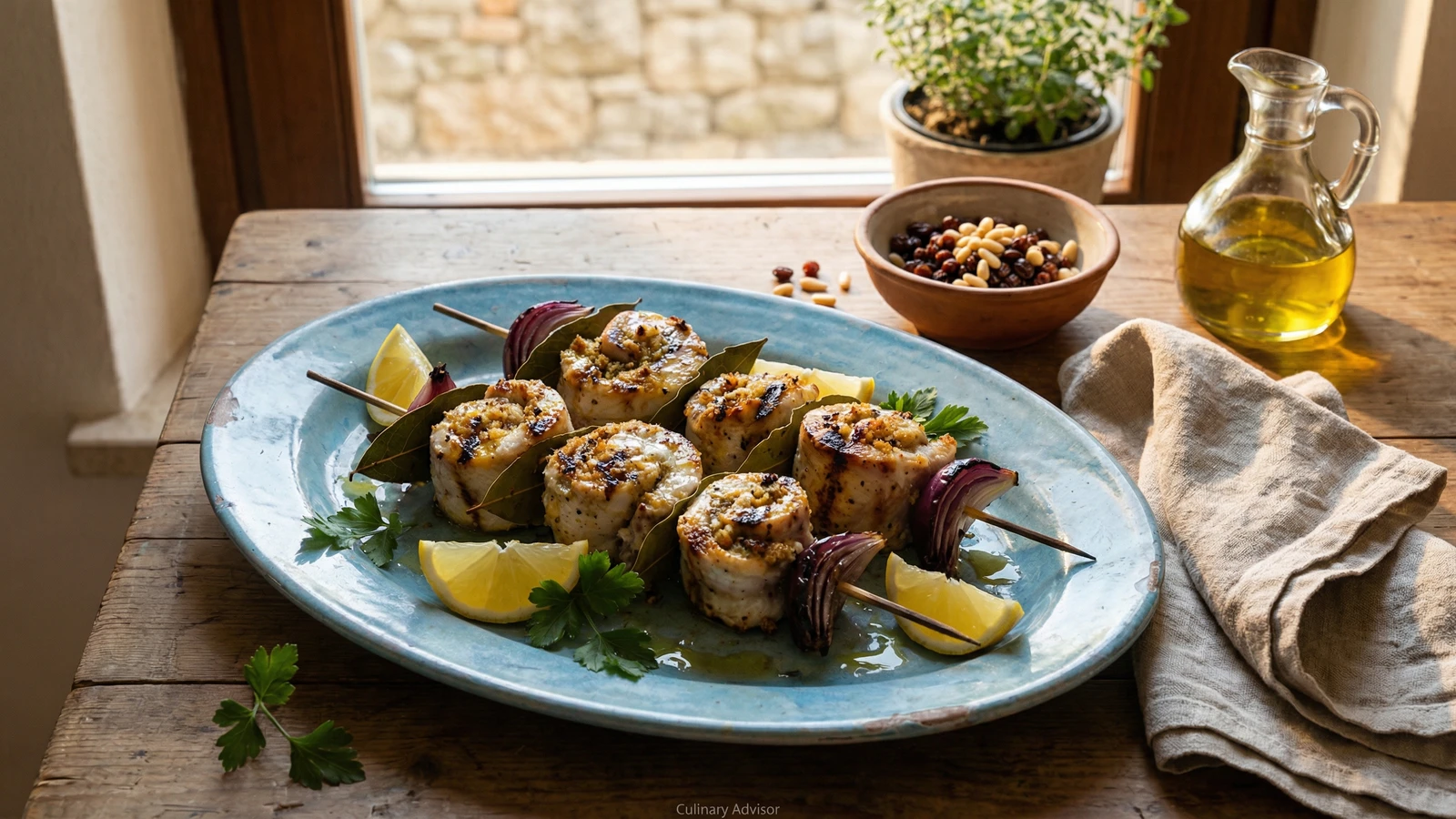
Involtini di Pesce Spada
Created by Chef Graziella
Thin swordfish slices rolled around a filling of toasted breadcrumbs, pine nuts, and currants, threaded on skewers with bay leaves and grilled until golden. Sicily's Arab heritage made edible.
Sicily is not quite Italy. For centuries it belonged to everyone but the Italians: Greeks, Romans, Arabs, Normans, Spanish. Each occupation left its mark on the table. These swordfish rolls carry the clearest fingerprint of Arab rule, that golden age from the ninth to eleventh centuries when Palermo rivaled Baghdad in sophistication. The pine nuts and currants, the sweet-savory balance, the fragrant bay leaves: this is North African cooking adapted to the Sicilian shore.
The fishermen of the Strait of Messina have hunted swordfish since antiquity. They still use traditional feluccas with tall masts and long harpoons, spotting the great fish from platforms high above the deck. In the coastal towns, cooks developed countless preparations for this firm, meaty catch. Involtini became the celebration dish, worthy of saints' days and Sunday tables.
Simple does not mean easy. The fish must be sliced thin and pounded thinner. The filling requires balance: enough breadcrumb to hold it together, enough fat to keep it moist, enough currant and pine nut to taste the history. The grilling demands attention. But when you bring these rolls to the table, bronze and fragrant from the fire, you serve something that has nourished Sicilian families for a thousand years.
Arab rulers controlled Sicily from 827 to 1091 AD, transforming the island's agriculture and cuisine. They introduced pine nuts, currants, saffron, and the sweet-savory combinations that distinguish Sicilian cooking from the rest of Italy. Involtini di pesce spada likely emerged in this period, when the Arab taste for stuffed and rolled preparations met the abundant swordfish of the Strait of Messina.
The technique, the tradition, and the story behind every dish.
Discover Culinary AdvisorIngredients
swordfish
Quantity
1 1/2 pounds
cut into 8 thin slices (about 1/4 inch thick)
fine dried breadcrumbs
Quantity
1 cup
pine nuts
Quantity
1/4 cup
currants
Quantity
3 tablespoons
capers
Quantity
2 tablespoons
rinsed and chopped
flat-leaf parsley
Quantity
3 tablespoons
chopped fine
garlic
Quantity
2 cloves
minced very fine
extra virgin olive oil
Quantity
1/2 cup, divided
lemon
Quantity
1
zested
bay leaves
Quantity
12
fresh if possible
red onion
Quantity
1 medium
cut into 1-inch pieces
kosher salt
Quantity
to taste
black pepper
Quantity
to taste
freshly ground
lemon wedges
Quantity
for serving
| Ingredient | Quantity |
|---|---|
| swordfishcut into 8 thin slices (about 1/4 inch thick) | 1 1/2 pounds |
| fine dried breadcrumbs | 1 cup |
| pine nuts | 1/4 cup |
| currants | 3 tablespoons |
| capersrinsed and chopped | 2 tablespoons |
| flat-leaf parsleychopped fine | 3 tablespoons |
| garlicminced very fine | 2 cloves |
| extra virgin olive oil | 1/2 cup, divided |
| lemonzested | 1 |
| bay leavesfresh if possible | 12 |
| red onioncut into 1-inch pieces | 1 medium |
| kosher salt | to taste |
| black pepperfreshly ground | to taste |
| lemon wedges | for serving |
Equipment Needed
- •Meat mallet or rolling pin
- •Metal or wooden skewers (4)
- •Grill or broiler
- •Plastic wrap
Instructions
- 1
Prepare the swordfish
If your fishmonger has not already done so, slice the swordfish into thin pieces, about one-quarter inch thick. Place each slice between sheets of plastic wrap and pound gently with a meat mallet until uniformly thin, roughly one-eighth inch. The fish should be pliable enough to roll without cracking. Season both sides lightly with salt and pepper.
Ask your fishmonger to slice the swordfish for you. A skilled hand with a sharp knife produces cleaner slices than most home cooks can manage. This is not a failing. It is wisdom. - 2
Toast the pine nuts
In a dry skillet over medium-low heat, toast the pine nuts, stirring constantly, until they turn golden and fragrant. This takes three to four minutes. Watch them without distraction. They burn in seconds once they begin to color. Transfer immediately to a plate to cool.
- 3
Make the filling
In a bowl, combine the breadcrumbs, toasted pine nuts, currants, capers, parsley, garlic, lemon zest, and four tablespoons of the olive oil. Mix thoroughly with your hands. The mixture should hold together when pressed but remain loose, not pasty. Season with salt and pepper. Taste it. The filling must be well-seasoned because it will flavor the fish from within.
The currants and pine nuts are the soul of this dish, evidence of the Arab traders who shaped Sicilian cooking. Do not substitute raisins without thought. Currants are smaller, drier, and more intense. If you must use raisins, chop them. - 4
Fill and roll
Lay a swordfish slice flat on your work surface. Place two tablespoons of filling at the wider end. Roll the fish around the filling, tucking in the sides as you go, creating a compact bundle. The roll should be snug but not bursting. Repeat with the remaining slices and filling.
- 5
Assemble the skewers
Thread the rolls onto metal skewers, alternating each roll with a bay leaf and a piece of red onion. The bay leaves are not decoration. They perfume the fish as it cooks. Place two rolls on each skewer, leaving space between components for even cooking. Brush the assembled skewers generously with the remaining olive oil.
- 6
Grill or broil
Heat a grill to medium-high or preheat your broiler. Cook the skewers for three to four minutes per side, until the fish is opaque throughout and the exterior shows golden char marks. The filling will darken slightly where exposed. Swordfish is dense; it can handle the heat. But do not overcook it. When the flesh flakes under gentle pressure, it is done.
If using a broiler, position the rack four to five inches from the heat source. Watch constantly. The line between perfectly charred and ruined is measured in moments. - 7
Serve immediately
Transfer the skewers to a warm platter. Squeeze fresh lemon over all. Serve at once with additional lemon wedges alongside. The fish will not wait. Once it begins to cool, the texture tightens and the filling loses its perfume. Call your guests to the table before you begin cooking, not after.
Chef Tips
- •Swordfish must be impeccably fresh. The flesh should be firm and moist, with a clean sea smell. Any hint of ammonia means the fish has turned. Walk away.
- •If you cannot find swordfish, this preparation works with tuna steaks, though the texture differs. Do not attempt it with delicate white fish. The filling will overwhelm them.
- •Wooden skewers require soaking for thirty minutes before use to prevent burning. Metal skewers conduct heat and cook the rolls from within, which is preferable.
- •The bay leaves between the rolls are essential. Fresh bay has a floral quality that dried cannot match. If you must use dried, increase the quantity by half.
Advance Preparation
- •The filling can be made several hours ahead and refrigerated. Bring to room temperature before using.
- •The rolls can be assembled and skewered up to two hours before cooking. Keep refrigerated, covered with plastic wrap. Allow them to lose their chill for fifteen minutes before grilling.
- •Once cooked, these do not reheat well. Make only what you will serve.
Frequently Asked Questions
Nutrition Information
1 serving (about 230g)
Where cooking meets culture.
Culinary mentorship, cultural storytelling, and the editorial depth that makes cooking meaningful.
Explore Culinary Advisor