Culinary Advisor
A cooking platform built around craft, culture, and the stories behind what we eat.
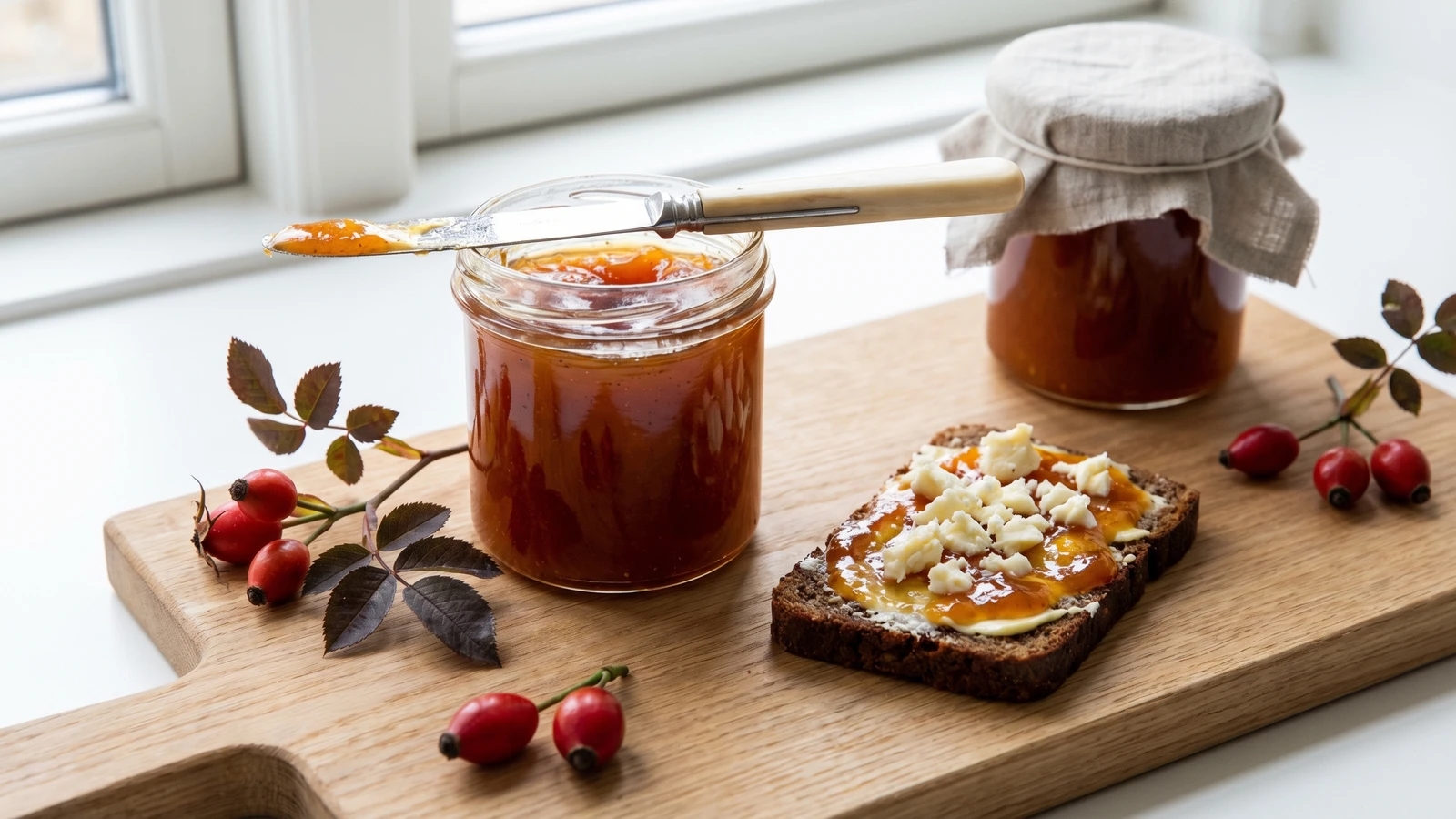
Hybenmarmelade
Created by Chef Freja
Beach rosehips halved and deseeded by hand, cooked slow with sugar and vanilla into a deep amber marmalade that tastes like the Danish coast in October. Spread it on buttered rugbrod with aged Vesterhavsost and understand why people walk the hedgerows every autumn.
October along the Danish coast is when the beach roses give you their last gift. The flowers are long gone. What remains are the hips, firm and heavy, turning from orange to a deep sunset red in the hedgerows and along the dunes from Skagen to Bornholm. You pick them after the first frost if you can, because the cold softens the flesh and concentrates the sweetness. But any time in October or early November, when the hips are ripe and give slightly under your thumb, is the right time.
Hybenmarmelade is one of the oldest preserves in the Danish kitchen, and the most labour-intensive in the simplest way: not difficult, just slow. You halve each rosehip, scrape out the seeds and the fine irritant hairs that line the inside, rinse until clean, and cook what remains with sugar, vanilla, and lemon until it thickens into something that glows like amber held against the light. The work is in the cleaning. I won't pretend otherwise. A kilo of rosehips and a sharp knife and an hour of your time. Put something on the radio. Let your hands learn the rhythm of it.
What you get in return is a marmalade with a flavor that sits between tart and floral, with a warmth underneath from the vanilla that deepens over the weeks it sits in the jar. Spread it on buttered rugbrod with a slice of aged Vesterhavsost, the salty, crumbly West Sea cheese from Jutland, and the pairing is one of those things that feels as if it has always existed. The sweet preserve, the sharp cheese, the dark bread. You'll know when it's right because you won't want to change a thing.
Rosa rugosa, the Japanese beach rose, naturalized along the entire Danish coastline during the 19th century and became so deeply embedded in the landscape that most Danes consider it native. Rosehip preserving, however, predates this arrival. Danish farmhouse kitchens had been making hybenmarmelade from native dog rose hips (Rosa canina) for centuries, a practice documented in household recipe collections as early as the 1700s. During the Second World War, rosehip syrup and marmalade experienced a revival across Scandinavia as a critical source of vitamin C when citrus imports were cut off, and the foraging tradition never entirely faded. Today, walking the hedgerows in October with a basket remains one of Denmark's quiet seasonal rituals.
The technique, the tradition, and the story behind every dish.
Discover Culinary AdvisorIngredients
fresh rosehips
Quantity
1kg
firm, deeply orange-red
granulated sugar
Quantity
400g
water
Quantity
400ml
vanilla pod
Quantity
1
split lengthwise, seeds scraped
lemon
Quantity
1
juiced
| Ingredient | Quantity |
|---|---|
| fresh rosehipsfirm, deeply orange-red | 1kg |
| granulated sugar | 400g |
| water | 400ml |
| vanilla podsplit lengthwise, seeds scraped | 1 |
| lemonjuiced | 1 |
Equipment Needed
- •Heavy-bottomed pot, 3 litre
- •Small sharp paring knife
- •Small spoon or grapefruit spoon for deseeding
- •Stick blender (optional, for smooth version)
- •4 sterilized glass jars with lids, approx. 250ml each
- •Ladle
Instructions
- 1
Halve and deseed
Trim the stem and blossom ends from each rosehip with a small sharp knife, then cut it in half lengthwise. Using the tip of the knife or a small spoon, scrape out every seed and the fine pale hairs that surround them. This is the work of the recipe. It is slow. There is no way around it. Those hairs are irritants, tiny barbed fibres that have no place in a marmalade, and if you leave them in, the texture will sting on the tongue. Work through the kilo steadily. Put something on the radio.
A small serrated grapefruit spoon makes the scraping easier. The curved edge catches the seeds cleanly. Whatever tool you use, get all the hairs. Every last one. - 2
Rinse thoroughly
Place all the cleaned rosehip halves in a large bowl of cold water and swirl them around with your hands. Drain, then repeat two more times. You are washing away any stray hairs and seeds that clung to the flesh during the cleaning. Hold a handful up to the light after the third rinse. The inner surface should be smooth and clean, with no fine fibres visible. If you see any, rinse again. This step is not optional.
- 3
Cook the rosehips
Put the cleaned rosehip halves into a heavy pot with the water. Bring to a gentle simmer over medium heat, then lower the flame and cook for twenty to twenty-five minutes, stirring occasionally, until the flesh is completely soft and yields to a spoon with no resistance. The color will deepen from bright orange to a warm russet. If the water reduces too much and the rosehips start to catch on the bottom, add a splash more. You want them soft enough to crush between your fingers.
- 4
Add sugar and vanilla
Add the sugar, the vanilla seeds, the scraped pod, and the lemon juice. Stir until the sugar dissolves completely. The lemon does two things: it brightens the flavor, which can go flat without acid, and the pectin in rosehips activates better in an acidic environment, which helps the set. Bring the mixture back to a steady simmer.
Split the vanilla pod and scrape the seeds out with the back of the knife. Drop both seeds and pod into the pot. The pod will simmer alongside and release its flavor slowly. You'll fish it out before jarring. - 5
Simmer until thick
Let the marmalade cook at a low, steady bubble for twenty to twenty-five minutes, stirring more frequently as it thickens. You are looking for a consistency that coats the back of a spoon and holds a brief trail when you draw your finger through it. Rosehips are naturally high in pectin, so the set will firm further as it cools. Don't cook it to the thickness you want in the jar, cook it to just before that point. If you take it too far on the stove, the marmalade will be stiff and waxy once cooled.
The cold plate test is your friend. Put a saucer in the freezer before you start cooking. When you think the marmalade is close, drop a small spoonful onto the cold plate and wait thirty seconds. Push it with your finger. If the surface wrinkles, it's ready. If it slides like syrup, give it five more minutes. - 6
Blend or leave rustic
This is a choice, and both are right. If you want a smooth marmalade, remove the vanilla pod, then blend the mixture with a stick blender until it is even and velvety. If you prefer texture, a rougher preserve with visible pieces of rosehip that you can feel on the bread, leave it as it is, just crush a few pieces against the side of the pot with your spoon. I prefer the rustic version. You can see what you made.
- 7
Jar while hot
Remove the vanilla pod. Ladle the hot marmalade into sterilized jars, filling them to within a centimetre of the rim. Seal the lids tightly and turn the jars upside down for five minutes, then flip them back. The heat creates the vacuum that preserves the marmalade. You'll hear the lids click as they seal. That small sound is the whole point. It means you've kept the season.
Sterilize jars and lids in a 120C oven for fifteen minutes, or run them through the hottest cycle of the dishwasher. Use them while they're still warm. A hot marmalade going into a cold jar risks cracking the glass.
Chef Tips
- •Pick rosehips after the first frost if you can. The frost breaks down the cell walls and the flesh softens, which means faster cooking and a more concentrated flavor. If frost hasn't come yet and the hips are ripe, spread them on a tray in the freezer overnight. The effect is the same.
- •The fine hairs inside the rosehip are the only thing that can ruin this recipe. They cause an unpleasant itch on the tongue and throat if they remain. Three thorough rinses in cold water after deseeding will remove them. Don't skip this. It's the difference between a marmalade you're proud to give away and one you quietly throw out.
- •Hybenmarmelade and aged Danish cheese is the pairing to know. Vesterhavsost from Jutland is my choice, hard and salty with a crystalline crumble. But any well-aged Danish cow's milk cheese works. Spread the marmalade on buttered rugbrod, lay a thin slice of cheese on top, and that's a breakfast or an afternoon snack that needs nothing else.
- •A jar of hybenmarmelade with a handwritten label is one of the best things you can give someone in December. It tastes like the coast and it keeps for months. Made with love, and they'll know it.
Advance Preparation
- •Sealed jars of hybenmarmelade keep in a cool, dark cupboard for up to a year. Once opened, refrigerate and use within four weeks.
- •The rosehips can be cleaned, deseeded, rinsed, and frozen in bags if you want to spread the work across two days. Freeze the cleaned halves flat on a tray, then bag them. Cook from frozen, adding five minutes to the initial simmering time.
- •If you're making this as gifts for December, start in late October when the rosehips are at their best. The flavor deepens over the first few weeks in the jar.
Frequently Asked Questions
Nutrition Information
1 serving (about 20g)
Where cooking meets culture.
Culinary mentorship, cultural storytelling, and the editorial depth that makes cooking meaningful.
Explore Culinary Advisor