Culinary Advisor
A cooking platform built around craft, culture, and the stories behind what we eat.
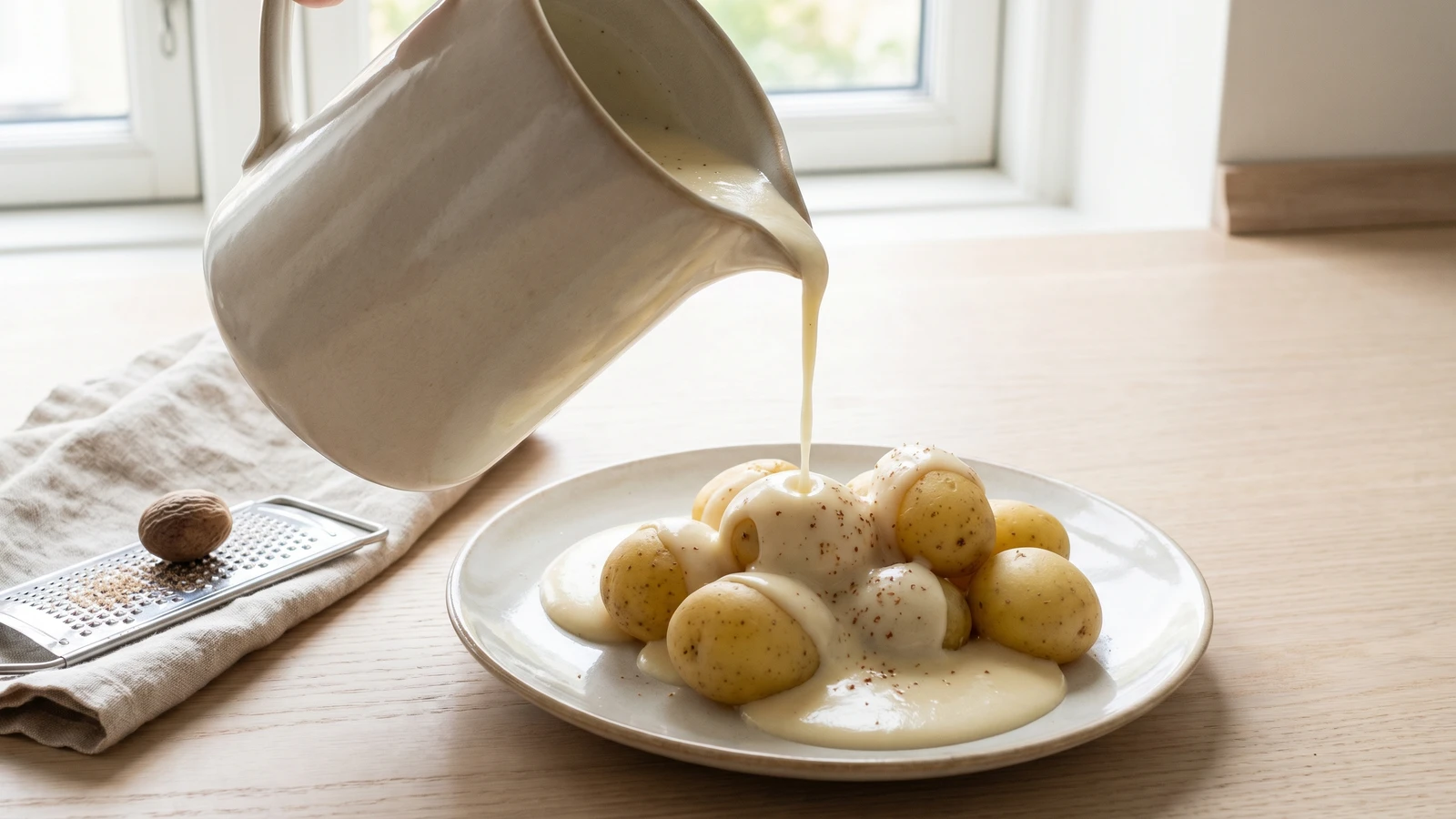
Hvid Sovs
Created by Chef Freja
The patient Danish white sauce that holds the weeknight kitchen together: a slow roux of butter and flour, milk whisked in gradually, finished with a generous grating of whole nutmeg. Learn this and everything else follows.
Every Danish cook learns hvid sovs. Not from a book, from standing next to someone who already knows. You watch the butter melt. You watch the flour go in. You watch the milk added slowly, a little at a time, and you learn the rhythm before you learn the reason. This is the sauce that holds the weeknight kitchen together.
In Denmark we call this opbagt sovs, which means something like "baked-up sauce," a name that comes from the moment the flour cooks in the butter. That moment is the foundation. Get it right and the sauce is smooth, mild, and clean. Rush it and you'll taste raw flour in every bite, a starchy, papery note that no amount of seasoning can hide. I want you to give the roux two full minutes of your attention. That's all it takes.
The nutmeg at the end is not optional. It's the quiet detail that lifts hvid sovs from plain to something that makes you pause and notice. Grate it fresh from a whole nut, because the difference between fresh and pre-ground is the difference between a sauce that tastes cooked with love and one that tastes like it came from a packet. This is one of the simplest things you'll ever make, and once you've made it, you'll reach for it all winter: over boiled potatoes, alongside frikadeller, spooned across steamed fish, stirred through vegetables. It's not one recipe. It's the beginning of dozens.
The roux-based white sauce arrived in Danish kitchens through French culinary influence in the 18th and 19th centuries, but Danish cooks made it their own by simplifying it down to its essentials and pairing it with the boiled meats, poached fish, and root vegetables that define everyday Danish eating. By the early 1900s, opbagt sovs had become so central to home cooking that the technique appeared in every Danish household manual, including the landmark Frøken Jensens Kogebog, first published in 1901, which treated it as the first skill a young cook should master. The generous use of nutmeg, a spice that reached Copenhagen through the Dutch spice trade, distinguishes the Danish version from its French ancestor and gives it the warm, sweet undertone that Danish cooks consider essential.
The technique, the tradition, and the story behind every dish.
Discover Culinary AdvisorIngredients
unsalted butter
Quantity
40g
plain flour
Quantity
40g
whole milk
Quantity
500ml
warmed
whole nutmeg
Quantity
for grating
fine sea salt
Quantity
to taste
white pepper
Quantity
to taste
| Ingredient | Quantity |
|---|---|
| unsalted butter | 40g |
| plain flour | 40g |
| whole milkwarmed | 500ml |
| whole nutmeg | for grating |
| fine sea salt | to taste |
| white pepper | to taste |
Equipment Needed
- •Heavy-bottomed saucepan, 1.5 litre
- •Whisk
- •Wooden spoon
- •Fine grater or microplane for the nutmeg
Instructions
- 1
Melt the butter
Set a heavy-bottomed saucepan over medium-low heat. Add the butter and let it melt completely. You want it liquid and gently foaming, not browning. If the butter takes on any color at all, the sauce will carry that toasted note through every step that follows, and hvid sovs should taste clean and mild. The foam tells you the water in the butter is cooking off. That's when you're ready.
Use a pan with a thick, heavy base. Thin pans create hot spots, and hot spots burn flour before you can react. - 2
Cook the roux
Add all the flour at once and stir it into the butter with a wooden spoon. Keep stirring over medium-low heat for two full minutes. The mixture will look like wet sand at first, then smooth into a pale paste. This is your roux, the opbagning, and cooking it properly is the most important two minutes in the recipe. Raw flour tastes like paste and cardboard. Cooked flour tastes like nothing, which is exactly what you want. It disappears into the sauce and does its work invisibly. You'll know it's ready when it smells faintly biscuity and pulls away from the sides of the pan as a single mass.
Don't stop stirring. The roux cooks unevenly if you leave it, and burned spots will taste bitter in the finished sauce. Two minutes of steady attention is all it asks. - 3
Add the milk gradually
Take the pan off the heat. Pour in about a quarter of the warm milk and whisk immediately. The roux will seize up into a thick, stubborn paste. That's normal. Keep whisking until the paste is completely smooth and there are no lumps at all. Return the pan to medium-low heat. Add the remaining milk in three or four additions, whisking each time until the sauce is smooth before adding the next. The reason you add milk gradually is physics: a small amount of liquid mixes into a thick paste far more easily than a large amount. Dump all the milk in at once and you'll be chasing lumps for the rest of the evening.
Warm milk, not cold. Cold milk shocks the roux and creates lumps that no amount of whisking will dissolve. You don't need it hot, just warm enough that it doesn't feel cold when you dip your finger in. - 4
Simmer until it coats
Once all the milk is incorporated and the sauce is smooth, let it come to a very gentle simmer. Cook for five to seven minutes, stirring often with the whisk or a wooden spoon. The sauce will thicken as the starch in the flour swells and sets. You'll see it change: first thin and liquid, then gradually heavier, until it coats the back of a spoon and holds when you draw a line through it with your finger. That's the consistency you want. If it's too thick, add a splash more milk. If it's too thin, give it another two minutes.
- 5
Season and finish
Take the pan off the heat. Season with salt and white pepper. White pepper because the sauce is white and black specks would break the calm surface, but also because white pepper has a sharper, more direct heat that sits better in a milk-based sauce. Now grate the nutmeg directly over the pan. Start with six or seven good passes across a fine grater. Stir it through and taste. The nutmeg should be present but not dominant: a warm, slightly sweet note in the background that makes you wonder what it is before you recognize it. Add more if you want. Nutmeg from a whole nut is twice as alive as the pre-ground kind. You'll know when it's right.
Always grate nutmeg fresh. Pre-ground nutmeg loses its volatile oils within weeks of being opened. A whole nutmeg keeps for years and gives you that warm, resinous depth that the powdered version can only remember.
Chef Tips
- •Equal weights of butter and flour is the rule. 40g of each to 500ml of milk gives you a medium sauce, thick enough to coat but thin enough to pour. For a thicker sauce to bind a gratin or fill a pie, use 50g of each. For a thin sauce to dress vegetables lightly, use 30g.
- •If lumps happen, and they can happen to anyone, push the sauce through a fine sieve and return it to a clean pan. No one will know. The sieve forgives everything.
- •Hvid sovs is a mother sauce. Add grated mature cheese and you have ostesovs. Stir in chopped parsley and a squeeze of lemon and you have persillesovs for boiled cod. Add a spoonful of strong Danish mustard and you have sennepssovs for frikadeller. Learn the base and the variations are yours.
- •Use whole milk, always. Skimmed milk makes a thin, watery sauce that tastes like compromise. The fat in whole milk is what gives hvid sovs its body and its gentle richness.
Advance Preparation
- •Hvid sovs keeps in the fridge for two days. Press a piece of cling film directly onto the surface before chilling to prevent a skin from forming. Reheat gently over low heat, whisking in a splash of milk to restore the consistency.
- •You can make the roux ahead and keep it in the fridge for up to a week. When you're ready, warm the roux gently and add the milk as described. This cuts weeknight cooking time to under ten minutes.
Frequently Asked Questions
Nutrition Information
1 serving (about 125g)
Where cooking meets culture.
Culinary mentorship, cultural storytelling, and the editorial depth that makes cooking meaningful.
Explore Culinary Advisor