Culinary Advisor
A cooking platform built around craft, culture, and the stories behind what we eat.
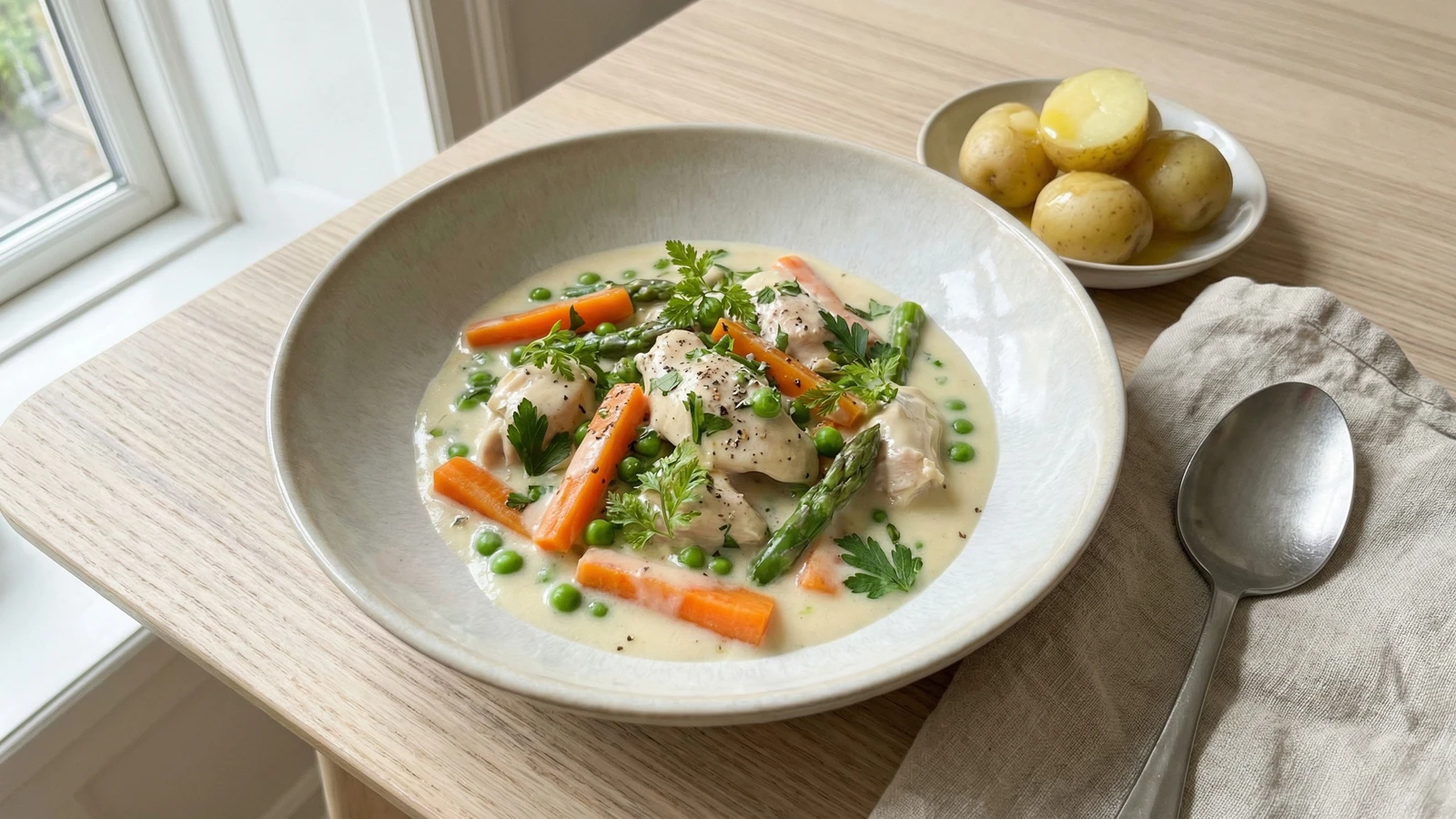
Honsefrikasse
Created by Chef Freja
Danish chicken fricassee with poached chicken in a pale, silky sauce, bright with young carrots, peas, and the first asparagus. Spring comfort food the Danish way, gentle and deeply kind.
There's a moment in lateApril when the asparagus arrives at the market and the peas follow a few weeks later. The light is back, the evenings are long again, but the air still carries a chill off the Oresund. This is honsefrikasse weather. Not the heavy stews of January, not yet the cold plates of midsummer. Something in between. A dish that belongs to the transition.
Honsefrikasse is what a Danish mother makes when she wants to feed her family something gentle. A whole chicken, poached slowly with aromatics, then folded into a pale velvet sauce the color of ivory. Bright young carrots, fresh peas, a handful of asparagus if the season allows. Parsley and chervil on top, lemon at the end. It looks modest on the plate and tastes like something much greater than its parts. That is the whole Danish philosophy of home cooking in one bowl.
I want you to trust the process on this one. There are a few small moments that matter more than the rest: the gentle poach that keeps the chicken tender, the blonde roux that must not darken, and the tempered egg yolks at the end that give the sauce its particular silk. I'll walk you through each one. None of it is difficult. It just asks for attention and a pot that isn't rushing. The season decides when this dish is at its best, and the season is now.
Honsefrikasse arrived in Danish kitchens from France in the late 1700s, when French cuisine was the dominant influence on the tables of the Copenhagen bourgeoisie. The word itself comes from the French fricassée, a white braise of meat in a cream sauce. By the middle of the 1800s it had migrated from grand houses to everyday Danish cookbooks, and by the twentieth century it was firmly a dish of the home kitchen, particularly associated with the spring months when young chickens and early vegetables came together on the same plate. The Danish version is distinguished from the French by its insistence on a pale, not browned, sauce and by the generous use of dill or chervil alongside the parsley, a nod to the herbs that thrive in the Danish garden.
The technique, the tradition, and the story behind every dish.
Discover Culinary AdvisorIngredients
whole chicken
Quantity
1, about 1.5kg
or 1.5kg bone-in chicken pieces
onion
Quantity
1 medium
peeled and halved
leek
Quantity
1
white part only, roughly chopped
celery stalk
Quantity
1
roughly chopped
bay leaves
Quantity
2
black peppercorns
Quantity
8
fine sea salt
Quantity
1 teaspoon, plus more to taste
cold water
Quantity
1.5 litres
young carrots
Quantity
400g
peeled and cut into batons
fresh peas
Quantity
200g
or frozen peas if out of season
thin green asparagus (optional)
Quantity
200g
trimmed and cut into 4cm lengths
unsalted butter
Quantity
60g
plain flour
Quantity
50g
double cream
Quantity
150ml
egg yolks
Quantity
2
fresh lemon juice
Quantity
1 tablespoon
flat-leaf parsley
Quantity
small bunch
chopped
fresh chervil (optional)
Quantity
a few sprigs
white pepper
Quantity
to taste
boiled new potatoes or steamed rice
Quantity
to serve
| Ingredient | Quantity |
|---|---|
| whole chickenor 1.5kg bone-in chicken pieces | 1, about 1.5kg |
| onionpeeled and halved | 1 medium |
| leekwhite part only, roughly chopped | 1 |
| celery stalkroughly chopped | 1 |
| bay leaves | 2 |
| black peppercorns | 8 |
| fine sea salt | 1 teaspoon, plus more to taste |
| cold water | 1.5 litres |
| young carrotspeeled and cut into batons | 400g |
| fresh peasor frozen peas if out of season | 200g |
| thin green asparagus (optional)trimmed and cut into 4cm lengths | 200g |
| unsalted butter | 60g |
| plain flour | 50g |
| double cream | 150ml |
| egg yolks | 2 |
| fresh lemon juice | 1 tablespoon |
| flat-leaf parsleychopped | small bunch |
| fresh chervil (optional) | a few sprigs |
| white pepper | to taste |
| boiled new potatoes or steamed rice | to serve |
Equipment Needed
- •Large heavy pot, 5 litre, for poaching
- •Fine mesh sieve
- •Wide heavy saucepan, 24cm
- •Whisk
- •Small saucepan for the vegetables
- •Ladle
Instructions
- 1
Poach the chicken
Place the chicken in a large pot and add the onion, leek, celery, bay leaves, peppercorns, and salt. Pour in enough cold water to just cover the bird, about 1.5 litres. Bring slowly to a bare simmer over medium heat. The moment you see bubbles breaking the surface, drop the heat. Never let it boil. A full boil toughens the chicken and clouds the stock, and the stock is half the dish. Cover partially and poach gently for 45 minutes, until the chicken is cooked through and the leg meat pulls easily from the bone.
Skim any grey foam that rises to the surface in the first ten minutes. That is where the off-flavors hide, and taking a minute to lift them out gives you a clearer, cleaner stock. - 2
Rest and strain
Lift the chicken out of the pot and set it on a plate to cool until you can handle it. Strain the poaching liquid through a fine sieve into a clean jug or bowl. Discard the aromatics. You should have about a litre of pale golden stock. This is the soul of the fricassee. Taste it. If it tastes of something, you're on the right path. If it tastes of nothing, reduce it down by a third to concentrate the flavor before you go further.
- 3
Pick the meat
Once the chicken is cool enough to handle, pull the meat from the bones in generous pieces. Not shreds, not cubes. Pieces. The size of a walnut is about right. Discard the skin and bones, or save the bones for another stock. Cover the meat loosely and set it aside while you make the sauce.
Keep the meat in large pieces. Honsefrikasse is not a shredded chicken stew. The pieces should hold their shape on the spoon and give you something to bite into. - 4
Cook the vegetables
Bring a small pot of salted water to a gentle simmer. Add the carrots first and cook for four minutes, then add the asparagus if using and cook for two minutes more, then add the peas for a final minute. Drain and tip them straight into a bowl of very cold water. This stops the cooking and holds their color bright. Drain again and set aside. Crowding the vegetables into the fricassee at the end is how you keep them tasting like spring instead of like stewed vegetables.
- 5
Make the blonde roux
Melt the butter in a wide, heavy pan over medium heat. When it foams, scatter in the flour and whisk it into a smooth paste. Cook the roux for two full minutes, whisking constantly. You want it to smell faintly of toasted biscuits, not of raw flour. This is a blonde roux, not a brown one. The sauce for honsefrikasse should be pale ivory, not caramel. If the roux darkens, you've gone too far and the whole dish shifts in the wrong direction.
- 6
Build the sauce
Start adding the warm poaching stock to the roux, a ladleful at a time, whisking hard between each addition. The first ladle will seize and look alarming. Keep whisking. By the third ladle it loosens into a smooth cream. Once all the stock is in, let the sauce come to a gentle simmer and cook for ten minutes, stirring often. It will thicken to the consistency of soft custard, thick enough to coat the back of a spoon but still pourable. That's what you want. A sauce that coats the chicken without gluing it down.
Warm stock into a hot roux gives you a smooth sauce every time. Cold stock shocks the roux and you'll fight lumps the rest of the way. - 7
Temper the egg yolks
In a small bowl, whisk the egg yolks with the cream. Take a ladle of the hot sauce and whisk it slowly into the egg and cream mixture. This warms the yolks gradually so they don't scramble when they meet the pan. Pour the tempered mixture back into the sauce, whisking as you go, and keep the heat low. Do not let it boil after the yolks go in. Boiling will split the sauce and turn the whole thing grainy. The yolks give you a richness and a silkiness that cream alone can't deliver, and you'll taste the difference.
- 8
Fold everything together
Add the chicken pieces and the cooked vegetables to the sauce. Fold them in gently so the chicken doesn't break apart and the vegetables stay whole. Warm everything through over low heat for two or three minutes, no longer. The chicken is already cooked. You're just bringing it to temperature and letting it marry with the sauce. Finish with the lemon juice, a generous pinch of white pepper, and salt to taste. The lemon is not optional. It lifts the cream and wakes the whole dish up.
- 9
Serve with the greens
Scatter the chopped parsley and chervil over the top just before serving. Ladle generously into shallow bowls with boiled new potatoes or a scoop of steamed rice alongside to catch the sauce. You'll know it's right when the sauce is ivory, the vegetables are still bright, and the chicken holds together in tender pieces. Tak for mad.
Chef Tips
- •A good chicken matters more than any technique you can apply to a bad one. Buy the best bird you can find, free-range if possible. The stock you make from its bones is the foundation of the whole dish, and a flavorless chicken gives you a flavorless stock.
- •If fresh peas are out of season, frozen peas are honestly fine. They're picked and frozen at their peak and they slip into the sauce beautifully. Fresh pea pods in March are a lie. The joy of waiting is real, but the freezer is also a friend.
- •Chervil is the quiet Danish secret in honsefrikasse. It tastes of aniseed and parsley at once, and it belongs in this dish as naturally as dill belongs in gravlax. If your shop doesn't carry it, lean a little harder on the parsley and add a few fennel fronds if you have them.
- •This is a dish that improves overnight. The sauce deepens, the chicken soaks up the flavors. Make it a day ahead if you can, reheat it gently, and add the fresh herbs just before serving.
- •A crisp, dry Danish beer or a glass of unoaked white wine, something like a Riesling or a Gruner Veltliner, sits beside this dish beautifully. Nothing heavy. The sauce is already rich.
Advance Preparation
- •The chicken can be poached and the stock made a day ahead. Keep the picked meat and strained stock separately in the fridge. When you're ready to serve, bring the stock back up and build the sauce fresh.
- •The entire fricassee can be made a day ahead and reheated gently over low heat. Do not let it boil on the reheat or the egg yolks will split. Add the fresh herbs and lemon juice just before serving to keep them bright.
- •Leftovers keep for three days in the fridge and reheat beautifully for a weekday lunch over rice or boiled potatoes.
Frequently Asked Questions
Nutrition Information
1 serving (about 380g)
Where cooking meets culture.
Culinary mentorship, cultural storytelling, and the editorial depth that makes cooking meaningful.
Explore Culinary Advisor