Culinary Advisor
A cooking platform built around craft, culture, and the stories behind what we eat.
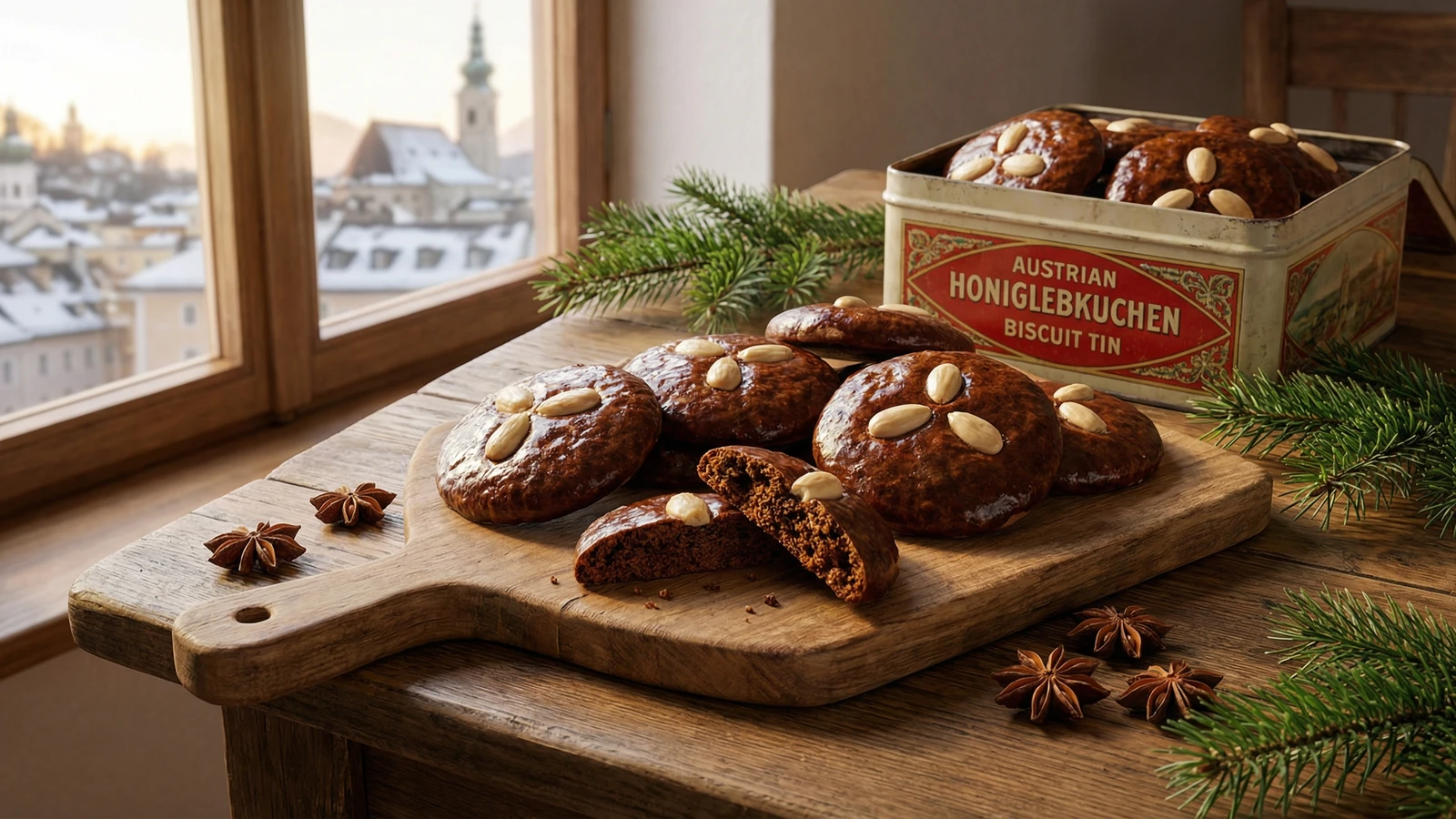
Honiglebkuchen
Created by Chef Elsa
Dark, spiced Austrian honey gingerbread with rye flour and a whole blanched almond on top. They smell like a Salzburg Christmas market and taste better on day four than day one.
The first time I understood what Advent really meant in Austria, I was eight years old, standing in Salzburg's Christkindlmarkt with Gretel and my grandmother Eva. The air smelled of Glühwein and roasted chestnuts and, underneath all of it, Lebkuchen. That warm, honeyed, spiced smell that settles into wooden market stalls and old stone archways and doesn't leave until January. Gretel bought me a Lebkuchenherz on a ribbon and I wore it around my neck for the rest of the trip, eating it from the edges inward over three days.
Honiglebkuchen are the oldest form of Lebkuchen, and the simplest. Honey is the backbone, not sugar. Rye flour gives them their dense, almost fudgy chew, a texture nothing like a crisp ginger snap or a cakey American gingerbread cookie. The spices are warm and round: cinnamon, cloves, allspice, a little cardamom, a whisper of ginger. The lemon zest lifts everything. A splash of dark rum deepens the whole picture. And on top, a single blanched almond pressed into each one, like a small signature.
What makes these extraordinary is patience. Honiglebkuchen improve with time. On day one they're pleasant. By day three or four, the honey has softened the crumb, the spices have married, and every bite has a depth you didn't taste at first. Austrians know this. It's why they bake Lebkuchen weeks before Christmas, storing them in tins with a slice of apple to keep them tender. The waiting is part of the recipe. Gretel always said that any biscuit worth eating should be worth waiting for, and she was right about that, the way she was right about most things in the kitchen.
Lebkuchen have been baked in the Austrian and German-speaking lands since the 13th century, when monasteries held a near-monopoly on the spice trade and honey supply needed to produce them. Salzburg, Nuremberg, and Graz all developed distinct Lebkuchen traditions. The Austrian Honiglebkuchen, with its reliance on rye flour and dark honey over the almond-heavy Elisenlebkuchen of Franconia, reflects an Alpine baking tradition shaped by what grew locally: rye in the mountain valleys, honey from forest apiaries, and the spices that traveled north through Venice and over the Brenner Pass into Habsburg territory.
The technique, the tradition, and the story behind every dish.
Discover Culinary AdvisorIngredients
honey (dark, aromatic wildflower or Austrian forest honey)
Quantity
250g
dark muscovado sugar
Quantity
100g
unsalted butter
Quantity
80g
egg
Quantity
1 large
rye flour (Roggenmehl)
Quantity
200g
plain flour
Quantity
150g
baking soda
Quantity
1 teaspoon
Lebkuchengewürz (gingerbread spice blend)
Quantity
2 teaspoons
ground cinnamon
Quantity
1/2 teaspoon
fine salt
Quantity
1/4 teaspoon
unwaxed lemon
Quantity
zest of 1
dark rum
Quantity
1 tablespoon
whole blanched almonds
Quantity
about 36
for decorating
egg yolk
Quantity
1
mixed with 1 tablespoon milk for egg wash
| Ingredient | Quantity |
|---|---|
| honey (dark, aromatic wildflower or Austrian forest honey) | 250g |
| dark muscovado sugar | 100g |
| unsalted butter | 80g |
| egg | 1 large |
| rye flour (Roggenmehl) | 200g |
| plain flour | 150g |
| baking soda | 1 teaspoon |
| Lebkuchengewürz (gingerbread spice blend) | 2 teaspoons |
| ground cinnamon | 1/2 teaspoon |
| fine salt | 1/4 teaspoon |
| unwaxed lemon | zest of 1 |
| dark rum | 1 tablespoon |
| whole blanched almondsfor decorating | about 36 |
| egg yolkmixed with 1 tablespoon milk for egg wash | 1 |
Equipment Needed
- •Medium saucepan
- •Rolling pin
- •Baking trays (2 large)
- •Pastry brush
- •Airtight storage tin
Instructions
- 1
Warm the honey mixture
Combine the honey, muscovado sugar, and butter in a saucepan over low heat. Stir gently until the butter melts and the sugar dissolves into the honey. The mixture will turn dark and glossy, smelling like Christmas already. Do not let it boil. You want the heat just high enough to bring everything together. Remove from the heat and let it cool until it's warm to the touch but not hot, about fifteen minutes. If you add the egg to a hot mixture it will cook and you'll have scrambled honey, which is not what we're after.
The quality of the honey matters more here than in almost any other recipe. This is a cookie named after honey. Use the best you can find: dark, aromatic, with real character. Pale, mild clover honey disappears behind the spices. - 2
Build the dough
Beat the egg into the cooled honey mixture until smooth. In a large bowl, whisk together the rye flour, plain flour, baking soda, Lebkuchengewürz, extra cinnamon, and salt. Pour the wet mixture into the dry and stir with a wooden spoon until a soft, sticky dough forms. Add the lemon zest and rum and work them through. The rye flour gives the dough a slightly gritty, earthy feel. That's correct. It will soften as it rests.
Rye flour is not a substitute here, it's the point. It gives Honiglebkuchen their distinctive texture: dense, chewy, almost fudgy after a few days. If you use only white flour, you'll get a perfectly pleasant cookie that tastes nothing like what an Austrian grandmother would recognize. - 3
Rest the dough
Wrap the dough tightly in cling film and refrigerate for at least two hours, or overnight. The dough needs to firm up so you can roll it without it sticking to everything in your kitchen. The resting also lets the spices bloom into the honey. If you have the patience, three days in the fridge makes a noticeably better Lebkuchen. Old Austrian recipes call for resting the dough for weeks. You don't need to go that far, but longer rest is always rewarded.
- 4
Shape the Lebkuchen
Preheat your oven to 180°C (350°F). Line two baking trays with parchment. Take the dough out of the fridge and let it sit for ten minutes to lose the deepest chill. On a lightly floured surface (use the rye flour), roll the dough to about seven or eight millimeters thick. Cut into rectangles roughly 5 by 8 centimeters, or use a round cutter if you prefer. Place them on the trays with a centimeter or two between each. They spread a little but they're not unruly about it.
- 5
Decorate and glaze
Press a single blanched almond firmly into the center of each Lebkuchen. The almond should sit in the dough, not just balanced on top, or it will fall off after baking. Brush each cookie with the egg wash. Be thorough but not heavy-handed. You want a thin, even coat that gives them a burnished shine without pooling in the corners.
- 6
Bake
Bake for 12 to 15 minutes. The Lebkuchen are done when they feel just set on top but still give slightly when you press the edge. They will look a shade lighter than you think they should be. That's right. They darken as they cool and they firm up considerably. If you wait until they look done in the oven, they'll be hard as paving stones by morning. Pull them out when they're still a little soft and trust the process.
Rotate the trays halfway through baking. Most home ovens have hot spots, and Lebkuchen are dark enough in color that you won't notice uneven browning until it's too late. - 7
Cool and store
Let the Lebkuchen cool on the tray for five minutes, then move them to a wire rack. They'll feel slightly soft and you might worry you've underbaked them. You haven't. Once completely cool, store them in an airtight tin with a slice of apple tucked in alongside. The apple gives off just enough moisture to keep the cookies soft and chewy over the following days. Replace the apple slice every two days. Honiglebkuchen taste good on day one. They taste extraordinary on day four.
Chef Tips
- •Make your own Lebkuchengewürz. Mix four parts cinnamon with two parts ground cloves, two parts ground allspice, one part ground ginger, one part ground nutmeg, and one part ground cardamom. Keep it in a sealed jar. The pre-mixed stuff from the supermarket sits on shelves for months and the spices lose their nerve. Fresh-ground makes a real difference here.
- •If you can't find rye flour, a good wholemeal spelt flour will get you closer to the right texture than plain white flour ever will. But look for the rye. Most health food shops carry it, and it's the ingredient that separates real Honiglebkuchen from ordinary spiced biscuits.
- •The apple-in-the-tin trick is not optional if you want soft Lebkuchen. Without it, they dry out and harden within a few days. A slice of fresh apple, replaced every two days, releases just enough moisture to keep the crumb tender. Gretel taught me this when I was ten and I've never stored Lebkuchen any other way.
- •These freeze beautifully for up to three months. Layer them between sheets of parchment in a tin or freezer container. Thaw at room temperature and they taste as good as the day you baked them.
Advance Preparation
- •The dough can rest in the fridge for up to five days before baking. It only gets better. Some Austrian bakers rest their Lebkuchen dough for two weeks.
- •Baked Lebkuchen should be stored in an airtight tin with a slice of fresh apple for at least two to three days before serving. They reach their best texture around day four.
- •Honiglebkuchen freeze well for up to three months, fully baked. Thaw at room temperature in their tin.
Frequently Asked Questions
Nutrition Information
1 serving (about 23g)
Where cooking meets culture.
Culinary mentorship, cultural storytelling, and the editorial depth that makes cooking meaningful.
Explore Culinary Advisor