Culinary Advisor
A cooking platform built around craft, culture, and the stories behind what we eat.
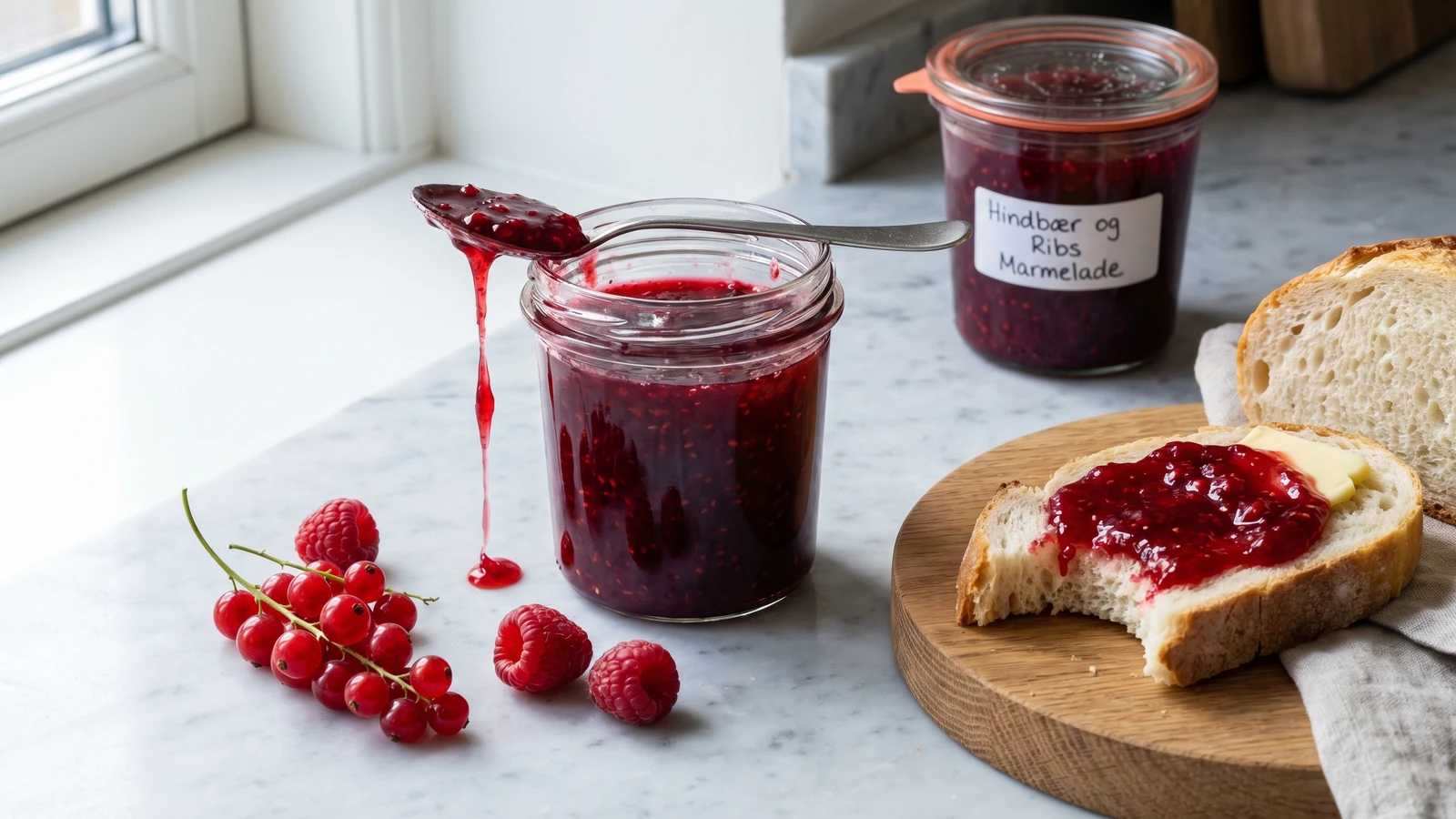
Hindbaer og Ribs Marmelade
Created by Chef Freja
Raspberries and redcurrants cooked together into a set, ruby-red jam that needs no bought pectin. The ribs do the work. You do the stirring. The jars carry the summer forward into darker months.
Late June in Denmark is the week the redcurrant bushes turn. You walk past a garden hedge and suddenly the branches are heavy with clusters of translucent red fruit, glowing like tiny lanterns in the long evening light. The raspberries follow within days. When both are ripe at the same time, you make this jam. The season decides.
Hindbaer og ribs marmelade is one of the great Danish summer preserves, and it exists because of a small piece of kitchen chemistry that home cooks have understood for generations: redcurrants are full of natural pectin. Mix them with raspberries, add sugar, and boil, and the jam sets on its own. No bought pectin, no special powder, nothing from a packet. The fruit does the work. What you get is a jam with a clean, firm set and a flavor that balances sweetness and tartness so precisely that it belongs on everything from fresh bread and butter to a slice of aged cheese.
I'll walk you through every step, but here's what matters most: the set test. When you push a spoonful on a cold saucer and the surface wrinkles, you're there. That moment is your signal. Everything before it is patience, and patience with boiling fruit is the only real skill this recipe asks of you. You'll know when it's right.
Home preserving in Denmark, known as syltning, was for centuries not a hobby but a necessity. The short growing season meant that summer fruit had to be captured in sugar if it was to last through the dark months. Redcurrants (ribs) have been cultivated in Danish kitchen gardens since at least the 1700s, and their high pectin content made them the preferred partner for softer, low-pectin fruits like raspberries and strawberries. The tradition of marking each jar with the year and storing them in the kaelder (cellar) persisted in most Danish households well into the late twentieth century, and in many homes it continues still.
The technique, the tradition, and the story behind every dish.
Discover Culinary AdvisorIngredients
fresh raspberries
Quantity
500g
fresh redcurrants
Quantity
500g
stripped from their stems
granulated sugar
Quantity
700g
lemon juice
Quantity
1 tablespoon
freshly squeezed
| Ingredient | Quantity |
|---|---|
| fresh raspberries | 500g |
| fresh redcurrantsstripped from their stems | 500g |
| granulated sugar | 700g |
| lemon juicefreshly squeezed | 1 tablespoon |
Equipment Needed
- •Large heavy-bottomed pot or preserving pan, at least 4 litres
- •Wooden spoon
- •Clean glass jars with lids, about 5 jars of 250ml
- •Wide-mouthed jam funnel (optional but helpful)
- •Ladle
Instructions
- 1
Sterilize the jars
Wash your jars and lids in hot soapy water and rinse them well. Place them upside down on a baking tray and put them in the oven at 120C for fifteen minutes. Leave them there until you need them. The jars must be hot when you fill them. Cold glass and boiling jam is a crack waiting to happen, and a dirty jar means mould within the week. Put a small saucer in the freezer now. You'll need it later to test the set.
If you don't have proper preserving jars with new lids, any clean glass jar with a tight-fitting lid works. But new lids seal better and the jam lasts longer. - 2
Prepare the fruit
Run a fork down each redcurrant stem to strip the berries free. It's a quiet, repetitive task and it goes faster than you think. Pick over the raspberries and discard any that are soft or mouldy, but don't wash them unless you must. Washing dilutes the flavor and adds water you'll only have to boil off later. If they came from a garden or a market you trust, leave them as they are.
- 3
Cook the fruit down
Put the redcurrants into a large, heavy-bottomed pot over a medium heat. Press them gently with a wooden spoon as they warm. Within a few minutes they'll burst and release their juice, a flood of sharp, brilliant pink liquid. Add the raspberries, stir everything together, and let the mixture simmer for about five minutes until all the fruit has collapsed. The kitchen will smell like a Danish July, and there's nothing quite like it.
Start with the redcurrants alone because their skins are tougher and need a head start. The raspberries dissolve almost immediately and don't need the extra time. - 4
Add sugar and boil
Take the pot off the heat and add the sugar all at once. Stir until every grain has dissolved. This is important: if you boil before the sugar dissolves, it can crystallize in the finished jam and give you a grainy texture that no amount of cooking will fix. Add the lemon juice. The lemon isn't for flavor so much as for chemistry. It lowers the pH just enough to help the pectin in the redcurrants form a firm gel. Return the pot to a high heat and bring it to a full rolling boil, the kind that doesn't stop when you stir.
- 5
Test for set
After about eight to ten minutes of hard boiling, take the pot off the heat and drop a small spoonful of jam onto the cold saucer from the freezer. Wait thirty seconds, then push it with your fingertip. If the surface wrinkles and holds its shape, the jam is set. If it runs like syrup, put the pot back on, boil for another two minutes, and test again. Trust this test. It's more reliable than any thermometer for a batch this size, because what you're really testing is how the pectin is behaving, not the temperature.
Skim off any pink foam that gathers on the surface while the jam boils. It's harmless but it clouds the jars and makes the jam look less clean. A small knob of butter stirred in at the end also helps settle the foam, though it's not strictly necessary. - 6
Pot the jam
Take the hot jars from the oven, keeping them upright, and fill them with the boiling jam using a ladle and a wide-mouthed funnel if you have one. Leave about half a centimetre of space at the top. Wipe the rims clean with a damp cloth, then seal the lids tightly. Turn the jars upside down for five minutes. This sterilizes the small pocket of air trapped under the lid. Turn them right-side up and let them cool completely on the counter. You'll hear the lids click and pop as they seal. That sound means they're airtight.
Chef Tips
- •Use fruit that is just ripe, not overripe. Slightly underripe redcurrants actually contain more pectin, so a few firm ones in the mix help the set. Overripe fruit makes a softer jam that can end up more like a sauce.
- •The ratio here is equal parts raspberry and redcurrant. You can shift it, more ribs for a sharper, firmer jam, more hindbaer for a softer, sweeter one. But fifty-fifty is where the balance lives, and I'd start there.
- •This jam is exceptional on fresh white bread with a thick layer of butter. It also belongs alongside a good Danish cheese, something firm and nutty like aged Danbo or Vesterhavsost. And a spoonful stirred into yoghurt on a January morning will remind you exactly what summer tasted like.
- •Don't double the batch. Pectin sets best in small quantities. If you have more fruit, make two separate batches back to back. It takes the same time and the set is more reliable.
Advance Preparation
- •Sealed jars keep in a cool, dark cupboard for up to a year. Once opened, store in the fridge and use within three weeks.
- •The redcurrants can be stripped from their stems and frozen if they ripen before the raspberries are ready. Frozen currants work just as well and their pectin holds.
Frequently Asked Questions
Nutrition Information
1 serving (about 20g)
Where cooking meets culture.
Culinary mentorship, cultural storytelling, and the editorial depth that makes cooking meaningful.
Explore Culinary Advisor