Culinary Advisor
A cooking platform built around craft, culture, and the stories behind what we eat.
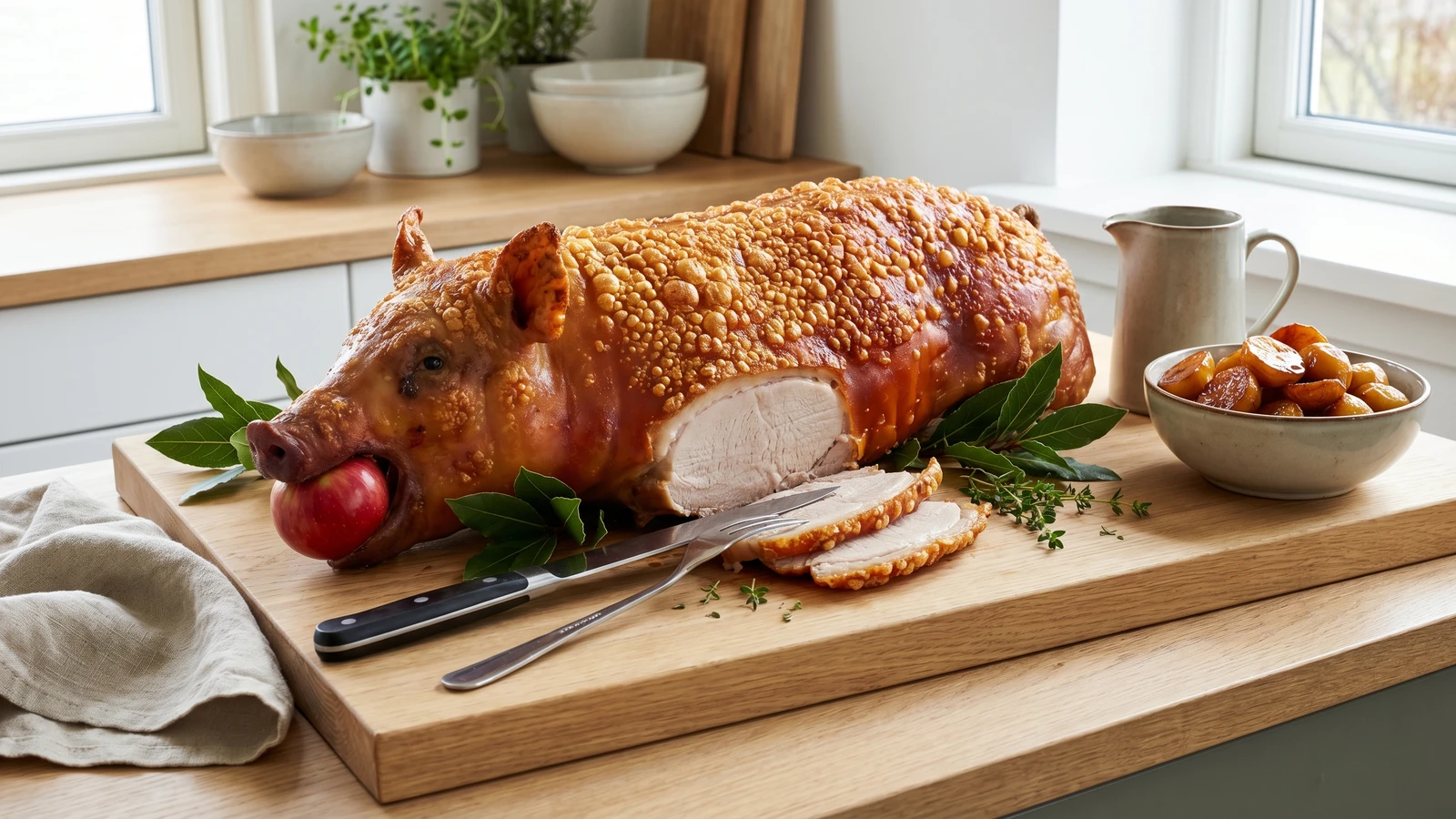
Helstegt Pattegris
Created by Chef Freja
A whole suckling pig roasted slowly until the svaer crackles across every surface, carried to the garden table with an apple in its mouth and brunede kartofler alongside. The Danish celebration at its most generous.
There's a morning in late May when someone's father backs a car up to the butcher's shop and loads a small pig, wrapped in paper, into the boot. Konfirmation season. The garden chairs are out, the tablecloths are pressed, and something extraordinary is about to happen at a table that most weekdays sees nothing more ambitious than frikadeller.
Helstegt pattegris is the Danish garden party at its most generous. A whole suckling pig, scored and salted and roasted slowly until the skin, the svaer, turns to crackling across every centimetre of its body. It arrives on a board with an apple in its mouth, and the table goes quiet for a moment before someone picks up the carving knife. This is how we greet each other when the occasion calls for it.
I want to be straightforward with you: this is not a difficult dish, but it is a committed one. The pig needs your attention over several hours. The rind must be scored in tight lines without cutting through to the meat, because cuts that go too deep let the juices escape and the crackling buckles instead of crisping flat. The coarse salt must sit in every groove, because fine salt dissolves before it can draw the moisture from the skin. These are the details that separate a good roast from one people talk about for years. I'll walk you through every one of them, and you'll stand at that garden table with the carving knife feeling ready. You'll know when it's right.
Whole roast pig has been served at Danish celebrations since at least the 1700s, when lavish country feasts marked weddings, harvests, and christenings across the islands and Jutland. The pattegris, a suckling pig no older than six weeks, became particularly associated with konfirmation celebrations in the 19th century, when the church ceremony marking a young person's passage into adulthood demanded a feast proportionate to the occasion. The apple placed in the pig's mouth is a medieval European banquet tradition that survives almost nowhere else in modern Danish home cooking, a piece of culinary theater that has become inseparable from the dish itself.
The technique, the tradition, and the story behind every dish.
Discover Culinary AdvisorIngredients
whole suckling pig
Quantity
1, approximately 5 kg
cleaned by the butcher with head on
coarse sea salt
Quantity
4 tablespoons
black pepper
Quantity
1 tablespoon
freshly ground
unsalted butter (for the rind)
Quantity
50g
softened
onions
Quantity
2 medium
quartered
firm apples (for the cavity)
Quantity
3
cored and quartered
bay leaves
Quantity
6
fresh thyme
Quantity
small bunch
red apple (for serving)
Quantity
1 whole
plain flour
Quantity
2 tablespoons
chicken or veal stock
Quantity
500ml
fine sea salt
Quantity
to taste
white pepper
Quantity
to taste
small waxy potatoes
Quantity
1.5 kg
white sugar
Quantity
150g
unsalted butter (for brunede kartofler)
Quantity
75g
| Ingredient | Quantity |
|---|---|
| whole suckling pigcleaned by the butcher with head on | 1, approximately 5 kg |
| coarse sea salt | 4 tablespoons |
| black pepperfreshly ground | 1 tablespoon |
| unsalted butter (for the rind)softened | 50g |
| onionsquartered | 2 medium |
| firm apples (for the cavity)cored and quartered | 3 |
| bay leaves | 6 |
| fresh thyme | small bunch |
| red apple (for serving) | 1 whole |
| plain flour | 2 tablespoons |
| chicken or veal stock | 500ml |
| fine sea salt | to taste |
| white pepper | to taste |
| small waxy potatoes | 1.5 kg |
| white sugar | 150g |
| unsalted butter (for brunede kartofler) | 75g |
Equipment Needed
- •Large roasting tray with wire rack, big enough to hold the whole pig
- •Very sharp knife or clean box cutter blade for scoring
- •Kitchen twine or metal skewers
- •Meat thermometer
- •Wide heavy-bottomed pan for brunede kartofler
- •Large carving board
- •Carving knife and two-pronged fork
Instructions
- 1
Score the rind
Using a very sharp knife or a clean box cutter blade, score the rind of the pig in parallel lines about 1 centimetre apart. Work across the entire surface: the back, the sides, the shoulders, the legs. Cut through the skin and into the fat beneath, but stop before you reach the meat. About 5 millimetres deep. This is the single most important step in the whole recipe. Score lines that are too shallow won't let the fat render, and the skin stays chewy. Lines that cut into the meat let the juices escape during roasting and cause the crackling to warp and buckle instead of crisping flat. Take your time with this. Steady, even lines, each one the same depth.
A box cutter gives you more control than a long kitchen knife. The short blade limits how deep you can cut, which is exactly what you want. If you use a kitchen knife, press gently and let the weight of the blade do the work. - 2
Tighten and salt the rind
Boil a full kettle. Set the pig on a rack over the sink and pour the boiling water slowly and evenly across the entire rind. You'll see the skin tighten and the score lines open like little mouths. This is an old technique: the heat contracts the surface so that it crisps more evenly in the oven. Pat the rind completely dry with clean kitchen towels. Any moisture left on the surface will steam instead of crisp, and steam is the enemy of good svaer. Now rub the coarse sea salt generously into every score line, pressing it into the grooves with your fingers. Use more than you think you need. The salt draws moisture out of the skin over hours, and dry skin is what crackles. Fine salt won't work here. It dissolves too quickly and leaves the surface damp. You need coarse crystals that sit in those grooves and do their work slowly.
- 3
Fill the cavity
Season the inside of the pig with salt and pepper. Tuck the quartered onions, quartered apples, bay leaves, and thyme sprigs loosely into the cavity. These aren't stuffing in the usual sense. They perfume the meat from the inside while it roasts and flavour the drippings that will become your brun sovs. Close the cavity with kitchen twine, lacing it shut through the skin, or thread metal skewers across the opening and wind twine between them in a figure-eight pattern. The closure doesn't need to be airtight. It just needs to keep the aromatics inside.
- 4
Prepare for the oven
Heat the oven to 160°C. Wrap the pig's ears and the tip of its tail with small pieces of foil. These thin extremities burn long before the rest of the pig is done, and foil is the simple solution. Rub the softened butter over any areas where the rind is thin, particularly the belly and the inner legs. Set the pig on a wire rack inside your largest roasting tray, legs tucked underneath. The pig must not sit directly in its own drippings, or the underside skin will braise instead of roast. If your tray doesn't have a rack, crumple sheets of foil into a lattice beneath the pig to lift it clear of the base. Pour about 500ml of water into the bottom of the tray. This catches the drippings and prevents them from burning, and the gentle steam during the first hour helps begin rendering the fat beneath the skin.
- 5
Roast at gentle heat
Place the pig in the oven and roast at 160°C for approximately 3 hours. Check the tray every 45 minutes and add more water if the drippings are drying out or beginning to smoke. Do not baste the rind. The surface needs to stay dry to crackle later. If certain areas are browning faster than others, cover them loosely with a small piece of foil. After about 2 and a half hours, push a meat thermometer into the thickest part of the thigh without touching bone. You're looking for 68°C. The temperature will climb another 4 to 5 degrees during resting, bringing it to the safe, perfect point. The meat should feel tender when you press near the shoulder joint. The rind will be golden at this stage, but it won't have crackled yet. That comes next.
Every oven is different. A pig that's closer to 4 kilograms may reach 68°C in 2 and a half hours. A larger one may take closer to 3 and a half. Trust the thermometer over the clock. - 6
Blast for crackling
When the thigh reads 68°C, increase the oven to 220°C. Watch carefully for the next 20 to 30 minutes. The svaer will begin to blister and lift, turning deep golden and crisp across the surface. You'll hear it: a steady popping and crackling from inside the oven. If reluctant patches remain, brush them lightly with a little oil. Stay close during this stage. The line between perfect crackling and burnt skin is narrow, perhaps five minutes. When the entire surface has blistered and turned a deep, even gold, the pig is done.
If a few stubborn patches won't crackle, don't push the whole pig further. Remove the pig when the majority of the svaer is done, cut the uncrackled sections away, and finish them under a hot grill on a separate tray. Better to rescue a few pieces than risk the rest. - 7
Rest the pig
Lift the pig carefully onto a large carving board and cover it loosely with foil. Let it rest for 30 minutes. This is not a step you can skip. The juices need time to settle back into the meat. If you carve straight from the oven, the outer slices will be dry and the centre will weep. While the pig rests, you have exactly enough time to make the gravy and the brunede kartofler. The resting pig keeps its heat. It will still be warm when you carve.
- 8
Make the brun sovs
Set the roasting tray across two burners on medium heat. Pour off most of the fat into a bowl, keeping the dark caramelized drippings in the tray. Sprinkle in the flour and stir it into the drippings, scraping every bit of colour from the bottom with a wooden spoon. These caramelized bits are concentrated flavour, and the gravy depends on them. Cook for two minutes until the flour smells toasty and has absorbed the drippings. Pour in the stock gradually, stirring constantly, and let the gravy simmer for 10 minutes until it thickens and coats the back of a spoon. Strain through a fine sieve into a warm jug, pressing the solids. Season with salt and white pepper. This brun sovs carries the flavour of the whole afternoon in concentrated form.
- 9
Make brunede kartofler
If you haven't already boiled the potatoes, cook them in salted water until just tender, about 15 minutes. Drain and peel them while warm. In a wide, heavy pan, melt the sugar over medium heat without stirring. Swirl the pan gently instead. Stirring causes the sugar to crystallize and seize into lumps. When the sugar turns a deep amber, a shade or two darker than honey, add the butter. It will foam vigorously. Swirl until the butter melts into the caramel, then add the potatoes. Turn them carefully in the caramel with a wooden spoon for about 5 minutes until each potato is coated and glossy. Season with a pinch of salt. The caramel is fiercely hot, so work with patience and steady hands. Brunede kartofler should be sweet, buttery, and slightly bitter from the deep caramel. They are the only accompaniment this pig truly needs.
The sugar goes from amber to burnt in seconds. Stay with the pan and trust your eyes. The moment it smells like toffee and looks like dark honey, the butter goes in. Don't wait for it to get darker. - 10
Carve and serve
Remove the foil from the ears and tail. Place the whole red apple in the pig's mouth. Carry the pig to the table on the board with the carving knife and fork resting alongside. Let the table see it whole before you begin. This is the moment the work is for. To carve, first lift away the crackling in large sheets and set it on a separate board, then separate the legs and shoulders at the joints, and finally slice the loin along the spine. The meat of a young pig is pale, fine-grained, and impossibly tender. Give each plate a portion of meat, a generous piece of crackling broken into shards, brunede kartofler, and a spoonful of brun sovs. Cooked with love. Tak for mad.
Chef Tips
- •Order your pattegris from a good butcher at least a week in advance. Ask for a pig no heavier than 6 kilograms. Larger than that and it won't fit in a standard home oven, and the meat begins to lose the fine, tender quality that makes pattegris worth the effort.
- •Coarse salt is non-negotiable for the svaer. Fine salt dissolves before it can do its work. You need crystals that sit in the score lines and draw moisture out of the skin over hours. Flake salt works. Table salt doesn't. This is one detail where the ingredient is the technique.
- •Score and salt the rind the evening before and leave the pig uncovered in the fridge overnight. The cold circulating air dries the skin further, and drier skin crackles better. This single step of overnight drying makes more difference than anything you do during roasting.
- •The leftover pork makes extraordinary smorrebrod the next day. Thin slices on rugbrod with remoulade and pickled rodkal. The celebration continues at the lunch table.
- •Serve with cold lager and snaps. This is a garden party. A good pilsner, a cold aquavit, and the people you've chosen to share it with are all this table needs.
Advance Preparation
- •Order the pig from your butcher at least one week ahead. Ask for it cleaned, head on, internal organs removed. A good butcher will have it ready for you to collect the day before your celebration.
- •Score and salt the rind the evening before. Place the pig uncovered on a tray in the fridge overnight. The cold air dries the skin, and drier skin crackles better. This is the single best thing you can do for the finished dish.
- •Boil the potatoes for brunede kartofler up to a day ahead. Peel them while warm and keep them dry in the fridge until you're ready to caramelize. Cold, dry potatoes take the caramel more evenly.
Frequently Asked Questions
Nutrition Information
1 serving (about 390g)
Where cooking meets culture.
Culinary mentorship, cultural storytelling, and the editorial depth that makes cooking meaningful.
Explore Culinary Advisor