Culinary Advisor
A cooking platform built around craft, culture, and the stories behind what we eat.
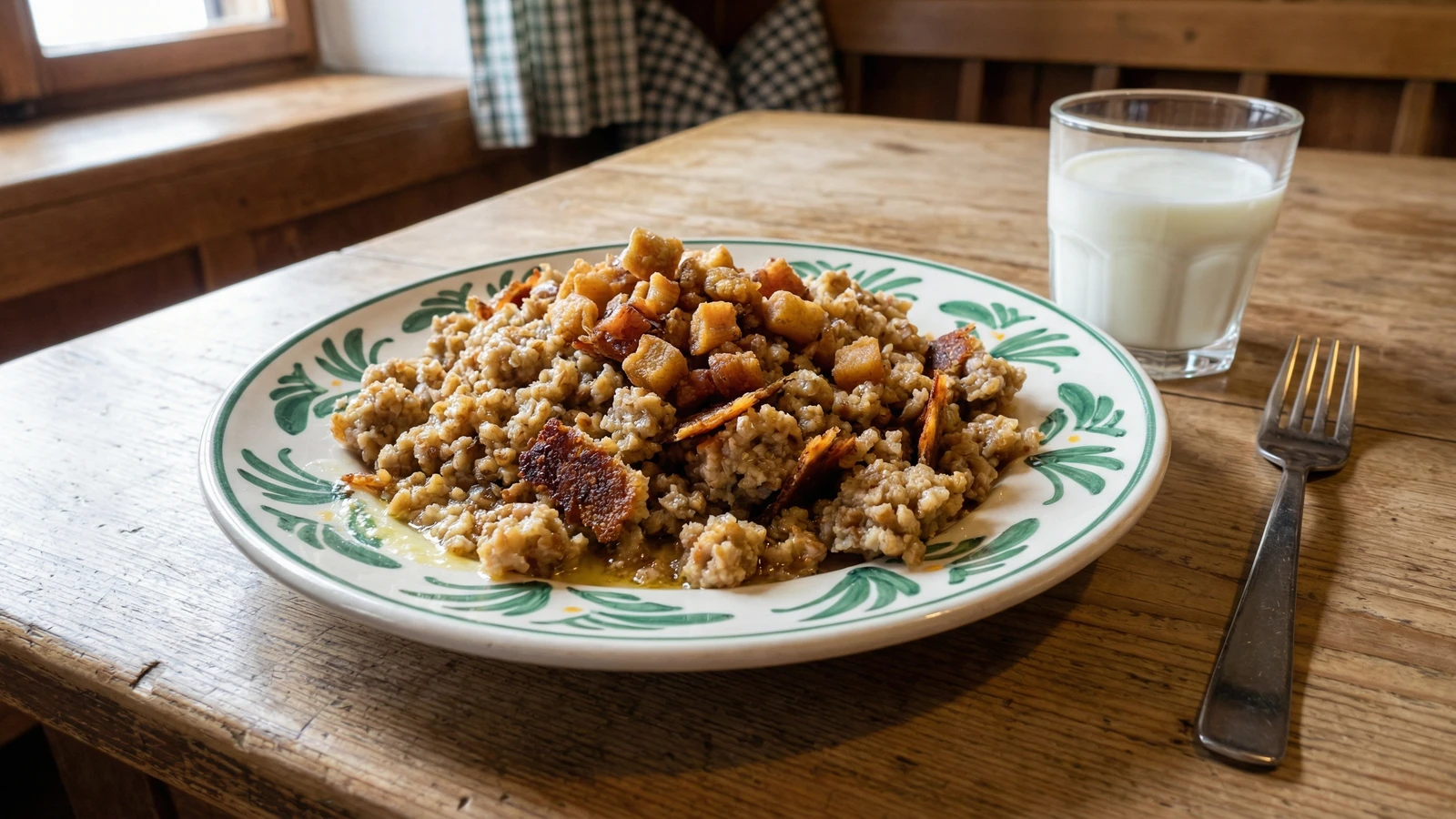
Heidensterz (Styrian Buckwheat Sterz)
Created by Chef Elsa
Styrian buckwheat flour toasted in hot fat until the kitchen smells like roasted hazelnuts, then crumbled rough with two forks and served with crackling Grammeln and cold sour milk.
On our trips through Styria, Gretel and my grandmother Eva would stop at Gasthäuser so far off the main roads that you had to trust the gravel was taking you somewhere worth going. It always was. The tables were pine and scarred from decades of elbows, and what came out of those kitchens was never complicated. Sterz was on every menu. A heap of rough, nutty crumbles on a plain plate, a little dish of Grammeln on the side, a glass of sour milk if you wanted it. I was ten years old the first time I tasted Heidensterz, and I remember thinking it smelled like the woods around us.
Heidensterz is buckwheat flour, toasted in a mix of butter and lard until the raw, grassy smell turns warm and roasted. Then boiling salted water goes in, and you let the whole thing cook undisturbed until a golden crust forms on the bottom. That crust is the prize. You break the mass apart with two forks into rough, irregular crumbles, toss them with more butter, and pile them on a plate. The texture is dry and sandy in the best possible way, with bits of crust scattered through like little chips of flavor.
This is peasant food from the Styrian hills, and it makes no apologies for what it is. There's no sauce, no garnish, no technique that takes years to learn. You toast flour in fat and add water. The whole thing comes together in half an hour. But when the buckwheat is good and you let that crust form properly, Heidensterz is one of the most satisfying things you'll eat all week. Gretel always said the dishes that survive centuries are the ones that feed people honestly. This is one of those.
Buckwheat arrived in Austria through Eastern European trade routes in the late medieval period, taking root in Styria and Carinthia where the cooler mountain climate and poorer soils made wheat cultivation unreliable. Sterz, from the Old German word for something stirred or broken, became the daily staple of Alpine farming families across southern Austria. Heidensterz, using Heiden (the Styrian dialect word for buckwheat), was so central to Styrian peasant life that it replaced bread at many tables, eaten at every meal with whatever fat, milk, or broth the household had on hand.
The technique, the tradition, and the story behind every dish.
Discover Culinary AdvisorIngredients
buckwheat flour (Buchweizenmehl / Heidenmehl)
Quantity
250g
water
Quantity
400ml
boiling
salt (for the water)
Quantity
1 teaspoon
unsalted butter
Quantity
60g
lard (Schweineschmalz)
Quantity
40g
salt
Quantity
pinch
Grammeln (pork cracklings)
Quantity
80g
for serving
sour milk or buttermilk
Quantity
for serving
cold
| Ingredient | Quantity |
|---|---|
| buckwheat flour (Buchweizenmehl / Heidenmehl) | 250g |
| waterboiling | 400ml |
| salt (for the water) | 1 teaspoon |
| unsalted butter | 60g |
| lard (Schweineschmalz) | 40g |
| salt | pinch |
| Grammeln (pork cracklings)for serving | 80g |
| sour milk or buttermilkcold | for serving |
Equipment Needed
- •Heavy-bottomed pan or cast iron skillet (26-28cm)
- •Wooden spoon
- •Two forks for breaking
Instructions
- 1
Heat the fats
Put the butter and lard into a heavy pan over medium heat. Let the butter melt into the lard and wait until the foaming dies down. You want hot, quiet fat, not sizzling. The combination of butter and lard is traditional and it matters: butter gives you flavor, lard gives you the high heat you need to toast the flour without burning the milk solids.
If you want a vegetarian Sterz, use all butter, about 80g. It won't taste exactly the same, but it will still be good. What you lose is that deeper, rounded savoriness the lard brings. - 2
Toast the buckwheat flour
Add the buckwheat flour all at once and stir constantly with a wooden spoon. Keep the heat at medium. You're dry-roasting the flour in the fat, and you need to keep it moving or it will scorch in patches. After four or five minutes, the flour will change color from gray-green to a warm brown and the kitchen will fill with a deep, roasted, almost nutty smell. That smell is how you know you're there. If it smells bitter or acrid, your heat was too high and you need to start over.
Use your nose more than your eyes. The color change is subtle, but the smell shift is unmistakable. Raw buckwheat smells green and grassy. Properly toasted buckwheat smells like roasted hazelnuts. - 3
Add the boiling water
Dissolve the teaspoon of salt in the boiling water. Now, carefully pour the salted boiling water into the pan in a steady stream. Stand back as you pour because it will spit and hiss when the water hits the hot fat. Stir quickly to combine. The mixture will seize up into a thick, heavy mass. That's exactly right. Don't panic and don't add more water. The ratio is deliberate: you want a stiff dough, not a porridge.
The water must be properly boiling, not just hot. Boiling water sets the starch in the buckwheat immediately, which is what gives you that dry, crumbly texture later. Warm water makes paste. - 4
Form the crust
Reduce the heat to low. Press the dough into an even layer across the bottom of the pan with your wooden spoon. Now leave it alone. Don't stir, don't poke, don't lift the edges to check. Let it sit for ten to twelve minutes. You're building a golden crust on the bottom, and that crust is where most of the flavor lives. You'll hear a faint crackling when it forms. If the pan starts to smell like burnt toast, your heat is still too high. Turn it down.
- 5
Break the Sterz
Take two forks and tear the mass apart into rough, irregular crumbles. Work through the whole pan, breaking up the crust and folding it through the softer interior. The pieces should be uneven: some the size of a walnut, some like coarse breadcrumbs, some flat shards of crust. This is the texture of Sterz. It's not meant to be uniform. If it looks messy and ragged, you're doing it right.
If the Sterz feels too compact and won't break apart easily, it needed another minute or two of crust-building time. Don't worry. Just press it back down, give it three more minutes, and try again. - 6
Finish with butter
Cut a generous knob of extra butter, about 20g, and toss it through the crumbles. Let it melt and coat the pieces, turning them glossy. Give the pan another minute on low heat so the smallest crumbles crisp up. The finished Sterz should be dry to the touch but rich with butter, sandy and crumbly with golden bits of crust scattered through.
- 7
Serve with Grammeln and sour milk
Pile the Sterz onto a warm plate. Scatter Grammeln (crispy pork cracklings) over the top or heap them alongside. Pour cold sour milk or buttermilk into a glass or small bowl and set it next to the plate. The Styrian way is to take a forkful of hot, buttery Sterz, then a sip of cold, tangy milk. The temperature contrast and the push between rich and sour is the whole point. Mahlzeit!
Chef Tips
- •Buy whole buckwheat groats and grind them yourself if you can. Pre-ground buckwheat flour loses its aroma fast. If you're buying packaged flour, smell it before you use it. It should smell earthy and a little sweet, not flat or stale.
- •Grammeln are pork cracklings rendered from pork back fat until they turn golden and crispy. If you can't find them, render some diced fatty bacon slowly in a dry pan until the fat is liquid and the bits are crunchy. Drain and use those. They're not the same, but they're honest.
- •In Styria, the sour milk served with Sterz is thick and tangy, closer to kefir than what most supermarkets sell as buttermilk. If you can find proper Sauermilch or full-fat kefir, use that. The fat content matters because it stands up to the richness of the Sterz.
- •Leftover Sterz reheats beautifully. Crumble it into a hot pan with a little butter and let it crisp up again. Some people prefer it this way, with even more crust the second time around.
Advance Preparation
- •Heidensterz can be made up to two days ahead and stored in the fridge. Reheat in a hot pan with butter, breaking it up and letting it crisp again. The texture actually improves.
- •Grammeln can be rendered ahead and stored in an airtight container for up to a week. Recrisp briefly in a dry pan before serving.
Frequently Asked Questions
Nutrition Information
1 serving (about 330g)
Where cooking meets culture.
Culinary mentorship, cultural storytelling, and the editorial depth that makes cooking meaningful.
Explore Culinary Advisor