Culinary Advisor
A cooking platform built around craft, culture, and the stories behind what we eat.
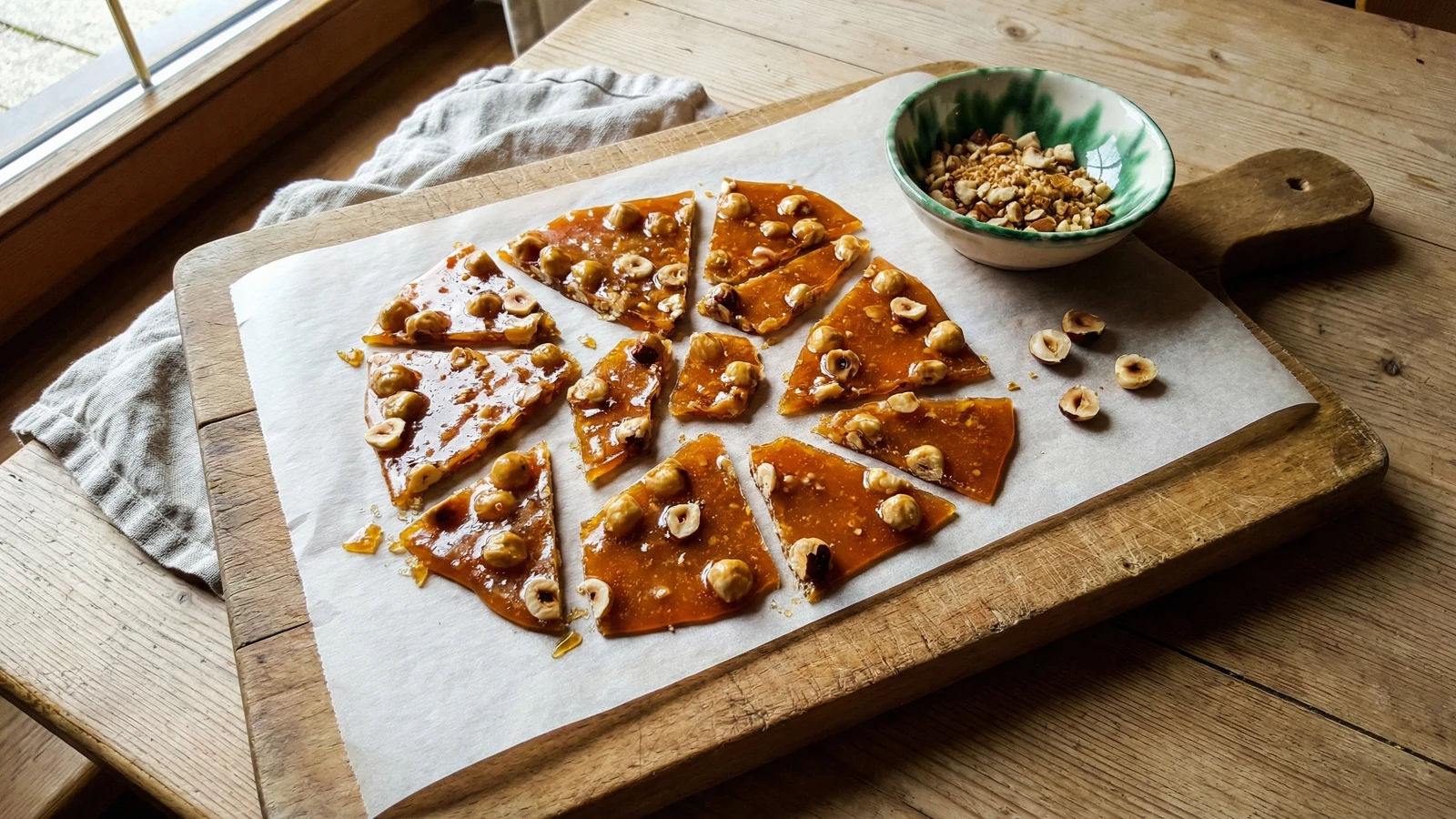
Haselnusskrokant
Created by Chef Elsa
Golden caramel shattered through with toasted hazelnuts, the Austrian confection that turns up inside Torten, on top of ice cream, and in the pockets of anyone passing through a Konditorei before Christmas.
Gretel always said you could tell a good Konditor by the quality of their Krokant. It sounds like a small thing, this crunchy nut brittle that shows up everywhere in Austrian baking, but the difference between good Krokant and bad Krokant is the difference between a Torte that sings and one that just sits there. Good Krokant tastes of deep caramel and warm toasted hazelnuts. Bad Krokant tastes of burnt sugar and regret.
I learned to make Krokant before I learned to make the things you put it in. In my grandmother Eva's kitchen, Gretel would set a small pan of sugar on the stove and let me watch it transform. That was the word she used: transform. One minute you had a pile of white crystals. A few minutes later, without adding anything at all, you had liquid amber that smelled like toffee and bonfire smoke. She'd stir in a handful of hazelnuts she'd toasted herself, pour the whole thing onto an oiled board, and by the time I'd finished licking the spoon it was already hard enough to crack like glass.
Haselnusskrokant is one of the secrets of Viennese pastry. You'll find it folded into Buttercreme fillings, pressed onto the sides of Torten, scattered over Eisbecher at any Eissalon in Salzburg, or piled into paper bags at Christmas markets. It keeps for weeks in a tin, it takes twenty-five minutes from start to finish, and once you've made it from scratch you won't go back to the bought stuff. Two ingredients do almost all the work. The rest is just paying attention.
Krokant entered Austrian confectionery through French influence, the word deriving from the French croquant, meaning 'crunchy.' The Habsburg court's deep ties to French culinary fashion brought techniques like dry caramel work into Viennese Konditorei practice by the 18th century, where they merged with Austria's own nut traditions. Hazelnuts from Styria and the Wachau valley became the preferred nut for Austrian Krokant, distinguishing it from the almond-based pralin more common in France. Today Krokant remains a staple building block of Austrian Konditorei, essential to classics like Krokant-Torte, Esterházy-Torte fillings, and the nut brittle sold at Christkindlmärkte across the country.
The technique, the tradition, and the story behind every dish.
Discover Culinary AdvisorIngredients
granulated sugar
Quantity
200g
whole hazelnuts
Quantity
200g
skin on
unsalted butter
Quantity
10g
fine sea salt
Quantity
pinch
neutral oil
Quantity
for the baking sheet
| Ingredient | Quantity |
|---|---|
| granulated sugar | 200g |
| whole hazelnutsskin on | 200g |
| unsalted butter | 10g |
| fine sea salt | pinch |
| neutral oil | for the baking sheet |
Equipment Needed
- •Heavy-bottomed saucepan (20cm)
- •Baking sheet or marble slab
- •Wooden spoon or oiled palette knife
- •Pastry brush for oiling
Instructions
- 1
Toast the hazelnuts
Spread the hazelnuts on a baking tray in a single layer and toast in a 170°C oven for ten to twelve minutes. You'll smell them before the timer goes off. That warm, oily, almost sweet smell is your signal. Pull them out when the skins have split and darkened and the nut underneath looks golden. Rub the warm nuts in a clean tea towel to remove most of the loose skins. Don't fuss over every last flake. A little skin left on adds colour to the finished Krokant.
Shake the tray halfway through toasting so the nuts colour evenly. Hazelnuts go from toasted to burnt in about thirty seconds, so stay close. - 2
Chop the nuts roughly
Chop the toasted hazelnuts roughly with a heavy knife. You want a mix of halves, coarse pieces, and some finer bits. Uneven is good. The different sizes give you texture when you bite through the finished brittle: large pieces that crack between your teeth, smaller ones embedded in the caramel like rubble in amber. Set them aside within arm's reach of the stove. Once the sugar starts to move, everything happens fast.
- 3
Oil the surface
Lightly oil a baking sheet or a marble slab with a thin layer of neutral oil. Use a pastry brush or a paper towel. The caramel will stick to anything that isn't oiled, and you don't want to be sorting that out when you've got a pan of molten sugar in your other hand. Have your oiled spatula or palette knife ready too.
- 4
Make a dry caramel
Pour the sugar into a heavy-bottomed pan in an even layer. Set it over medium heat. Don't stir. Don't touch it. The sugar will start to melt at the edges first, turning liquid and pale gold. Once you see colour creeping in from the sides, gently swirl the pan to distribute the melted sugar toward the unmelted centre. Swirl, don't stir. A spoon or spatula will cause the sugar to crystallize and seize up into a grainy mess. Keep swirling until all the sugar is liquid and the colour is a deep amber, like dark honey held up to the light.
Dry caramel means no water. You're melting sugar directly, which is faster and gives you a more intense flavour than a wet caramel. The trade-off is that it's less forgiving. Stay with it the whole time. - 5
Add butter, salt, and nuts
The moment your caramel reaches deep amber, pull the pan off the heat. Drop in the butter and the pinch of salt. The butter will foam and spit, so keep your hand back. Swirl until the butter melts into the caramel. Now tip in all the chopped hazelnuts at once and stir with a wooden spoon or oiled spatula to coat every piece. Work quickly. The caramel is still cooking from residual heat and you have about thirty seconds before it starts to darken past the point you want.
The butter does two things. It rounds out the bitterness of the caramel and it makes the finished Krokant slightly more tender to bite. A small addition that matters. - 6
Pour and spread
Turn the mixture out onto your oiled baking sheet immediately. Use the oiled spatula to spread it into an even layer, about half a centimetre thick. Don't press down hard. Just coax it flat. If it resists, it's already cooling and setting. That's fine. It doesn't need to be perfect. Krokant gets broken into shards anyway.
- 7
Cool and break
Let the Krokant cool completely at room temperature. This takes about fifteen to twenty minutes. It will go from sticky and pliable to hard and glassy. You'll know it's ready when you tap it with a spoon and it sounds like you're knocking on a window. Break it into shards with your hands or the back of a heavy knife. For Torte fillings or ice cream toppings, crush it in a bag with a rolling pin until it's the size of coarse gravel. For eating on its own, leave the pieces large enough to pick up. Mahlzeit!
Chef Tips
- •Buy whole hazelnuts and toast them yourself. Pre-chopped or pre-toasted nuts from a bag have lost most of their oil and flavour. The fifteen minutes of toasting is what gives your Krokant that deep, warm nuttiness that people can't stop eating.
- •Don't stir the sugar while it melts. I know it's tempting. Your instinct says 'help it along.' Resist. Stirring introduces air and causes crystallization, which turns your smooth caramel into grainy chalk. Swirl the pan instead. Let gravity do the mixing.
- •Colour is flavour. Pale gold caramel tastes flat and one-dimensional. You want deep amber, the colour of strong tea. That's where the complex, bittersweet, almost smoky notes live. Go darker than you think you should, but pull it off the heat the instant it starts to smell sharp. The line between deep caramel and burnt sugar is thin.
- •Store Krokant in an airtight tin at room temperature. Moisture is the enemy. If you put it in the fridge, condensation will make it sticky and soft within a day. A sealed tin in a cool cupboard keeps it crunchy for three weeks.
Advance Preparation
- •Krokant stores beautifully. Keep whole shards in an airtight tin at room temperature for up to three weeks. Crush or chop only when you're ready to use it, as smaller pieces absorb moisture faster.
- •Hazelnuts can be toasted and skinned a day ahead. Store them at room temperature in a jar. Don't refrigerate, the cold dulls the flavour.
Frequently Asked Questions
Nutrition Information
1 serving (about 40g)
Where cooking meets culture.
Culinary mentorship, cultural storytelling, and the editorial depth that makes cooking meaningful.
Explore Culinary Advisor