Culinary Advisor
A cooking platform built around craft, culture, and the stories behind what we eat.
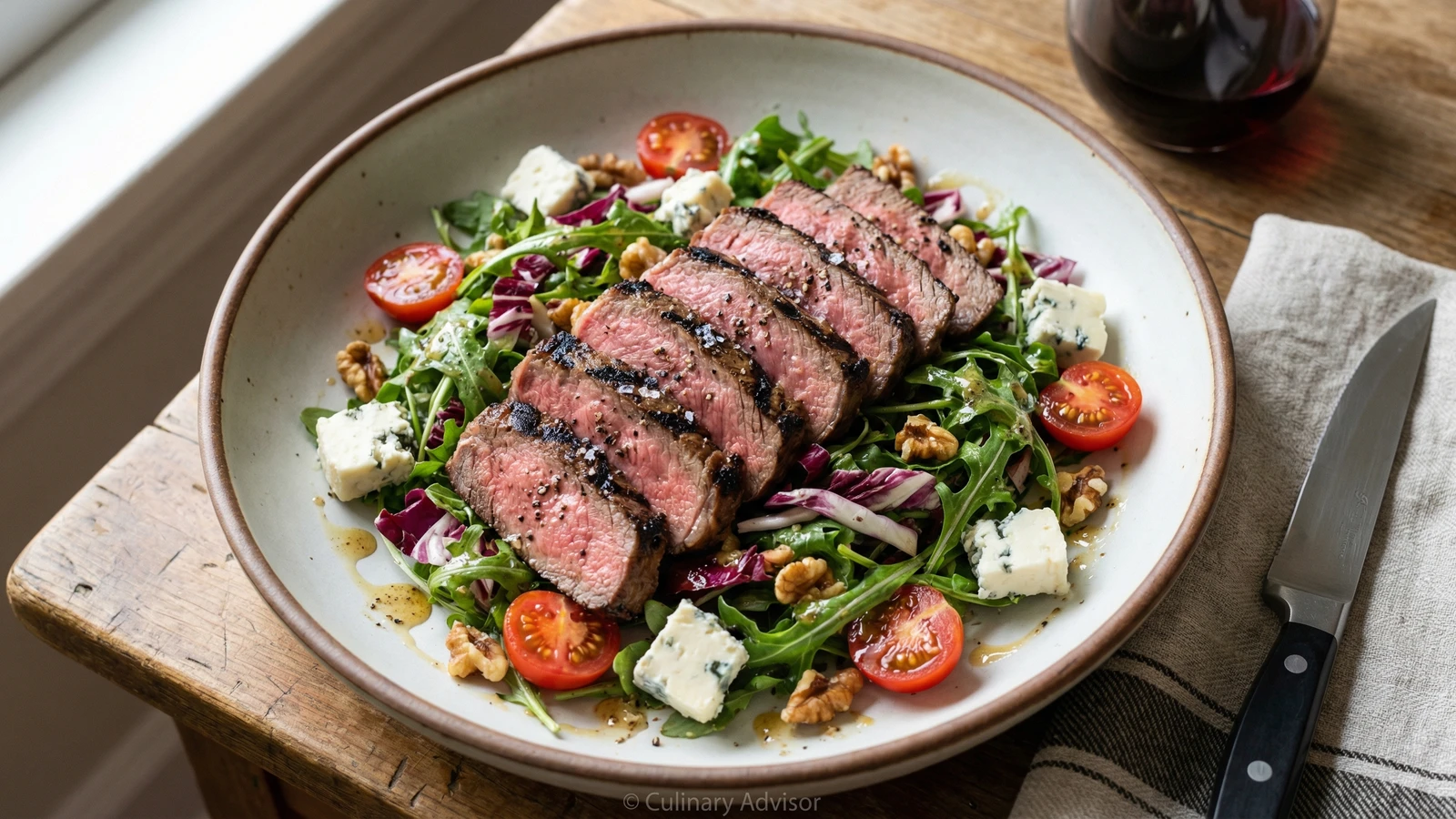
Grilled Steak Salad with Blue Cheese
Created by
Charred ribeye sliced thin against the grain and fanned over a bed of peppery arugula, crowned with sharp blue cheese crumbles and a shallot vinaigrette that pulls every element into delicious harmony.
The steakhouse salad occupies hallowed ground in American dining. It emerged in the great chophouses of the mid-twentieth century as a way to deliver the pleasures of a prime steak without the heaviness of potatoes and creamed spinach. This is that salad, done right.
The secret lives in three places: a properly rested steak, a vinaigrette that clings without drowning, and greens assertive enough to stand up to the meat. Arugula earns its place here. Its peppery bite cuts through the richness of beef and blue cheese in a way that mild lettuces cannot. The leaves should be young and tender, not those overgrown specimens that taste like chewing on a lawn.
I've served this salad to skeptics who believed a steak salad was just leftover meat thrown on lettuce. One bite changed their minds. The warm beef wilts the greens ever so slightly where they touch, releasing their fragrance. The blue cheese softens against the heat. The vinaigrette bridges everything. This is composed salad at its finest, worthy of a Saturday night with someone you want to impress.
The technique, the tradition, and the story behind every dish.
Discover Culinary AdvisorIngredients
ribeye steak
Quantity
1 (1 to 1 1/4 pounds, about 1 inch thick)
neutral oil
Quantity
2 tablespoons
for the steak
kosher salt
Quantity
to taste
black pepper
Quantity
to taste
freshly cracked
baby arugula
Quantity
5 ounces
radicchio
Quantity
1 small head
cored and thinly sliced
cherry tomatoes
Quantity
1 cup
halved
red onion
Quantity
1/4 small
sliced paper-thin
quality blue cheese
Quantity
4 ounces
crumbled
walnuts
Quantity
1/3 cup
toasted and roughly chopped
shallots
Quantity
2 medium (about 3 tablespoons)
minced
red wine vinegar
Quantity
2 tablespoons
sherry vinegar
Quantity
1 tablespoon
Dijon mustard
Quantity
1 teaspoon
honey
Quantity
1/2 teaspoon
extra-virgin olive oil
Quantity
1/3 cup
flaky sea salt
Quantity
for finishing
| Ingredient | Quantity |
|---|---|
| ribeye steak | 1 (1 to 1 1/4 pounds, about 1 inch thick) |
| neutral oilfor the steak | 2 tablespoons |
| kosher salt | to taste |
| black pepperfreshly cracked | to taste |
| baby arugula | 5 ounces |
| radicchiocored and thinly sliced | 1 small head |
| cherry tomatoeshalved | 1 cup |
| red onionsliced paper-thin | 1/4 small |
| quality blue cheesecrumbled | 4 ounces |
| walnutstoasted and roughly chopped | 1/3 cup |
| shallotsminced | 2 medium (about 3 tablespoons) |
| red wine vinegar | 2 tablespoons |
| sherry vinegar | 1 tablespoon |
| Dijon mustard | 1 teaspoon |
| honey | 1/2 teaspoon |
| extra-virgin olive oil | 1/3 cup |
| flaky sea salt | for finishing |
Equipment Needed
- •Outdoor grill or 12-inch cast iron grill pan
- •Instant-read thermometer
- •Sharp carving knife
- •Large mixing bowl
- •Small bowl and whisk for vinaigrette
Instructions
- 1
Temper the steak
Pull your ribeye from the refrigerator forty-five minutes before cooking. Cold meat hitting a hot grill is the enemy of a proper crust. The exterior cooks too fast while the interior stays raw. Pat the steak aggressively with paper towels until the surface is bone dry. Moisture is what stands between you and those beautiful char marks.
A dry surface is essential for the Maillard reaction. Any moisture will steam instead of sear, leaving you with gray meat. - 2
Build the vinaigrette
While the steak tempers, make your vinaigrette. Place the minced shallots in a small bowl with both vinegars and a generous pinch of salt. Let this sit for ten minutes. The acid softens the shallots' harsh edge and draws out their sweetness. Raw shallot straight into a dressing is punishing; macerated shallot is refined.
- 3
Emulsify the dressing
Add the Dijon mustard and honey to your shallot mixture. Whisk to combine. The mustard is your emulsifier, the ingredient that convinces oil and vinegar to become one. Now, whisking constantly, add the olive oil in a thin, steady stream. The dressing should thicken and turn creamy, clinging to the whisk. Taste it. Adjust salt if needed. A vinaigrette should have pleasant acidity, not make you wince.
If your dressing breaks and looks oily, start fresh in a new bowl with a teaspoon of mustard. Slowly whisk in the broken dressing, and it will come back together. - 4
Season and oil the steak
Rub the ribeye all over with the neutral oil, then season generously with kosher salt and cracked black pepper on both sides. Don't be timid. Much will fall off on the grill. The fat cap along the edge deserves seasoning too.
- 5
Prepare the grill
Heat your grill to high, or if using a grill pan, set it over high heat for a full five minutes. You want the grates ripping hot. Hold your hand six inches above the surface. If you can keep it there for more than two seconds, your grill isn't ready. Clean the grates with a wire brush and oil them with a paper towel dipped in vegetable oil, held with tongs.
- 6
Grill the ribeye
Lay the steak on the grill at a forty-five degree angle to the grates. Do not touch it for three minutes. Resist the urge. Moving it prevents those crosshatch marks and interrupts the crust formation. After three minutes, rotate the steak ninety degrees for diamond grill marks if you want them, or simply flip. Grill another three to four minutes for medium-rare, until an instant-read thermometer reads 125°F in the thickest part.
The steak will carry over approximately five degrees while resting. Pull it slightly under your target temperature. - 7
Rest the meat
Transfer the steak to a cutting board and let it rest for eight to ten minutes. This is not optional. The fibers need time to relax and reabsorb their juices. Cut too soon and those juices run out onto your board instead of staying in the meat. Tent loosely with foil if your kitchen runs cold.
- 8
Prepare the greens
While the steak rests, combine the arugula and radicchio in a large bowl. The radicchio adds bitter notes and textural variety, purple streaks against the green. Add the halved tomatoes and paper-thin red onion slices. Drizzle with about two-thirds of the vinaigrette and toss gently with your hands, coating every leaf without bruising them. The greens should glisten, not swim.
- 9
Slice the steak
Locate the grain of the meat, those parallel lines running through the ribeye. Slice against them at a sharp angle, cutting pieces about a quarter-inch thick. Cutting against the grain shortens the muscle fibers, making each bite tender. Cutting with the grain produces chewy, stringy meat no matter how perfectly you cooked it.
- 10
Compose and serve
Divide the dressed greens between two large plates or shallow bowls. Fan the warm steak slices over the top, allowing some to rest directly on the arugula. Scatter the blue cheese crumbles generously, then the toasted walnuts. Drizzle the remaining vinaigrette over the steak. Finish with flaky sea salt and another crack of black pepper. Serve immediately. This salad does not improve with time.
Chef Tips
- •Buy your blue cheese from a shop that cuts it fresh. Pre-crumbled blue cheese in plastic tubs has been exposed to air too long and loses its creamy pungency. A wedge of Maytag Blue from Iowa or genuine Roquefort from France will transform this salad.
- •If you don't have access to a grill, a cast iron skillet over high heat produces excellent results. The steak won't have crosshatch marks, but the crust will be deeper and more uniform.
- •The shallot vinaigrette improves if made a few hours ahead. The flavors marry and the shallots mellow further. Store at room temperature; cold vinaigrette won't coat greens properly.
- •For a wine pairing, reach for a California Zinfandel or an Argentine Malbec. You want something with enough structure to stand up to the steak and the funk of the blue cheese without overwhelming the greens.
Advance Preparation
- •The vinaigrette can be made up to three days ahead and refrigerated. Bring to room temperature and whisk vigorously before using.
- •Walnuts can be toasted up to a week ahead and stored in an airtight container at room temperature.
- •Greens can be washed, dried, and stored wrapped in paper towels in a plastic bag for up to two days.
- •The steak must be grilled and sliced just before serving. This is not a make-ahead salad. The warm beef against cool greens is the entire point.
Frequently Asked Questions
Nutrition Information
1 serving (about 465g)
Where cooking meets culture.
Culinary mentorship, cultural storytelling, and the editorial depth that makes cooking meaningful.
Explore Culinary Advisor