Culinary Advisor
A cooking platform built around craft, culture, and the stories behind what we eat.
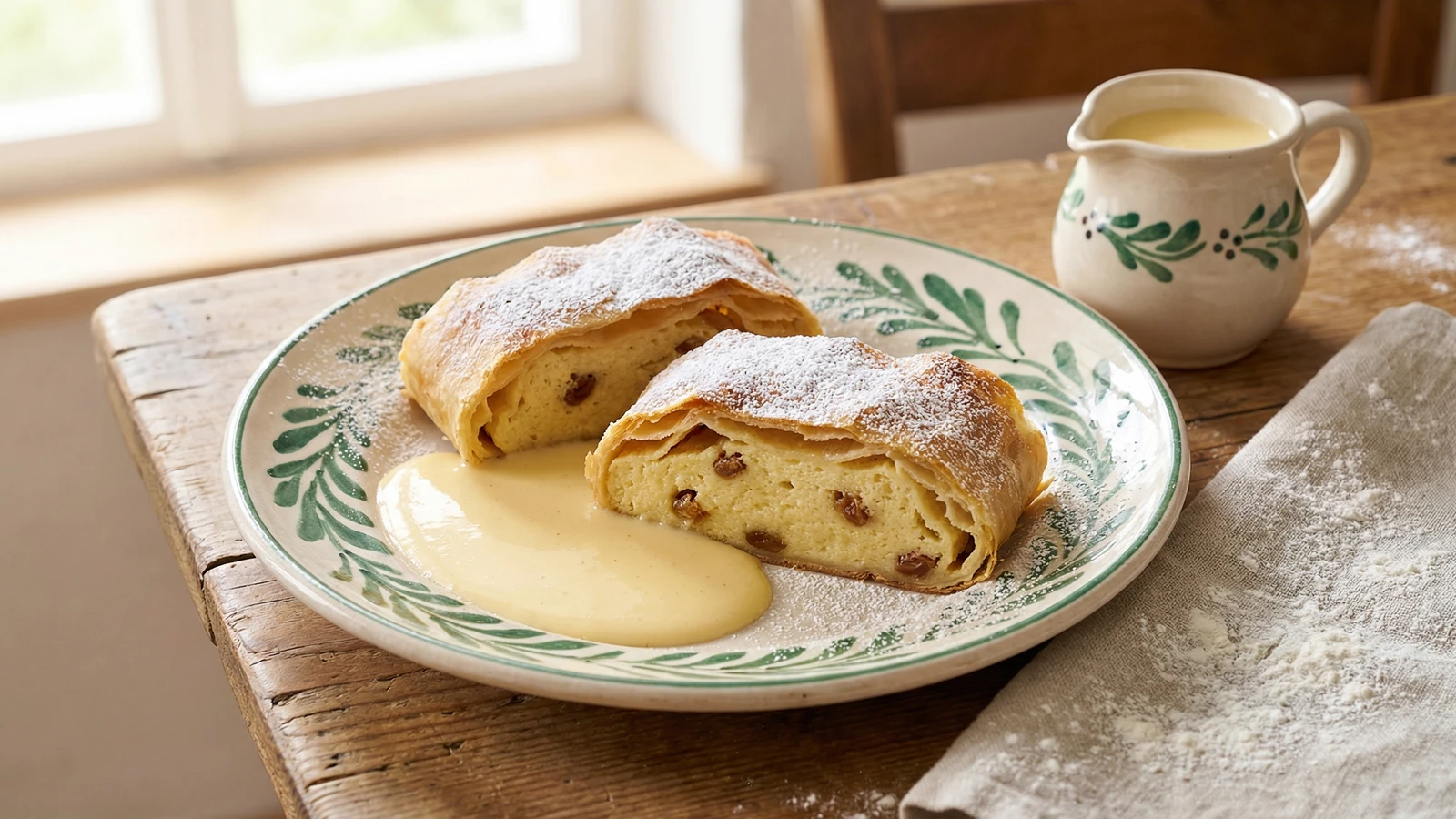
Griessstrudel (Semolina Strudel)
Created by Chef Elsa
Semolina custard folded inside hand-stretched strudel dough and baked until golden, the kind of quiet Austrian Mehlspeise that doesn't shout but makes you come back for a second slice every time.
Griessstrudel is the strudel nobody photographs and everybody finishes. It doesn't have the drama of Apfelstrudel or the fame of Topfenstrudel. What it has is a semolina filling so light and comforting it could make you forget what day of the week it is. I grew up eating this on ordinary afternoons in my grandmother Eva's kitchen in Kent, not on special occasions. Gretel would make the filling while the dough rested under a warm bowl, and I'd watch the semolina porridge thicken in the pan and wonder how something so plain could turn into something so good.
The trick is in the egg whites. You fold beaten whites into the cooled semolina custard, which means the filling puffs and sets inside the strudel as it bakes, turning from dense porridge into something almost souffleed. When you slice it, you see the pale, tender filling cradled inside those paper-thin layers of dough, and the whole thing holds its shape on the plate like it was always meant to be there.
Gretel always said that the simple Mehlspeisen are the ones that test you. Apfelstrudel can hide behind its fruit. Griessstrudel has nowhere to go. The dough has to be properly stretched, the filling has to be properly made, and the whole thing has to bake until the pastry is golden and the filling is just set. It's good Austrian home cooking at its most honest, and once you've learned it, you'll make it again and again because it asks so little and gives so much.
Griessstrudel belongs to the large family of filled strudels that developed in the kitchens of the Habsburg empire, where Griess (semolina) was a pantry staple used across dozens of Mehlspeisen, from Griesnockerl in soup to Griesskoch as a children's meal. The strudel dough technique itself came to Vienna through Hungarian and Ottoman influences, and by the 18th century the Viennese had wrapped it around nearly everything in the kitchen. Griessstrudel was always a Hausmannskost dish, everyday home cooking rather than Konditorei showmanship, which is why it appears in handwritten family recipe collections more often than in pastry shop windows.
The technique, the tradition, and the story behind every dish.
Discover Culinary AdvisorIngredients
griffiges Mehl (coarse flour)
Quantity
250g
neutral oil (sunflower or rapeseed)
Quantity
1 tablespoon
white wine vinegar
Quantity
1 teaspoon
salt (for dough)
Quantity
pinch
warm water
Quantity
125ml
whole milk
Quantity
500ml
fine semolina (Griess)
Quantity
120g
unsalted butter (for filling)
Quantity
80g
granulated sugar
Quantity
80g
eggs
Quantity
3 large
separated
vanilla sugar (Vanillezucker)
Quantity
2 teaspoons
lemon
Quantity
1
zested
raisins
Quantity
50g
soaked in 2 tablespoons rum
salt (for egg whites)
Quantity
pinch
fine dry breadcrumbs
Quantity
40g
unsalted butter (for breadcrumbs and brushing)
Quantity
30g
powdered sugar
Quantity
for dusting
warm vanilla sauce (Vanillesauce)
Quantity
for serving
| Ingredient | Quantity |
|---|---|
| griffiges Mehl (coarse flour) | 250g |
| neutral oil (sunflower or rapeseed) | 1 tablespoon |
| white wine vinegar | 1 teaspoon |
| salt (for dough) | pinch |
| warm water | 125ml |
| whole milk | 500ml |
| fine semolina (Griess) | 120g |
| unsalted butter (for filling) | 80g |
| granulated sugar | 80g |
| eggsseparated | 3 large |
| vanilla sugar (Vanillezucker) | 2 teaspoons |
| lemonzested | 1 |
| raisinssoaked in 2 tablespoons rum | 50g |
| salt (for egg whites) | pinch |
| fine dry breadcrumbs | 40g |
| unsalted butter (for breadcrumbs and brushing) | 30g |
| powdered sugar | for dusting |
| warm vanilla sauce (Vanillesauce) | for serving |
Equipment Needed
- •Heavy saucepan for semolina
- •Large clean cotton cloth for stretching dough
- •Rolling pin
- •Baking tray (40cm or longer)
- •Pastry brush
- •Hand mixer or stand mixer for egg whites
Instructions
- 1
Make the strudel dough
Mound the griffiges Mehl on a clean work surface and make a well in the center. Pour in the warm water, oil, vinegar, and a pinch of salt. Work everything together with your hands, pulling the flour in gradually from the edges. Knead the dough for a full ten minutes. It will start out rough and sticky. Keep going. By the end it should be smooth, soft, and elastic, pulling back gently when you stretch it. Shape it into a ball, brush the surface lightly with oil, cover with a warm bowl turned upside down, and let it rest for at least thirty minutes.
The vinegar helps relax the gluten, which makes the dough easier to stretch later. The warm water activates it. Between the two, you're setting yourself up to pull that dough thin without it tearing on you. - 2
Cook the semolina filling
Bring the milk to a gentle simmer in a heavy saucepan. Pour in the semolina in a thin, steady stream, stirring constantly with a wooden spoon. Keep stirring. The mixture will thicken quickly into a smooth, dense porridge, about three to four minutes. It should pull away from the sides of the pan cleanly. Take it off the heat and transfer to a large bowl. Let it cool until you can comfortably hold your hand against the side of the bowl.
- 3
Build the filling
Beat the 80g butter with the sugar, Vanillezucker, and lemon zest until pale and fluffy. Add the egg yolks one at a time, beating well after each. Fold this mixture into the cooled semolina until evenly combined. The filling will become lighter and richer. Stir in the rum-soaked raisins. In a separate clean bowl, whisk the egg whites with a pinch of salt to stiff, glossy peaks. Fold them into the semolina mixture in two additions, gently, using a large metal spoon. You want to keep that air. It's what makes the filling set up light and pillowy inside the strudel instead of sitting like a dense brick.
The filling must be cool before you add the butter and egg mixture. If the semolina is still hot it will melt the butter and scramble the yolks, and you'll have to start over. - 4
Stretch the dough
Lay a clean cotton cloth over your table and dust it generously with flour. Place the rested dough in the center and roll it out as far as you can with a rolling pin. Then slide your hands underneath, palms down, knuckles up, and start stretching from the center outward. Work your way around the dough, pulling gently and letting gravity help. The dough should stretch to roughly 60 by 40 centimeters, thin enough to read a newspaper through. Gretel always said that if you can't see your hand underneath, it's still too thick. Trim any thick edges with scissors.
If the dough tears, don't panic. Small tears won't ruin the strudel. Overlap the torn edges slightly and carry on. The filling will hold everything together once it bakes. - 5
Toast breadcrumbs and assemble
Melt the 30g butter in a small pan and toast the breadcrumbs over medium heat, stirring constantly, until golden and fragrant. Two minutes, no more. Toasted breadcrumbs absorb moisture from the filling and keep the bottom of the strudel from going soggy. Brush the entire stretched dough with melted butter. Scatter the toasted breadcrumbs evenly across the surface, leaving a five-centimeter border on all sides. Spread the semolina filling in a wide strip along the long edge nearest to you, covering roughly the bottom third of the dough.
- 6
Roll the strudel
Fold the side edges of the dough inward over the filling to seal the ends. Then, using the cloth underneath to help you, lift the edge nearest to you and roll the strudel away from you in one steady motion. The cloth does the work. Don't use your hands to roll or you'll tear the dough. Let it fall gently, seam side down, onto a baking tray lined with parchment. Curve it slightly into a crescent if it's too long for your tray. Brush the top generously with melted butter.
- 7
Bake the strudel
Bake at 180°C (350°F) for about thirty-five to forty minutes. After fifteen minutes, brush with melted butter again. The strudel is done when the pastry is deep golden brown and the layers along the sides look flaky and dry to the touch. You'll see the dough puff slightly where the filling has set and expanded. Let it rest on the tray for ten minutes before cutting. The filling needs that time to firm up or it will ooze when you slice.
- 8
Slice and serve
Cut generous slices with a sharp serrated knife, showing the spiral of thin dough layers wrapped around the pale, set semolina filling inside. Dust each slice with powdered sugar and serve warm with vanilla sauce poured alongside, not over the top. The sauce pools on the plate and you drag each forkful through it. Mahlzeit!
Chef Tips
- •Use griffiges Mehl if you can find it. Austrian coarse-milled flour has less protein than standard all-purpose, which makes a dough that stretches more willingly and bakes up more tender. If you can't find it, use a lower-protein flour or mix half all-purpose with half cake flour.
- •Soak the raisins in rum for at least an hour, or better, overnight. Gretel always said unsoaked raisins in a strudel are just dried-out disappointments taking up space. The rum plumps them and gives the filling a background warmth you can't get any other way.
- •Don't skip toasting the breadcrumbs. They form a barrier between the wet filling and the stretched dough, keeping the bottom layers crisp. Untoasted breadcrumbs taste like nothing. Toasted ones taste like butter and toast, which is exactly what you want.
- •Serve this warm, not hot. Ten minutes of resting lets the filling set up properly, and warm vanilla sauce on the side is what makes it a complete dish. If you serve it without the sauce, you've served half a recipe.
Advance Preparation
- •The strudel dough can rest for up to two hours under the warm bowl. Longer than that and it starts to dry out at the edges.
- •The semolina filling can be made up to four hours ahead and refrigerated, but fold in the egg whites just before assembling. The whites deflate if they sit.
- •Vanilla sauce can be made a day ahead and refrigerated. Reheat gently, stirring, and add a splash of milk if it thickens too much.
Frequently Asked Questions
Nutrition Information
1 serving (about 215g)
Where cooking meets culture.
Culinary mentorship, cultural storytelling, and the editorial depth that makes cooking meaningful.
Explore Culinary Advisor