Culinary Advisor
A cooking platform built around craft, culture, and the stories behind what we eat.
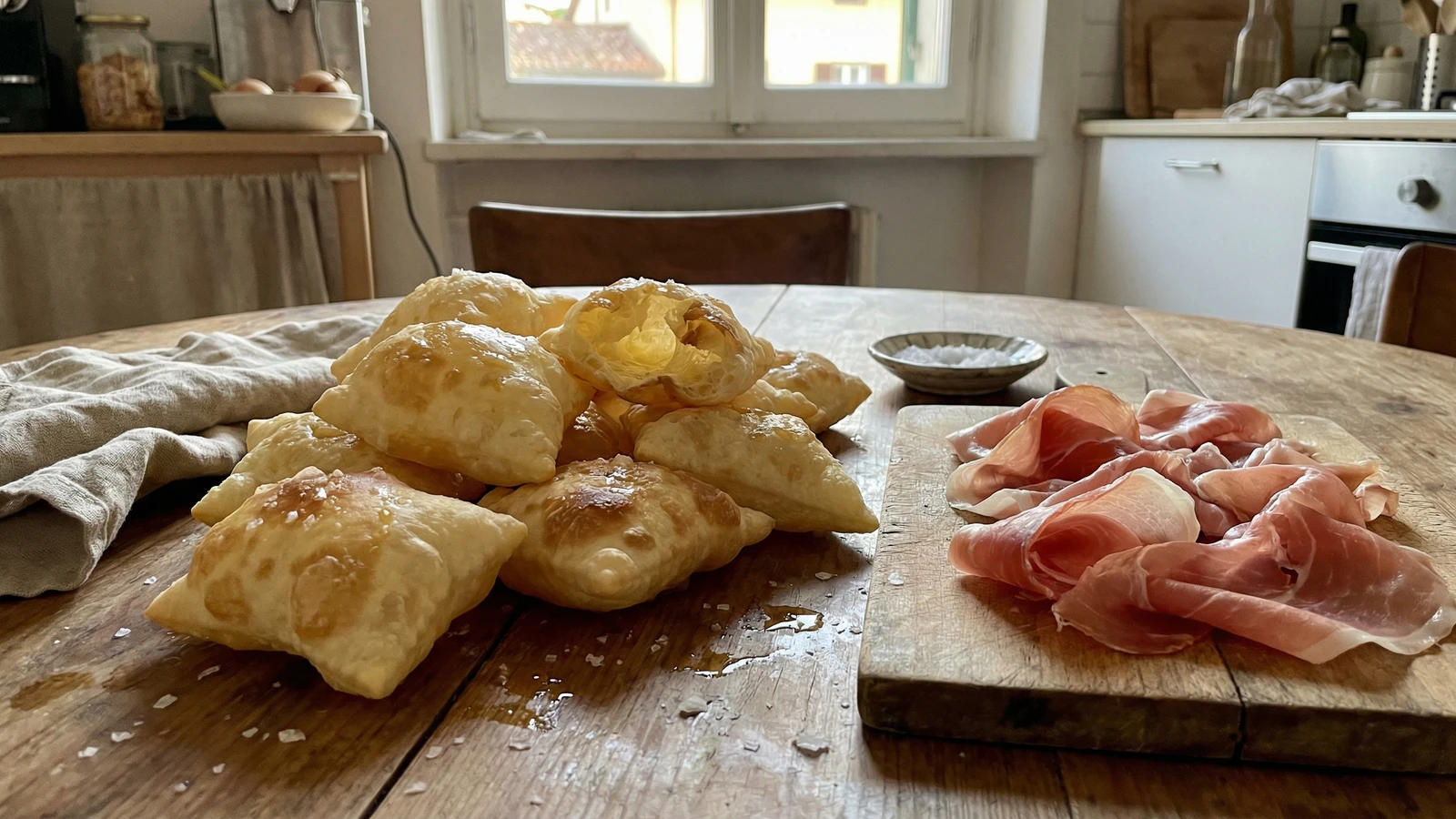
Gnocco Fritto con Salumi
Created by Chef Graziella
The golden, crackling fried bread of Emilia-Romagna, puffed hollow and light as air, served alongside paper-thin slices of prosciutto that melt against the warm dough.
In my home region of Emilia-Romagna, gnocco fritto is not a recipe. It is a birthright. Every family makes it, every osteria serves it, and the arguments about proper technique have been going on for centuries. In Modena they call it gnocco fritto. In Bologna they say crescentine. In Parma it becomes torta fritta. The name changes every thirty kilometers, but the principle remains: a simple dough, fried until it puffs into golden pillows, eaten immediately with the finest cured meats.
The dough contains lard. This is not negotiable. Lard in the dough creates the distinctive tenderness. Lard for frying creates the proper crispness. You may use vegetable oil for frying if you must, but the dough itself requires strutto. A good butcher will have it. Ask.
What you keep out matters here as much as anywhere. No herbs. No cheese in the dough. No garlic, certainly. The gnocco must be neutral, slightly salty, a vehicle for the prosciutto. The marriage of warm, crackling bread and cool, silky ham is the entire point. Do not complicate it.
Gnocco fritto emerged from the farmhouses of the Po Valley, where families rendered their own lard after the annual pig slaughter. The dish appeared on feast days and Sunday tables, made by women who could judge frying temperature by watching how the dough behaved in the fat. Each province claimed its own name and slight variations, but the tradition unified the entire region.
The technique, the tradition, and the story behind every dish.
Discover Culinary AdvisorIngredients
all-purpose flour
Quantity
500g (about 4 cups)
lard
Quantity
75g (5 tablespoons)
softened, plus more for frying
fine sea salt
Quantity
1 teaspoon
baking powder
Quantity
1 teaspoon
whole milk
Quantity
200ml (about 3/4 cup plus 2 tablespoons)
at room temperature
lard or vegetable oil
Quantity
about 4 cups
for frying
Prosciutto di Parma
Quantity
8 ounces
sliced paper-thin
mortadella (optional)
Quantity
4 ounces
sliced thin
culatello or coppa (optional)
Quantity
4 ounces
sliced thin
flaky sea salt
Quantity
for finishing
| Ingredient | Quantity |
|---|---|
| all-purpose flour | 500g (about 4 cups) |
| lardsoftened, plus more for frying | 75g (5 tablespoons) |
| fine sea salt | 1 teaspoon |
| baking powder | 1 teaspoon |
| whole milkat room temperature | 200ml (about 3/4 cup plus 2 tablespoons) |
| lard or vegetable oilfor frying | about 4 cups |
| Prosciutto di Parmasliced paper-thin | 8 ounces |
| mortadella (optional)sliced thin | 4 ounces |
| culatello or coppa (optional)sliced thin | 4 ounces |
| flaky sea salt | for finishing |
Equipment Needed
- •Large wooden board or clean work surface for kneading
- •Rolling pin
- •Sharp knife or pastry wheel
- •Deep heavy pot or Dutch oven for frying (at least 4 inches deep)
- •Deep-fry or candy thermometer
- •Spider or slotted spoon
- •Paper towel-lined tray for draining
Instructions
- 1
Make the dough
Mound the flour on a large wooden board or clean work surface. Make a well in the center. Add the softened lard, salt, and baking powder to the well. Begin incorporating the flour into the center, working with your fingertips. Add the milk gradually, mixing as you go. When the dough becomes shaggy and holds together, begin kneading.
The lard must be soft, almost spreadable. Cold lard will not incorporate properly and you will fight the dough for the next ten minutes. - 2
Knead until smooth
Knead the dough vigorously for 8 to 10 minutes. Push it away from you with the heel of your hand, fold it back, rotate a quarter turn, and repeat. The dough should become smooth, elastic, and slightly tacky but not sticky. If it clings to your hands, add flour sparingly. If it cracks and resists, your lard was too cold or you added too little milk. Adjust accordingly.
- 3
Rest the dough
Shape the dough into a ball, wrap it tightly in plastic, and let it rest at room temperature for at least 30 minutes. The gluten must relax or rolling will be a battle. You can rest it up to 2 hours. Do not refrigerate; the lard will harden and the dough will become difficult to work.
- 4
Roll and cut
Divide the dough into four portions. Work with one at a time, keeping the rest covered. Roll each portion very thin, about 2 millimeters, nearly translucent. The thinner you roll, the more dramatically it will puff. Cut into rectangles roughly 8 by 10 centimeters, or diamonds if you prefer. Make two small slits in the center of each piece with a sharp knife.
The slits are not decorative. They allow steam to escape evenly so the gnocco puffs uniformly instead of forming one large bubble that deflates. - 5
Heat the frying fat
In a deep, heavy pan or Dutch oven, heat the lard or oil to 180°C (350°F). Use a thermometer. The temperature matters enormously. Too cool and the gnocco absorbs fat, becoming greasy and heavy. Too hot and the outside browns before the inside cooks through. Maintain this temperature throughout frying.
- 6
Fry until golden
Slide two or three pieces of dough into the hot fat. Do not crowd the pan. They will sink briefly, then rise and begin to puff dramatically. Use a spider or slotted spoon to gently press them under the surface and turn them. They should puff into pillows and turn golden on both sides, about 1 to 2 minutes total. The sound should be vigorous bubbling, not lazy sputtering.
- 7
Drain and season
Transfer the fried gnocco to a tray lined with paper towels. Sprinkle immediately with flaky salt while the surface is still hot enough to make it stick. The gnocco should feel almost weightless in your hand. If they feel heavy or dense, your oil was not hot enough.
- 8
Serve immediately
Gnocco fritto waits for no one. Arrange the warm pieces on a wooden board or in a cloth-lined basket alongside the sliced salumi. The prosciutto should be draped loosely, not stacked. Guests wrap the ham around the warm bread and eat with their hands. This is not elegant food. It is honest food. Serve while still crackling.
Chef Tips
- •Ask your butcher for leaf lard, rendered from the fat around the kidneys. It has the cleanest flavor and highest smoke point. Ordinary lard works, but leaf lard is superior for both the dough and the frying.
- •If you cannot find lard for the dough, cold unsalted butter cut into small pieces is acceptable. The texture will be slightly different, more like a biscuit than the authentic tender crumb, but edible. For frying, vegetable oil or peanut oil will work, though the flavor will not be the same.
- •The prosciutto must be sliced thin enough to see through. Thick-cut prosciutto is chewy and fights the delicate bread. A good Italian market will slice it properly. Supermarket prosciutto is often too thick.
- •Do not attempt to keep gnocco fritto warm in an oven. They will steam and become leathery. Fry in batches and serve each batch immediately while you fry the next. Your guests can begin eating while you continue cooking.
Advance Preparation
- •The dough can be made up to 6 hours ahead and held at room temperature, tightly wrapped. Do not refrigerate.
- •You can roll and cut the pieces up to 1 hour before frying. Lay them in a single layer on parchment-lined sheet pans, covered with a kitchen towel.
- •The salumi can be sliced and arranged on its serving platter, covered tightly, up to 2 hours ahead. Refrigerate, then bring to cool room temperature before serving.
Frequently Asked Questions
Nutrition Information
1 serving (about 230g)
Where cooking meets culture.
Culinary mentorship, cultural storytelling, and the editorial depth that makes cooking meaningful.
Explore Culinary Advisor