Culinary Advisor
A cooking platform built around craft, culture, and the stories behind what we eat.
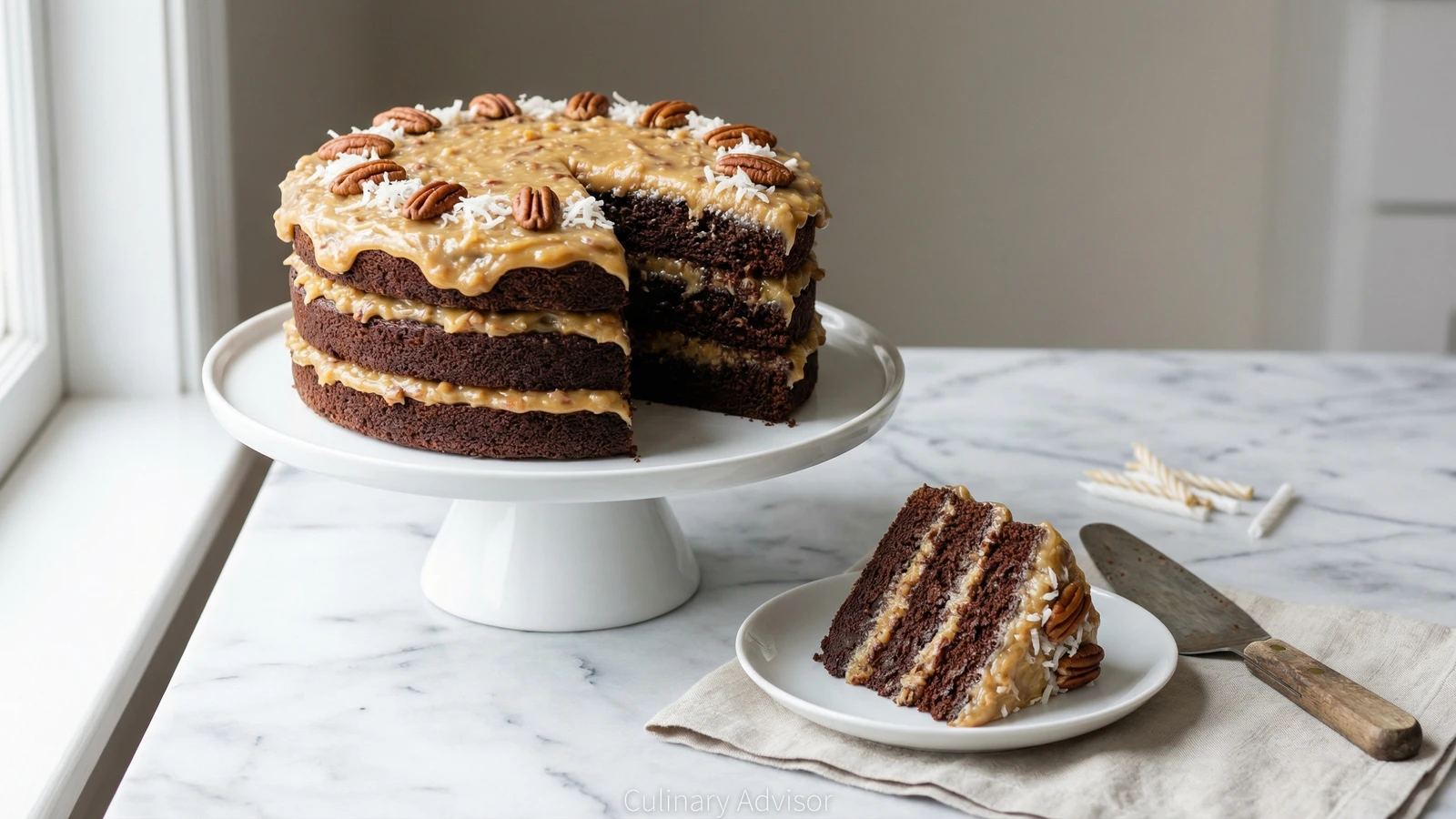
German Chocolate Cake
Created by
Three layers of tender, deeply chocolatey cake crowned with a rich, gooey frosting loaded with toasted pecans and sweet coconut, the dessert that launched a thousand birthday wishes and proves American baking holds its own against any tradition.
This cake has nothing to do with Germany. In 1852, an Englishman named Samuel German developed a mild, pre-sweetened baking chocolate for Baker's Chocolate Company. A century later, a Dallas homemaker sent her recipe using German's chocolate to a local newspaper. The cake swept the nation. Grocery stores couldn't keep coconut and pecans on the shelves.
The genius lives in that frosting. It isn't buttercream or ganache. It's a cooked custard studded with toasted pecans and sweet coconut, sticky and rich and absolutely essential to the cake's identity. The layers themselves are tender and deeply chocolate, their sweetness balanced by buttermilk's gentle tang. Separated egg whites folded into the batter create a crumb so delicate it seems impossible for three layers to stack so proudly.
I've taught this recipe for decades. Students arrive intimidated by the multiple components, the stovetop frosting, the layer assembly. They leave converted. This is not difficult baking. It requires attention, not expertise. If you can stir a pot and spread with a spatula, you can make a cake that will become your signature.
The technique, the tradition, and the story behind every dish.
Discover Culinary AdvisorIngredients
German's sweet baking chocolate
Quantity
4 ounces
boiling water
Quantity
1/2 cup
unsalted butter (for cake)
Quantity
1 cup (2 sticks/226g)
softened
granulated sugar (for cake)
Quantity
2 cups (400g)
large egg yolks (for cake)
Quantity
4
at room temperature
pure vanilla extract (for cake)
Quantity
1 teaspoon
all-purpose flour
Quantity
2 1/2 cups (310g)
baking soda
Quantity
1 teaspoon
fine sea salt
Quantity
1/2 teaspoon
buttermilk
Quantity
1 cup
at room temperature
large egg whites
Quantity
4
at room temperature
evaporated milk
Quantity
1 (12-ounce) can
granulated sugar (for frosting)
Quantity
1 1/2 cups (300g)
large egg yolks (for frosting)
Quantity
4
unsalted butter (for frosting)
Quantity
3/4 cup (1 1/2 sticks/170g)
cut into pieces
pure vanilla extract (for frosting)
Quantity
1 1/2 teaspoons
sweetened flaked coconut
Quantity
2 cups (200g)
pecans
Quantity
1 1/2 cups (170g)
toasted and chopped
| Ingredient | Quantity |
|---|---|
| German's sweet baking chocolate | 4 ounces |
| boiling water | 1/2 cup |
| unsalted butter (for cake)softened | 1 cup (2 sticks/226g) |
| granulated sugar (for cake) | 2 cups (400g) |
| large egg yolks (for cake)at room temperature | 4 |
| pure vanilla extract (for cake) | 1 teaspoon |
| all-purpose flour | 2 1/2 cups (310g) |
| baking soda | 1 teaspoon |
| fine sea salt | 1/2 teaspoon |
| buttermilkat room temperature | 1 cup |
| large egg whitesat room temperature | 4 |
| evaporated milk | 1 (12-ounce) can |
| granulated sugar (for frosting) | 1 1/2 cups (300g) |
| large egg yolks (for frosting) | 4 |
| unsalted butter (for frosting)cut into pieces | 3/4 cup (1 1/2 sticks/170g) |
| pure vanilla extract (for frosting) | 1 1/2 teaspoons |
| sweetened flaked coconut | 2 cups (200g) |
| pecanstoasted and chopped | 1 1/2 cups (170g) |
Equipment Needed
- •Three 9-inch round cake pans
- •Stand mixer or hand mixer
- •Large saucepan (3-quart minimum)
- •Wire cooling racks
- •Offset spatula
- •Parchment paper rounds
Instructions
- 1
Melt the chocolate
Chop the German's chocolate into small pieces and place in a heatproof bowl. Pour the boiling water over the chocolate and let it sit for one minute, then stir gently until completely smooth and glossy. The mixture should look like dark silk. Set aside to cool to room temperature while you prepare the batter.
German's sweet chocolate is sweeter and milder than semisweet. Baker's brand is the original from 1852, but any German's-style bar works. Do not substitute regular bittersweet or the cake will taste different. - 2
Prepare your pans
Position a rack in the center of your oven and preheat to 350°F. Butter three 9-inch round cake pans generously, line the bottoms with parchment paper rounds, butter the parchment, then dust with cocoa powder, tapping out the excess. This cocoa coating prevents white flour streaks on your chocolate layers.
- 3
Cream butter and sugar
In a large bowl or the bowl of a stand mixer, beat the softened butter on medium speed until creamy, about one minute. Add the two cups of sugar gradually, beating for four to five minutes until the mixture is pale, fluffy, and has nearly doubled in volume. Scrape down the sides twice during this process. Proper creaming creates the cake's tender crumb.
The butter should be cool room temperature, yielding to gentle pressure but not greasy or soft. If your kitchen runs warm, briefly chill the mixing bowl before starting. - 4
Add yolks and chocolate
Add the four egg yolks one at a time, beating well after each addition until fully incorporated. The mixture may look slightly curdled after the first yolk but will smooth out. Beat in the vanilla extract, then pour in the cooled melted chocolate, mixing until the batter is uniformly dark and glossy.
- 5
Combine dry ingredients
In a separate bowl, whisk together the flour, baking soda, and salt until evenly distributed. This takes thirty seconds of actual whisking. The baking soda is your only leavening here, so even distribution matters.
- 6
Alternate wet and dry
With the mixer on low speed, add the flour mixture in three additions, alternating with the buttermilk in two additions, beginning and ending with flour. Mix just until each addition disappears before adding the next. The batter will be thick and luxurious. Overmixing develops gluten and toughens your cake.
No buttermilk? Stir one tablespoon of white vinegar or lemon juice into one cup of whole milk and let sit five minutes until slightly thickened. - 7
Whip and fold egg whites
In a clean, dry bowl with clean beaters, whip the egg whites on medium-high speed until they hold stiff peaks but are not dry, about two to three minutes. They should look glossy and bend over slightly at the tip when you lift the beaters. Fold one-third of the whites into the chocolate batter vigorously to lighten it, then gently fold in the remaining whites in two additions, using broad strokes and rotating the bowl. Stop when you see only tiny white streaks.
- 8
Bake the layers
Divide the batter evenly among the three prepared pans, about two cups per pan. Smooth the tops with an offset spatula. Bake for 28 to 32 minutes, rotating the pans halfway through if your oven heats unevenly. The cakes are done when they spring back when gently pressed in the center and a toothpick inserted comes out with just a few moist crumbs attached. The layers will pull slightly from the pan edges.
- 9
Cool completely
Let the cakes cool in their pans on wire racks for fifteen minutes. Run a thin knife around the edges, then invert onto the racks. Peel off the parchment and let cool completely, at least one hour. Patience here prevents frosting disaster. Warm cakes melt the frosting into a soupy mess.
- 10
Toast the pecans
While the cakes cool, spread the pecans on a rimmed baking sheet and toast in a 350°F oven for 8 to 10 minutes, stirring once, until fragrant and slightly darkened. You'll smell them before you see the color change. Let cool completely before chopping. Toasting transforms pecans from pleasant to essential.
- 11
Cook the frosting base
In a large saucepan, whisk together the evaporated milk, one and a half cups sugar, four egg yolks, and butter pieces. Cook over medium heat, stirring constantly with a wooden spoon or heatproof spatula, until the mixture thickens enough to coat the back of the spoon and hold a line when you draw your finger through it, 12 to 15 minutes. Do not let it boil or the eggs will scramble. The transformation happens slowly, then suddenly.
Stir constantly and watch the edges where scorching begins. If you see any lumps forming, remove from heat immediately and whisk vigorously. - 12
Finish the frosting
Remove the pan from heat. Stir in the vanilla, then fold in the coconut and toasted pecans. Transfer to a bowl and let cool to room temperature, stirring occasionally, until thick and spreadable, about one hour. The frosting will continue to thicken as it cools. Resist refrigerating to speed this along or it will become too stiff to spread.
- 13
Assemble the cake
Place one cake layer on a serving plate or cake stand, flat side up. Spread about one cup of frosting evenly over the top, leaving a quarter-inch border at the edge. The frosting is heavy and will want to slide, so work gently. Place the second layer on top, flat side up, and repeat. Top with the third layer, flat side down for a level surface, and spread the remaining frosting over the top only. The sides of a German chocolate cake traditionally remain unfrosted, showing off those gorgeous dark layers.
- 14
Rest before serving
Let the assembled cake rest at room temperature for at least thirty minutes before slicing. This allows the frosting to set and the layers to meld. Use a long serrated knife dipped in hot water and wiped clean between cuts for the cleanest slices. Each piece should show three distinct chocolate layers with that caramel-colored frosting spilling over the edges.
Chef Tips
- •German's sweet baking chocolate is specific to this recipe and worth seeking out. Regular bittersweet or semisweet chocolate creates a different, less balanced flavor. Check the baking aisle near the cocoa powder.
- •Room temperature ingredients matter more here than in most cakes. Cold eggs won't emulsify properly with the butter, and cold buttermilk will seize the chocolate. Set everything out an hour before you begin.
- •The frosting seems loose when you first stir in the coconut and pecans. Walk away. It thickens significantly as it cools. Rushing this step with refrigeration makes it stiff and difficult to spread.
- •For perfect layers, weigh your batter: divide total weight by three and portion accordingly. A kitchen scale costs fifteen dollars and ends the guessing forever.
- •This cake actually improves on day two. The moisture from the frosting seeps into the layers, and the flavors deepen. Make it the day before your celebration if you can bear to wait.
Advance Preparation
- •Cake layers can be baked up to two days ahead, wrapped tightly in plastic wrap and stored at room temperature, or frozen for up to one month. Thaw completely before frosting.
- •The frosting can be made one day ahead and stored refrigerated. Bring to room temperature and stir well before using; it will need 30 to 45 minutes to become spreadable again.
- •The fully assembled cake keeps at room temperature under a cake dome for up to three days. Refrigeration firms the frosting uncomfortably; return to room temperature before serving.
- •Toast and chop the pecans up to one week ahead. Store in an airtight container at room temperature.
Frequently Asked Questions
Nutrition Information
1 serving (about 145g)
Where cooking meets culture.
Culinary mentorship, cultural storytelling, and the editorial depth that makes cooking meaningful.
Explore Culinary Advisor