Culinary Advisor
A cooking platform built around craft, culture, and the stories behind what we eat.
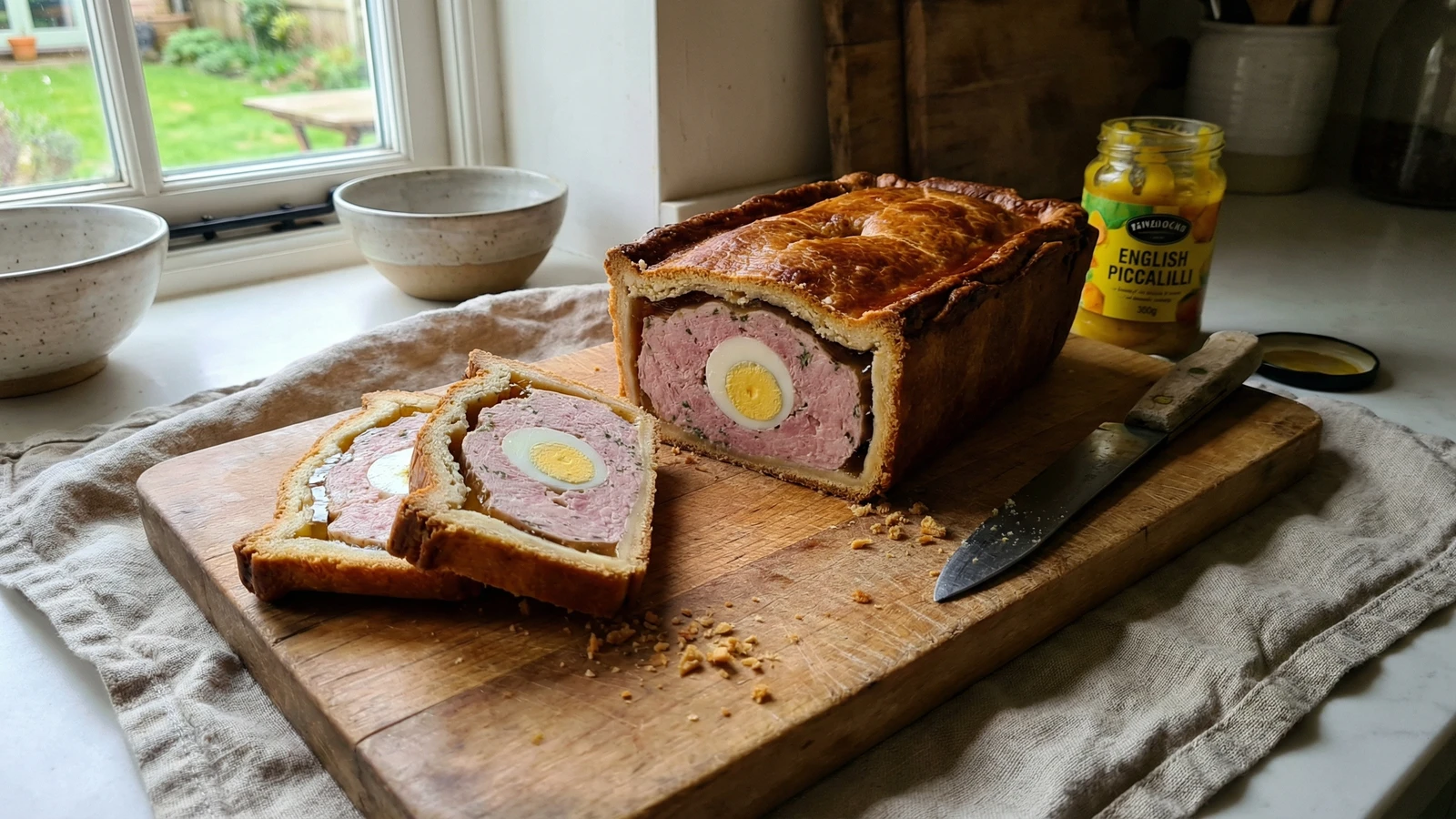
Gala Pie with Boiled Eggs
Created by Chef Thomas
A proper gala pie, hot water crust wrapped around seasoned pork and a row of boiled eggs, the kind of thing you slice on a blanket with a penknife and a feeling that spring has finally arrived.
There's a Saturday in April, sometimes March if the year is kind, when the light changes. The mornings are still cold but the afternoons have warmth in them, and you start thinking about eating outside. Not a barbecue. Not yet. Something you can carry in a basket, slice with a knife, eat with your hands on a blanket that still smells of last year's grass stains. This is the pie for that day.
Gala pie. The name comes from the miners' galas of the north, those big community celebrations where food had to travel, feed a crowd, and taste right at any temperature. A rectangular pork pie with boiled eggs set through the middle like a seam of gold, so every slice reveals a neat disc of white and yellow against the pink, peppered meat. It's a generous, sociable thing. Nobody makes a gala pie for one.
The pastry is hot water crust: lard, boiling water, flour, brought together in a saucepan and worked while still warm. It's not delicate. It's not supposed to be. This is pastry built to hold, to travel, to be cut with a pocket knife on a hillside. The filling is seasoned pork, simple and honest, and the whole thing sets around a jelly made from good stock that fills every gap and seals every air pocket. I wrote it down in the notebook last Easter: "Gala pie. Took it to the field. Came back empty-handed." Best compliment there is.
It wants a bit of time, this one. An afternoon's quiet work, the kind where the radio is on and you're not in a hurry. But the reward is something you can carry into the next day, slice after slice, each cut looking like a small celebration. Right food, right evening. Or right afternoon, in this case, with the sun on your face and a good knife in your hand.
The technique, the tradition, and the story behind every dish.
Discover Culinary AdvisorIngredients
plain flour
Quantity
400g
fine sea salt
Quantity
1 teaspoon, plus extra for the filling
lard
Quantity
150g
water
Quantity
175ml
pork shoulder
Quantity
600g
coarsely minced
smoked streaky bacon
Quantity
150g
finely chopped
sage leaves
Quantity
small handful
finely chopped
flat-leaf parsley
Quantity
small handful
finely chopped
ground mace
Quantity
1 teaspoon
ground white pepper
Quantity
½ teaspoon
nutmeg
Quantity
generous grating
medium eggs
Quantity
5
egg
Quantity
1
beaten, for glaze
good pork or chicken stock
Quantity
300ml
leaf gelatine
Quantity
2 leaves
| Ingredient | Quantity |
|---|---|
| plain flour | 400g |
| fine sea salt | 1 teaspoon, plus extra for the filling |
| lard | 150g |
| water | 175ml |
| pork shouldercoarsely minced | 600g |
| smoked streaky baconfinely chopped | 150g |
| sage leavesfinely chopped | small handful |
| flat-leaf parsleyfinely chopped | small handful |
| ground mace | 1 teaspoon |
| ground white pepper | ½ teaspoon |
| nutmeg | generous grating |
| medium eggs | 5 |
| eggbeaten, for glaze | 1 |
| good pork or chicken stock | 300ml |
| leaf gelatine | 2 leaves |
Equipment Needed
- •900g (2lb) loaf tin
- •Large saucepan for the pastry
- •Rolling pin
- •Wire cooling rack
- •Small funnel or jug for the jelly
Instructions
- 1
Boil the eggs
Bring a pan of water to a rolling boil. Lower the eggs in gently with a spoon and cook for exactly nine minutes. You want them just set, the yolks firm but still a shade darker at the centre. Plunge them into cold water the moment they're done. When they're cool enough to handle, peel them carefully. A cracked egg in the middle of a gala pie is not a disaster, but a whole one is a thing of beauty. Set them aside.
Eggs a few days old peel better than fresh ones. If yours are straight from the market, add a splash of vinegar to the boiling water. It helps. - 2
Make the hot water crust
Put the flour and salt into a large bowl and make a well in the centre. In a small saucepan, heat the lard and water together until the lard has melted and the whole thing comes to a proper boil, not a simmer, a boil. Pour it into the flour in one go and stir with a wooden spoon until it comes together into a rough dough. It will be hot. Turn it out onto the worktop and knead briefly until smooth. The dough should feel warm and pliable, like modelling clay. Work quickly. Hot water crust stiffens as it cools, and a cold dough will crack and fight you. Cut off a third and set it aside under a tea towel for the lid. The rest is for the base and sides.
If the dough cools and becomes difficult to work with, wrap it in cling film and warm it gently in a low oven for five minutes. It will soften and behave again. - 3
Prepare the filling
In a large bowl, combine the minced pork, chopped bacon, sage, parsley, mace, white pepper, nutmeg, and a good teaspoon of salt. Mix it thoroughly with your hands. You want the herbs and spices distributed evenly through the meat, not sitting in patches. Fry a small pinch of the mixture in a hot pan, taste it, and adjust the seasoning. This is the only chance you'll have before it's sealed inside pastry. Trust your tongue.
Ask your butcher to mince the pork shoulder coarsely. You want texture in the finished pie, not a paste. If you're doing it at home, cut the meat into small pieces and pulse it briefly in a food processor. Stop well before it turns smooth. - 4
Line the tin and assemble
Grease a 900g loaf tin well. Roll the larger piece of dough out on a floured surface into a rectangle big enough to line the base and come up the sides with a little overhang. Don't worry about precision. Press it into the tin, smoothing out any air pockets with your knuckles. Spread half the pork filling into the base, pressing it into the corners. Lay the peeled eggs in a neat row down the centre, end to end. They should sit like a string of beads. Pack the remaining filling around and over the eggs, pressing it down gently so there are no gaps. The meat should come level with the top of the tin.
If five eggs are too many for your tin, use four. The important thing is that they sit in a single line and every slice reveals a cross-section of egg. That's the whole point of a gala pie. - 5
Seal and glaze
Roll out the reserved pastry to form a lid. Brush the edges of the pastry case with beaten egg, lay the lid over the top, and press the edges together firmly to seal. Trim any excess and crimp with a fork or your fingers, whichever feels right. Cut a small hole in the centre of the lid, about the width of a pencil. This is important. Steam needs somewhere to go, and later, the jelly needs a way in. Brush the entire top generously with beaten egg. It will turn the crust a deep, lacquered gold.
Roll a small cylinder of foil and push it into the steam hole to keep it open during baking. The pastry will try to close over it. Don't let it. - 6
Bake the pie
Set the oven to 200C/180C fan. Bake the pie for thirty minutes until the crust has started to colour and set. Then reduce the heat to 160C/140C fan and bake for a further hour. The pastry should be a deep, confident gold all over, not pale, not tentative. If the top is browning too quickly, lay a sheet of foil loosely over it. When it's done, take it out and let it cool in the tin for twenty minutes. Then carefully unmould it onto a wire rack. It will feel fragile. Be gentle. It firms as it cools.
- 7
Fill with jelly
While the pie cools, warm the stock in a small pan. Soak the gelatine leaves in cold water for five minutes until soft, then squeeze out the excess water and stir them into the warm stock until dissolved. Let it cool until it's barely warm but still liquid. Using a small jug or a funnel, pour the jellied stock slowly through the hole in the top of the pie. Go gently. Let it seep in, wait, then add more. You may not need all of it. The jelly fills the gap between the meat and the pastry where the filling has shrunk during baking. This is what holds the whole thing together.
If the stock is too hot when you add the gelatine, it won't set properly. If it's too cold, it will set before it reaches the gaps. Warm, not hot. Patience, not haste. - 8
Chill overnight and serve
Refrigerate the pie overnight, or for at least eight hours. The jelly needs to set fully and the flavours need time to settle and become themselves. When you're ready, take it from the fridge and let it sit at room temperature for twenty minutes before slicing. A cold pie from the fridge is fine, but one that has lost its chill tastes more. Slice it thickly with a sharp knife. Each cut should reveal the golden pastry, the pink seasoned pork, and that perfect round of egg in the centre. There are few better feelings than putting this on a board and watching people reach for it.
Chef Tips
- •The pork shoulder is everything. Go to a butcher, not a supermarket. Ask for shoulder, coarsely minced, with a good proportion of fat still in it. Lean mince makes a dry, crumbly pie that no amount of jelly will rescue. The fat keeps it moist and gives it that rich, porky flavour that a gala pie depends on.
- •Hot water crust is not like any other pastry you've made. It's warm, it's pliable, it's forgiving in ways that shortcrust never is. Don't be afraid of it. Work quickly, work with confidence, and if it tears, just patch it. Nobody will know once it's baked.
- •The jelly is not optional. I know it seems like a fiddly step, and it is, but the jelly is what turns a good pie into a proper one. It fills every gap, carries flavour into every corner, and gives each slice that glossy, set quality that tells you someone knew what they were doing.
- •This pie improves on the second day. Make it on a Friday, eat it on Saturday. Pack it for Easter Monday. It keeps in the fridge for up to four days, wrapped in greaseproof paper, and it travels better than almost anything else you could put in a basket.
Advance Preparation
- •The pie must be made at least a day ahead. It needs overnight chilling for the jelly to set and the flavours to come together. This is not a same-day dish.
- •Once set, the pie keeps refrigerated for up to four days, wrapped loosely in greaseproof paper. It travels well and is at its best on the second or third day.
- •The filling can be made a day ahead and refrigerated. Bring it to room temperature before assembling, as cold filling in warm pastry causes cracks.
Frequently Asked Questions
Nutrition Information
1 serving (about 230g)
Where cooking meets culture.
Culinary mentorship, cultural storytelling, and the editorial depth that makes cooking meaningful.
Explore Culinary Advisor